Get help with Mathematics, Grade 3
Most tutoring makes your child sit through material your child already knows. MapleMind flips that: pick the exact skill that's causing trouble — any of the 46 below — and the tutor teaches just that one, step by step, as many times as it takes. Ask questions in plain words, any time of day, in English, French, or 12 other languages.
The official Ontario Mathematics, Grade 3 curriculum
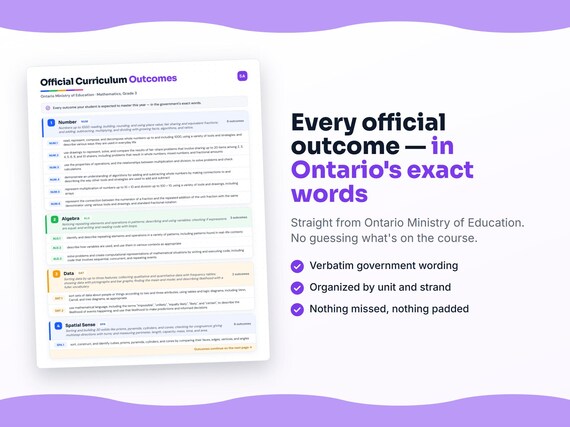
Ontario defines Mathematics, Grade 3 by strands and outcomes. MapleMind teaches the same curriculum reorganized for one-skill-at-a-time tutoring — the table shows exactly where every official strand lands, and the ministry's own wording is quoted under each unit below.
Official source Ontario's official mathematics curriculumRead it on the government site — dcp.edu.gov.on.ca ↗| Official strand | Outcomes | Where MapleMind teaches it |
|---|---|---|
| Strand B | 16 | Number |
| Strand C | 9 | Algebra |
| Strand D | 7 | Data |
| Strand E | 13 | Spatial Sense |
| Strand F | 1 | Financial Literacy |
Ontario also defines Strand A — Social-Emotional Learning Skills — which the ministry teaches through every other strand rather than as its own unit, so it doesn't get a row of its own.
Every skill below, taught one on one.
 Try the first session free
How MapleMind teaches Mathematics, Grade 3 — every unit, lesson, and skill
Every skill below runs as a short session: a plain-words lesson, a worked example, solving it together, then a five-question skill check that earns up to three stars. Guided Mode keeps it teaching instead of answer-handing — turning it off needs a parent's password.
Unit 1NumberOfficial strand · Strand B
Numbers up to 1000: reading, building, rounding, and using place value; fair sharing and equivalent fractions; and adding, subtracting, multiplying, and dividing with growing facts, algorithms, and ratios.
Numbers to 1000
- Reading, showing, building, and breaking apart numbers to 1000B1.1 — Read whole numbers up to 1000, show them different ways, build them from parts, and break them into parts, then talk about how numbers show up in everyday life.
- Comparing and ordering numbers to 1000B1.2 — Compare two numbers up to 1000 and put a group of numbers in order from least to greatest or greatest to least.
- Rounding to the nearest ten or hundredB1.3 — Round whole numbers to the nearest ten or nearest hundred, depending on the situation.
- Counting to 1000 by 50s, 100s, and 200sB1.4 — Count all the way to 1000 using jumps of 50, 100, and 200, using tools like a hundred chart or objects grouped together.
- Using place value to describe multi-digit numbersB1.5 — Describe and show multi-digit numbers in different ways using place value, including with base ten materials.
Fair Sharing and Equivalent Fractions
- Sharing fairly among many friends, up to 20 itemsB1.6 — Use drawings to share up to 20 items fairly among 2, 3, 4, 5, 6, 8, or 10 friends, and compare the results, even when the answer is a whole number, a mixed number, or a fraction.
- Finding equivalent fractions through fair sharingB1.7 — Solve fair-share problems to find and use equivalent fractions, including halves and fourths and eighths, thirds and sixths, and fifths and tenths.
How Multiplication and Division Connect, and Quick Facts
- How multiplication and division connectB2.1 — Use what multiplication and division have in common, and how they undo each other, to solve problems and check answers.
- Multiplication and division facts for 2, 5, and 10B2.2 — Know and quickly use multiplication facts for 2, 5, and 10, and the matching division facts.
- Mental math to add and subtract within 1000B2.3 — Use mental math tricks, including estimating by rounding, to add and subtract numbers that total no more than 1000, and explain how it was solved.
Adding and Subtracting with Algorithms
- Understanding the steps of addition and subtraction algorithmsB2.4 — Understand the steps of standard algorithms for adding and subtracting, by connecting them to other tools and strategies.
- Solving addition and subtraction problems to 1000B2.5 — Show and solve addition and subtraction problems with numbers that total no more than 1000, using tools and algorithms.
Multiplication and Division with Arrays
- Showing multiplication to 10×10 and division to 100÷10 with arraysB2.6 — Show multiplication of numbers up to 10×10 and division up to 100÷10 using tools and drawings, including arrays.
- Solving multiplication and division problems, including groups of a half, fourth, or thirdB2.7 — Show and solve multiplication and division problems, including problems with groups of one half, one fourth, and one third, using tools and drawings.
Fraction Notation and Ratios
- Seeing a fraction's numerator as repeated addition of a unit fractionB2.8 — Show how the numerator of a fraction connects to adding the same unit fraction over and over, using tools, drawings, and standard fraction notation.
- Using ratios of 1 to 2, 1 to 5, and 1 to 10 to scale numbersB2.9 — Use the ratios 1 to 2, 1 to 5, and 1 to 10 to scale numbers up and solve problems.
The official wording — 16 outcomes in this unit
- B1.1
read, represent, compose, and decompose whole numbers up to and including 1000, using a variety of tools and strategies, and describe various ways they are used in everyday life
- B1.2
compare and order whole numbers up to and including 1000, in various contexts
- B1.3
round whole numbers to the nearest ten or hundred, in various contexts
- B1.4
count to 1000, including by 50s, 100s, and 200s, using a variety of tools and strategies
- B1.5
use place value when describing and representing multi-digit numbers in a variety of ways, including with base ten materials
- B1.6
use drawings to represent, solve, and compare the results of fair-share problems that involve sharing up to 20 items among 2, 3, 4, 5, 6, 8, and 10 sharers, including problems that result in whole numbers, mixed numbers, and fractional amounts
- B1.7
represent and solve fair-share problems that focus on determining and using equivalent fractions, including problems that involve halves, fourths, and eighths; thirds and sixths; and fifths and tenths
- B2.1
use the properties of operations, and the relationships between multiplication and division, to solve problems and check calculations
- B2.2
recall and demonstrate multiplication facts of 2, 5, and 10, and related division facts
- B2.3
use mental math strategies, including estimation, to add and subtract whole numbers that add up to no more than 1000, and explain the strategies used
- B2.4
demonstrate an understanding of algorithms for adding and subtracting whole numbers by making connections to and describing the way other tools and strategies are used to add and subtract
- B2.5
represent and solve problems involving the addition and subtraction of whole numbers that add up to no more than 1000, using various tools and algorithms
- B2.6
represent multiplication of numbers up to 10 × 10 and division up to 100 ÷ 10, using a variety of tools and drawings, including arrays
- B2.7
represent and solve problems involving multiplication and division, including problems that involve groups of one half, one fourth, and one third, using tools and drawings
- B2.8
represent the connection between the numerator of a fraction and the repeated addition of the unit fraction with the same denominator using various tools and drawings, and standard fractional notation
- B2.9
use the ratios of 1 to 2, 1 to 5, and 1 to 10 to scale up numbers and to solve problems
Unit 2AlgebraOfficial strand · Strand C
Noticing repeating elements and operations in patterns; describing and using variables; checking if expressions are equal; and writing and reading code with loops.
Patterns with Repeating Elements and Operations
- Spotting repeating elements and operations in patternsC1.1 — Notice and describe patterns that repeat an element or a math operation, including patterns from everyday life.
- Making and re-showing patterns, including with tables of valuesC1.2 — Create patterns with repeating elements, movements, or operations, and show the same pattern using shapes, numbers, or a table of values.
- Finding pattern rules for repeating elements and operationsC1.3 — Figure out the rule of a pattern with repeating elements, movements, or operations, then use it to extend the pattern, make and check predictions, and fill in missing parts.
- Using patterns to show how numbers to 1000 relateC1.4 — Make and describe patterns that show relationships among whole numbers up to 1000.
Variables and Making Expressions Equal
- Describing and using variablesC2.1 — Describe how variables are used in math and coding, and use them in the right situations.
- Are these four-operation expressions equal?C2.2 — Figure out whether given addition, subtraction, multiplication, and division expressions give the same amount.
- Finding equal ways to make the same number to 1000C2.3 — Find and use different ways of making the same amount for whole numbers up to 1000.
Coding with Repeating Loops
- Writing and running code that repeats with loopsC3.1 — Solve problems and show math situations by writing and running code, including code that repeats steps using a loop.
- Reading and changing code with repeating loopsC3.2 — Read code where steps repeat using a loop, change it, and describe what happens differently.
The official wording — 9 outcomes in this unit
- C1.1
identify and describe repeating elements and operations in a variety of patterns, including patterns found in real-life contexts
- C1.2
create and translate patterns that have repeating elements, movements, or operations using various representations, including shapes, numbers, and tables of values
- C1.3
determine pattern rules and use them to extend patterns, make and justify predictions, and identify missing elements in patterns that have repeating elements, movements, or operations
- C1.4
create and describe patterns to illustrate relationships among whole numbers up to
- C2.1
describe how variables are used, and use them in various contexts as appropriate
- C2.2
determine whether given sets of addition, subtraction, multiplication, and division expressions are equivalent or not
- C2.3
identify and use equivalent relationships for whole numbers up to 1000, in various contexts
- C3.1
solve problems and create computational representations of mathematical situations by writing and executing code, including code that involves sequential, concurrent, and repeating events
- C3.2
read and alter existing code, including code that involves sequential, concurrent, and repeating events, and describe how changes to the code affect the outcomes
Unit 3DataOfficial strand · Strand D
Sorting data by up to three features; collecting qualitative and quantitative data with frequency tables; showing data with pictographs and bar graphs; finding the mean and mode; and describing likelihood with a fuller vocabulary.
Sorting, Collecting, and Showing Data
- Sorting data by two or three featuresD1.1 — Sort information about people or things by two or three features at once, using tables, Venn diagrams, Carroll diagrams, and tree diagrams.
- Collecting qualitative and quantitative data and using frequency tablesD1.2 — Collect data by watching, trying things out, or asking questions, including describing (qualitative) and counting (quantitative) data, then organize it in a frequency table.
- Showing data with pictographs and bar graphs using scalesD1.3 — Show data using pictographs and bar graphs where one picture or bar unit can stand for more than one piece of data, with a title, labels, and an appropriate scale.
- Finding the mean and the mode of a data setD1.4 — Find the mean and the mode (or modes) of a data set involving whole numbers, and explain what each measure tells us.
- Asking and answering questions about data in frequency tables and scaled graphsD1.5 — Look closely at data shown in frequency tables and graphs with different scales, asking and answering questions, then use it to make a good decision.
How Likely Is It?
- Describing likelihood: unlikely, equally likely, and likelyD2.1 — Use the words "impossible," "unlikely," "equally likely," "likely," and "certain" to describe how likely an event is, and use that to make predictions.
- Predicting if the mean and mode will match in a different groupD2.2 — Make and test a prediction about whether the mean and mode of a data set will be the same when collected from a different group.
The official wording — 7 outcomes in this unit
- D1.1
sort sets of data about people or things according to two and three attributes, using tables and logic diagrams, including Venn, Carroll, and tree diagrams, as appropriate
- D1.2
collect data through observations, experiments, and interviews to answer questions of interest that focus on qualitative and quantitative data, and organize the data using frequency tables
- D1.3
display sets of data, using many-to-one correspondence, in pictographs and bar graphs with proper sources, titles, and labels, and appropriate scales
- D1.4
determine the mean and identify the mode(s), if any, for various data sets involving whole numbers, and explain what each of these measures indicates about the data
- D1.5
analyse different sets of data presented in various ways, including in frequency tables and in graphs with different scales, by asking and answering questions about the data and drawing conclusions, then make convincing arguments and informed decisions
- D2.1
use mathematical language, including the terms "impossible", "unlikely", "equally likely", "likely", and "certain", to describe the likelihood of events happening, and use that likelihood to make predictions and informed decisions
- D2.2
make and test predictions about the likelihood that the mean and the mode(s) of a data set will be the same for data collected from different populations
Unit 4Spatial SenseOfficial strand · Strand E
Sorting and building 3D solids like prisms, pyramids, cylinders, and cones; checking for congruence; giving multistep directions with turns; and measuring perimeter, length, capacity, mass, time, and area.
Sorting and Building 3D Solids
- Sorting and naming prisms, pyramids, cylinders, and conesE1.1 — Sort, build, and name cubes, prisms, pyramids, cylinders, and cones by comparing their faces, edges, vertices, and angles.
- Building and breaking apart structures to find shapes insideE1.2 — Build and take apart structures, and find the 2D shapes and 3D objects that make them up.
- Checking if 3D objects match exactly (congruent)E1.3 — Match lengths, angles, and faces of 3D objects by picturing or physically comparing them, to decide if the objects are congruent.
Multistep Directions with Turns
- Giving and following multistep directions with half- and quarter-turnsE1.4 — Give and follow directions with several steps for moving from one place to another, including distances and half-turns and quarter-turns.
Measuring Perimeter and Length
- Measuring and building shapes with a given perimeterE2.1 — Estimate, measure, and compare the perimeters of straight-sided and curved shapes, and build a polygon with a given perimeter.
- Millimetres, centimetres, metres, and kilometres, with benchmarksE2.2 — Explain how millimetres, centimetres, metres, and kilometres relate to each other, and use benchmarks to estimate lengths.
Measuring Capacity and Mass
- Measuring capacity with non-standard unitsE2.3 — Estimate, measure, and compare capacity using non-standard units, and explain how overfilling, underfilling, and gaps affect accuracy.
- Measuring mass with a pan balanceE2.4 — Compare, estimate, and measure the mass of objects using a pan balance and non-standard units.
- Using different-sized units to measure the same attributeE2.5 — Measure the same attribute of an object with different-sized units, and show that the attribute stays the same even though the count changes.
Telling Time and Comparing Areas
- Telling time in hours, minutes, and secondsE2.6 — Use analog and digital clocks and timers to tell time in hours, minutes, and seconds.
- Comparing areas by matching, covering, and decomposing shapesE2.7 — Compare the areas of 2D shapes by matching, covering, or breaking apart and rebuilding shapes, and show that different shapes can have the same area.
Measuring Area
- Measuring area with non-standard unitsE2.8 — Use appropriate non-standard units to measure area, and explain how gaps and overlaps affect accuracy.
- Measuring area in square centimetres and square metresE2.9 — Use square centimetres and square metres to estimate, measure, and compare the areas of 2D shapes, including shapes with curved sides.
The official wording — 13 outcomes in this unit
- E1.1
sort, construct, and identify cubes, prisms, pyramids, cylinders, and cones by comparing their faces, edges, vertices, and angles
- E1.2
compose and decompose various structures, and identify the two-dimensional shapes and three-dimensional objects that these structures contain
- E1.3
identify congruent lengths, angles, and faces of three-dimensional objects by mentally and physically matching them, and determine if the objects are congruent
- E1.4
give and follow multistep instructions involving movement from one location to another, including distances and half- and quarter-turns
- E2.1
use appropriate units of length to estimate, measure, and compare the perimeters of polygons and curved shapes, and construct polygons with a given perimeter
- E2.2
explain the relationships between millimetres, centimetres, metres, and kilometres as metric units of length, and use benchmarks for these units to estimate lengths
- E2.3
use non-standard units appropriately to estimate, measure, and compare capacity, and explain the effect that overfilling or underfilling, and gaps between units, have on accuracy
- E2.4
compare, estimate, and measure the mass of various objects, using a pan balance and non- standard units
- E2.5
use various units of different sizes to measure the same attribute of a given item, and demonstrate that even though using different-sized units produces a different count, the size of the attribute remains the same
- E2.6
use analog and digital clocks and timers to tell time in hours, minutes, and seconds
- E2.7
compare the areas of two-dimensional shapes by matching, covering, or decomposing and recomposing the shapes, and demonstrate that different shapes can have the same area
- E2.8
use appropriate non-standard units to measure area, and explain the effect that gaps and overlaps have on accuracy
- E2.9
use square centimetres (cm2) and square metres (m2) to estimate, measure, and compare the areas of various two-dimensional shapes, including those with curved sides
Unit 5Financial LiteracyOfficial strand · Strand F
Estimating and calculating change for simple cash purchases.
Estimating and Calculating Change
- Estimating and calculating change for cash purchasesF1.1 — Estimate and calculate the change needed for simple cash purchases, including whole-dollar amounts and amounts under one dollar.
The official wording — 1 outcome in this unit
- F1.1
estimate and calculate the change required for various simple cash transactions involving whole-dollar amounts and amounts of less than one dollar
Printable workbook · A keepsake of the year
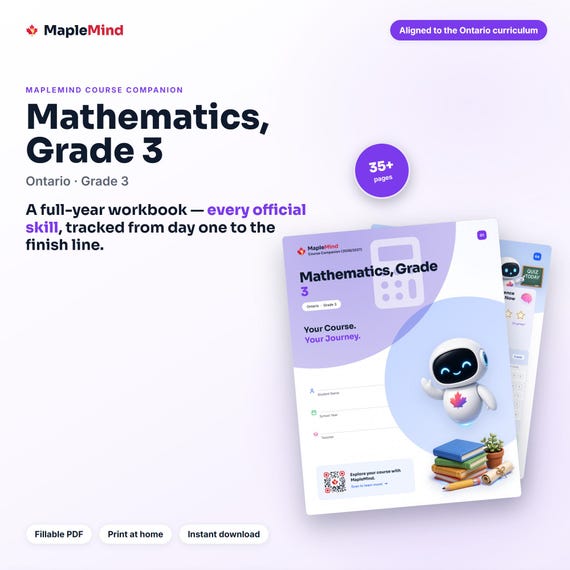
A Mathematics, Grade 3 workbook worth keeping
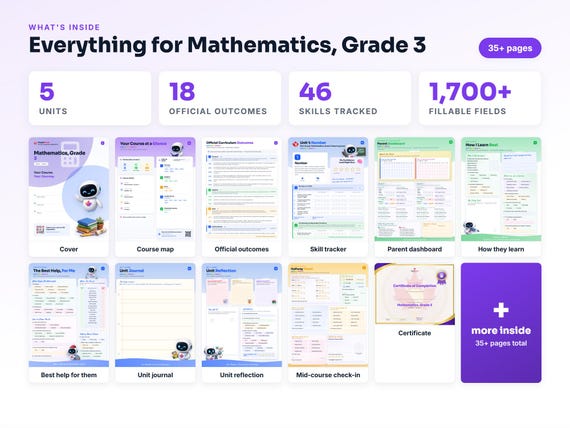
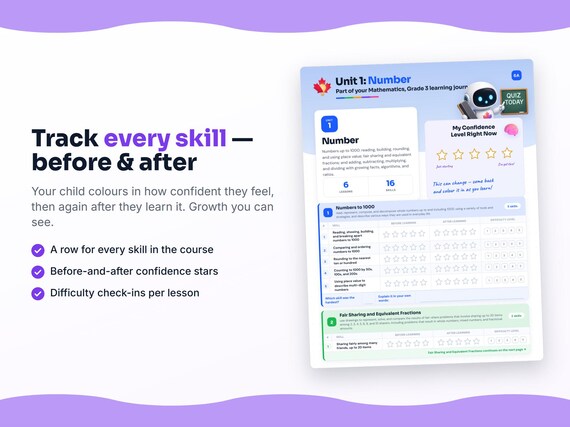
Built from the same official curriculum as this page. Before and after each skill above, your student colours in how sure they feel — so the two of you can see, on one page, what's clicking and what needs another look. It's a quiet way to follow how the year is really going.
By June it's full of their own handwriting: units worked through, confidence grown, a mid-year check-in, notes from parent-teacher night, and a certificate at the end. Less a worksheet, more a record of the year worth keeping on the shelf.
Instant download · see every page, reviews and the full description · five or more workbooks are $2.99 each
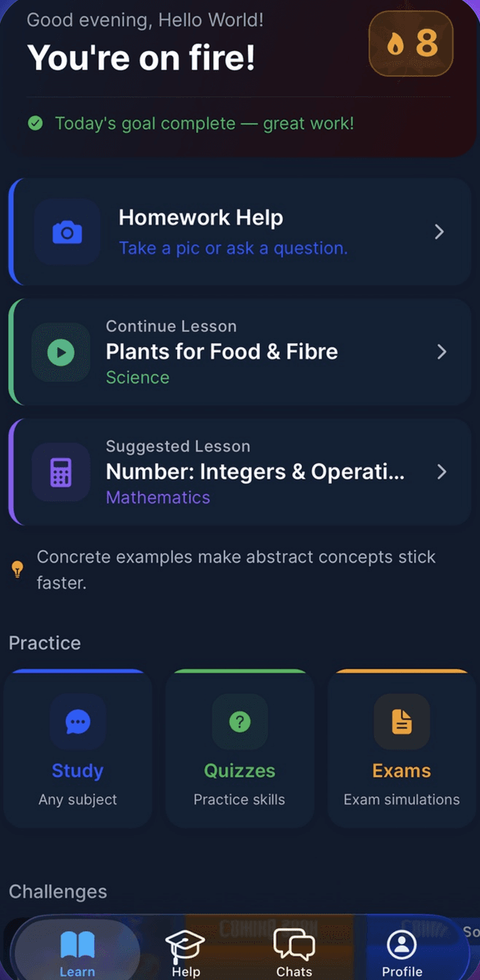
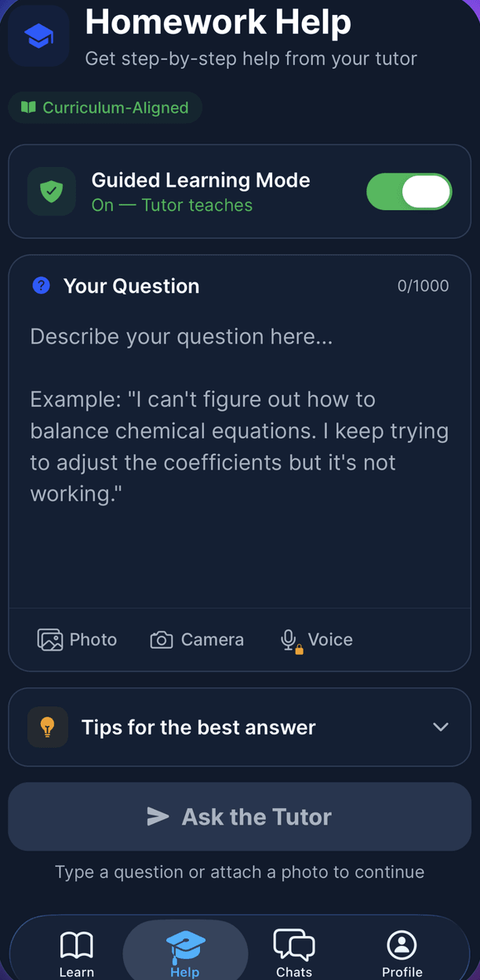
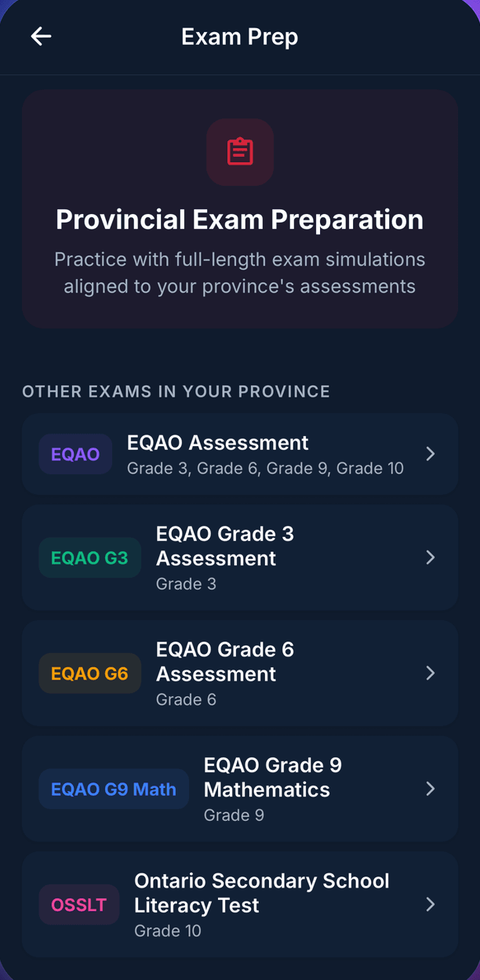
What it looks like in the app
Preparing for the EQAO Grade 3 assessment?
Ontario runs EQAO assessments in Grade 3. MapleMind's practice and exam modes build questions from this course so the format feels familiar.
Common questions
Can MapleMind help my child with Mathematics, Grade 3?
Yes. MapleMind's AI tutor covers all 46 skills in Ontario's Mathematics, Grade 3 — your child picks the exact skill, and the tutor teaches it step by step: a short lesson, a worked example, solving together, then a skill check to show it stuck.
Is MapleMind aligned to Ontario's official curriculum?
Yes. Every skill in this course maps to an official outcome code from Ontario's Grade 3 Mathematics curriculum, and the ministry's own wording is quoted under each unit on this page — with the official government source linked so you can check it yourself.
What does MapleMind cost?
It's free to start — 5 tutoring chats and a practice quiz every day, no credit card. A Pro subscription ($9.99/month or $49.99/year CAD, 7-day free trial) unlocks unlimited tutoring, practice, and exam simulations.
What if my child is stuck on just one topic?
That's the point of skill-level tutoring: open Mathematics, Grade 3 in the app, tap the exact skill from the list on this page, and the tutor teaches just that — no wading through lessons your child doesn't need.
Does MapleMind work in French or other languages?
Yes — 14 languages, including French. Both the app and the tutor's explanations switch to the language your child chooses.
Where can I see the official Ontario curriculum for Mathematics, Grade 3?
The official source is linked on this page — Ontario's official mathematics curriculum. The outline here follows it: every MapleMind skill carries its official outcome code, and the ministry's own wording is quoted under each unit.
Does MapleMind help with the EQAO Grade 3 assessment?
Yes. Ontario runs EQAO assessments in Grade 3. MapleMind's practice and exam modes build questions from this course so the format feels familiar.
Keep exploring
Ready when you are
Pick a skill from this page and see it taught properly — free, in the browser, in under a minute.