Get help with Studies in Literature, Grade 12, University Preparation
Most tutoring makes you sit through material you already know. MapleMind flips that: pick the exact skill that's causing trouble — any of the 18 below — and the tutor teaches just that one, step by step, as many times as it takes. Ask questions in plain words, any time of day, in English, French, or 12 other languages.
The official Ontario Studies in Literature, Grade 12, University Preparation curriculum
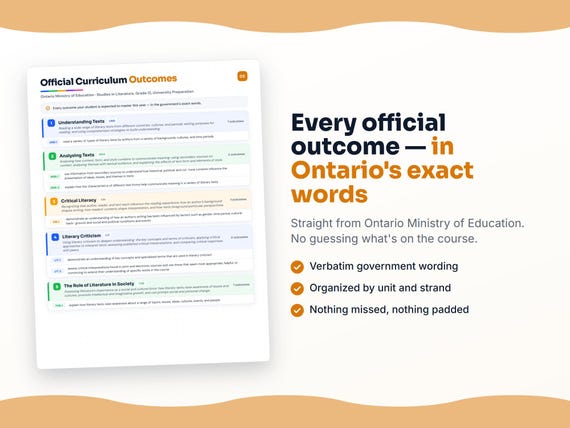
Ontario defines Studies in Literature, Grade 12, University Preparation by strands and outcomes. MapleMind teaches the same curriculum reorganized for one-skill-at-a-time tutoring — the table shows exactly where every official strand lands, and the ministry's own wording is quoted under each unit below.
Official source Ontario's official curriculumRead it on the government site — dcp.edu.gov.on.ca ↗| Official strand | Outcomes | Where MapleMind teaches it |
|---|---|---|
| Strand 1 | 18 | Understanding Texts · Analysing Texts · Critical Literacy · Literary Criticism · The Role of Literature in Society |
Every skill below, taught one on one.
 Try the first session free
How MapleMind teaches Studies in Literature, Grade 12, University Preparation — every unit, lesson, and skill
Every skill below runs as a short session: a plain-words lesson, a worked example, solving it together, then a five-question skill check that earns up to three stars. Guided Mode keeps it teaching instead of answer-handing — turning it off needs a parent's password.
Unit 1Understanding TextsOfficial strand · Strand 1
Reading a wide range of literary texts from different countries, cultures, and periods; setting purposes for reading; and using comprehension strategies to build understanding.
Reading Widely and With Purpose
- Reading literary texts across cultures and periodsets4u.ETS4U.1.1 — Read a variety of literary texts by authors from different backgrounds, cultures, and time periods.
- Setting a purpose for reading a textets4u.ETS4U.1.2 — Identify a purpose (or purposes) for reading particular texts.
- Using reading comprehension strategiesets4u.ETS4U.1.3 — Identify a variety of reading comprehension strategies, select the most appropriate ones, and use them before, during, and after reading.
- Responding to texts to extend understandingets4u.ETS4U.1.4 — Respond to texts in a variety of ways before, during, and after reading to extend understanding of their ideas, themes, and language.
The official wording — 4 outcomes in this unit
- ets4u.ETS4U.1.1
read a variety of types of literary texts by authors from a variety of backgrounds, cultures, and time periods
- ets4u.ETS4U.1.2
identify a purpose (or purposes) for reading particular texts
- ets4u.ETS4U.1.3
identify a variety of reading comprehension strategies, select those that are most appropri- ate for specific reading purposes and tasks, and use them before, during, and after reading to enhance their understanding of texts
- ets4u.ETS4U.1.4
respond to texts in a variety of ways before, during, and after reading to extend their understanding of the ideas, themes, language,
Unit 2Analysing TextsOfficial strand · Strand 1
Analysing how content, form, and style combine to communicate meaning: using secondary sources on context, analysing themes with textual evidence, and explaining the effects of text form and elements of style.
Context, Ideas, and Themes
- Using secondary sources to understand contextets4u.ETS4U.1.5 — Use information from secondary sources to understand how historical, political, and cultural contexts influence the presentation of ideas, issues, and themes in texts.
- Analysing ideas, issues, and themes with evidenceets4u.ETS4U.1.6 — Analyse texts in terms of the information, ideas, issues, and themes they explore, providing evidence from the texts to support the analysis.
Form and Style
- How text form communicates meaningets4u.ETS4U.1.7 — Explain how the characteristics of different text forms help communicate meaning in a variety of literary texts.
- Analysing elements of styleets4u.ETS4U.1.8 — Identify various elements of style used in texts and explain how they help communicate meaning and enhance the text's effectiveness.
The official wording — 4 outcomes in this unit
- ets4u.ETS4U.1.5
use information from secondary sources to understand how historical, political, and cul- tural contexts influence the presentation of ideas, issues, and themes in texts
- ets4u.ETS4U.1.6
analyse texts in terms of the information, ideas, issues, and themes they explore, providing evidence from the texts to support their analy- sis
- ets4u.ETS4U.1.7
explain how the characteristics of different text forms help communicate meaning in a variety of literary texts
- ets4u.ETS4U.1.8
identify various elements of style used in texts and explain how they help communicate meaning and enhance the effectiveness of the text
Unit 3Critical LiteracyOfficial strand · Strand 1
Recognizing that author, reader, and text each influence the reading experience: how an author's background shapes writing, how readers' contexts shape interpretation, and how texts foreground particular perspectives.
Author, Reader, and Perspective
- How readers' contexts shape interpretationets4u.ETS4U.1.10 — Analyse texts in terms of how social, cultural, and political contexts and different readers' perspectives may influence readers' interpretations.
- Identifying whose perspective a text foregroundsets4u.ETS4U.1.11 — Analyse texts to identify the particular perspectives presented and the stylistic or structural means used to communicate them.
The official wording — 3 outcomes in this unit
- ets4u.ETS4U.1.9
demonstrate an understanding of how an author’s writing has been influenced by factors such as gender, time period, cultural back- ground, and social and political conditions and events
- ets4u.ETS4U.1.10
analyse texts in terms of how social, cultural, and political contexts and different readers’ personal perspectives may influence readers’ interpretations of the text
- ets4u.ETS4U.1.11
analyse texts to identify particular perspectives presented in them and the stylistic and/or structural means used to communicate those perspectives
Unit 4Literary CriticismOfficial strand · Strand 1
Using literary criticism to deepen understanding: the key concepts and terms of criticism, applying critical approaches to interpret texts, assessing published critical interpretations, and comparing critical responses with peers.
The Language and Lenses of Criticism
- Key concepts and terms of literary criticismets4u.ETS4U.1.12 — Demonstrate an understanding of key concepts and specialized terms used in literary criticism.
- Applying critical approaches to interpret textsets4u.ETS4U.1.13 — Use key concepts or approaches of literary criticism to help analyse and interpret literary texts.
Working With Critical Interpretations
- Assessing published critical interpretationsets4u.ETS4U.1.14 — Assess critical interpretations found in print and electronic sources and use those most appropriate to extend understanding of specific works.
- Comparing critical responses with peersets4u.ETS4U.1.15 — Compare peers' critical responses with their own to clarify and extend understanding of literary texts.
The official wording — 4 outcomes in this unit
- ets4u.ETS4U.1.12
demonstrate an understanding of key concepts and specialized terms that are used in literary criticism
- ets4u.ETS4U.1.13
use key concepts or approaches of literary crit- icism to help them analyse and interpret liter- ary texts
- ets4u.ETS4U.1.14
assess critical interpretations found in print and electronic sources and use those that seem most appropriate, helpful, or convincing to extend their understanding of specific works in the course
- ets4u.ETS4U.1.15
compare peers’ critical responses with their own to clarify and extend their understanding of literary texts
Unit 5The Role of Literature in SocietyOfficial strand · Strand 1
Assessing literature's importance as a social and cultural force: how literary texts raise awareness of issues and cultures, promote intellectual and imaginative growth, and can prompt social and personal change.
Literature as a Social and Cultural Force
- How literature raises awarenessets4u.ETS4U.1.16 — Explain how literary texts raise awareness about a range of topics, issues, ideas, cultures, events, and people.
- How literature promotes intellectual and imaginative growthets4u.ETS4U.1.17 — Identify ways in which literary texts can promote readers' intellectual and imaginative growth.
The official wording — 3 outcomes in this unit
- ets4u.ETS4U.1.16
explain how literary texts raise awareness about a range of topics, issues, ideas, cultures, events, and people
- ets4u.ETS4U.1.17
identify ways in which literary texts can pro- mote readers’ intellectual and imaginative growth
- ets4u.ETS4U.1.18
identify ways in which literary texts might promote social and personal change
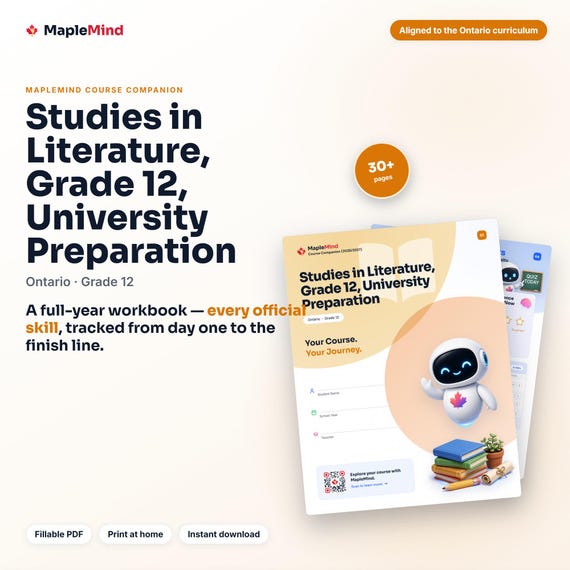
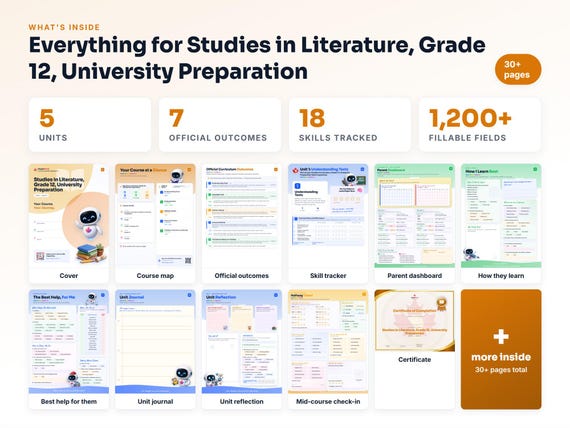
Printable workbook · A keepsake of the year
A Studies in Literature, Grade 12, University Preparation workbook worth keeping
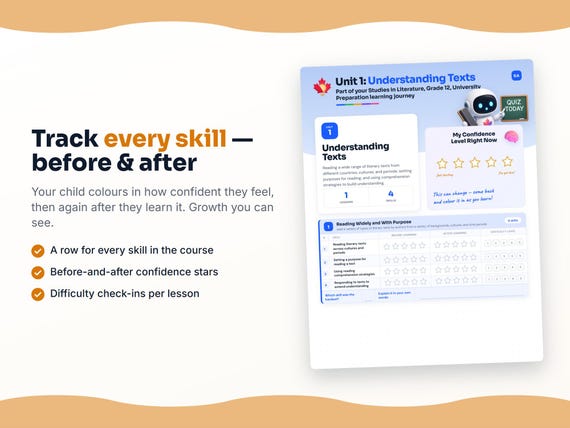
Built from the same official curriculum as this page. Before and after each skill above, your student colours in how sure they feel — so the two of you can see, on one page, what's clicking and what needs another look. It's a quiet way to follow how the year is really going.
By June it's full of their own handwriting: units worked through, confidence grown, a mid-year check-in, notes from parent-teacher night, and a certificate at the end. Less a worksheet, more a record of the year worth keeping on the shelf.
Instant download · see every page, reviews and the full description · five or more workbooks are $2.99 each
What it looks like in the app
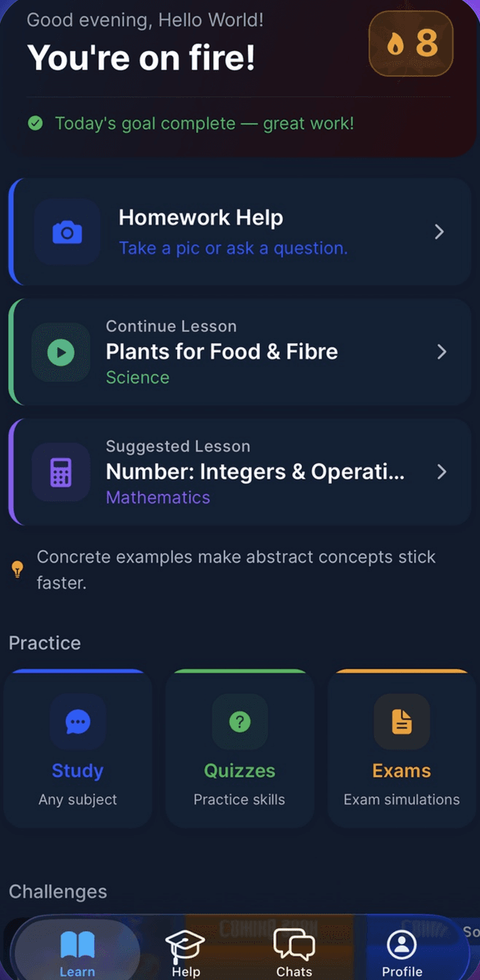
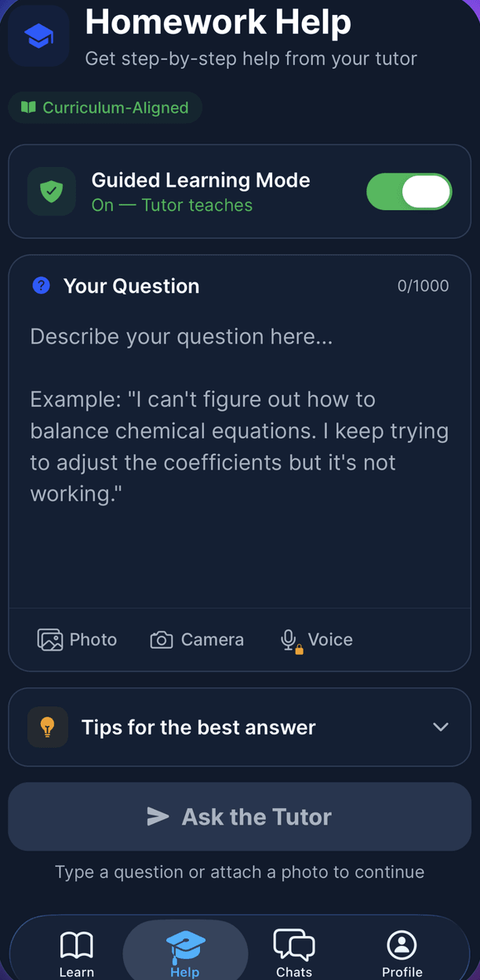
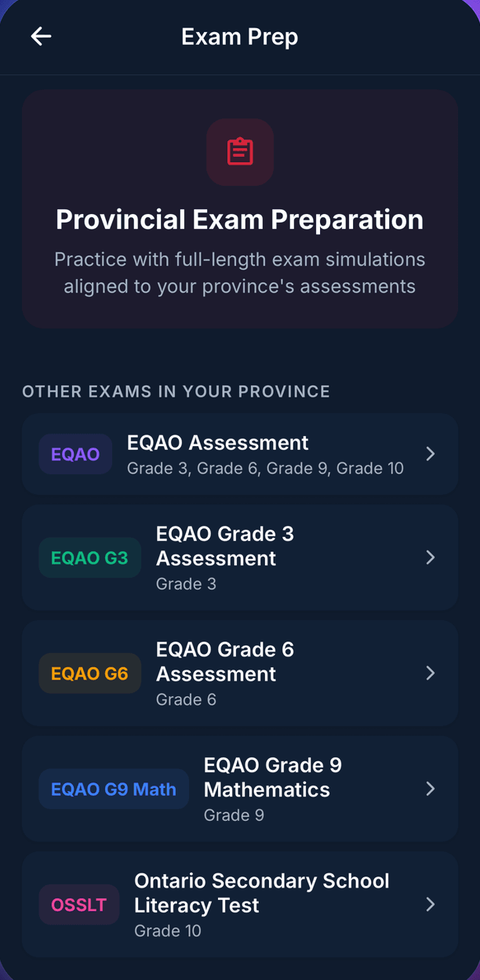
Common questions
Can MapleMind help me with Studies in Literature, Grade 12, University Preparation?
Yes. MapleMind's AI tutor covers all 18 skills in Ontario's Studies in Literature, Grade 12, University Preparation — you pick the exact skill, and the tutor teaches it step by step: a short lesson, a worked example, solving together, then a skill check to show it stuck.
Is MapleMind aligned to Ontario's official curriculum?
Yes. Every skill in this course maps to an official outcome code from Ontario's Grade 12 English Language Arts curriculum, and the ministry's own wording is quoted under each unit on this page — with the official government source linked so you can check it yourself.
What does MapleMind cost?
It's free to start — 5 tutoring chats and a practice quiz every day, no credit card. A Pro subscription ($9.99/month or $49.99/year CAD, 7-day free trial) unlocks unlimited tutoring, practice, and exam simulations.
What if I'm stuck on just one topic?
That's the point of skill-level tutoring: open Studies in Literature, Grade 12, University Preparation in the app, tap the exact skill from the list on this page, and the tutor teaches just that — no wading through lessons you don't need.
Does MapleMind work in French or other languages?
Yes — 14 languages, including French. Both the app and the tutor's explanations switch to the language you choose.
Where can I see the official Ontario curriculum for Studies in Literature, Grade 12, University Preparation?
The official source is linked on this page — Ontario's official curriculum. The outline here follows it: every MapleMind skill carries its official outcome code, and the ministry's own wording is quoted under each unit.
Keep exploring
Ready when you are
Pick a skill from this page and see it taught properly — free, in the browser, in under a minute.