Get help with English, Grade 12, College Preparation
Most tutoring makes you sit through material you already know. MapleMind flips that: pick the exact skill that's causing trouble — any of the 61 below — and the tutor teaches just that one, step by step, as many times as it takes. Ask questions in plain words, any time of day, in English, French, or 12 other languages.
The official Ontario English, Grade 12, College Preparation curriculum
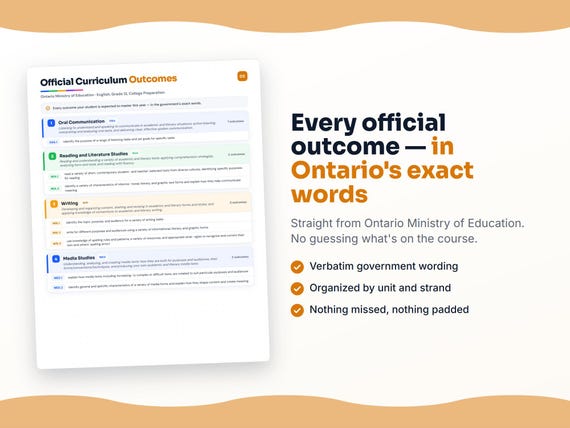
Ontario defines English, Grade 12, College Preparation by strands and outcomes. MapleMind teaches the same curriculum reorganized for one-skill-at-a-time tutoring — the table shows exactly where every official strand lands, and the ministry's own wording is quoted under each unit below.
Official source Ontario's official curriculumRead it on the government site — dcp.edu.gov.on.ca ↗| Official strand | Outcomes | Where MapleMind teaches it |
|---|---|---|
| Strand 1 | 16 | Oral Communication |
| Strand 2 | 14 | Reading and Literature Studies |
| Strand 3 | 19 | Writing |
| Strand 4 | 12 | Media Studies |
Every skill below, taught one on one.
 Try the first session free
How MapleMind teaches English, Grade 12, College Preparation — every unit, lesson, and skill
Every skill below runs as a short session: a plain-words lesson, a worked example, solving it together, then a five-question skill check that earns up to three stars. Guided Mode keeps it teaching instead of answer-handing — turning it off needs a parent's password.
Unit 1Oral CommunicationOfficial strand · Strand 1
Listening to understand and speaking to communicate in academic and literary situations: active listening, interpreting and analyzing oral texts, and delivering clear, effective spoken communication.
Listening to Understand
- Setting a purpose and goals for listeningeng4c.ENG4C.1.1 — Identify the purpose of a range of listening tasks and set goals for specific tasks.
- Using active listening strategieseng4c.ENG4C.1.2 — Select and use the most appropriate active listening strategies when participating in a range of situations.
- Listening comprehension strategies for complex textseng4c.ENG4C.1.3 — Select and use the most appropriate listening comprehension strategies before, during, and after listening to understand oral texts, including increasingly complex or difficult texts.
- Identifying the important ideas in oral textseng4c.ENG4C.1.4 — Identify the important information and ideas in oral texts, including increasingly complex or difficult texts, in a variety of ways.
- Interpreting oral texts with evidenceeng4c.ENG4C.1.5 — Develop and explain interpretations of oral texts, including increasingly complex or difficult texts, using evidence from the text and.
- Extending understanding by making connectionseng4c.ENG4C.1.6 — Extend understanding of oral texts, including increasingly complex or difficult texts, by making effective connections between the ideas in them and personal knowledge, experience, and insights; other texts; and the world around them.
- Analyzing how oral texts communicateeng4c.ENG4C.1.7 — Analyse oral texts, including increasingly complex or difficult texts, focusing on the ways in which they communicate information, ideas, issues, and themes and influence the listener’s/ viewer’s response.
- Identifying perspectives and bias in oral textseng4c.ENG4C.1.8 — Identify and analyse the perspectives and/or biases evident in oral texts, including increasingly complex or difficult texts, and comment with growing understanding on any questions they may raise about beliefs, values, identity, and power.
- Evaluating presentation strategieseng4c.ENG4C.1.9 — Evaluate the effectiveness of a variety of presentation strategies used in oral texts, including increasingly complex or difficult texts, and suggest other strategies that could be used effectively.
- Communicating orally for a purpose and audienceeng4c.ENG4C.1.10 — Communicate orally for a range of purposes, using language appropriate for the intended audience.
- Adapting interpersonal speaking strategieseng4c.ENG4C.1.11 — Demonstrate an understanding of a variety of interpersonal speaking strategies and adapt them to suit the purpose, situation, and audience, exhibiting sensitivity to cultural differences.
- Communicating a clear, structured argumenteng4c.ENG4C.1.12 — Communicate in a clear, coherent manner, using a structure and style effective for the purpose, subject matter, and intended audience.
- Word choice and stylistic devices in speakingeng4c.ENG4C.1.13 — Use appropriate words, phrases, and terminology, and a variety of stylistic devices, to effectively communicate their meaning and engage their intended audience.
- Using vocal strategies effectivelyeng4c.ENG4C.1.14 — Identify a variety of vocal strategies, including tone, pace, pitch, and volume, and use them effectively and with sensitivity to audience needs and cultural differences.
- Using non-verbal cueseng4c.ENG4C.1.15 — Identify a variety of non-verbal cues, including facial expressions, gestures, and eye contact, and use them effectively to help convey their meaning and with sensitivity to audience needs and cultural differences.
- Using audio-visual aids to support a presentationeng4c.ENG4C.1.16 — Use a variety of audio-visual aids effectively to support and enhance oral presentations and to engage an audience.
The official wording — 16 outcomes in this unit
- eng4c.ENG4C.1.1
identify the purpose of a range of listening tasks and set goals for specific tasks
- eng4c.ENG4C.1.2
select and use the most appropriate active listening strategies when participating in a range of situations
- eng4c.ENG4C.1.3
select and use the most appropriate listening comprehension strategies before, during, and after listening to understand oral texts, includ- ing increasingly complex or difficult texts
- eng4c.ENG4C.1.4
identify the important information and ideas in oral texts, including increasingly complex or difficult texts, in a variety of ways
- eng4c.ENG4C.1.5
develop and explain interpretations of oral texts, including increasingly complex or diffi- cult texts, using evidence from the text and
- eng4c.ENG4C.1.6
extend understanding of oral texts, including increasingly complex or difficult texts, by mak- ing effective connections between the ideas in them and personal knowledge, experience, and insights; other texts; and the world around them
- eng4c.ENG4C.1.7
analyse oral texts, including increasingly com- plex or difficult texts, focusing on the ways in which they communicate information, ideas, issues, and themes and influence the listener’s/ viewer’s response
- eng4c.ENG4C.1.8
identify and analyse the perspectives and/or biases evident in oral texts, including increas- ingly complex or difficult texts, and comment with growing understanding on any questions they may raise about beliefs, values, identity, and power
- eng4c.ENG4C.1.9
evaluate the effectiveness of a variety of pres- entation strategies used in oral texts, including increasingly complex or difficult texts, and suggest other strategies that could be used effectively
- eng4c.ENG4C.1.10
communicate orally for a range of purposes, using language appropriate for the intended audience
- eng4c.ENG4C.1.11
demonstrate an understanding of a variety of interpersonal speaking strategies and adapt them to suit the purpose, situation, and audi- ence, exhibiting sensitivity to cultural differ- ences
- eng4c.ENG4C.1.12
communicate in a clear, coherent manner, using a structure and style effective for the purpose, subject matter, and intended audi- ence
- eng4c.ENG4C.1.13
use appropriate words, phrases, and terminolo- gy, and a variety of stylistic devices, to effec- tively communicate their meaning and engage their intended audience
- eng4c.ENG4C.1.14
identify a variety of vocal strategies, including tone, pace, pitch, and volume, and use them effectively and with sensitivity to audience needs and cultural differences
- eng4c.ENG4C.1.15
identify a variety of non-verbal cues, including facial expressions, gestures, and eye contact, and use them effectively to help convey their meaning and with sensitivity to audience needs and cultural differences
- eng4c.ENG4C.1.16
use a variety of audio-visual aids effectively to support and enhance oral presentations and to engage an audience
Unit 2Reading and Literature StudiesOfficial strand · Strand 2
Reading and understanding a variety of academic and literary texts: applying comprehension strategies, analyzing form and style, and reading with fluency.
Reading for Meaning
- Reading diverse texts with a purposeeng4c.ENG4C.2.1 — Read a variety of short, contemporary studentand teacher-selected texts from diverse cultures, identifying specific purposes for reading.
- Using reading comprehension strategieseng4c.ENG4C.2.2 — Select and use the most appropriate reading comprehension strategies to understand texts, including increasingly complex or difficult texts.
- Identifying important ideas and supporting detailseng4c.ENG4C.2.3 — Identify the most important ideas and supporting details in texts, including increasingly complex or difficult texts.
- Making and explaining inferenceseng4c.ENG4C.2.4 — Make and explain inferences about texts, including increasingly complex or difficult texts, supporting their explanations with wellchosen stated and implied ideas from the texts.
- Extending understanding by making connectionseng4c.ENG4C.2.5 — Extend understanding of texts, including increasingly complex or difficult texts, by making appropriate and increasingly rich connections between the ideas in them and personal knowledge, experience, and insights; other texts; and the world around them.
- Analyzing how texts develop ideas and themeseng4c.ENG4C.2.6 — Analyse texts in terms of the information, ideas, issues, and themes they explore, examining how various aspects of the texts contribute to the presentation or development of these elements.
- Evaluating the effectiveness of texts with evidenceeng4c.ENG4C.2.7 — Evaluate the effectiveness of texts, including increasingly complex or difficult texts, using evidence from the text effectively to support their opinions.
- Identifying perspectives and bias in textseng4c.ENG4C.2.8 — Identify and analyse the perspectives and/or biases evident in texts, including increasingly complex or difficult texts, commenting with growing understanding on any questions they may raise about beliefs, values, identity, and power.
Understanding Form and Style
- Characteristics of text formseng4c.ENG4C.2.9 — Identify a variety of characteristics of informational, literary, and graphic text forms and explain how they help communicate meaning.
- Text features and how they communicateeng4c.ENG4C.2.10 — Identify a variety of text features and explain how they help communicate meaning.
- Elements of style and their effectseng4c.ENG4C.2.11 — Identify a variety of elements of style in texts, including increasingly complex or difficult texts, and explain how they help communicate meaning and enhance the effectiveness of the texts.
- Understanding words automatically in contexteng4c.ENG4C.2.12 — Automatically understand most words in a variety of reading contexts.
- Decoding unfamiliar wordseng4c.ENG4C.2.13 — Use appropriate decoding strategies to read and understand unfamiliar words, including words of increasing difficulty.
- Strategies to expand vocabularyeng4c.ENG4C.2.14 — Use a variety of strategies, with increasing regularity, to explore and extend vocabulary, focusing on the precision with which words are used in the texts they are reading.
The official wording — 14 outcomes in this unit
- eng4c.ENG4C.2.1
read a variety of short, contemporary student- and teacher-selected texts from diverse cultures, identifying specific purposes for reading
- eng4c.ENG4C.2.2
select and use the most appropriate reading comprehension strategies to understand texts, including increasingly complex or difficult texts
- eng4c.ENG4C.2.3
identify the most important ideas and sup- porting details in texts, including increasingly complex or difficult texts
- eng4c.ENG4C.2.4
make and explain inferences about texts, including increasingly complex or difficult texts, supporting their explanations with well- chosen stated and implied ideas from the texts
- eng4c.ENG4C.2.5
extend understanding of texts, including increasingly complex or difficult texts, by making appropriate and increasingly rich connections between the ideas in them and personal knowledge, experience, and insights; other texts; and the world around them
- eng4c.ENG4C.2.6
analyse texts in terms of the information, ideas, issues, and themes they explore, exam- ining how various aspects of the texts con- tribute to the presentation or development of these elements
- eng4c.ENG4C.2.7
evaluate the effectiveness of texts, including increasingly complex or difficult texts, using evidence from the text effectively to support their opinions
- eng4c.ENG4C.2.8
identify and analyse the perspectives and/or biases evident in texts, including increasingly complex or difficult texts, commenting with growing understanding on any questions they may raise about beliefs, values, identity, and power
- eng4c.ENG4C.2.9
identify a variety of characteristics of informa- tional, literary, and graphic text forms and explain how they help communicate meaning
- eng4c.ENG4C.2.10
identify a variety of text features and explain how they help communicate meaning
- eng4c.ENG4C.2.11
identify a variety of elements of style in texts, including increasingly complex or difficult texts, and explain how they help communicate meaning and enhance the effectiveness of the texts
- eng4c.ENG4C.2.12
automatically understand most words in a variety of reading contexts
- eng4c.ENG4C.2.13
use appropriate decoding strategies to read and understand unfamiliar words, including words of increasing difficulty
- eng4c.ENG4C.2.14
use a variety of strategies, with increasing regularity, to explore and extend vocabulary, focusing on the precision with which words are used in the texts they are reading
Unit 3WritingOfficial strand · Strand 3
Developing and organizing content, drafting and revising in academic and literary forms and styles, and applying knowledge of conventions to academic and literary writing.
Developing and Organizing Content
- Identifying topic, purpose, and audienceeng4c.ENG4C.3.1 — Identify the topic, purpose, and audience for a variety of writing tasks.
- Generating and focusing ideaseng4c.ENG4C.3.2 — Generate, expand, explore, and focus ideas for potential writing tasks, using a variety of strategies and print, electronic, and other resources, as appropriate.
- Locating and selecting supporting informationeng4c.ENG4C.3.3 — Locate and select information to effectively support ideas for writing, using a variety of strategies and print, electronic, and other resources, as appropriate.
- Organizing ideas with suitable patternseng4c.ENG4C.3.4 — Identify, sort, and order main ideas and supporting details for writing tasks, using a variety of strategies and selecting the organizational pattern best suited to the content and the purpose for writing.
- Checking that ideas are relevant, accurate, and completeeng4c.ENG4C.3.5 — Determine whether the ideas and information gathered are accurate and complete, interesting, and effectively meet the requirements of the writing task.
Using Knowledge of Form and Style
- Writing in a variety of forms for purposes and audienceseng4c.ENG4C.3.6 — Write for different purposes and audiences using a variety of informational, literary, and graphic forms.
- Establishing voice in writingeng4c.ENG4C.3.7 — Establish a distinctive voice in their writing, modifying language and tone skilfully and effectively to suit the form, audience, and purpose for writing.
- Choosing vivid, precise wordseng4c.ENG4C.3.8 — Use appropriate descriptive and evocative words, phrases, and expressions imaginatively to make their writing clear, vivid, and interesting for their intended audience.
- Varying sentences and making smooth transitionseng4c.ENG4C.3.9 — Write complete sentences that communicate their meaning clearly and effectively, skilfully varying sentence type, structure, and length to suit different purposes and making smooth and logical transitions between ideas.
- Recognizing beliefs and values in your writingeng4c.ENG4C.3.10 — Explain how their own beliefs, values, and experiences are revealed in their writing.
- Revising drafts to improve content and styleeng4c.ENG4C.3.11 — Revise drafts to improve the content, organization, clarity, and style of their written work, using a variety of teacher-modelled strategies.
- Producing revised drafts to criteriaeng4c.ENG4C.3.12 — Produce revised drafts of texts, including increasingly complex texts, written to meet criteria identified by the teacher, based on the curriculum expectations.
Applying Knowledge of Conventions
- Spelling correctly using rules and resourceseng4c.ENG4C.3.13 — Use knowledge of spelling rules and patterns, a variety of resources, and appropriate strategies to recognize and correct their own and others’ spelling errors.
- Building and refining word choice for writingeng4c.ENG4C.3.14 — Build vocabulary for writing by confirming word meaning(s) and reviewing and refining word choice, using a variety of resources and strategies, as appropriate for the purpose.
- Using punctuation correctlyeng4c.ENG4C.3.15 — Use punctuation correctly and effectively to communicate their intended meaning.
- Using grammar conventions correctlyeng4c.ENG4C.3.16 — Use grammar conventions correctly and appropriately to communicate their intended meaning clearly and effectively.
- Proofreading and correcting writingeng4c.ENG4C.3.17 — Regularly proofread and correct their writing.
- Using presentation features to publisheng4c.ENG4C.3.18 — Use a variety of presentation features, including print and script, fonts, graphics, and layout, to improve the clarity and coherence of their written work and to heighten its appeal and effectiveness for their audience.
- Producing published work to criteriaeng4c.ENG4C.3.19 — Produce pieces of published work to meet criteria identified by the teacher, based on the curriculum expectations.
The official wording — 19 outcomes in this unit
- eng4c.ENG4C.3.1
identify the topic, purpose, and audience for a variety of writing tasks
- eng4c.ENG4C.3.2
generate, expand, explore, and focus ideas for potential writing tasks, using a variety of strategies and print, electronic, and other resources, as appropriate
- eng4c.ENG4C.3.3
locate and select information to effectively support ideas for writing, using a variety of strategies and print, electronic, and other resources, as appropriate
- eng4c.ENG4C.3.4
identify, sort, and order main ideas and supporting details for writing tasks, using a variety of strategies and selecting the organi- zational pattern best suited to the content and the purpose for writing
- eng4c.ENG4C.3.5
determine whether the ideas and information gathered are accurate and complete, interest- ing, and effectively meet the requirements of the writing task
- eng4c.ENG4C.3.6
write for different purposes and audiences using a variety of informational, literary, and graphic forms
- eng4c.ENG4C.3.7
establish a distinctive voice in their writing, modifying language and tone skilfully and effectively to suit the form, audience, and purpose for writing
- eng4c.ENG4C.3.8
use appropriate descriptive and evocative words, phrases, and expressions imaginatively to make their writing clear, vivid, and interest- ing for their intended audience
- eng4c.ENG4C.3.9
write complete sentences that communicate their meaning clearly and effectively, skilfully varying sentence type, structure, and length to suit different purposes and making smooth and logical transitions between ideas
- eng4c.ENG4C.3.10
explain how their own beliefs, values, and experiences are revealed in their writing
- eng4c.ENG4C.3.11
revise drafts to improve the content, organiza- tion, clarity, and style of their written work, using a variety of teacher-modelled strategies
- eng4c.ENG4C.3.12
produce revised drafts of texts, including increasingly complex texts, written to meet criteria identified by the teacher, based on the curriculum expectations
- eng4c.ENG4C.3.13
use knowledge of spelling rules and patterns, a variety of resources, and appropriate strat- egies to recognize and correct their own and others’ spelling errors
- eng4c.ENG4C.3.14
build vocabulary for writing by confirming word meaning(s) and reviewing and refining word choice, using a variety of resources and strategies, as appropriate for the purpose
- eng4c.ENG4C.3.15
use punctuation correctly and effectively to communicate their intended meaning
- eng4c.ENG4C.3.16
use grammar conventions correctly and appro- priately to communicate their intended mean- ing clearly and effectively
- eng4c.ENG4C.3.17
regularly proofread and correct their writing
- eng4c.ENG4C.3.18
use a variety of presentation features, includ- ing print and script, fonts, graphics, and lay- out, to improve the clarity and coherence of their written work and to heighten its appeal and effectiveness for their audience
- eng4c.ENG4C.3.19
produce pieces of published work to meet cri- teria identified by the teacher, based on the curriculum expectations
Unit 4Media StudiesOfficial strand · Strand 4
Understanding, analyzing, and creating media texts: how they are built for purposes and audiences, their forms/conventions/techniques, and producing your own academic and literary media texts.
Understanding Media Texts
- How media texts suit purposes and audienceseng4c.ENG4C.4.1 — Explain how media texts, including increasingly complex or difficult texts, are created to suit particular purposes and audiences.
- Interpreting overt and implied media messageseng4c.ENG4C.4.2 — Interpret media texts, including increasingly complex or difficult texts, identifying and explaining the overt and implied messages they convey.
- Evaluating how effectively media texts communicateeng4c.ENG4C.4.3 — Evaluate how effectively information, ideas, themes, issues, and opinions are communicated in media texts, including increasingly complex or difficult texts, and decide whether the texts achieve their intended purpose.
- Why media texts prompt different responseseng4c.ENG4C.4.4 — Explain why the same media text might prompt different responses from different audiences.
- Identifying perspectives and bias in media textseng4c.ENG4C.4.5 — Identify the perspectives and/or biases evident in media texts, including increasingly complex or difficult texts, and comment on any questions they may raise about beliefs, values, identity, and power.
- How production factors shape the media industryeng4c.ENG4C.4.6 — Explain how production, marketing, financing, distribution, and legal/regulatory factors influence the media industry.
Media Forms, Conventions, and Creating Media Texts
- Characteristics of media formseng4c.ENG4C.4.7 — Identify general and specific characteristics of a variety of media forms and explain how they shape content and create meaning.
- Conventions and techniques in media formseng4c.ENG4C.4.8 — Identify conventions and/or techniques used in a variety of media forms and explain how they convey meaning and influence their audience.
- Planning a media text: topic, purpose, audienceeng4c.ENG4C.4.9 — Describe the topic, purpose, and audience for media texts they plan to create.
- Selecting an appropriate media formeng4c.ENG4C.4.10 — Select a media form to suit the topic, purpose, and audience for a media text they plan to create, and explain why it is a highly appropriate choice.
- Planning conventions and techniques for a media texteng4c.ENG4C.4.11 — Identify a variety of conventions and/or techniques appropriate to a media form they plan to use, and explain how these will help communicate a specific aspect of their intended meaning effectively.
- Producing media textseng4c.ENG4C.4.12 — Produce media texts, including increasingly complex texts, for a variety of purposes and audiences, using appropriate forms, conventions, and techniques.
The official wording — 12 outcomes in this unit
- eng4c.ENG4C.4.1
explain how media texts, including increasing- ly complex or difficult texts, are created to suit particular purposes and audiences
- eng4c.ENG4C.4.2
interpret media texts, including increasingly complex or difficult texts, identifying and explaining the overt and implied messages they convey
- eng4c.ENG4C.4.3
evaluate how effectively information, ideas, themes, issues, and opinions are communicat- ed in media texts, including increasingly com- plex or difficult texts, and decide whether the texts achieve their intended purpose
- eng4c.ENG4C.4.4
explain why the same media text might prompt different responses from different audiences
- eng4c.ENG4C.4.5
identify the perspectives and/or biases evident in media texts, including increasingly complex or difficult texts, and comment on any questions they may raise about beliefs, values, identity, and power
- eng4c.ENG4C.4.6
explain how production, marketing, financing, distribution, and legal/regulatory factors influence the media industry
- eng4c.ENG4C.4.7
identify general and specific characteristics of a variety of media forms and explain how they shape content and create meaning
- eng4c.ENG4C.4.8
identify conventions and/or techniques used in a variety of media forms and explain how they convey meaning and influence their audi- ence
- eng4c.ENG4C.4.9
describe the topic, purpose, and audience for media texts they plan to create
- eng4c.ENG4C.4.10
select a media form to suit the topic, purpose, and audience for a media text they plan to cre- ate, and explain why it is a highly appropriate choice
- eng4c.ENG4C.4.11
identify a variety of conventions and/or tech- niques appropriate to a media form they plan to use, and explain how these will help com- municate a specific aspect of their intended meaning effectively
- eng4c.ENG4C.4.12
produce media texts, including increasingly complex texts, for a variety of purposes and audiences, using appropriate forms, conven- tions, and techniques
Printable workbook · A keepsake of the year
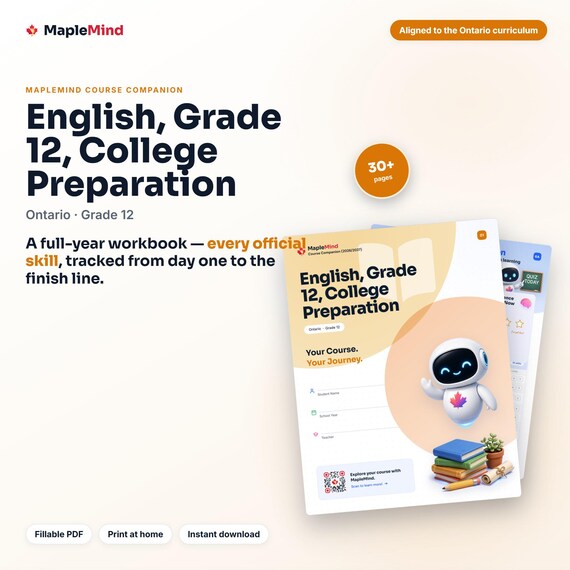
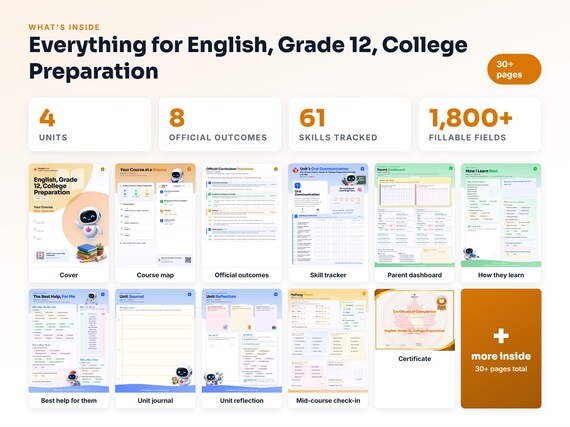
A English, Grade 12, College Preparation workbook worth keeping
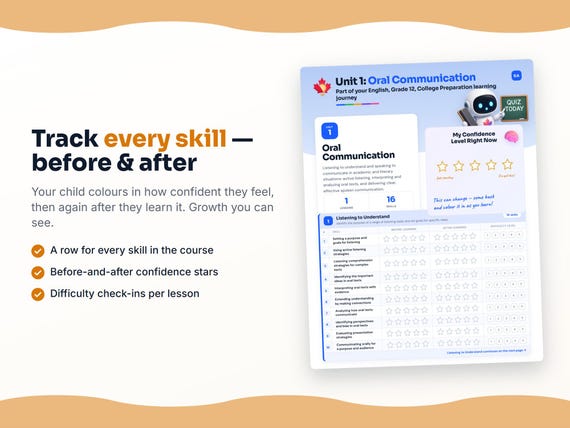
Built from the same official curriculum as this page. Before and after each skill above, your student colours in how sure they feel — so the two of you can see, on one page, what's clicking and what needs another look. It's a quiet way to follow how the year is really going.
By June it's full of their own handwriting: units worked through, confidence grown, a mid-year check-in, notes from parent-teacher night, and a certificate at the end. Less a worksheet, more a record of the year worth keeping on the shelf.
Instant download · see every page, reviews and the full description · five or more workbooks are $2.99 each
What it looks like in the app



Common questions
Can MapleMind help me with English, Grade 12, College Preparation?
Yes. MapleMind's AI tutor covers all 61 skills in Ontario's English, Grade 12, College Preparation — you pick the exact skill, and the tutor teaches it step by step: a short lesson, a worked example, solving together, then a skill check to show it stuck.
Is MapleMind aligned to Ontario's official curriculum?
Yes. Every skill in this course maps to an official outcome code from Ontario's Grade 12 English Language Arts curriculum, and the ministry's own wording is quoted under each unit on this page — with the official government source linked so you can check it yourself.
What does MapleMind cost?
It's free to start — 5 tutoring chats and a practice quiz every day, no credit card. A Pro subscription ($9.99/month or $49.99/year CAD, 7-day free trial) unlocks unlimited tutoring, practice, and exam simulations.
What if I'm stuck on just one topic?
That's the point of skill-level tutoring: open English, Grade 12, College Preparation in the app, tap the exact skill from the list on this page, and the tutor teaches just that — no wading through lessons you don't need.
Does MapleMind work in French or other languages?
Yes — 14 languages, including French. Both the app and the tutor's explanations switch to the language you choose.
Where can I see the official Ontario curriculum for English, Grade 12, College Preparation?
The official source is linked on this page — Ontario's official curriculum. The outline here follows it: every MapleMind skill carries its official outcome code, and the ministry's own wording is quoted under each unit.
Keep exploring
Ready when you are
Pick a skill from this page and see it taught properly — free, in the browser, in under a minute.