Get help with Science, Grade 7
Most tutoring makes you sit through material you already know. MapleMind flips that: pick the exact skill that's causing trouble — any of the 38 below — and the tutor teaches just that one, step by step, as many times as it takes. Ask questions in plain words, any time of day, in English, French, or 12 other languages.
The official Nova Scotia Science, Grade 7 curriculum
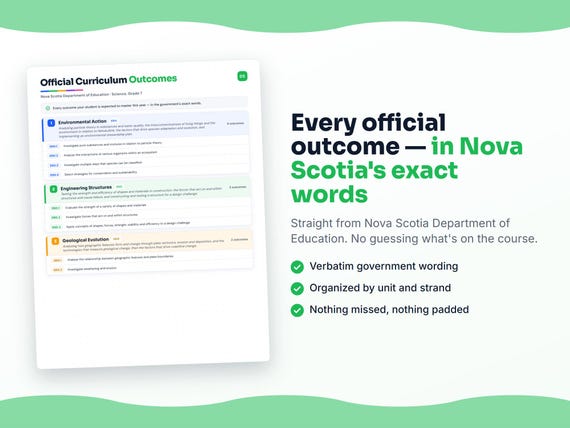
Nova Scotia defines Science, Grade 7 by strands and outcomes. MapleMind teaches the same curriculum reorganized for one-skill-at-a-time tutoring — the table shows exactly where every official strand lands, and the ministry's own wording is quoted under each unit below.
Official source Nova Scotia's official curriculumRead it on the government site — curriculum.novascotia.ca ↗| Official strand | Outcomes | Where MapleMind teaches it |
|---|---|---|
| Strand 1 | 19 | Environmental Action |
| Strand 2 | 12 | Engineering Structures |
| Strand 3 | 7 | Geological Evolution |
Every skill below, taught one on one.
 Try the first session free
How MapleMind teaches Science, Grade 7 — every unit, lesson, and skill
Every skill below runs as a short session: a plain-words lesson, a worked example, solving it together, then a five-question skill check that earns up to three stars. Guided Mode keeps it teaching instead of answer-handing — turning it off needs a parent's password.
Unit 1Environmental ActionOfficial strand · Strand 1
Analysing particle theory in substances and water quality, the interconnectiveness of living things and the environment in relation to Netukulimk, the factors that drive species adaptation and evolution, and implementing an environmental stewardship plan.
Particle Theory and Water Quality
- Pure substances and mixturessci7.1.1 — Investigate pure substances and mixtures using particle theory.
- Separating solutions and mixturessci7.1.2 — Investigate methods of separating solutions and mixtures.
- Solubility and concentrationsci7.1.3 — Analyse the factors that affect solubility and concentration.
- Measuring water health with probewaresci7.1.4 — Measure indicators of a local waterway's health using probeware.
- Analysing a waterway's healthsci7.1.5 — Analyse the health of a local waterway from the evidence collected.
- Water purification and pollution cleanupsci7.1.6 — Investigate methods of water purification and pollution cleanup.
Ecosystems and Netukulimk
- Interactions of organisms in an ecosystemsci7.2.1 — Analyse the interactions of various organisms within an ecosystem.
- Human impact on ecosystemssci7.2.2 — Analyse the impact of humans on ecosystems, including pollution and green technologies.
- Resource management and Netukulimksci7.2.3 — Analyse choices about resource management and sustainability in relation to Netukulimk.
- Energy flow and matter recyclingsci7.2.4 — Investigate energy input and matter recycling in an ecosystem.
- Biotic and abiotic connectionssci7.2.5 — Analyse the interconnectiveness of biotic and abiotic components in nature, inclusive of a Mi'kmaw perspective.
- Biological indicators of healthsci7.2.6 — Investigate biological indicators of environmental health.
Adaptation and Evolution
- Ways species can be classifiedsci7.3.1 — Investigate multiple ways that species can be classified.
- Hypothesizing how organisms adaptsci7.3.2 — Hypothesize ways organisms may adapt in response to environmental and predation factors.
- Natural selection and evolutionsci7.3.3 — Investigate the concept of natural selection and its role in evolution.
- Evidence of evolutionsci7.3.4 — Investigate evidence that supports evolution.
Environmental Stewardship
- Strategies for conservation and sustainabilitysci7.4.1 — Select strategies for conservation and sustainability.
- Community stewardship initiativessci7.4.2 — Investigate community environmental stewardship initiatives.
- Making a stewardship plansci7.4.3 — Formulate an environmental stewardship plan to mitigate environmental harm in relation to Netukulimk.
The official wording — 19 outcomes in this unit
- sci7.1.1
Investigate pure substances and mixtures in relation to particle theory
- sci7.1.2
Investigate methods of separation in solutions and mixtures
- sci7.1.3
Analyse the factors that affect solubility and concentration
- sci7.1.4
Measure the indicators of health of a local waterway with probeware
- sci7.1.5
Analyse the health of a local waterway
- sci7.1.6
Investigate methods of water purification and pollution cleanup
- sci7.2.1
Analyse the interactions of various organisms within an ecosystem
- sci7.2.2
Analyse the impact of humans on ecosystems, including pollution and green technologies
- sci7.2.3
Analyse choices about resource management and sustainability in relation to Netukulimk
- sci7.2.4
Investigate energy input and matter recycling in an ecosystem
- sci7.2.5
Analyse the interconnectiveness of biotic and abiotic components in nature, inclusive of a Mi’kmaw perspective
- sci7.2.6
Investigate biological indicators of environmental health
- sci7.3.1
Investigate multiple ways that species can be classified
- sci7.3.2
Hypothesize ways in which organisms may adapt in response to environmental and predation factors
- sci7.3.3
Investigate the concept of natural selection and its role in evolution
- sci7.3.4
Investigate evidence of evolution
- sci7.4.1
Select strategies for conservation and sustainability
- sci7.4.2
Investigate community environmental stewardship initiatives
- sci7.4.3
Formulate an environmental stewardship plan to mitigate environmental harm in relation to the concept of Netukulimk
Unit 2Engineering StructuresOfficial strand · Strand 2
Testing the strength and efficiency of shapes and materials in construction, the forces that act on and within structures and cause failure, and constructing and testing a structure for a design challenge.
Strength of Shapes and Materials
- Strength of shapes and materialssci7.5.1 — Evaluate the strength of a variety of shapes and materials.
- Applications of shapes and materialssci7.5.2 — Evaluate the applications of shapes and materials used in construction.
- Properties of construction materialssci7.5.3 — Investigate the properties of materials used in construction.
- Manufactured and natural structuressci7.5.4 — Compare features of manufactured and natural structures.
Forces on Structures
- Forces on and within structuressci7.6.1 — Investigate forces that act on and within structures.
- Testing structures to failuresci7.6.2 — Test structures to determine their failure points.
- Forces that cause structural failuresci7.6.3 — Analyse the forces that lead to structural failure.
- Static and dynamic forcessci7.6.4 — Compare static and dynamic forces that impact structures.
Structure Design Challenge
- Applying design conceptssci7.7.1 — Apply concepts of shapes, forces, strength, stability, and efficiency to a design challenge.
- Choosing materials for the challengesci7.7.2 — Evaluate materials in relation to a design challenge.
- Building the structuresci7.7.3 — Implement a plan for a structural design challenge.
- Testing against challenge criteriasci7.7.4 — Test a constructed structure according to the design challenge criteria.
The official wording — 12 outcomes in this unit
- sci7.5.1
Evaluate the strength of a variety of shapes and materials
- sci7.5.2
Evaluate the applications of shapes and materials used in construction
- sci7.5.3
Investigate properties of materials used in construction
- sci7.5.4
Compare features of manufactured and natural structures
- sci7.6.1
Investigate forces that act on and within structures
- sci7.6.2
Test structures to determine failure points
- sci7.6.3
Analyse forces that lead to structural failure
- sci7.6.4
Compare static and dynamic forces that impact structures
- sci7.7.1
Apply concepts of shapes, forces, strength, stability and efficiency to a design challenge
- sci7.7.2
Evaluate materials in relation to a design challenge
- sci7.7.3
Implement a plan for a structural design challenge
- sci7.7.4
Test a constructed structure according to design challenge criteria
Unit 3Geological EvolutionOfficial strand · Strand 3
Analysing how geographic features form and change through plate tectonics, erosion and deposition, and the technologies that measure geological change, then the factors that drive coastline change.
How Geographic Features Form
- Geographic features and plate boundariessci7.8.1 — Analyse the relationship between geographic features and plate boundaries.
- Evidence for plate movementsci7.8.2 — Analyse the evidence for plate movement.
- Erosion and depositionsci7.8.3 — Investigate erosion and deposition and how they shape the land.
- Technologies that measure geological changesci7.8.4 — Investigate the technologies used to measure geological change.
Coastline Change
- Weathering and erosionsci7.9.1 — Investigate weathering and erosion along coastlines.
- Impact of waves and tidessci7.9.2 — Analyse the impact of waves and tides on rivers and coastlines.
- Protecting the coastsci7.9.3 — Compare possible strategies for mitigating coastal degradation.
The official wording — 7 outcomes in this unit
- sci7.8.1
Analyse the relationship between geographic features and plate boundaries
- sci7.8.2
Analyse the evidence for plate movement
- sci7.8.3
Investigate erosion and deposition
- sci7.8.4
Investigate technologies used to measure geological change
- sci7.9.1
Investigate weathering and erosion
- sci7.9.2
Analyse the impact of waves and tides on rivers and coastlines
- sci7.9.3
Compare possible strategies for mitigating coastal degradation
Printable workbook · A keepsake of the year
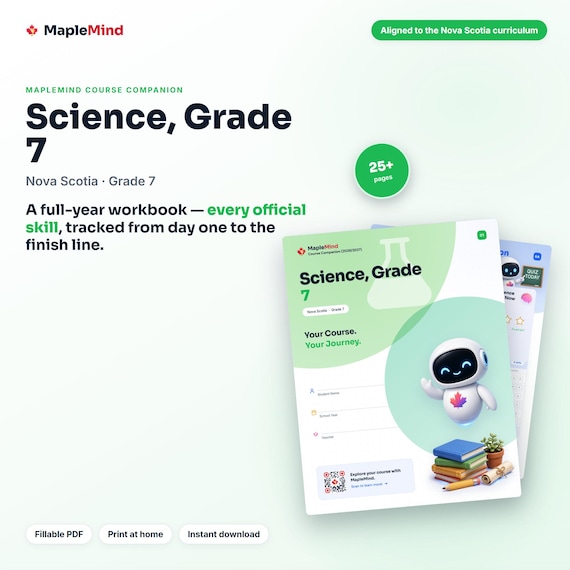
A Science, Grade 7 workbook worth keeping
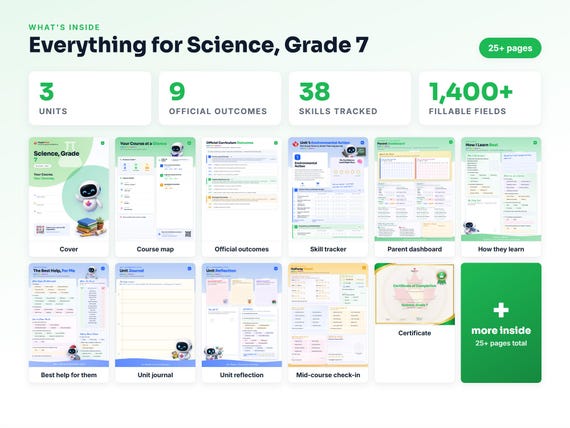
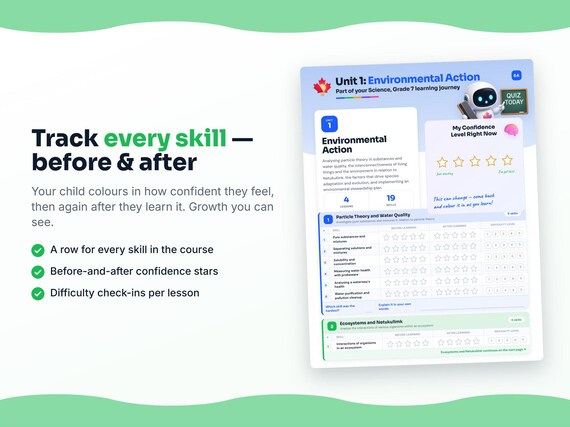
Built from the same official curriculum as this page. Before and after each skill above, your student colours in how sure they feel — so the two of you can see, on one page, what's clicking and what needs another look. It's a quiet way to follow how the year is really going.
By June it's full of their own handwriting: units worked through, confidence grown, a mid-year check-in, notes from parent-teacher night, and a certificate at the end. Less a worksheet, more a record of the year worth keeping on the shelf.
Instant download · see every page, reviews and the full description · five or more workbooks are $2.99 each
What it looks like in the app



Common questions
Can MapleMind help me with Science, Grade 7?
Yes. MapleMind's AI tutor covers all 38 skills in Nova Scotia's Science, Grade 7 — you pick the exact skill, and the tutor teaches it step by step: a short lesson, a worked example, solving together, then a skill check to show it stuck.
Is MapleMind aligned to Nova Scotia's official curriculum?
Yes. Every skill in this course maps to an official outcome code from Nova Scotia's Grade 7 Science curriculum, and the ministry's own wording is quoted under each unit on this page — with the official government source linked so you can check it yourself.
What does MapleMind cost?
It's free to start — 5 tutoring chats and a practice quiz every day, no credit card. A Pro subscription ($9.99/month or $49.99/year CAD, 7-day free trial) unlocks unlimited tutoring, practice, and exam simulations.
What if I'm stuck on just one topic?
That's the point of skill-level tutoring: open Science, Grade 7 in the app, tap the exact skill from the list on this page, and the tutor teaches just that — no wading through lessons you don't need.
Does MapleMind work in French or other languages?
Yes — 14 languages, including French. Both the app and the tutor's explanations switch to the language you choose.
Where can I see the official Nova Scotia curriculum for Science, Grade 7?
The official source is linked on this page — Nova Scotia's official curriculum. The outline here follows it: every MapleMind skill carries its official outcome code, and the ministry's own wording is quoted under each unit.
Keep exploring
Ready when you are
Pick a skill from this page and see it taught properly — free, in the browser, in under a minute.