Get help with Science, Grade 6
Most tutoring makes your child sit through material your child already knows. MapleMind flips that: pick the exact skill that's causing trouble — any of the 24 below — and the tutor teaches just that one, step by step, as many times as it takes. Ask questions in plain words, any time of day, in English, French, or 12 other languages.
The official Nova Scotia Science, Grade 6 curriculum
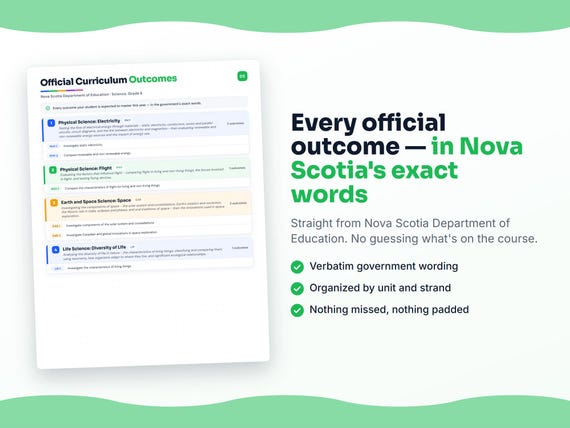
Nova Scotia defines Science, Grade 6 by strands and outcomes. MapleMind teaches the same curriculum reorganized for one-skill-at-a-time tutoring — the table shows exactly where every official strand lands, and the ministry's own wording is quoted under each unit below.
Official source Nova Scotia's official curriculumRead it on the government site — curriculum.novascotia.ca ↗| Official strand | Outcomes | Where MapleMind teaches it |
|---|---|---|
| Strand 1 | 9 | Physical Science: Electricity |
| Strand 2 | 3 | Physical Science: Flight |
| Strand 3 | 6 | Earth and Space Science: Space |
| Strand 4 | 6 | Life Science: Diversity of Life |
Every skill below, taught one on one.
 Try the first session free
How MapleMind teaches Science, Grade 6 — every unit, lesson, and skill
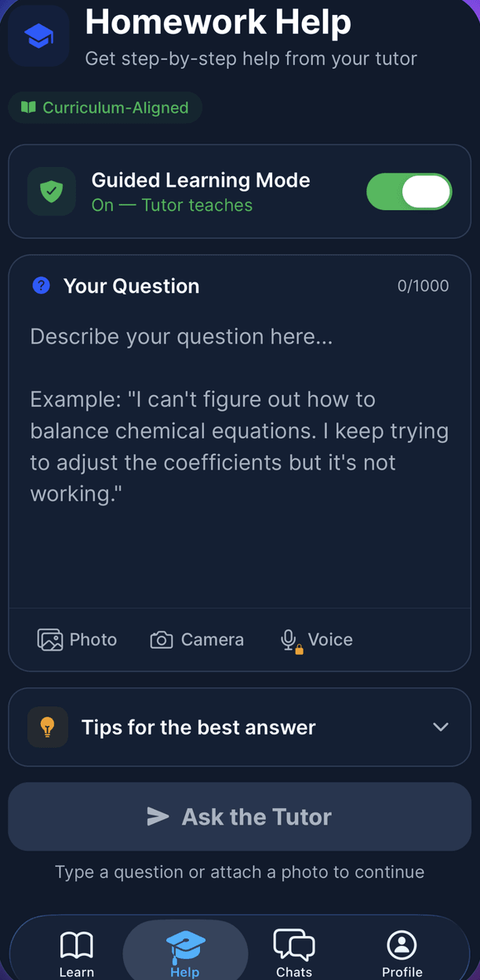
Every skill below runs as a short session: a plain-words lesson, a worked example, solving it together, then a five-question skill check that earns up to three stars. Guided Mode keeps it teaching instead of answer-handing — turning it off needs a parent's password.
Unit 1Physical Science: ElectricityOfficial strand · Strand 1
Testing the flow of electrical energy through materials - static electricity, conductors, series and parallel circuits, circuit diagrams, and the link between electricity and magnetism - then evaluating renewable and non-renewable energy sources and the impact of energy use.
Electricity and Circuits
- Static electricitysci6.1.1 — Investigate static electricity and how it builds up and discharges.
- Materials that conduct electricitysci6.1.2 — Investigate which materials conduct electricity and which do not.
- Series and parallel circuitssci6.1.3 — Test series and parallel circuits for how electric current moves.
- Reading circuit drawingssci6.1.4 — Analyse circuit drawings to judge whether a circuit will work.
- How series and parallel circuits are usedsci6.1.5 — Compare how series and parallel circuits are used in real devices.
- Electricity and magnetismsci6.1.6 — Investigate the relationship between electricity and magnetism.
Energy Sources
- Renewable and non-renewable energysci6.2.1 — Compare renewable and non-renewable sources of energy.
- Energy transformationssci6.2.2 — Investigate types of energy transformation, how energy changes from one form to another.
- Impact of electrical energy usesci6.2.3 — Analyse the impact of using electrical energy on the environment and society.
The official wording — 9 outcomes in this unit
- sci6.1.1
Investigate static electricity
- sci6.1.2
Investigate materials that conduct electricity
- sci6.1.3
Test series and parallel circuits for movement of electric current
- sci6.1.4
Analyse circuit drawings for effectiveness
- sci6.1.5
Compare how series and parallel circuits are used
- sci6.1.6
Investigate the relationship between electricity and magnetism
- sci6.2.1
Compare renewable and non-renewable energy
- sci6.2.2
Investigate types of energy transformation
- sci6.2.3
Analyse impact of electrical energy consumption
Unit 2Physical Science: FlightOfficial strand · Strand 2
Evaluating the factors that influence flight - comparing flight in living and non-living things, the forces involved in flight, and testing flying devices.
How Things Fly
- Flight in living and non-living thingssci6.3.1 — Compare the characteristics of flight in living and non-living things.
- Forces involved in flightsci6.3.2 — Investigate the forces involved in flight, like lift, gravity, thrust, and drag.
- Testing flying devicessci6.3.3 — Test flying devices to see how well they fly.
The official wording — 3 outcomes in this unit
- sci6.3.1
Compare the characteristics of flight for living and non-living things
- sci6.3.2
Investigate forces involved in flight
- sci6.3.3
Test flying devices
Unit 3Earth and Space Science: SpaceOfficial strand · Strand 3
Investigating the components of space - the solar system and constellations, Earth's rotation and revolution, the Moon's role in tides, eclipses and phases, and oral traditions of space - then the innovations used in space exploration.
Components of Space
- The solar system and constellationssci6.4.1 — Investigate the components of the solar system and constellations.
- Earth's rotation and revolutionsci6.4.2 — Investigate how Earth's rotation and revolution cause day and night and the seasons.
- The Moon: tides, eclipses, and phasessci6.4.3 — Investigate the Moon's involvement in tides, eclipses, and moon phases.
- Oral traditions of spacesci6.4.4 — Investigate oral traditions of space phenomena, including Mi'kmaw oral traditions.
Exploring Space
- Innovations in space explorationsci6.5.1 — Investigate Canadian and global innovations in space exploration.
- How astronauts meet their needssci6.5.2 — Investigate how astronauts meet their needs in space.
The official wording — 6 outcomes in this unit
- sci6.4.1
Investigate components of the solar system and constellations
- sci6.4.2
Investigate how Earth’s rotation and revolution relate to the cycle of day and night, and the seasons
- sci6.4.3
Investigate the involvement of Earth’s Moon in tides, eclipses and moon phases
- sci6.4.4
Investigate oral traditions of space phenomena, including Mi’kmaw oral traditions
- sci6.5.1
Investigate Canadian and global innovations in space exploration
- sci6.5.2
Investigate how astronauts meet their needs in space
Unit 4Life Science: Diversity of LifeOfficial strand · Strand 4
Analysing the diversity of life in nature - the characteristics of living things, classifying and comparing them, using taxonomy, how organisms adapt to where they live, and significant ecological relationships.
Classifying Living Things
- Characteristics of living thingssci6.6.1 — Investigate the characteristics that all living things share.
- Classifying living thingssci6.6.2 — Classify a set of living things into groups by shared characteristics.
- Using taxonomy to learn about lifesci6.6.3 — Investigate applications of taxonomy for learning about the diversity of life.
- Comparing animals by characteristicssci6.6.4 — Compare animals based on their characteristics.
- How organisms adapt to where they livesci6.6.5 — Analyse how organisms adapt depending on where they live.
- Significant ecological relationshipssci6.6.6 — Investigate significant ecological relationships between living things.
The official wording — 6 outcomes in this unit
- sci6.6.1
Investigate the characteristics of living things
- sci6.6.2
Classify a set of living things
- sci6.6.3
Investigate applications of taxonomy for learning about diversity of life
- sci6.6.4
Compare animals based on their characteristics
- sci6.6.5
Analyse how organisms adapt depending on where they live
- sci6.6.6
Investigate significant ecological relationships
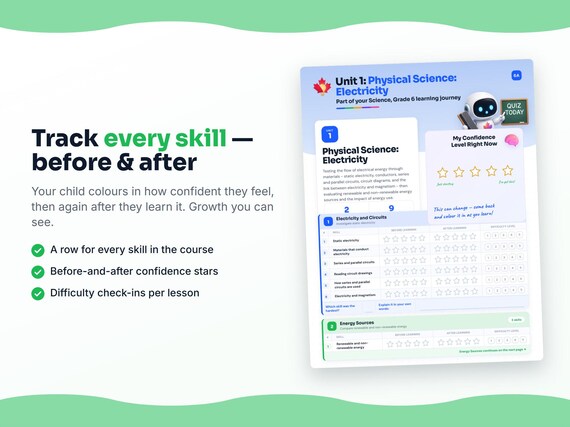
Printable workbook · A keepsake of the year
A Science, Grade 6 workbook worth keeping
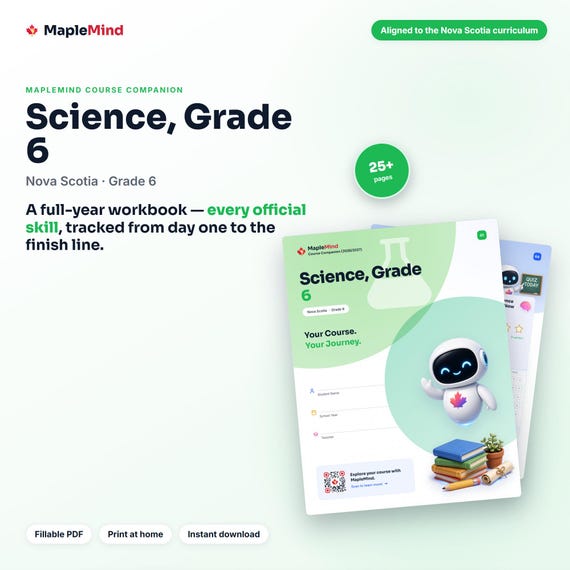
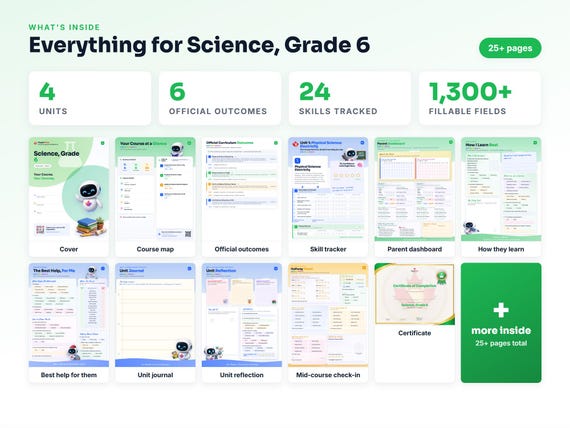
Built from the same official curriculum as this page. Before and after each skill above, your student colours in how sure they feel — so the two of you can see, on one page, what's clicking and what needs another look. It's a quiet way to follow how the year is really going.
By June it's full of their own handwriting: units worked through, confidence grown, a mid-year check-in, notes from parent-teacher night, and a certificate at the end. Less a worksheet, more a record of the year worth keeping on the shelf.
Instant download · see every page, reviews and the full description · five or more workbooks are $2.99 each
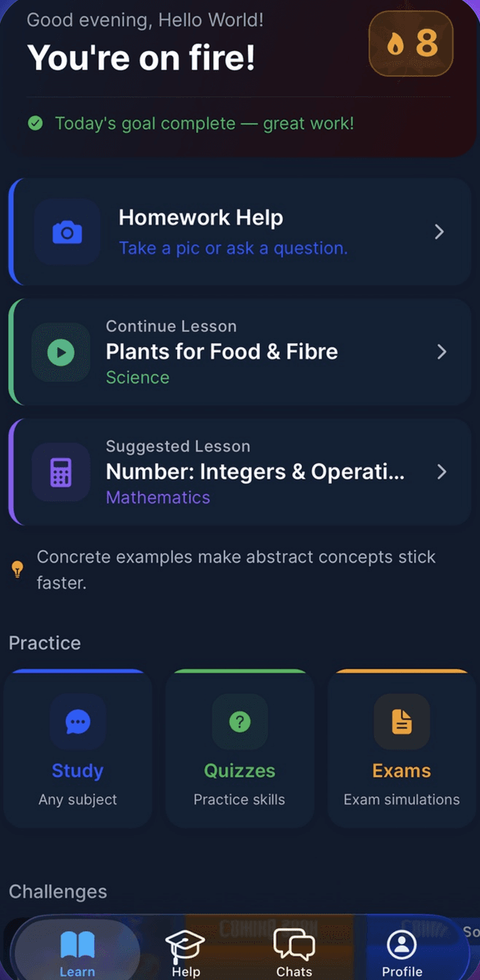
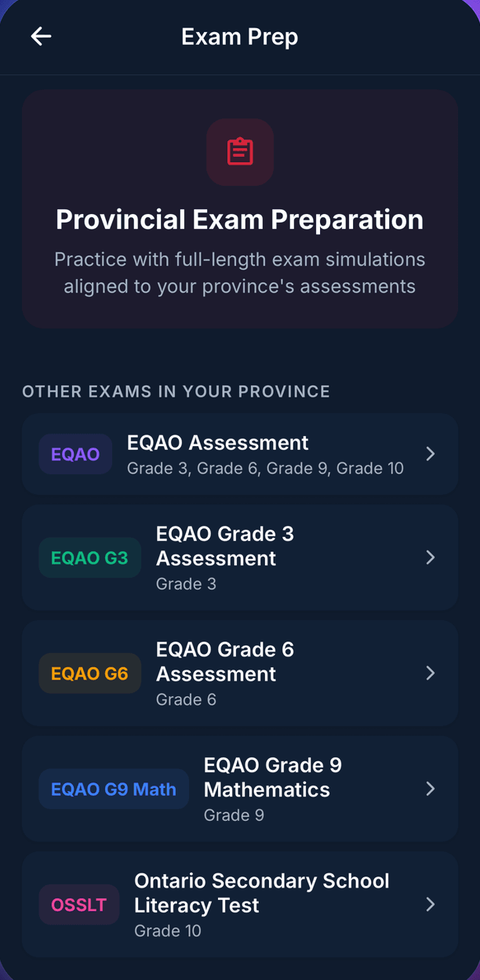
What it looks like in the app
Common questions
Can MapleMind help my child with Science, Grade 6?
Yes. MapleMind's AI tutor covers all 24 skills in Nova Scotia's Science, Grade 6 — your child picks the exact skill, and the tutor teaches it step by step: a short lesson, a worked example, solving together, then a skill check to show it stuck.
Is MapleMind aligned to Nova Scotia's official curriculum?
Yes. Every skill in this course maps to an official outcome code from Nova Scotia's Grade 6 Science curriculum, and the ministry's own wording is quoted under each unit on this page — with the official government source linked so you can check it yourself.
What does MapleMind cost?
It's free to start — 5 tutoring chats and a practice quiz every day, no credit card. A Pro subscription ($9.99/month or $49.99/year CAD, 7-day free trial) unlocks unlimited tutoring, practice, and exam simulations.
What if my child is stuck on just one topic?
That's the point of skill-level tutoring: open Science, Grade 6 in the app, tap the exact skill from the list on this page, and the tutor teaches just that — no wading through lessons your child doesn't need.
Does MapleMind work in French or other languages?
Yes — 14 languages, including French. Both the app and the tutor's explanations switch to the language your child chooses.
Where can I see the official Nova Scotia curriculum for Science, Grade 6?
The official source is linked on this page — Nova Scotia's official curriculum. The outline here follows it: every MapleMind skill carries its official outcome code, and the ministry's own wording is quoted under each unit.
Keep exploring
Ready when you are
Pick a skill from this page and see it taught properly — free, in the browser, in under a minute.