Get help with Citizenship 9
Most tutoring makes you sit through material you already know. MapleMind flips that: pick the exact skill that's causing trouble — any of the 24 below — and the tutor teaches just that one, step by step, as many times as it takes. Ask questions in plain words, any time of day, in English, French, or 12 other languages.
The official Nova Scotia Citizenship 9 curriculum
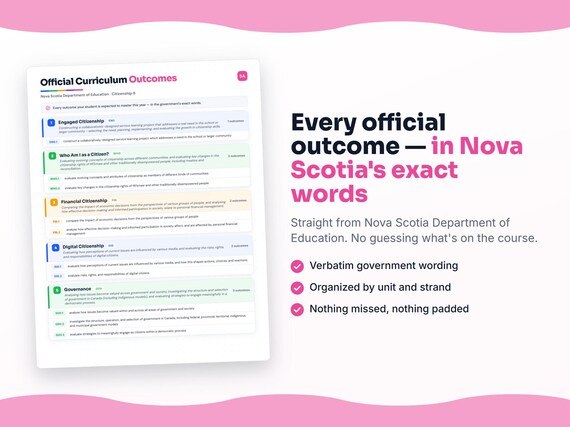
Nova Scotia defines Citizenship 9 by strands and outcomes. MapleMind teaches the same curriculum reorganized for one-skill-at-a-time tutoring — the table shows exactly where every official strand lands, and the ministry's own wording is quoted under each unit below.
Official source Nova Scotia's official curriculumRead it on the government site — curriculum.novascotia.ca ↗| Official strand | Outcomes | Where MapleMind teaches it |
|---|---|---|
| Strand EC | 1 | Engaged Citizenship |
| Strand WA | 2 | Who Am I as a Citizen? |
| Strand FC | 2 | Financial Citizenship |
| Strand DC | 2 | Digital Citizenship |
| Strand GV | 3 | Governance |
| Strand GC | 1 | Global Citizenship |
Every skill below, taught one on one.
 Try the first session free
How MapleMind teaches Citizenship 9 — every unit, lesson, and skill
Every skill below runs as a short session: a plain-words lesson, a worked example, solving it together, then a five-question skill check that earns up to three stars. Guided Mode keeps it teaching instead of answer-handing — turning it off needs a parent's password.
Unit 1Engaged CitizenshipOfficial strand · Strand EC
Constructing a collaboratively-designed service learning project that addresses a real need in the school or larger community - selecting the need, planning, implementing, and evaluating the growth in citizenship skills.
A Service Learning Project
- Selecting a need and planning the projectNS-CIT9-EC.1 — Evaluate the merit of a collaboratively-selected community need, weigh personal skills and interests, and plan a service learning project to achieve the goal.
- Implementing and evaluating the projectNS-CIT9-EC.1 — Implement the service learning plan and evaluate how the project developed your citizenship skills.
The official wording — 1 outcome in this unit
- NS-CIT9-EC.1
construct a collaboratively-designed service learning project which addresses a need in the school or larger community
Unit 2Who Am I as a Citizen?Official strand · Strand WA
Evaluating evolving concepts of citizenship across different communities, and evaluating key changes in the citizenship rights of Mi'kmaw and other traditionally disempowered people, including treaties and reconciliation.
Evolving Concepts of Citizenship
- Rights, responsibilities, and worldviewNS-CIT9-WA.1 — Compare the rights and responsibilities of current and future citizens, and investigate how worldview shapes the understanding of citizenship.
- Personal strengths and a changing roleNS-CIT9-WA.1 — Evaluate your personal strengths and how they contribute to communities, and predict how a citizen's role may change over time.
Changing Citizenship Rights: Mi'kmaw and Disempowered Peoples
- How rights changed and the role of treatiesNS-CIT9-WA.2 — Investigate how and why citizenship rights have changed for Mi'kmaw and other disempowered peoples in Canada, and evaluate the importance of the Peace and Friendship Treaties as integral to citizenship rights and responsibilities.
- The role of all citizens in reconciliationNS-CIT9-WA.2 — Analyse the role that all citizens play in reconciliation with Mi'kmaw and Indigenous peoples.
The official wording — 2 outcomes in this unit
- NS-CIT9-WA.1
evaluate evolving concepts and attributes of citizenship as members of different kinds of communities
- NS-CIT9-WA.2
evaluate key changes in the citizenship rights of Mi’kmaw and other traditionally disempowered people
Unit 3Financial CitizenshipOfficial strand · Strand FC
Comparing the impact of economic decisions from the perspectives of various groups of people, and analysing how effective decision-making and informed participation in society relate to personal financial management.
Economic Decisions from Different Perspectives
- Culture, money, and taxationNS-CIT9-FC.1 — Investigate different cultural ideas surrounding needs, wants, money, and value, and the purpose, value, and types of taxation.
- Economic disparity and equalityNS-CIT9-FC.1 — Investigate economic disparity between groups, the relationship between government priorities and economic equality for Indigenous peoples, and compare economic fairness with economic equality.
Informed Participation and Personal Finance
- Financial goals and informed choicesNS-CIT9-FC.2 — Investigate personal financial management practices, including short- and long-term goal setting, and the impact of informed financial choices on personal goals.
- Impact on others and financial capabilityNS-CIT9-FC.2 — Investigate the direct and indirect impacts of financial choices on others, and analyse the internal and external factors that affect personal financial capability.
The official wording — 2 outcomes in this unit
- NS-CIT9-FC.1
compare the impact of economic decisions from the perspectives of various groups of people
- NS-CIT9-FC.2
analyse how effective decision-making and informed participation in society affect, and are affected by, personal financial management
Unit 4Digital CitizenshipOfficial strand · Strand DC
Evaluating how perceptions of current issues are influenced by various media, and evaluating the risks, rights, and responsibilities of digital citizens.
How Media Shapes Perceptions
- Representation and omission in mediaNS-CIT9-DC.1 — Evaluate how various groups are represented or omitted in media and the influence this has on people's perspectives.
- How media shapes issue awareness and choicesNS-CIT9-DC.1 — Analyse how social and mass media impact awareness of issues, and how citizens' and governments' choices can be affected by different media.
Risks, Rights, and Responsibilities Online
- Opportunities, risks, and your digital footprintNS-CIT9-DC.2 — Evaluate the opportunities and risks of being digitally connected, and investigate how a digital footprint influences others' perceptions.
- The role of anonymity onlineNS-CIT9-DC.2 — Investigate the role of anonymity in both the production and consumption of media.
The official wording — 2 outcomes in this unit
- NS-CIT9-DC.1
evaluate how perceptions of current issues are influenced by various media, and how this shapes actions, choices, and reactions
- NS-CIT9-DC.2
evaluate risks, rights, and responsibilities of digital citizens
Unit 5GovernanceOfficial strand · Strand GV
Analysing how issues become valued across government and society, investigating the structure and selection of government in Canada (including Indigenous models), and evaluating strategies to engage meaningfully in a democratic process.
How Issues Become Valued
- Worldview and Canadian valuesNS-CIT9-GV.1 — Analyse the role worldview plays in personal and societal values and decision-making, and investigate perceived Canadian values and identity.
- Party platforms and why issues matterNS-CIT9-GV.1 — Analyse the values of various political parties by examining their platforms, and reflect on why a personally-chosen issue could be valued by society.
The Structure and Selection of Government
- How governments in Canada are formedNS-CIT9-GV.2 — Investigate how various types of government in Canada - federal, provincial, territorial, and municipal - are formed.
- Indigenous and non-Indigenous governanceNS-CIT9-GV.2 — Investigate interactions and decision-making in Indigenous and non-Indigenous governance models in Canada.
Engaging in a Democratic Process
- Working within and outside governmentNS-CIT9-GV.3 — Evaluate ways to work within and outside government structures to affect change, and investigate ways citizens can advocate for change, awareness, or action.
- Protest and unequal access to democracyNS-CIT9-GV.3 — Investigate the impact of resistance and protest as political and social actions, and analyse how unequal access to democracy makes some groups' voices more powerful than others.
The official wording — 3 outcomes in this unit
- NS-CIT9-GV.1
analyse how issues become valued within and across all areas of government and society
- NS-CIT9-GV.2
investigate the structure, operation, and selection of government in Canada, including federal, provincial, territorial, indigenous, and municipal government models
- NS-CIT9-GV.3
evaluate strategies to meaningfully engage as citizens within a democratic process
Unit 6Global CitizenshipOfficial strand · Strand GC
Evaluating the consequences of action and inaction as twenty-first century global citizens - examining global issues from differing perspectives, weighing consequences, connecting human rights and globalization, and evaluating Canada's response.
Global Issues and Their Consequences
- A global issue from differing perspectivesNS-CIT9-GC.1 — Investigate a global issue from differing perspectives.
- Consequences of action and inactionNS-CIT9-GC.1 — Evaluate the intended and unintended consequences of an action or inaction in regard to a global issue.
Human Rights, Globalization, and Canada's Response
- Human rights and globalizationNS-CIT9-GC.1 — Analyse the relationship between universal human rights and globalization.
- Evaluating Canada's response to a global issueNS-CIT9-GC.1 — Evaluate Canada's response to a selected global issue.
The official wording — 1 outcome in this unit
- NS-CIT9-GC.1
evaluate the consequences of action and inaction as twenty-first century global citizens
Printable workbook · A keepsake of the year
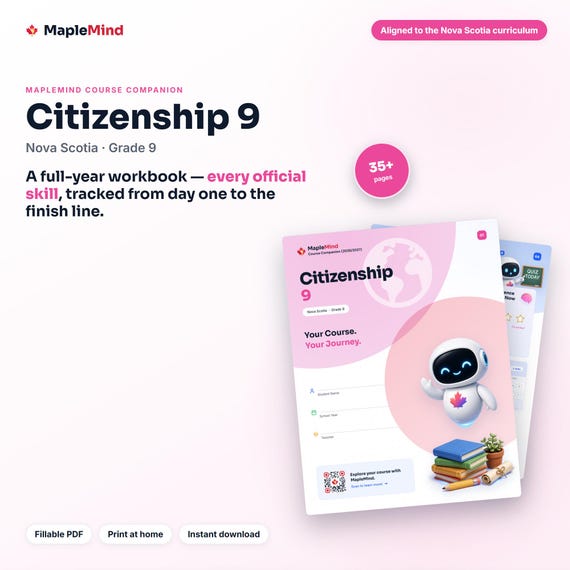
A Citizenship 9 workbook worth keeping
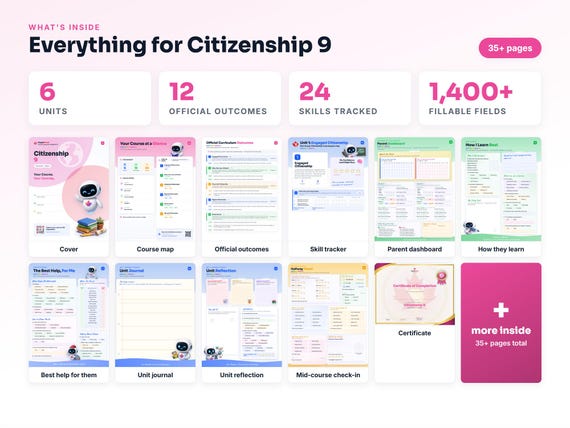
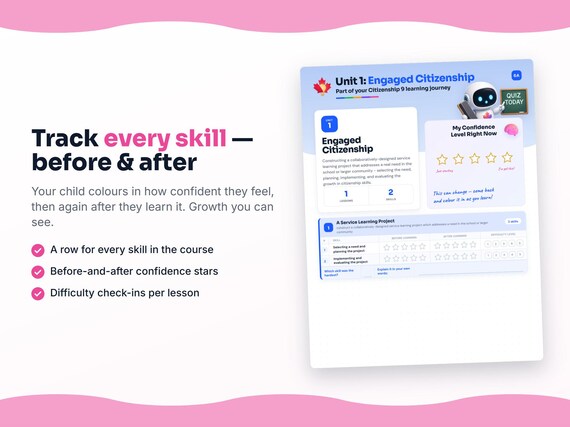
Built from the same official curriculum as this page. Before and after each skill above, your student colours in how sure they feel — so the two of you can see, on one page, what's clicking and what needs another look. It's a quiet way to follow how the year is really going.
By June it's full of their own handwriting: units worked through, confidence grown, a mid-year check-in, notes from parent-teacher night, and a certificate at the end. Less a worksheet, more a record of the year worth keeping on the shelf.
Instant download · see every page, reviews and the full description · five or more workbooks are $2.99 each
What it looks like in the app



Common questions
Can MapleMind help me with Citizenship 9?
Yes. MapleMind's AI tutor covers all 24 skills in Nova Scotia's Citizenship 9 — you pick the exact skill, and the tutor teaches it step by step: a short lesson, a worked example, solving together, then a skill check to show it stuck.
Is MapleMind aligned to Nova Scotia's official curriculum?
Yes. Every skill in this course maps to an official outcome code from Nova Scotia's Grade 9 Social Studies curriculum, and the ministry's own wording is quoted under each unit on this page — with the official government source linked so you can check it yourself.
What does MapleMind cost?
It's free to start — 5 tutoring chats and a practice quiz every day, no credit card. A Pro subscription ($9.99/month or $49.99/year CAD, 7-day free trial) unlocks unlimited tutoring, practice, and exam simulations.
What if I'm stuck on just one topic?
That's the point of skill-level tutoring: open Citizenship 9 in the app, tap the exact skill from the list on this page, and the tutor teaches just that — no wading through lessons you don't need.
Does MapleMind work in French or other languages?
Yes — 14 languages, including French. Both the app and the tutor's explanations switch to the language you choose.
Where can I see the official Nova Scotia curriculum for Citizenship 9?
The official source is linked on this page — Nova Scotia's official curriculum. The outline here follows it: every MapleMind skill carries its official outcome code, and the ministry's own wording is quoted under each unit.
Keep exploring
Ready when you are
Pick a skill from this page and see it taught properly — free, in the browser, in under a minute.