Get help with Core French 8
Most tutoring makes you sit through material you already know. MapleMind flips that: pick the exact skill that's causing trouble — any of the 19 below — and the tutor teaches just that one, step by step, as many times as it takes. Ask questions in plain words, any time of day, in English, French, or 12 other languages.
The official British Columbia Core French 8 curriculum
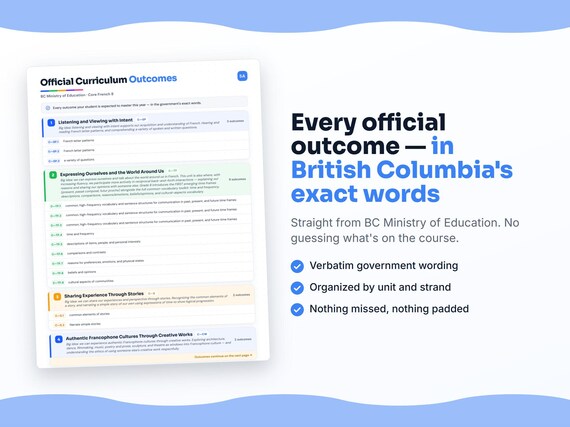
British Columbia defines Core French 8 by strands and outcomes. MapleMind teaches the same curriculum reorganized for one-skill-at-a-time tutoring — the table shows exactly where every official strand lands, and the ministry's own wording is quoted under each unit below.
Official source BC's official curriculumRead it on the government site — curriculum.gov.bc.ca ↗| Official strand | Outcomes | Where MapleMind teaches it |
|---|---|---|
| Content — Sound-spelling patterns | 3 | Listening and Viewing with Intent |
| Content — Time frames (past, present, future) and Communicative functions | 9 | Expressing Ourselves and the World Around Us |
| Content — Stories | 2 | Sharing Experience Through Stories |
| Content — Creative works and Ethics of expression | 2 | Authentic Francophone Cultures Through Creative Works |
| Content — Francophone world and Indigenous connections | 3 | Culture, Languages, and Communities |
Every skill below, taught one on one.
 Try the first session free
How MapleMind teaches Core French 8 — every unit, lesson, and skill
Every skill below runs as a short session: a plain-words lesson, a worked example, solving it together, then a five-question skill check that earns up to three stars. Guided Mode keeps it teaching instead of answer-handing — turning it off needs a parent's password.
Unit 1Listening and Viewing with IntentOfficial strand · Content — Sound-spelling patterns
Big Idea: listening and viewing with intent supports our acquisition and understanding of French. Hearing and reading French letter patterns, and comprehending a variety of spoken and written questions.
Same-Sound Groupings and Rhymes
- Same-sound letter groupings and rhyming words8.LP.1 — Recognize French letter groupings that make the same sound (like "au", "aux", "eau", "ô", "os") and identify rhyming words that share that sound.
Consistent Pronunciation Patterns, Liaisons, and Élisions
- Letter patterns with consistent pronunciations, liaisons, and élisions8.LP.2 — Recognize French letter patterns that always sound the same way (like "ai", "gn", "-ille", "-ment", "oi", "th", "-tion", "ui"), and use les liaisons (linking a silent final consonant to the next word's vowel) and les élisions (dropping a vowel before another vowel) when reading and listening.
Understanding a Variety of Questions
- Asking and understanding a variety of questions8.VS.1 — Ask and comprehend a variety of question types — Combien, Comment, Est-ce que, Où, Pourquoi, Quand, Quel, Qu'est-ce que, and Qui — to get and give specific information.
The official wording — 3 outcomes in this unit
- 8.LP.1
French letter patterns
- 8.LP.2
French letter patterns
- 8.VS.1
a variety of questions
Unit 2Expressing Ourselves and the World Around UsOfficial strand · Content — Time frames (past, present, future) and Communicative functions
Big Idea: we can express ourselves and talk about the world around us in French. This unit is also where, with increasing fluency, we participate more actively in reciprocal back-and-forth interactions — explaining our reasons and sharing our opinions with someone else. Grade 8 introduces the FIRST emerging time frames (present, passé composé, futur proche) alongside the full common-vocabulary toolkit: time and frequency, descriptions, comparisons, reasons/emotions, beliefs/opinions, and cultural-aspects vocabulary.
Talking About Now: The Present Tense System
- The present-tense system8.TF.1 — Use the present tense as a system to talk about what is happening now, recognizing that a sentence's wording must change to match its time frame (for example, "Elles ne sont pas à l'école aujourd'hui").
Talking About the Past: Passé Composé (Emerging)
- Passé composé (emerging): talking about the past8.TF.2 — Recognize and begin to use the passé composé to talk about something that already happened, changing the sentence's wording to show the shift into the past (for example, "J'ai étudié pour mon test hier soir").
Talking About the Future: Futur Proche (Emerging)
- Futur proche (emerging): talking about the future8.TF.3 — Recognize and begin to use the futur proche (aller + infinitive) to talk about what is going to happen, changing the sentence's wording to show the shift into the future (for example, "Nous allons regarder un film demain").
Expressing Time and Frequency
- Expressing time and frequency8.VS.2 — Use common time and frequency words — aujourd'hui, hier, demain, chaque jour, toujours, parfois, jamais — to say when and how often something happens.
Describing Items, People, and Personal Interests
- Describing items, people, and personal interests8.VS.3 — Describe items, people, and personal interests using common vocabulary and sentence structures — physical traits, personality, and hobbies you enjoy.
Making Comparisons and Contrasts
- Making comparisons and contrasts8.VS.4 — Make comparisons and contrasts using expressions like aussi, mais, plus que, aussi que, and moins que (for example, "Sarah est plus jeune que Nicole").
Giving Reasons for Preferences, Emotions, and Physical States
- Giving reasons for preferences, emotions, and physical states8.VS.5 — Give reasons for preferences, emotions, and physical states using frames like "Je préfère…parce que…" and "J'ai peur parce que…".
Expressing Beliefs and Opinions
- Expressing beliefs and opinions8.VS.6 — Express beliefs and opinions using frames like "À mon avis…", "Je pense que…", and "Selon moi…".
Vocabulary for Cultural Aspects of Communities
- Vocabulary for cultural aspects of communities8.VS.7 — Use vocabulary for cultural aspects of communities — celebrations, food, festivals, and traditions — in simple French sentences.
The official wording — 9 outcomes in this unit
- 8.TF.1
common, high-frequency vocabulary and sentence structures for communication in past, present, and future time frames
- 8.TF.2
common, high-frequency vocabulary and sentence structures for communication in past, present, and future time frames
- 8.TF.3
common, high-frequency vocabulary and sentence structures for communication in past, present, and future time frames
- 8.VS.2
time and frequency
- 8.VS.3
descriptions of items, people, and personal interests
- 8.VS.4
comparisons and contrasts
- 8.VS.5
reasons for preferences, emotions, and physical states
- 8.VS.6
beliefs and opinions
- 8.VS.7
cultural aspects of communities
Unit 3Sharing Experience Through StoriesOfficial strand · Content — Stories
Big Idea: we can share our experiences and perspective through stories. Recognizing the common elements of a story, and narrating a simple story of our own using expressions of time to show logical progression.
The Building Blocks of a Story
- Common elements of stories8.ST.1 — Identify the common elements of a story — place, characters, setting, and plot — in a French story.
Narrating a Simple Story
- Narrating a simple story using expressions of time8.NA.1 — Narrate a simple story using common expressions of time (like d'abord, ensuite, puis, enfin) to show its logical progression from beginning to end.
The official wording — 2 outcomes in this unit
- 8.ST.1
common elements of stories
- 8.NA.1
Narrate simple stories
Unit 4Authentic Francophone Cultures Through Creative WorksOfficial strand · Content — Creative works and Ethics of expression
Big Idea: we can experience authentic Francophone cultures through creative works. Exploring architecture, dance, filmmaking, music, poetry and prose, sculpture, and theatre as windows into Francophone culture — and understanding the ethics of using someone else's creative work respectfully.
Francophone Cultures Through Creative Works
- Exploring Francophone cultures through creative works8.CR.1 — Explore ways Francophone cultures are expressed through creative works — architecture, dance, filmmaking, music, poetry and prose, sculpture, and theatre.
The Ethics of Cultural Appropriation and Plagiarism
- Ethics of cultural appropriation and plagiarism8.ET.1 — Understand the ethics of cultural appropriation and plagiarism when exploring or using a creative work from a Francophone culture — using or sharing a cultural motif, story, or image respectfully and with proper context.
The official wording — 2 outcomes in this unit
- 8.CR.1
Explore ways in which Francophone cultures are expressed through creative works
- 8.ET.1
ethics of cultural appropriation and plagiarism
Unit 5Culture, Languages, and CommunitiesOfficial strand · Content — Francophone world and Indigenous connections
Big Idea: our understanding of culture is influenced by the languages we speak and the communities with which we engage. Discovering Francophone communities around the world, their cultural aspects, and the connections between indigenous communities and the French language.
Francophone Communities Around the World
- Francophone communities around the world8.CW.1 — Identify Francophone communities around the world — such as Belgium, France, Haiti, Morocco, Senegal, Switzerland, and Vietnam.
Cultural Aspects of Francophone Communities
- Cultural aspects of Francophone communities8.CA.1 — Describe cultural aspects of Francophone communities — activities, celebrations, dance, festivals, food, music, and traditions.
Indigenous Communities and the French Language
- Connections between indigenous communities and the French language8.IN.1 — Explore and share information about connections between indigenous communities and the French language — naming French-speaking First Nations, Métis, and Inuit communities, and understanding how Innu writers have used French through prose and poetry to speak to the effects of colonization on their families and communities.
The official wording — 3 outcomes in this unit
- 8.CW.1
Francophone communities around the world
- 8.CA.1
cultural aspects of Francophone communities
- 8.IN.1
Explore and share information about connections between indigenous communities and the French language
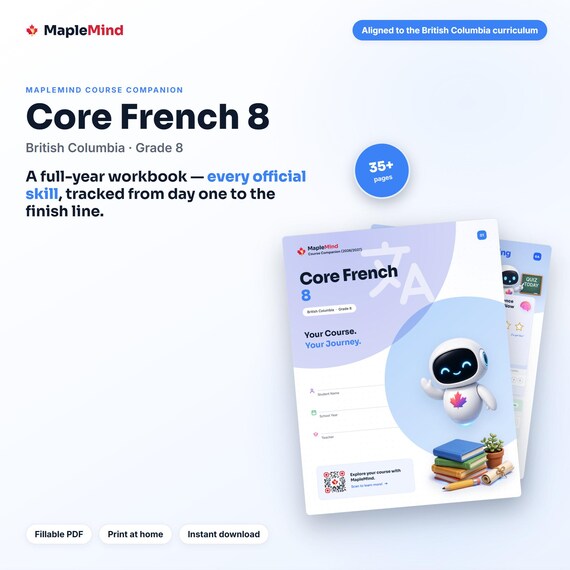
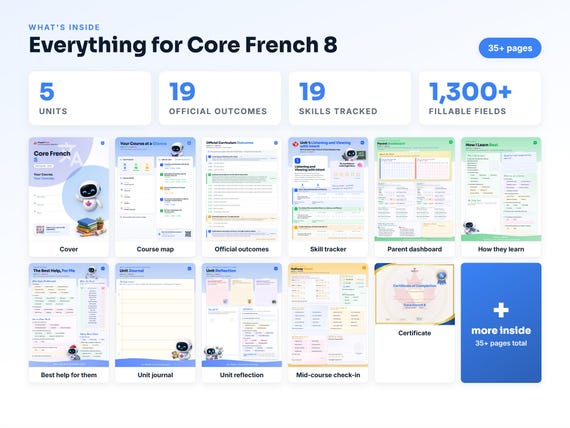
Printable workbook · A keepsake of the year
A Core French 8 workbook worth keeping
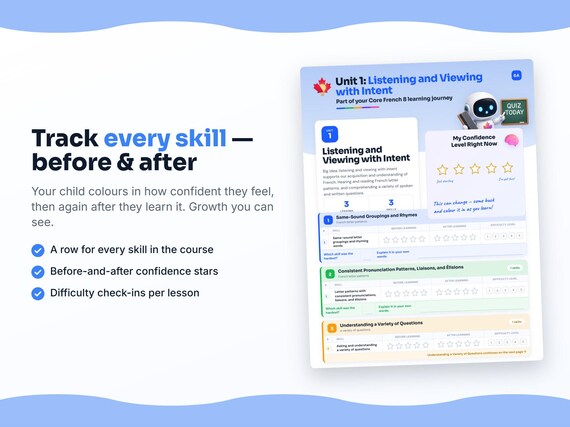
Built from the same official curriculum as this page. Before and after each skill above, your student colours in how sure they feel — so the two of you can see, on one page, what's clicking and what needs another look. It's a quiet way to follow how the year is really going.
By June it's full of their own handwriting: units worked through, confidence grown, a mid-year check-in, notes from parent-teacher night, and a certificate at the end. Less a worksheet, more a record of the year worth keeping on the shelf.
Instant download · see every page, reviews and the full description · five or more workbooks are $2.99 each
What it looks like in the app



Common questions
Can MapleMind help me with Core French 8?
Yes. MapleMind's AI tutor covers all 19 skills in British Columbia's Core French 8 — you pick the exact skill, and the tutor teaches it step by step: a short lesson, a worked example, solving together, then a skill check to show it stuck.
Is MapleMind aligned to British Columbia's official curriculum?
Yes. Every skill in this course maps to an official outcome code from British Columbia's Grade 8 French curriculum, and the ministry's own wording is quoted under each unit on this page — with the official government source linked so you can check it yourself.
What does MapleMind cost?
It's free to start — 5 tutoring chats and a practice quiz every day, no credit card. A Pro subscription ($9.99/month or $49.99/year CAD, 7-day free trial) unlocks unlimited tutoring, practice, and exam simulations.
What if I'm stuck on just one topic?
That's the point of skill-level tutoring: open Core French 8 in the app, tap the exact skill from the list on this page, and the tutor teaches just that — no wading through lessons you don't need.
Does MapleMind work in French or other languages?
Yes — 14 languages, including French. Both the app and the tutor's explanations switch to the language you choose.
Where can I see the official British Columbia curriculum for Core French 8?
The official source is linked on this page — BC's official curriculum. The outline here follows it: every MapleMind skill carries its official outcome code, and the ministry's own wording is quoted under each unit.
Keep exploring
Ready when you are
Pick a skill from this page and see it taught properly — free, in the browser, in under a minute.