Get help with Core French 7
Most tutoring makes you sit through material you already know. MapleMind flips that: pick the exact skill that's causing trouble — any of the 17 below — and the tutor teaches just that one, step by step, as many times as it takes. Ask questions in plain words, any time of day, in English, French, or 12 other languages.
The official British Columbia Core French 7 curriculum
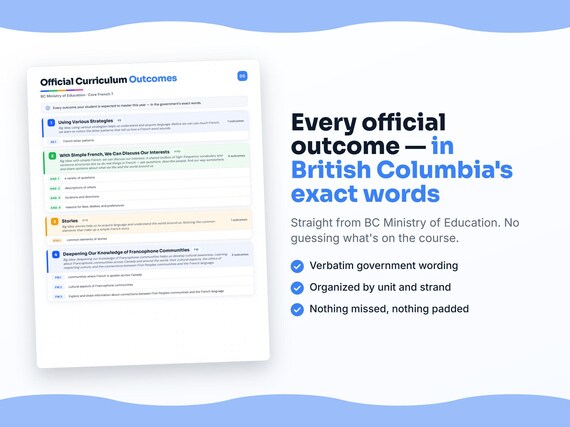
British Columbia defines Core French 7 by strands and outcomes. MapleMind teaches the same curriculum reorganized for one-skill-at-a-time tutoring — the table shows exactly where every official strand lands, and the ministry's own wording is quoted under each unit below.
Official source BC's official curriculumRead it on the government site — curriculum.gov.bc.ca ↗| Official strand | Outcomes | Where MapleMind teaches it |
|---|---|---|
| Sound and spelling | 2 | Using Various Strategies |
| Asking and answering questions · Describing people · Locations and directions · Opinions and preferences | 9 | With Simple French, We Can Discuss Our Interests |
| Stories | 1 | Stories |
| The Francophone world | 5 | Deepening Our Knowledge of Francophone Communities |
Every skill below, taught one on one.
 Try the first session free
How MapleMind teaches Core French 7 — every unit, lesson, and skill
Every skill below runs as a short session: a plain-words lesson, a worked example, solving it together, then a five-question skill check that earns up to three stars. Guided Mode keeps it teaching instead of answer-handing — turning it off needs a parent's password.
Unit 1Using Various StrategiesOfficial strand · Sound and spelling
Big Idea: using various strategies helps us understand and acquire language. Before we can use much French, we learn to notice the letter patterns that tell us how a French word sounds.
Sound and Spelling
- Letter groupings that make the same sound7.PHON.1 — Recognize French letter patterns — groupings of letters that make the same sound, such as au, aux, eau, ô, and os.
- Letter patterns with consistent pronunciation and rhyming7.PHON.2 — Recognize French letter patterns that have consistent pronunciations and that rhyme, such as ai, -ille, -ment, and -tion.
The official wording — 2 outcomes in this unit
- 7.PHON.1
French letter patterns
- 7.PHON.2
French letter patterns
Unit 2With Simple French, We Can Discuss Our InterestsOfficial strand · Asking and answering questions · Describing people · Locations and directions · Opinions and preferences
Big Idea: with simple French, we can discuss our interests. A shared toolbox of high-frequency vocabulary and sentence structures lets us do real things in French — ask questions, describe people, find our way somewhere, and share opinions about what we like and the world around us.
Asking and Answering Questions
- Asking information questions with question words7.QUES.1 — Ask information questions using question words — Où, Quand, Comment, Pourquoi, Combien, Qui, Quel — and understand the kind of answer each one expects.
- Asking yes/no and Est-ce que questions7.QUES.2 — Ask yes/no questions in French and form questions using Est-ce que, and answer them with a simple oui or non response.
Describing People
- Describing what other people look like7.DESC.1 — Describe what other people look like — their physical appearance — using common describing words and simple sentence patterns.
- Describing what other people are like and do7.DESC.2 — Describe what other people are like and what they do — personality traits and activities — using common describing words and simple sentence patterns.
Locations and Directions
- Saying where things are with prepositions of place7.LOC.1 — Say where things are using prepositions of place — such as à gauche, au parc, and sur la table.
- Giving simple directions to get somewhere7.LOC.2 — Give simple directions in French to help someone get from one place to another.
Opinions and Preferences
- Giving reasons for likes, dislikes, and preferences7.PREF.1 — Give reasons for likes, dislikes, and preferences using parce que, explaining why something is liked, disliked, or preferred.
- Making simple comparisons7.COMP.1 — Make simple comparisons between two things, such as J'aime les pommes, mais je préfère les bananes.
- Talking about cultural aspects of communities7.CULTVOC.1 — Talk in French about cultural aspects of communities, using vocabulary for everyday cultural life.
The official wording — 9 outcomes in this unit
- 7.QUES.1
a variety of questions
- 7.QUES.2
a variety of questions
- 7.DESC.1
descriptions of others
- 7.DESC.2
descriptions of others
- 7.LOC.1
locations and directions
- 7.LOC.2
locations and directions
- 7.PREF.1
reasons for likes, dislikes, and preferences
- 7.COMP.1
simple comparisons
- 7.CULTVOC.1
cultural aspects of communities
Unit 3StoriesOfficial strand · Stories
Big Idea: stories help us to acquire language and understand the world around us. Noticing the common elements that make up a simple French story.
Common Elements of Stories
- Finding the common elements of a story7.STORY.1 — Identify the common elements of a story — place, characters, setting, and plot — in a simple French story, spoken or written.
The official wording — 1 outcome in this unit
- 7.STORY.1
common elements of stories
Unit 4Deepening Our Knowledge of Francophone CommunitiesOfficial strand · The Francophone world
Big Idea: deepening our knowledge of Francophone communities helps us develop cultural awareness. Learning about Francophone communities across Canada and around the world, their cultural aspects, the ethics of respecting culture, and the connections between First Peoples communities and the French language.
Francophone Communities Across Canada and Around the World
- Communities where French is spoken across Canada7.CANFR.1 — Learn about communities where French is spoken across Canada.
- Communities where French is spoken around the world7.WORLDFR.1 — Learn about communities where French is spoken around the world.
Culture and Ethics in Francophone Communities
- Cultural aspects of Francophone communities7.CULT.1 — Learn about cultural aspects of Francophone communities — festivals, food, music, and traditions.
- Respecting cultural ownership and not copying others' work7.ETHICS.1 — Understand the ethics of cultural appropriation and plagiarism — respecting cultural ownership and not copying others' work.
First Peoples and French
- Connections between First Peoples communities and the French language7.FPFR.1 — Explore and share information about connections between First Peoples communities and the French language, including named nations and Métis communities.
The official wording — 5 outcomes in this unit
- 7.CANFR.1
communities where French is spoken across Canada
- 7.WORLDFR.1
communities where French is spoken around the world
- 7.CULT.1
cultural aspects of Francophone communities
- 7.ETHICS.1
ethics of cultural appropriation and plagiarism
- 7.FPFR.1
Explore and share information about connections between First Peoples communities and the French language
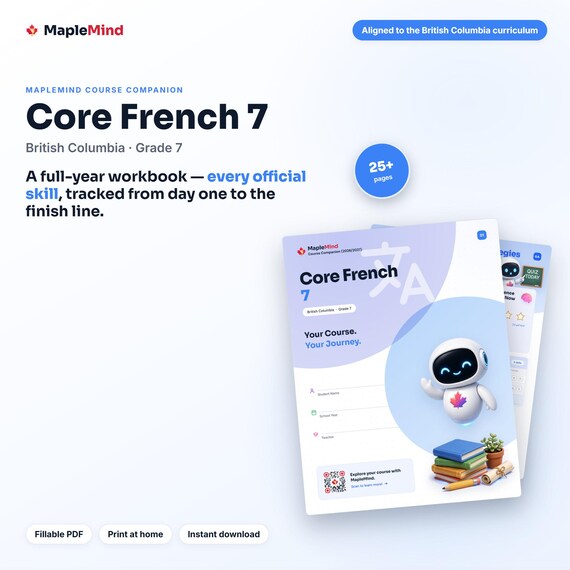
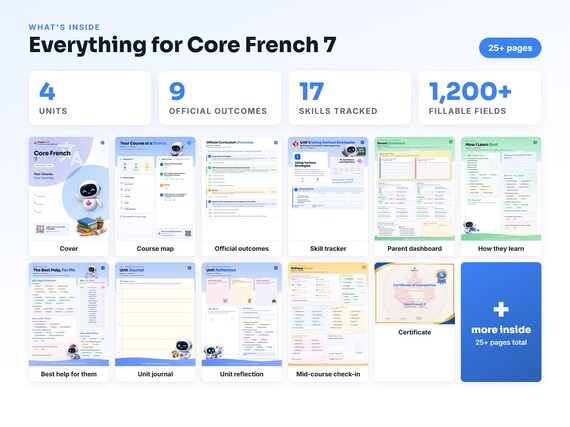
Printable workbook · A keepsake of the year
A Core French 7 workbook worth keeping
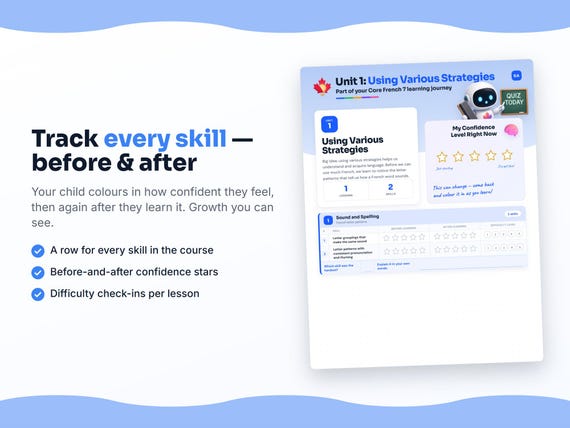
Built from the same official curriculum as this page. Before and after each skill above, your student colours in how sure they feel — so the two of you can see, on one page, what's clicking and what needs another look. It's a quiet way to follow how the year is really going.
By June it's full of their own handwriting: units worked through, confidence grown, a mid-year check-in, notes from parent-teacher night, and a certificate at the end. Less a worksheet, more a record of the year worth keeping on the shelf.
Instant download · see every page, reviews and the full description · five or more workbooks are $2.99 each
What it looks like in the app



Common questions
Can MapleMind help me with Core French 7?
Yes. MapleMind's AI tutor covers all 17 skills in British Columbia's Core French 7 — you pick the exact skill, and the tutor teaches it step by step: a short lesson, a worked example, solving together, then a skill check to show it stuck.
Is MapleMind aligned to British Columbia's official curriculum?
Yes. Every skill in this course maps to an official outcome code from British Columbia's Grade 7 French curriculum, and the ministry's own wording is quoted under each unit on this page — with the official government source linked so you can check it yourself.
What does MapleMind cost?
It's free to start — 5 tutoring chats and a practice quiz every day, no credit card. A Pro subscription ($9.99/month or $49.99/year CAD, 7-day free trial) unlocks unlimited tutoring, practice, and exam simulations.
What if I'm stuck on just one topic?
That's the point of skill-level tutoring: open Core French 7 in the app, tap the exact skill from the list on this page, and the tutor teaches just that — no wading through lessons you don't need.
Does MapleMind work in French or other languages?
Yes — 14 languages, including French. Both the app and the tutor's explanations switch to the language you choose.
Where can I see the official British Columbia curriculum for Core French 7?
The official source is linked on this page — BC's official curriculum. The outline here follows it: every MapleMind skill carries its official outcome code, and the ministry's own wording is quoted under each unit.
Keep exploring
Ready when you are
Pick a skill from this page and see it taught properly — free, in the browser, in under a minute.