Get help with English Language Arts 9
Most tutoring makes you sit through material you already know. MapleMind flips that: pick the exact skill that's causing trouble — any of the 82 below — and the tutor teaches just that one, step by step, as many times as it takes. Ask questions in plain words, any time of day, in English, French, or 12 other languages.
The official British Columbia English Language Arts 9 curriculum
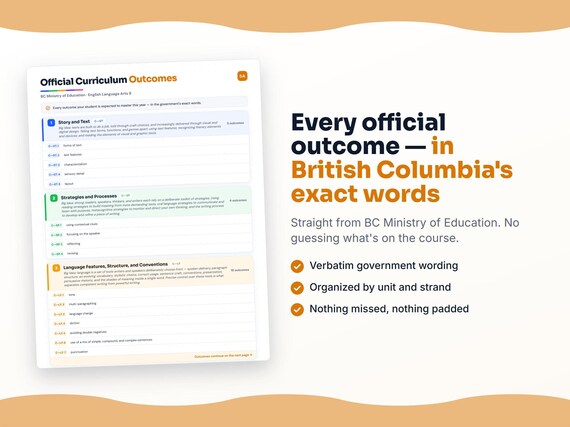
British Columbia defines English Language Arts 9 by strands and outcomes. MapleMind teaches the same curriculum reorganized for one-skill-at-a-time tutoring — the table shows exactly where every official strand lands, and the ministry's own wording is quoted under each unit below.
Official source BC's official English language arts curriculumRead it on the government site — curriculum.gov.bc.ca ↗| Official strand | Outcomes | Where MapleMind teaches it |
|---|---|---|
| Content — Story and Text | 21 | Story and Text |
| Content — Strategies and Processes | 22 | Strategies and Processes |
| Content — Language Features, Structure, and Conventions | 39 | Language Features, Structure, and Conventions |
Every skill below, taught one on one.
 Try the first session free
How MapleMind teaches English Language Arts 9 — every unit, lesson, and skill
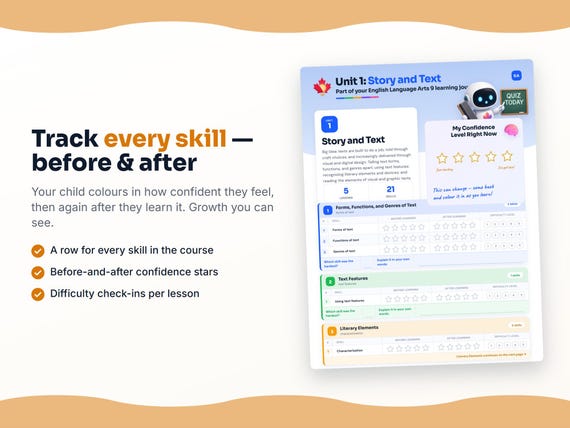
Every skill below runs as a short session: a plain-words lesson, a worked example, solving it together, then a five-question skill check that earns up to three stars. Guided Mode keeps it teaching instead of answer-handing — turning it off needs a parent's password.
Unit 1Story and TextOfficial strand · Content — Story and Text
Big Idea: texts are built to do a job, told through craft choices, and increasingly delivered through visual and digital design. Telling text forms, functions, and genres apart; using text features; recognizing literary elements and devices; and reading the elements of visual and graphic texts.
Forms, Functions, and Genres of Text
- Forms of text9.FFG.1 — Identify the form a text takes — an essay, a speech, a graphic novel, a podcast script — and notice how form shapes what a text can do.
- Functions of text9.FFG.2 — Identify the function a text is built to do — inform, persuade, entertain, or instruct — by analyzing what it wants the audience to think, feel, or do.
- Genres of text9.FFG.3 — Name a text's genre — such as satire, dystopian fiction, memoir, or editorial — from the conventions and patterns it uses.
Text Features
- Using text features9.TF.1 — Use text features — subheadings, pull quotes, sidebars, footnotes, an abstract — to navigate a more complex text efficiently and locate key information.
Literary Elements
- Characterization9.LE.1 — Analyze how an author builds a complex character — through action, dialogue, internal thought, and how other characters respond — including characters who change over a story.
- Narrative structures9.LE.2 — Recognize different narrative structures — linear, flashback, frame story, multiple timelines — and explain the effect a structure has on meaning.
- Setting9.LE.3 — Analyze how the time and place of a story shapes its mood, conflict, and characters, beyond just being the backdrop.
Literary Devices
- Sensory detail9.LD.1 — Identify sensory details in a text and explain how they build atmosphere and pull a reader into a scene.
- Figurative language9.LD.2 — Interpret figurative language — simile, metaphor, personification, symbolism — and explain the layered meaning it adds to a story.
- Irony9.LD.3 — Recognize irony in a story — when what happens is the opposite of what's expected — and explain the effect it creates.
- Paradox9.LD.4 — Recognize a paradox — a statement that seems to contradict itself but reveals a deeper truth — and explain what truth it points to.
- Oxymoron9.LD.5 — Recognize an oxymoron — two contradictory words placed side by side, like "deafening silence" — and explain the effect the contradiction creates.
Elements of Visual/Graphic Texts
- Layout9.EVG.1 — Analyze how a page or screen's layout — where elements are placed, sized, and spaced — guides a viewer's attention and shapes meaning.
- Infographics9.EVG.2 — Read an infographic by connecting its visuals, numbers, and short text to understand the argument or story it's telling.
- Emoticons9.EVG.3 — Explain how an emoticon adds tone or feeling to a digital message that plain text alone might miss.
- Icons9.EVG.4 — Explain how an icon uses a simple image to stand for an action or idea instantly, without words.
- Symbols9.EVG.5 — Interpret a symbol in a visual text — an image that stands for a larger idea, like a dove for peace — and explain what it represents.
- Interactive visuals9.EVG.6 — Explain how an interactive visual — a clickable map, a slider, an embedded video — changes what a viewer can do with a text compared to a static one.
- Hypertext9.EVG.7 — Explain how hypertext links let a reader choose their own path through connected information instead of reading start to finish.
- Colour9.EVG.8 — Analyze how colour choices in a visual text set a mood, draw attention, or carry symbolic meaning.
- Illustration style9.EVG.9 — Compare illustration styles — realistic, cartoonish, minimalist — and explain how each style changes how a viewer feels about the content.
The official wording — 21 outcomes in this unit
- 9.FFG.1
forms of text
- 9.FFG.2
functions of text
- 9.FFG.3
genres of text
- 9.TF.1
text features
- 9.LE.1
characterization
- 9.LE.2
narrative structures
- 9.LE.3
setting
- 9.LD.1
sensory detail
- 9.LD.2
figurative language
- 9.LD.3
irony
- 9.LD.4
paradox
- 9.LD.5
oxymoron
- 9.EVG.1
layout
- 9.EVG.2
infographics
- 9.EVG.3
emoticons
- 9.EVG.4
icons
- 9.EVG.5
symbols
- 9.EVG.6
interactive visuals
- 9.EVG.7
hypertext
- 9.EVG.8
colour
- 9.EVG.9
illustration style
Unit 2Strategies and ProcessesOfficial strand · Content — Strategies and Processes
Big Idea: strong readers, speakers, thinkers, and writers each rely on a deliberate toolkit of strategies. Using reading strategies to build meaning from more demanding texts, oral language strategies to communicate and listen with purpose, metacognitive strategies to monitor and direct your own thinking, and the writing process to develop and refine a piece of writing.
Reading Strategies
- Using contextual clues9.RS.1 — Use the surrounding sentences and passage to work out the meaning of an unfamiliar or ambiguous word.
- Using phonics and word structure9.RS.2 — Break an unfamiliar word into its sound and structural parts — prefixes, roots, suffixes — to work out its meaning and pronunciation.
- Visualizing9.RS.3 — Build a detailed mental image of a scene or argument from a text's details to deepen comprehension of more complex material.
- Questioning (reading)9.RS.4 — Generate questions before, during, and after reading to drive deeper analysis and check understanding of a text.
- Predicting9.RS.5 — Use evidence from a text so far to make a reasoned prediction about where it is heading, then revise that prediction as new evidence appears.
- Previewing text9.RS.6 — Skim a text's title, headings, and structure before reading closely to set expectations and read more efficiently.
- Summarizing9.RS.7 — Condense a text to its main argument or events in your own words, capturing what matters and leaving out supporting detail.
- Making inferences9.RS.8 — Combine textual evidence with background knowledge to draw a conclusion the author implies but never states directly.
Oral Language Strategies
- Focusing on the speaker9.OL.1 — Give full, active attention to a speaker in a discussion or presentation instead of mentally drafting your own response.
- Asking questions to clarify9.OL.2 — Ask a targeted question when a speaker's meaning is unclear, so you engage with what they actually mean rather than assuming.
- Listening for specifics9.OL.3 — Listen for exact details you need — a statistic, a claim, a deadline — rather than only following the general gist.
- Expressing opinions9.OL.4 — State an opinion clearly in a discussion or debate, supported by a reason or piece of evidence, and respond respectfully to disagreement.
- Speaking with expression9.OL.5 — Use vocal variety — tone, emphasis, energy — to deliver a presentation or argument so it lands the way you intend.
- Staying on topic9.OL.6 — Keep contributions to a discussion focused and relevant, building on the actual thread of conversation instead of derailing it.
- Taking turns9.OL.7 — Share speaking time fairly in a group discussion, waiting for a natural pause and inviting quieter voices in.
Metacognitive Strategies
- Reflecting9.MC.1 — Look back on a piece of learning or work to identify specifically what strategies worked, what didn't, and why.
- Questioning your own thinking9.MC.2 — Interrupt your own work to ask "does this actually make sense?" or "what exactly am I stuck on?" so confusion gets caught early.
- Goal setting9.MC.3 — Set a specific, checkable goal for your own learning or writing and use it to focus what you work on next.
- Self-evaluating9.MC.4 — Judge your own work honestly against a stated standard or rubric, naming specific strengths and specific next steps.
Writing Processes
- Revising9.WP.1 — Rework a draft's ideas, organization, and flow — reordering, cutting, or deepening content — as a separate step before editing surface errors.
- Editing9.WP.2 — Correct a draft's grammar, spelling, and punctuation once its ideas and structure are already solid.
- Considering audience9.WP.3 — Adjust vocabulary, tone, and level of detail in a piece of writing to fit the specific audience it's written for.
The official wording — 22 outcomes in this unit
- 9.RS.1
using contextual clues
- 9.RS.2
using phonics and word structure
- 9.RS.3
visualizing
- 9.RS.4
questioning
- 9.RS.5
predicting
- 9.RS.6
previewing text
- 9.RS.7
summarizing
- 9.RS.8
making inferences
- 9.OL.1
focusing on the speaker
- 9.OL.2
asking questions to clarify
- 9.OL.3
listening for specifics
- 9.OL.4
expressing opinions
- 9.OL.5
speaking with expression
- 9.OL.6
staying on topic
- 9.OL.7
taking turns
- 9.MC.1
reflecting
- 9.MC.2
questioning
- 9.MC.3
goal setting
- 9.MC.4
self-evaluating
- 9.WP.1
revising
- 9.WP.2
editing
- 9.WP.3
considering audience
Unit 3Language Features, Structure, and ConventionsOfficial strand · Content — Language Features, Structure, and Conventions
Big Idea: language is a set of tools writers and speakers deliberately choose from — spoken delivery, paragraph structure, an evolving vocabulary, stylistic choice, correct usage, sentence craft, conventions, presentation, persuasive rhetoric, and the shades of meaning inside a single word. Precise control over these tools is what separates competent writing from powerful writing.
Features of Oral Language
- Tone (spoken)9.FOL.1 — Analyze how a speaker's tone of voice — sincere, sarcastic, urgent — can shift or even reverse the literal meaning of their words.
- Volume9.FOL.2 — Explain how a speaker's volume signals urgency, confidence, or emotion, and choose volume deliberately in your own speaking.
- Inflection9.FOL.3 — Explain how the rise and fall of a speaker's pitch changes a sentence's meaning, such as turning a statement into a question or sarcasm.
- Pace9.FOL.4 — Explain how speeding up or slowing down speech builds tension, signals importance, or gives an audience time to absorb an idea.
- Gestures9.FOL.5 — Analyze how a speaker's gestures and body language reinforce, contradict, or add nuance to their spoken words.
Multi-Paragraphing
- Multi-paragraphing9.MP.1 — Organize a multi-paragraph piece of writing so each paragraph develops one idea and the paragraphs build logically toward an overall point.
Language Change
- Language change9.LC.1 — Explain how language changes over time — new slang, shifting word meanings, texting shorthand — and why that change is a normal, ongoing process, not decline.
Elements of Style
- Diction9.EST.1 — Analyze a writer's diction — their specific word choices — and explain the precise effect those choices create that a synonym wouldn't.
- Figurative language as style9.EST.2 — Analyze how a writer's use of figurative language is a deliberate stylistic choice that shapes their distinct voice, not just decoration.
- Tone (written style)9.EST.3 — Identify the tone a writer establishes in a piece of writing — such as critical, nostalgic, or playful — and explain how word choice creates it.
- Inclusive language9.EST.4 — Recognize inclusive language choices in a text and explain why a writer chooses words that respect and represent a full range of readers.
- Degree of formality9.EST.5 — Identify how formal or informal a piece of writing is and explain whether that degree of formality fits its purpose and audience.
Usage
- Avoiding double negatives9.US.1 — Recognize and correct a double negative (like "I don't need no help"), which cancels itself out or confuses meaning in standard English.
- Mixed metaphors9.US.2 — Recognize a mixed metaphor — combining two clashing comparisons in one image, like "we'll cross that bridge when it hatches" — and revise it to one consistent image.
- Malapropisms9.US.3 — Recognize a malapropism — an incorrect word swapped in for a similar-sounding correct one, like "dance the flamingo" for "flamenco" — and identify the intended word.
- Word misuse9.US.4 — Catch commonly confused or misused words (like "affect/effect" or "less/fewer") and correct them to the word that fits the sentence.
Syntax and Sentence Fluency
- Using a mix of sentence types9.SSF.1 — Combine simple, compound, and complex sentences deliberately in a piece of writing to control pacing and emphasis.
- Correct pronoun use9.SSF.2 — Use pronouns correctly — matching a pronoun clearly to the noun it replaces — so a sentence has no ambiguous or dangling reference.
- Subject-verb agreement9.SSF.3 — Match a verb correctly to its subject in more complex sentences, even when other phrases sit between the subject and the verb.
- Using transitional words9.SSF.4 — Use transitional words and phrases (however, therefore, in contrast, as a result) to signal logical relationships between ideas and improve flow.
- Spotting run-ons and fragments9.SSF.5 — Identify and fix run-on sentences and sentence fragments in a draft so every sentence expresses one complete, correctly joined thought.
Conventions
- Punctuation9.CV.1 — Use punctuation correctly and purposefully, including more advanced marks like the semicolon, colon, and em dash, to control how a sentence reads.
- Capitalization9.CV.2 — Apply capitalization rules correctly and consistently, including titles, proper nouns, and quoted material.
- Quoting9.CV.3 — Correctly punctuate and format a quotation from a text, including quotation marks and an in-text reference to its source.
- Canadian spelling9.CV.4 — Spell words consistently using Canadian conventions (like "colour," "centre," "travelled") throughout a piece of writing.
Presentation Techniques
- Presentation techniques9.PT.1 — Use presentation techniques — visual aids, pacing, eye contact, structured slides — to deliver information clearly and hold an audience's attention.
Rhetorical Devices
- Figurative language as rhetoric9.RD.1 — Analyze how a speaker or writer uses figurative language persuasively, to make an argument more vivid or memorable rather than just descriptive.
- Parallelism9.RD.2 — Recognize parallelism — repeating a grammatical pattern across a series of phrases — and explain how it makes an argument feel balanced and rhythmic.
- Repetition9.RD.3 — Recognize deliberate repetition of a word or phrase in a persuasive text and explain how it drives home the speaker's central point.
- Irony as rhetoric9.RD.4 — Recognize when a speaker uses irony to persuade or critique — saying the opposite of what they mean for effect — and explain its persuasive purpose.
- Humour9.RD.5 — Explain how a speaker or writer uses humour to win over an audience, ease tension, or make a serious point land more easily.
- Exaggeration9.RD.6 — Recognize exaggeration (hyperbole) used for persuasive effect and explain how overstating a point can make an argument feel more urgent or dramatic.
- Emotional language9.RD.7 — Identify emotional language (an appeal to pathos) in a persuasive text and explain how it is meant to make an audience feel a certain way.
- Logic9.RD.8 — Identify a logical appeal (an appeal to logos) — reasons, evidence, cause-and-effect — in a persuasive text and evaluate whether the logic actually holds up.
- Direct address9.RD.9 — Recognize when a speaker directly addresses the audience ("you," "we," a reader's name) and explain how it creates a personal, persuasive connection.
- Rhetorical questions9.RD.10 — Recognize a rhetorical question — asked to make a point rather than get an answer — and explain the point it is designed to lead the audience toward.
- Allusion9.RD.11 — Recognize an allusion — a brief reference to another well-known work, event, or figure — and explain the meaning it borrows to strengthen the argument.
Connotation and Denotation
- Connotation9.CD.1 — Identify a word's connotation — the feeling or association it carries beyond its dictionary meaning — and explain why a writer chose it over a near-synonym.
- Denotation9.CD.2 — Identify a word's denotation — its plain dictionary definition — and distinguish it from the connotations that word carries in context.
The official wording — 39 outcomes in this unit
- 9.FOL.1
tone
- 9.FOL.2
volume
- 9.FOL.3
inflection
- 9.FOL.4
pace
- 9.FOL.5
gestures
- 9.MP.1
multi-paragraphing
- 9.LC.1
language change
- 9.EST.1
diction
- 9.EST.2
figurative language
- 9.EST.3
tone
- 9.EST.4
inclusive language
- 9.EST.5
degree of formality
- 9.US.1
avoiding double negatives
- 9.US.2
mixed metaphors
- 9.US.3
malapropisms
- 9.US.4
word misuse
- 9.SSF.1
use of a mix of simple, compound, and complex sentences
- 9.SSF.2
correct pronoun use
- 9.SSF.3
subject-verb agreement
- 9.SSF.4
use of transitional words
- 9.SSF.5
awareness of run-on sentences and sentence fragments
- 9.CV.1
punctuation
- 9.CV.2
capitalization
- 9.CV.3
quoting
- 9.CV.4
Canadian spelling
- 9.PT.1
presentation techniques
- 9.RD.1
figurative language
- 9.RD.2
parallelism
- 9.RD.3
repetition
- 9.RD.4
irony
- 9.RD.5
humour
- 9.RD.6
exaggeration
- 9.RD.7
emotional language
- 9.RD.8
logic
- 9.RD.9
direct address
- 9.RD.10
rhetorical questions
- 9.RD.11
allusion
- 9.CD.1
connotation
- 9.CD.2
denotation
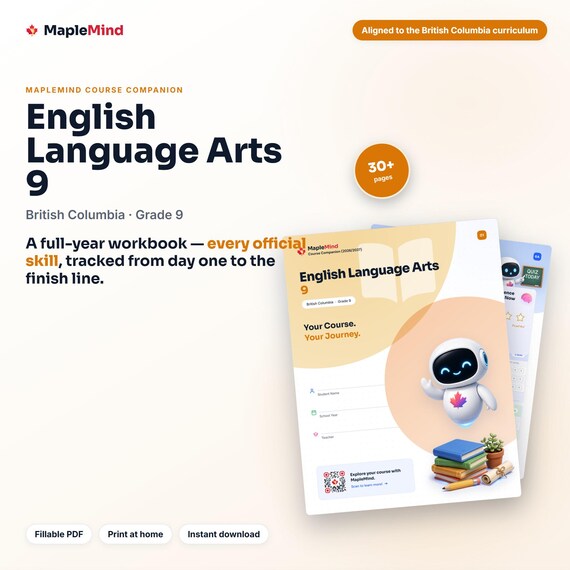
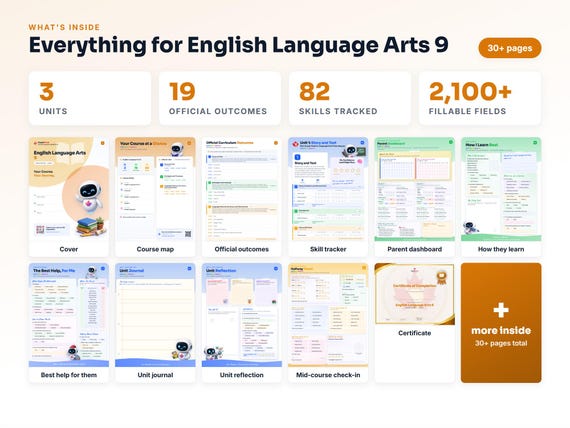
Printable workbook · A keepsake of the year
A English Language Arts 9 workbook worth keeping
Built from the same official curriculum as this page. Before and after each skill above, your student colours in how sure they feel — so the two of you can see, on one page, what's clicking and what needs another look. It's a quiet way to follow how the year is really going.
By June it's full of their own handwriting: units worked through, confidence grown, a mid-year check-in, notes from parent-teacher night, and a certificate at the end. Less a worksheet, more a record of the year worth keeping on the shelf.
Instant download · see every page, reviews and the full description · five or more workbooks are $2.99 each
What it looks like in the app



Common questions
Can MapleMind help me with English Language Arts 9?
Yes. MapleMind's AI tutor covers all 82 skills in British Columbia's English Language Arts 9 — you pick the exact skill, and the tutor teaches it step by step: a short lesson, a worked example, solving together, then a skill check to show it stuck.
Is MapleMind aligned to British Columbia's official curriculum?
Yes. Every skill in this course maps to an official outcome code from British Columbia's Grade 9 English Language Arts curriculum, and the ministry's own wording is quoted under each unit on this page — with the official government source linked so you can check it yourself.
What does MapleMind cost?
It's free to start — 5 tutoring chats and a practice quiz every day, no credit card. A Pro subscription ($9.99/month or $49.99/year CAD, 7-day free trial) unlocks unlimited tutoring, practice, and exam simulations.
What if I'm stuck on just one topic?
That's the point of skill-level tutoring: open English Language Arts 9 in the app, tap the exact skill from the list on this page, and the tutor teaches just that — no wading through lessons you don't need.
Does MapleMind work in French or other languages?
Yes — 14 languages, including French. Both the app and the tutor's explanations switch to the language you choose.
Where can I see the official British Columbia curriculum for English Language Arts 9?
The official source is linked on this page — BC's official English language arts curriculum. The outline here follows it: every MapleMind skill carries its official outcome code, and the ministry's own wording is quoted under each unit.
Keep exploring
Ready when you are
Pick a skill from this page and see it taught properly — free, in the browser, in under a minute.