Get help with Grade 4 Social Studies
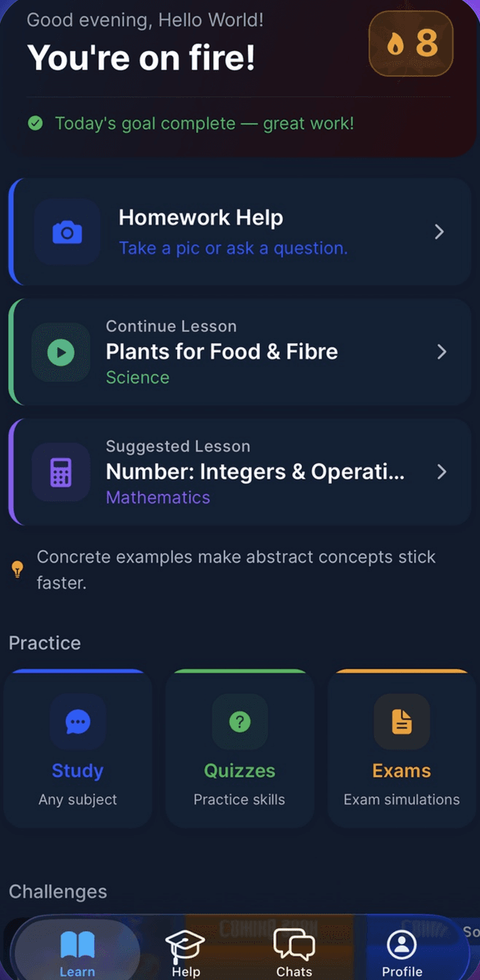
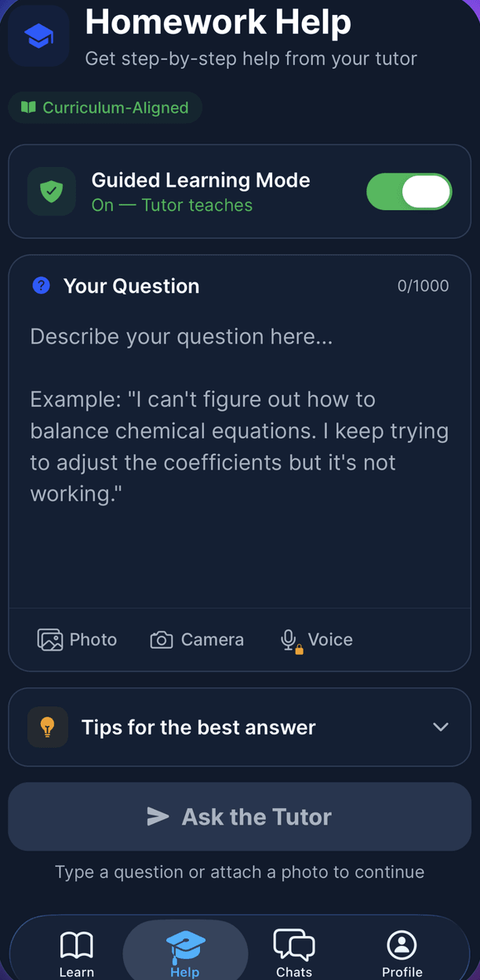
Most tutoring makes your child sit through material your child already knows. MapleMind flips that: pick the exact skill that's causing trouble — any of the 11 below — and the tutor teaches just that one, step by step, as many times as it takes. Ask questions in plain words, any time of day, in English, French, or 12 other languages.
The official Alberta Grade 4 Social Studies curriculum
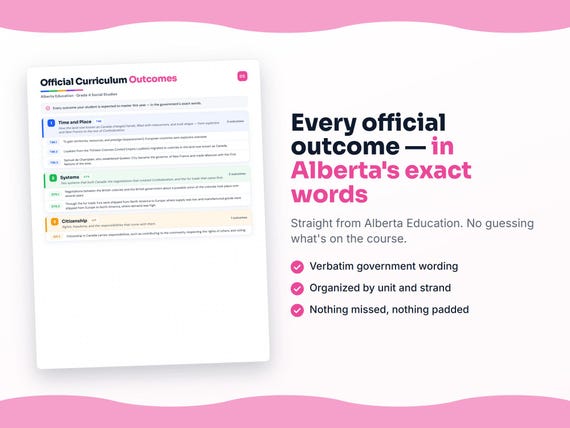
Alberta defines Grade 4 Social Studies by strands and outcomes. MapleMind teaches the same curriculum reorganized for one-skill-at-a-time tutoring — the table shows exactly where every official strand lands, and the ministry's own wording is quoted under each unit below.
Official source Alberta's official programs of studyRead it on the government site — alberta.ca ↗| Official strand | Outcomes | Where MapleMind teaches it |
|---|---|---|
| Strand TP | 2 | Time and Place |
| Strand S | 2 | Systems |
| Strand C | 1 | Citizenship |
Every skill below, taught one on one.
 Try the first session free
How MapleMind teaches Grade 4 Social Studies — every unit, lesson, and skill
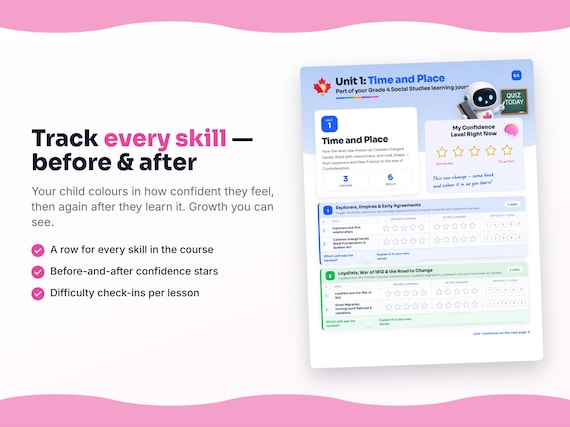
Every skill below runs as a short session: a plain-words lesson, a worked example, solving it together, then a five-question skill check that earns up to three stars. Guided Mode keeps it teaching instead of answer-handing — turning it off needs a parent's password.
Unit 1Time and PlaceOfficial strand · Strand TP
How the land now known as Canada changed hands, filled with newcomers, and took shape — from explorers and New France to the eve of Confederation.
Explorers, Empires & Early Agreements
- Explorers and first relationshipssss4.4.TP.1 — Investigate why European countries sent explorers (expansionism) — Cartier, Caboto, Champlain — and how First Nations and Europeans made treaties like the Two Row Wampum to live side by side.
- Colonies change hands: Royal Proclamation & Quebec Actsss4.4.TP.1 — Describe how Britain gained Acadia (1713) and New France (1763), the Royal Proclamation's ongoing significance for First Nations, and how the Quebec Act (1774) provided a foundation for bilingualism.
Loyalists, War of 1812 & the Road to Change
- Loyalists and the War of 1812sss4.4.TP.1 — Explain how the American Revolution sent United Empire Loyalists north, how Quebec was divided into Upper and Lower Canada (1791), and how British, French, First Nations, and Métis resisted American expansion together in the War of 1812.
- Great Migration, Underground Railroad & rebellionssss4.4.TP.1 — Investigate the Great Migration (1815–50), how enslaved Black people reached Canada via the Underground Railroad after Britain abolished slavery, and how the 1837–38 rebellions led to the Act of Union.
New France & Colonial Life
- France's permanent settlementssss4.4.TP.2 — Examine France's permanent settlements — Port-Royal (1605), Quebec City (1608), Trois-Rivières (1634), Montreal (1642) — and Champlain's alliances with First Nations.
- Colonization and life in the coloniessss4.4.TP.2 — Assess colonization as empire-building on land already occupied by Indigenous peoples (imperialism), why colonists came, the belief systems they brought, and the resources France and Britain imported.
The official wording — 2 outcomes in this unit
- sss4.4.TP.1
To gain territories, resources, and prestige (expansionism), European countries sent explorers overseas
- sss4.4.TP.2
Samuel de Champlain, who established Quebec City, became the governor of New France and made alliances with the First Nations of the area.
Unit 2SystemsOfficial strand · Strand S
Two systems that built Canada: the negotiations that created Confederation, and the fur trade that came first.
Confederation & the BNA Act
- The road to Confederationsss4.4.S.1 — Discuss the negotiations that led to Confederation — the Charlottetown, Quebec, and London conferences, fears of American expansionism, the railroad debate, and the Anglophone and Francophone Fathers of Confederation.
- The BNA Act and the parliamentary systemsss4.4.S.1 — Describe how the BNA Act (1867) united Ontario, Quebec, New Brunswick, and Nova Scotia into the Dominion of Canada and established the parliamentary system — MPs, prime minister, Governor General.
The Fur Trade
- The fur trade systemsss4.4.S.2 — Model the fur trade's system of exchange — furs to Europe where supply was low, manufactured goods to North America where demand was high — and how competition drove the HBC and NWC to expand with trading posts and forts.
- The people of the fur tradesss4.4.S.2 — Discuss the roles of First Nations, Métis, and Europeans in the fur trade — hunters, trappers, interpreters, guides, clerks, coureurs des bois, voyageurs — and how its success relied on First Nations and Métis women as intermediaries.
The official wording — 2 outcomes in this unit
- sss4.4.S.1
Negotiations between the British colonies and the British government about a possible union of the colonies took place over several years
- sss4.4.S.2
Through the fur trade, furs were shipped from North America to Europe, where supply was low, and manufactured goods were shipped from Europe to North America, where demand was high.
Unit 3CitizenshipOfficial strand · Strand C
Rights, freedoms, and the responsibilities that come with them.
Rights & Responsibilities
- Rights and responsibilities in Canadasss4.4.C.1 — Investigate the rights citizenship in Canada provides — like equal treatment regardless of difference — and the responsibilities it carries: contributing to community, respecting others' rights, voting.
The official wording — 1 outcome in this unit
- sss4.4.C.1
Citizenship in Canada carries responsibilities, such as contributing to the community, respecting the rights of others, and voting.
Printable workbook · A keepsake of the year
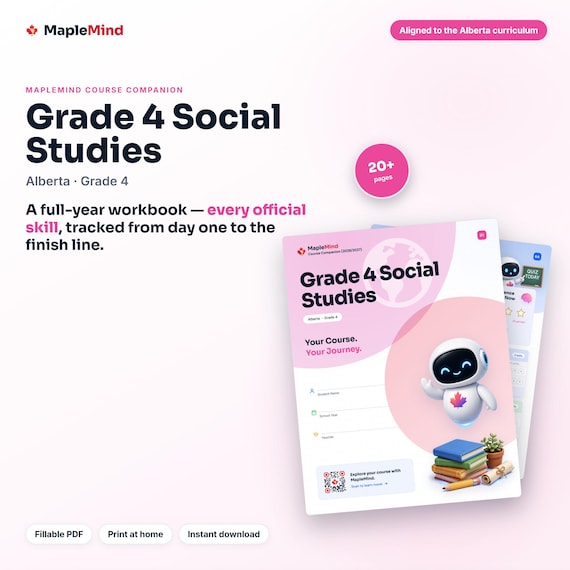
A Grade 4 Social Studies workbook worth keeping
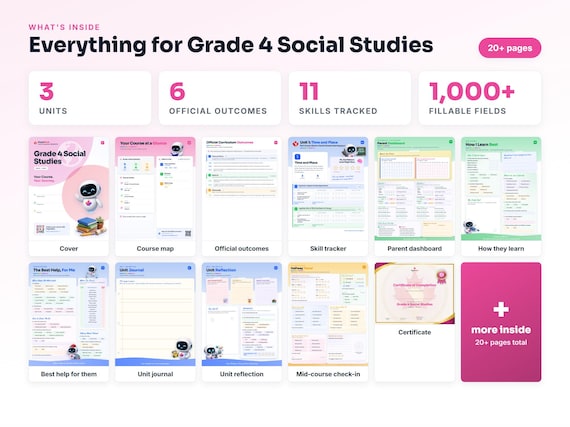
Built from the same official curriculum as this page. Before and after each skill above, your student colours in how sure they feel — so the two of you can see, on one page, what's clicking and what needs another look. It's a quiet way to follow how the year is really going.
By June it's full of their own handwriting: units worked through, confidence grown, a mid-year check-in, notes from parent-teacher night, and a certificate at the end. Less a worksheet, more a record of the year worth keeping on the shelf.
Instant download · see every page, reviews and the full description · five or more workbooks are $2.99 each
What it looks like in the app
Common questions
Can MapleMind help my child with Grade 4 Social Studies?
Yes. MapleMind's AI tutor covers all 11 skills in Alberta's Grade 4 Social Studies — your child picks the exact skill, and the tutor teaches it step by step: a short lesson, a worked example, solving together, then a skill check to show it stuck.
Is MapleMind aligned to Alberta's official curriculum?
Yes. Every skill in this course maps to an official outcome code from Alberta's Grade 4 Social Studies curriculum, and the ministry's own wording is quoted under each unit on this page — with the official government source linked so you can check it yourself.
What does MapleMind cost?
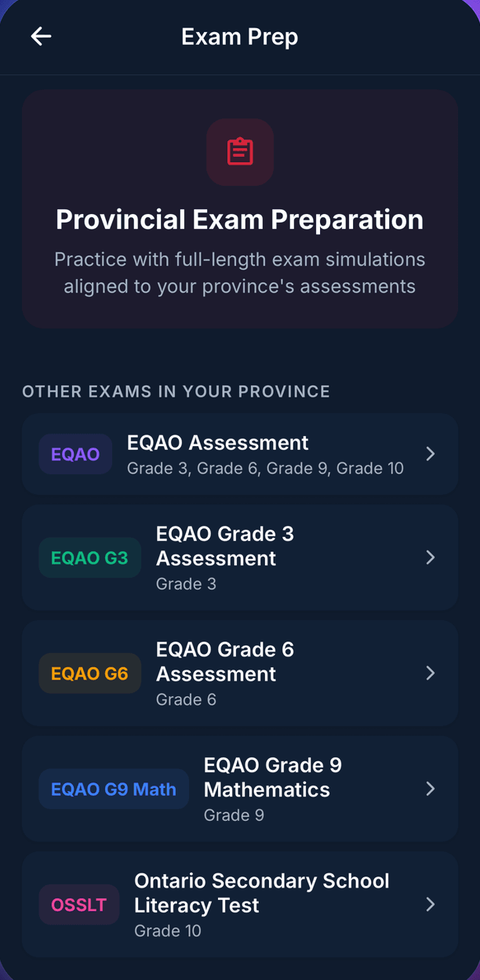
It's free to start — 5 tutoring chats and a practice quiz every day, no credit card. A Pro subscription ($9.99/month or $49.99/year CAD, 7-day free trial) unlocks unlimited tutoring, practice, and exam simulations.
What if my child is stuck on just one topic?
That's the point of skill-level tutoring: open Grade 4 Social Studies in the app, tap the exact skill from the list on this page, and the tutor teaches just that — no wading through lessons your child doesn't need.
Does MapleMind work in French or other languages?
Yes — 14 languages, including French. Both the app and the tutor's explanations switch to the language your child chooses.
Where can I see the official Alberta curriculum for Grade 4 Social Studies?
The official source is linked on this page — Alberta's official programs of study. The outline here follows it: every MapleMind skill carries its official outcome code, and the ministry's own wording is quoted under each unit.
Keep exploring
Ready when you are
Pick a skill from this page and see it taught properly — free, in the browser, in under a minute.