Nova Scotia · For parents

What your child learns in Grade 7 in Nova Scotia

Every subject, unit by unit, from Nova Scotia’s curriculum: 135 skills in plain words.

Subjects
5
Skills
135
Provincial exams
None
Official curriculum
curriculum.novascotia.ca

Math in Grade 7

Mathematics, Grade 7

5 units · 31 skills

  1. Unit 1

    Number

    Each divisor has a quick rule (e.g., divisible by 3 if the digit sum is divisible by 3).

    • Divisibility rules
    • Adding and subtracting decimals
    • Multiplying and dividing decimals
    8 more skills
    • Solving percent problems
    • Fractions and terminating decimals
    • Fractions and repeating decimals
    • Adding and subtracting fractions with like denominators
    • Adding and subtracting fractions with unlike denominators
    • Adding integers
    • Subtracting integers
    • Comparing and ordering fractions, decimals, and whole numbers
  2. Unit 2

    Patterns and Relations

    A linear relation like 2n + 3 describes a growing pattern.

    • Patterns and their linear relations
    • Tables and graphs of linear relations
    • Modelling preservation of equality
    5 more skills
    • Solving equations with preservation of equality
    • Expressions versus equations
    • Evaluating expressions
    • One-step linear equations
    • Two-step linear equations
  3. Unit 3

    Measurement

    The diameter is twice the radius.

    • Radius, diameter, circumference, and pi
    • Central angles and constructing circles
    • Solving circle problems
    2 more skills
    • Area of triangles and parallelograms
    • Area of circles
  4. Unit 4

    Geometry

    The axes divide the plane into four quadrants.

    • Plotting in four quadrants
  5. Unit 5

    Statistics and Probability

    Mean is the total divided by the count.

    • Mean, median, mode, and range
    • Choosing the most appropriate measure
    • The effect of outliers
    3 more skills
    • Constructing and interpreting circle graphs
    • Probability as ratios, fractions, and percents
    • Probability of two independent events
Science in Grade 7

Science, Grade 7

3 units · 38 skills

  1. Unit 1

    Environmental Action

    Particle theory: all matter is made of tiny particles, always moving, with spaces between them.

    • Pure substances and mixtures
    • Separating solutions and mixtures
    • Solubility and concentration
    16 more skills
    • Measuring water health with probeware
    • Analysing a waterway's health
    • Water purification and pollution cleanup
    • Interactions of organisms in an ecosystem
    • Human impact on ecosystems
    • Resource management and Netukulimk
    • Energy flow and matter recycling
    • Biotic and abiotic connections
    • Biological indicators of health
    • Ways species can be classified
    • Hypothesizing how organisms adapt
    • Natural selection and evolution
    • Evidence of evolution
    • Strategies for conservation and sustainability
    • Community stewardship initiatives
    • Making a stewardship plan
  2. Unit 2

    Engineering Structures

    Some shapes carry loads better: triangles and arches are strong.

    • Strength of shapes and materials
    • Applications of shapes and materials
    • Properties of construction materials
    9 more skills
    • Manufactured and natural structures
    • Forces on and within structures
    • Testing structures to failure
    • Forces that cause structural failure
    • Static and dynamic forces
    • Applying design concepts
    • Choosing materials for the challenge
    • Building the structure
    • Testing against challenge criteria
  3. Unit 3

    Geological Evolution

    Earth's surface is broken into large plates that move slowly.

    • Geographic features and plate boundaries
    • Evidence for plate movement
    • Erosion and deposition
    4 more skills
    • Technologies that measure geological change
    • Weathering and erosion
    • Impact of waves and tides
    • Protecting the coast

English in Grade 7

English Language Arts 7

6 units · 28 skills

  1. Unit 1

    Culture and Communication

    A communication form (a story, song, image, or video) can carry the values, history, and identity of the community that made it.

    • Investigating how forms express culture and identity
    • Comparing voices within a culture
    • Comprehending cultural expression through creators' choices
    1 more skill
    • Investigating how forms vary across cultures
  2. Unit 2

    Planning Responses

    A personal response shares your reaction and connection; a critical response analyzes the text using evidence.

    • Comparing personal and critical responses
    • Questioning interpretations of messages
    • Developing ideas for responses
    2 more skills
    • Relating audience, purpose, and form
    • Analysing supporting details
  3. Unit 3

    Creating Communication Forms

    Ideas keep developing while you create — a draft, a sketch, or a rehearsal surfaces new ideas.

    • Developing ideas when creating
    • Applying writing, design, and research processes
    • Selecting a form for an audience and purpose
    2 more skills
    • Applying revision, editing, and proof-reading
    • Analysing publishing and sharing
  4. Unit 4

    Speaking and Writing Strategies

    A communication strategy (a hook, an example, a tone) is effective only in relation to a particular audience and purpose.

    • Evaluating communication strategies
    • Investigating how language impacts communication
    • Investigating source credibility
    3 more skills
    • Investigating bias and validity in communication
    • Selecting organizational structures and devices
    • Applying conventions
  5. Unit 5

    Comprehending

    Active listening means focusing, noting key points, and asking questions — not just hearing.

    • Applying active listening strategies
    • Investigating reading and viewing strategies
    • Analysing how forms influence comprehension
    1 more skill
    • Reflecting on perspective and comprehension
  6. Unit 6

    Analysing Accuracy and Bias

    A reliable source is one you can trust — it has expertise, evidence, and a track record.

    • Selecting reliable sources
    • Comparing accuracy across sources
    • Choosing valid information
    1 more skill
    • Investigating bias in the message

French in Grade 7

Core French, Grade 7

3 units · 14 skills

  1. Unit 1

    Communication orale

    'Vecu' = your lived experience; speak about what is real to you.

    • Conveying information about your own life
    • Justifying your ideas and others' ideas
    • Complete sentences with a beginning of spontaneity
    4 more skills
    • Speaking with fluency for the task
    • Speaking with accuracy for the task
    • Selecting useful information in a conversation
    • Describing a topic from your own life
  2. Unit 2

    Comprehension / degager le sens des textes

    Textual cues (indices textuels): title, subtitles, pictures, bold words.

    • Applying reading strategies
    • Making meaning by answering oral questions
    • Reading aloud with fluency
    1 more skill
    • Reading aloud with accuracy
  3. Unit 3

    Creation de textes

    Follow the model: 'une phrase d'introduction, le developpement et une phrase de conclusion' (guide L801-802).

    • Producing a personal text following the model
    • Writing strategies for fluency
    • Revision strategies for accuracy

Social studies in Grade 7

Social Studies, Grade 7

6 units · 24 skills

  1. Unit 1

    Government Policies and Mi'kmaw Communities

    Mi'kma'ki is the ancestral homeland of the Mi'kmaq, known since time immemorial.

    • Geographic impact of government decisions on the Mi'kmaq
    • Civic impact and assimilation policy
    • Economic impact of denied treaty rights
    1 more skill
    • Mi'kmaw resilience
  2. Unit 2

    Historical Opportunities and Challenges in the Maritimes

    Civic conditions include access to education, services, and fair treatment.

    • Civic conditions for the peoples of the Maritimes
    • Geographic conditions and land
    • Economic conditions and entrepreneurship
    1 more skill
    • Impact of assimilation and segregation
  3. Unit 3

    Political Changes in the Maritimes

    Responsible government means leaders must answer to the elected assembly, not just to Britain.

    • The origins of responsible government
    • The controversy of Confederation
    • The impact of Confederation on the Mi'kmaq
    1 more skill
    • How Confederation impacted the Maritimes
  4. Unit 4

    Changing Societal Conditions in the Maritimes

    Advocacy means standing up for others and for change.

    • Advocates who changed social conditions
    • How change was created in communities
    • The impact of civic movements
    1 more skill
    • The impact of innovation
  5. Unit 5

    Impacts of World War I on the Maritimes

    Communities responded to WWI in different ways.

    • How communities responded to World War I
    • Economic factors and women's roles
    • Contributions that went unrecognized
    1 more skill
    • Formulating a response of remembrance
  6. Unit 6

    Present-Day Maritime Communities

    Demographics are facts about a population (age, where people come from).

    • Changing demographics
    • Opportunities in industry
    • Environmental sustainability and Netukulimk
    1 more skill
    • Responding to opportunities and challenges

MapleMind

See Grade 7 in MapleMind

Real screens from the app your child would use.

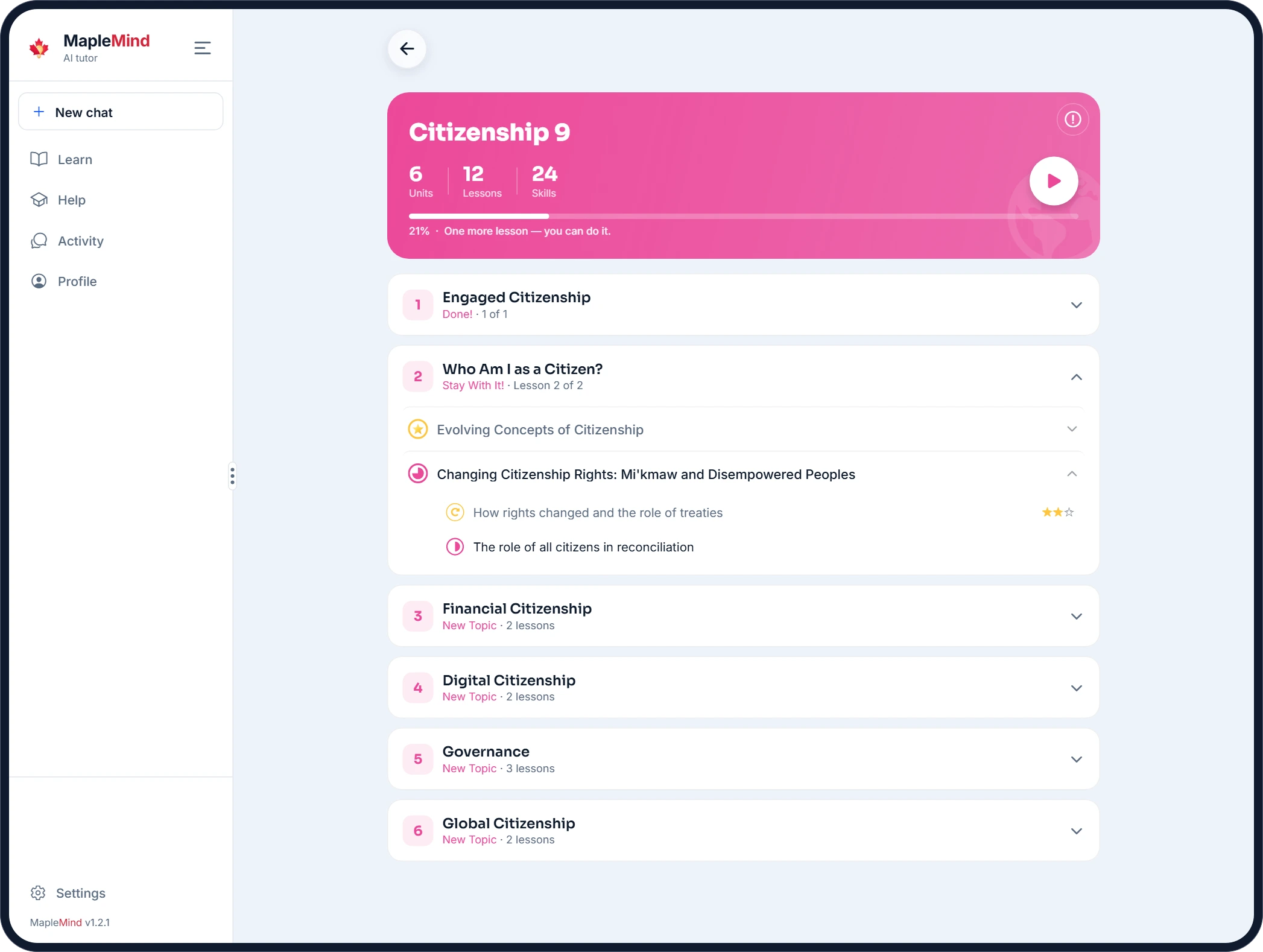
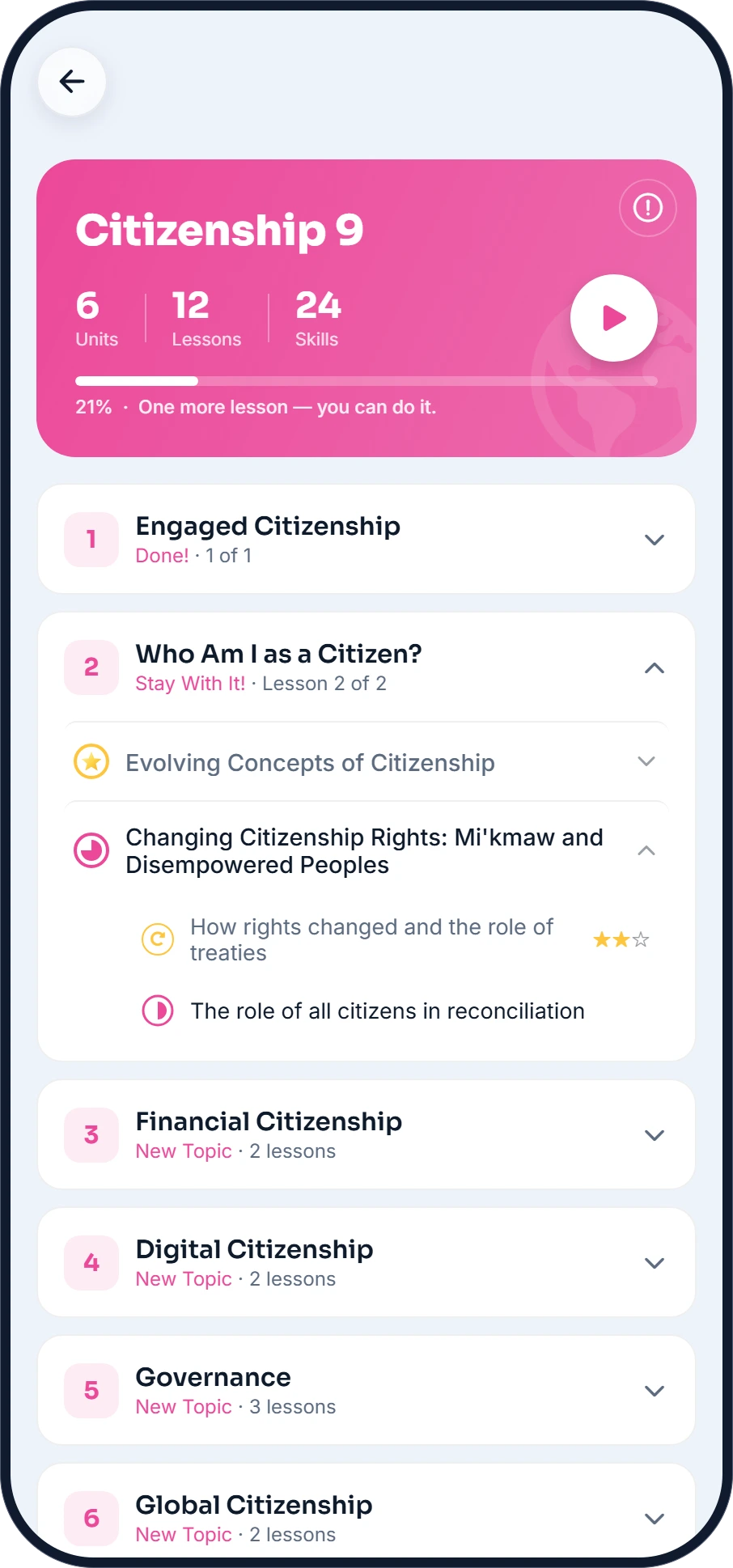
Citizenship 9 in MapleMind on a tablet: its units and lessons in order, a student partway through.Citizenship 9 in MapleMind on a phone: its units and lessons in order, a student partway through.
Their course, unit by unit, the way Nova Scotia teaches it.Shown: Citizenship 9
Homework Help on a tablet: a photo of a worksheet, the tutor’s worked example of a two-step equation, and a question back to the student.Homework Help on a phone: a photo of a worksheet, the tutor’s worked example of a two-step equation, and a question back to the student.
Homework Help: they take a photo of the question, and the tutor works through it with them.
The Parent Dashboard on a tablet: a student’s days studied, streak, lessons, quiz average and recent activity.The Parent Dashboard on a phone: a student’s days studied, streak, lessons, quiz average and recent activity.
The Parent Dashboard: how each child’s week went, in lessons, quizzes and days studied.
A Grade 9 provincial mathematics exam on a tablet: a readiness score, the exam’s time and its next sitting.A Grade 9 provincial mathematics exam on a phone: a readiness score, the exam’s time and its next sitting.
A provincial exam: a practice sitting under the real time, and how ready they are.
The Learn tab on a tablet: a four-day streak, the week’s days, Homework Help, the next lesson and a review.The Learn tab on a phone: a four-day streak, the week’s days, Homework Help, the next lesson and a review.
The Learn tab: their week so far, and the next thing to do.

Help at home

Questions parents ask

What will my child learn in Grade 7 in Nova Scotia?

Math: Mathematics, Grade 7. Science: Science, Grade 7. English: English Language Arts 7. French: Core French, Grade 7. Social studies: Social Studies, Grade 7. That’s 135 skills in all, from Nova Scotia’s curriculum.

Does my child write a provincial exam in Grade 7?

No. Nova Scotia has no provincial exam in Grade 7.

Where does this list come from?

From Nova Scotia’s official curriculum, the documents its education ministry publishes for each course. Each skill here is one of their expectations, written in plain words.

Can MapleMind help my child in Grade 7?

Yes. Every course on this page is in MapleMind, with lessons, practice and a tutor that works through each step with them. A free account gets 30 messages and 4 activities a day.

Help with Grade 7, one skill at a time.

Every course on this page is in MapleMind, free with daily limits.