Nova Scotia · For parents

What your child learns in Grade 10 in Nova Scotia

Every subject, unit by unit, from Nova Scotia’s curriculum: 175 skills in plain words.

Subjects
5
Skills
175
Provincial exams
3
Official curriculum
curriculum.novascotia.ca

Math in Grade 10

2 courses. Choose the one your child takes.

Mathematics 10

4 units · 38 skills

  1. Unit 1

    Measurement

    A referent is a known personal benchmark (a fingernail ≈ 1 cm, a doorknob ≈ 1 m high).

    • Referents and estimation for linear measure
    • Measuring and solving linear problems with instruments
    • Converting units with proportional reasoning
    6 more skills
    • Verifying conversions with unit analysis
    • Surface area and volume of prisms and cylinders
    • Surface area and volume of cones, pyramids, and spheres
    • Composite objects and unknown dimensions
    • Defining and setting up the primary trig ratios
    • Solving right triangles and indirect measurement
  2. Unit 2

    Algebra and Number

    An irrational number cannot be written as a fraction of integers; its decimal never terminates or repeats.

    • Identifying and ordering irrational numbers
    • Simplifying and converting radicals
    • Applying exponent laws with rational exponents
    5 more skills
    • Converting between powers and radicals
    • Multiplying binomials with an area model
    • Multiplying polynomials symbolically
    • Removing common factors
    • Factoring trinomials and differences of squares
  3. Unit 3

    Relations and Functions

    The shape of a graph encodes the situation — steep means fast change, flat means no change.

    • Interpreting graphs and situations
    • Domain and range from data
    • Distinguishing relations and functions
    13 more skills
    • Slope as rise over run and rate of change
    • Parallel and perpendicular slopes
    • Representing linear relations many ways
    • Characteristics of a linear graph
    • Slope-intercept form
    • General form and rewriting between forms
    • Slope-point form
    • Equation from a graph or a point and slope
    • Equation from two points
    • Equation from a parallel or perpendicular line
    • Representing a linear function with function notation
    • Solving systems graphically
    • Solving systems algebraically
  4. Unit 4

    Financial Mathematics

    Unit price is total cost divided by quantity, giving a per-item or per-gram cost.

    • Best buys with unit pricing
    • Currency exchange
    • Calculating gross pay
    2 more skills
    • Calculating net pay after deductions
    • Building a personal budget

Mathematics at Work 10

4 units · 24 skills

  1. Unit 1

    Measurement

    SI is a base-ten system: each prefix (milli, centi, kilo) shifts the value by a power of ten.

    • Relationships among SI units
    • Converting SI to imperial units
    • Relationships among imperial units
    6 more skills
    • Converting imperial to SI units
    • Referents and estimation for length
    • Solving and verifying linear problems
    • Referents and estimation for area
    • Area of composite and irregular 2-D shapes
    • Surface area of 3-D objects
  2. Unit 2

    Geometry

    Different puzzles suit different strategies (guess-and-check, pattern, work backwards).

    • Strategies for spatial puzzles and games
    • Verifying and identifying right triangles
    • Solving problems with the Pythagorean theorem
    6 more skills
    • Determining similarity of polygons
    • Solving problems with similar polygons
    • Generalizing the sine, cosine, and tangent ratios
    • Applying trigonometry to indirect measurement
    • Angle pairs from parallel lines and a transversal
    • Solving angle problems with transversals
  3. Unit 3

    Number

    Unit price is total cost divided by quantity (dollars per gram, per item).

    • Unit pricing and best buy
    • Currency exchange
    • Methods of earning income
    2 more skills
    • Calculating gross pay
    • Deductions and net pay
  4. Unit 4

    Algebra

    Rearranging a formula isolates the quantity you need to find.

    • Manipulating and applying formulas

Science in Grade 10

Science 10

SCI10 · 4 units · 31 skills

  1. Unit 1

    Earth and Space Science: Weather Dynamics

    Weather instruments measure specific variables: thermometer (temperature), barometer (air pressure), hygrometer (humidity), anemometer (wind speed), rain gauge (precipitation).

    • Using weather instruments and integrating data
    • Analyzing data to predict weather
    • Heat energy transfer in the water cycle
    6 more skills
    • The atmosphere and hydrosphere as heat sinks
    • Heat transfer and air/water currents
    • Explaining seasonal and weather variation
    • Canadian contributions to weather forecasting
    • The impact of accurate forecasting
    • Risks, benefits, and limits of forecasting responses
  2. Unit 2

    Physical Science: Chemical Reactions

    WHMIS (Workplace Hazardous Materials Information System) uses standardized hazard symbols and safety data sheets to communicate risks.

    • Investigating reactions safely with WHMIS
    • Identifying acids, bases, and salts
    • Neutralization reactions
    5 more skills
    • Naming and writing chemical formulas
    • Classifying acids, bases, and salts by formula
    • Balancing equations and conservation of mass
    • Factors affecting chemical reactions
    • Science and technology relationships
  3. Unit 3

    Physical Science: Motion

    Motion experiments measure distance/position (metre sticks, measuring tapes) and time (stopwatches, motion sensors, tickertape).

    • Accurate measurement in experiments
    • Analyzing scalar and vector motion
    • Constant, average, and instantaneous speed
    3 more skills
    • Design and function of motion technology
    • Framing motion research questions
    • Canadian contributions in motion
  4. Unit 4

    Life Science: Sustainability of Ecosystems

    A paradigm is a shared way of thinking; a paradigm shift is a fundamental change in that thinking.

    • Shifting views of sustainability
    • Biotic/abiotic factors and bioaccumulation
    • Biodiversity and sustainability
    5 more skills
    • External factors and ecosystem sustainability
    • Ecosystem responses to stress and change
    • Geography and similar ecosystems
    • Defending a course of action on an issue
    • Research and sustainable development
See the course: Science 10

English in Grade 10

English 10

ENG10 · 3 units · 37 skills

  1. Unit 1

    Speaking and Listening

    Good questions do work: they open up an issue rather than just testing recall.

    • Constructing ideas through questions and responses
    • Presenting a personal viewpoint to a group
    • Adapting to formal and informal speaking situations
    3 more skills
    • Adapting a message to the speaker-listener connection
    • Physical qualities and language choices in oral communication
    • Awareness of varieties of language and communication styles
  2. Unit 2

    Reading and Viewing

    Media and visual texts — film, advertising, journalism, music videos — are texts to be read, not just watched.

    • Viewing a wide variety of media and visual texts
    • Seeking meaning with reading strategies
    • Clearing up confusing parts and adjusting reading rate
    18 more skills
    • Understanding the impact of literary devices and media techniques
    • Researching information systematically
    • Selecting and evaluating information for a task
    • Integrating information to meet a task
    • Articulating and supporting a personal response
    • Questioning, connecting, evaluating, and extending
    • Making thematic connections across texts and media
    • Considering more than one interpretation
    • Examining aspects of texts that contribute to meaning
    • Making inferences and supported responses
    • Exploring relationships among language, genre, purpose, and audience
    • Discussing the characteristics of texts and genres
    • Awareness that texts reveal and produce ideologies
    • Evaluating how cultures and groups are portrayed in media
    • Investigating how gender roles and stereotypes are expressed
    • Investigating power dynamics and gender
    • Questioning how gender depictions influence perceptions of consent
    • Analysing how social norms shape bystander responses
  3. Unit 3

    Writing and Other Ways of Representing

    Exploratory and reflective writing is for thinking — it extends ideas and surfaces feelings and values.

    • Writing to extend ideas and reflect on learning
    • Note-making and representing to reconstruct knowledge
    • Choosing language for imaginative effect
    7 more skills
    • Creating an organizing structure for a text
    • Selecting form and style and engaging the reader
    • Reflecting on others' responses to create new pieces
    • Awareness of what writing processes work for you
    • Using conventions of written language consistently
    • Committing to crafting writing and representations
    • Using materials and ideas to clarify for an audience
See the course: English 10

French in Grade 10

Core French 10

2 units · 19 skills

  1. Unit 1

    Communication

    Negotiating meaning is repairing a conversation when it breaks down - at this level you use a small set of modelled repair phrases.

    • Negotiating for understanding
    • Varying language for the audience
    • Participating in interviews
    10 more skills
    • Developing descriptions and comparisons
    • Presenting a point of view logically
    • Defending a point of view
    • Choosing pertinent information
    • Organizing information
    • Interpreting and analyzing information
    • Telling stories
    • Giving summaries
    • Using your own words
    • Discussing Acadian and other francophone cultures
  2. Unit 2

    Linguistic Elements

    Agreement / disagreement: 'Je suis d'accord' (I agree), 'Je ne suis pas d'accord' (I disagree), 'Tu as raison' (You're right).

    • Using expressions that support interaction
    • Using verb tenses suited to the context
    • Refuting, rejecting, and contradicting to express an opinion
    3 more skills
    • Narrating events in the past
    • Summarizing the main ideas of a text
    • Reacting critically and creatively

Social studies in Grade 10

Geography 10

7 units · 26 skills

  1. Unit 1

    Part A · Unit 1 — Data Collection

    Remote sensing = collecting data without touching the target.

    • Remote sensing — the view from above
    • Field techniques — geography on the ground
  2. Unit 2

    Part A · Unit 2 — Data Processing and Representation

    Vertical images look straight down; obliques look at an angle (high shows horizon, low doesn't)

    • Reading aerial and satellite images
    • Choosing and using the right map
    • Organizing quantitative data
    1 more skill
    • Comparative mapping and GIS
  3. Unit 3

    Part B · Unit 1 — Geographic Perspective

    Location: where exactly (absolute) and relative to what.

    • The five themes of geography
    • Physical processes and human response
    • Culture, experience, and technology shape the view
  4. Unit 4

    Part B · Unit 2 — Land Environment

    Layers: crust, mantle, outer and inner core.

    • Earth's structure and plate tectonics
    • The changing face of Earth
    • Earth movements and mountain building
    5 more skills
    • Rock-building, classification, and uses
    • Weathering, mass wasting, and soil erosion
    • Rivers and their landscapes
    • Glacial processes and their imprint
    • Coastal landscapes and human interaction
  5. Unit 5

    Part B · Unit 3 — Ocean Environment

    The profile: continental shelf → slope → abyssal plain → trench.

    • Sea floor processes and submarine features
    • Moving waters, climate, and human activity
  6. Unit 6

    Part B · Unit 4 — Atmospheric Environment

    Composition: ~78% nitrogen, ~21% oxygen, trace gases with outsized roles.

    • The atmosphere's composition and zones
    • The sun-driven systems
    • The hydrosphere and precipitation
    2 more skills
    • Air masses and weather systems
    • Climate data and world zones
  7. Unit 7

    Part B · Unit 5 — Spaceship Earth

    Four spheres: lithosphere, hydrosphere, atmosphere, biosphere.

    • Earth's interconnected systems
    • Humanity in the web — sustainability

Provincial exams in Grade 10

MapleMind

See Grade 10 in MapleMind

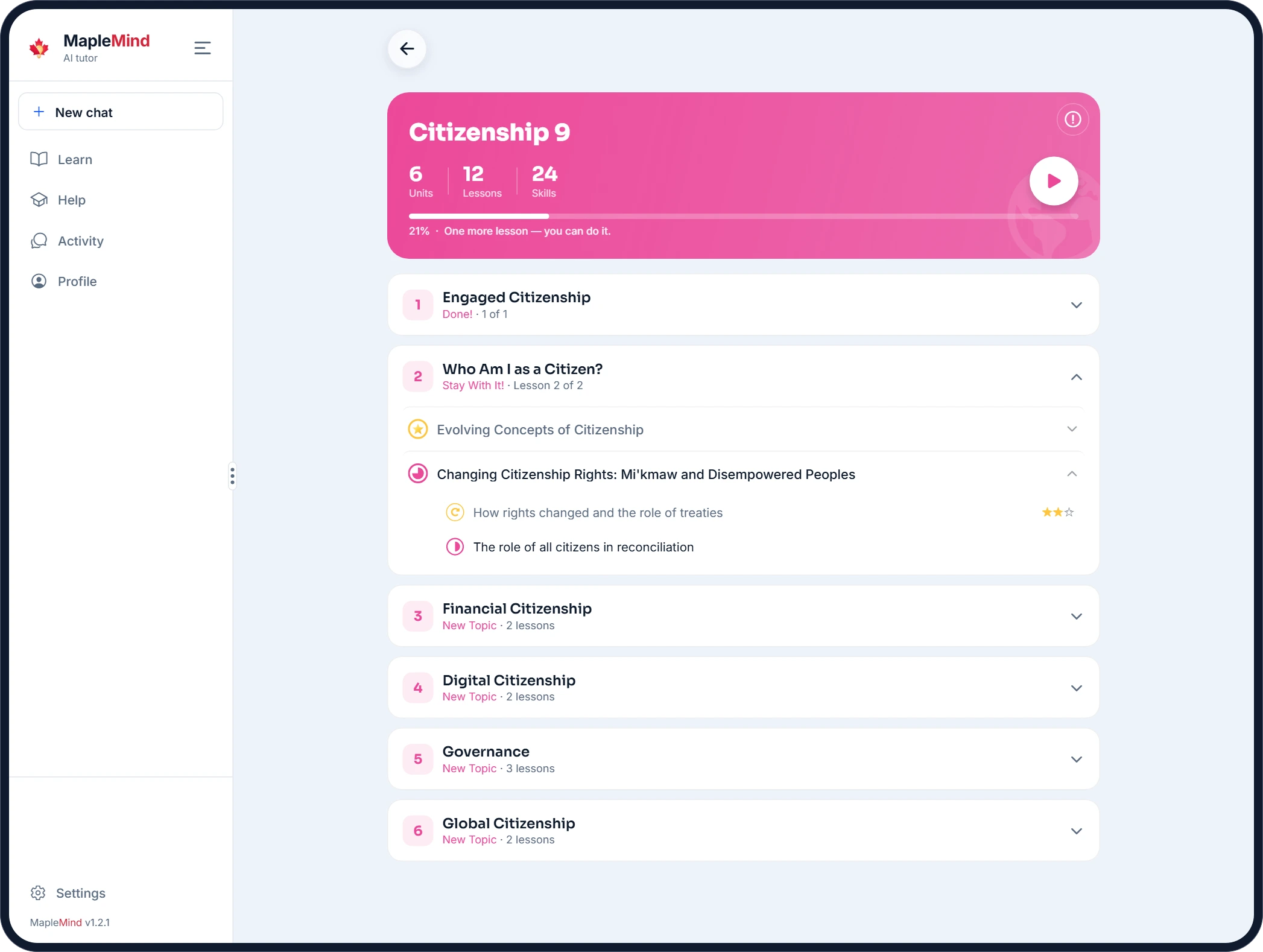
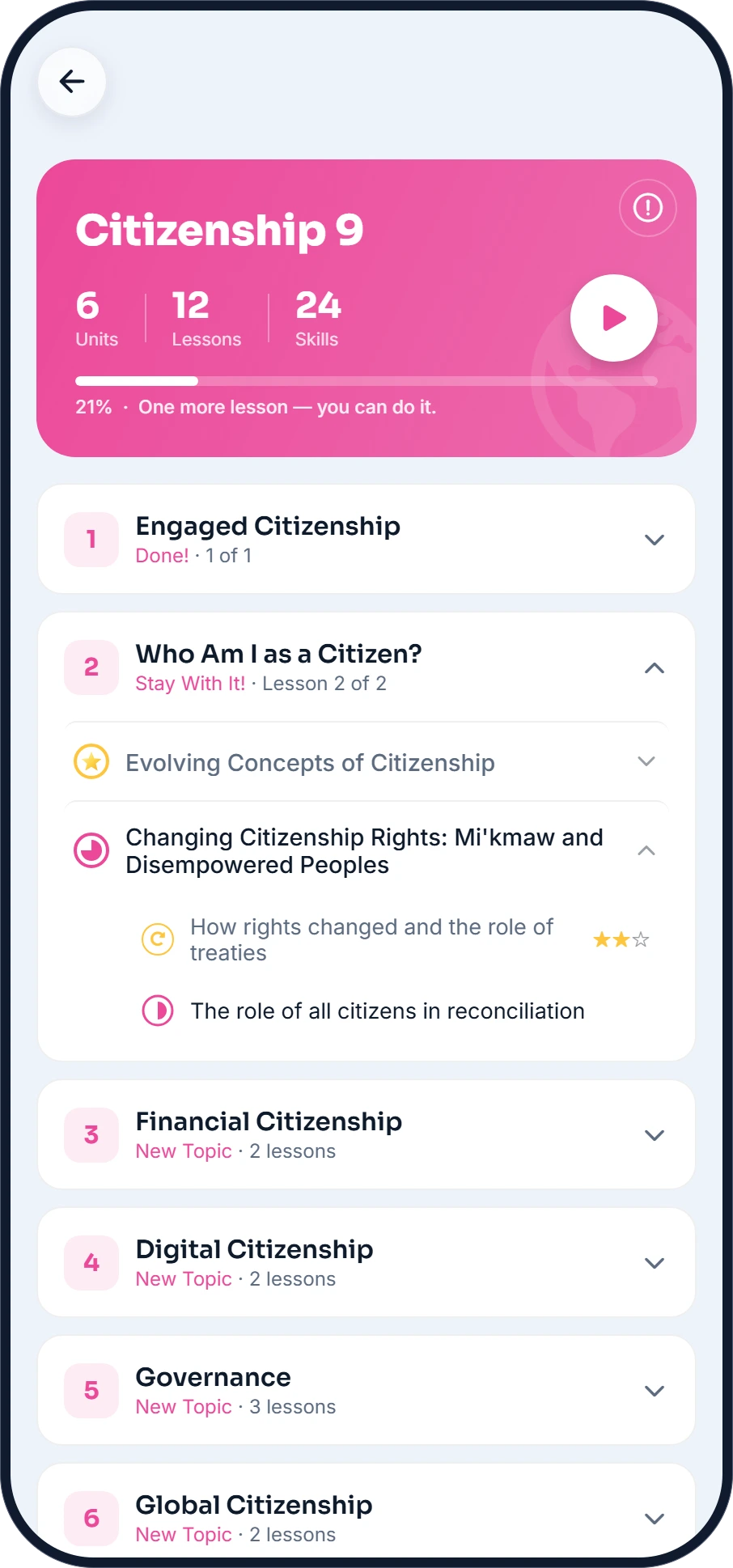
Real screens from the app your child would use.

Citizenship 9 in MapleMind on a tablet: its units and lessons in order, a student partway through.Citizenship 9 in MapleMind on a phone: its units and lessons in order, a student partway through.
Their course, unit by unit, the way Nova Scotia teaches it.Shown: Citizenship 9
Homework Help on a tablet: a photo of a worksheet, the tutor’s worked example of a two-step equation, and a question back to the student.Homework Help on a phone: a photo of a worksheet, the tutor’s worked example of a two-step equation, and a question back to the student.
Homework Help: they take a photo of the question, and the tutor works through it with them.
The Parent Dashboard on a tablet: a student’s days studied, streak, lessons, quiz average and recent activity.The Parent Dashboard on a phone: a student’s days studied, streak, lessons, quiz average and recent activity.
The Parent Dashboard: how each child’s week went, in lessons, quizzes and days studied.
A Grade 9 provincial mathematics exam on a tablet: a readiness score, the exam’s time and its next sitting.A Grade 9 provincial mathematics exam on a phone: a readiness score, the exam’s time and its next sitting.
A provincial exam: a practice sitting under the real time, and how ready they are.
The Learn tab on a tablet: a four-day streak, the week’s days, Homework Help, the next lesson and a review.The Learn tab on a phone: a four-day streak, the week’s days, Homework Help, the next lesson and a review.
The Learn tab: their week so far, and the next thing to do.

Help at home

Questions parents ask

What will my child learn in Grade 10 in Nova Scotia?

Math: Mathematics 10 and Mathematics at Work 10. Science: Science 10. English: English 10. French: Core French 10. Social studies: Geography 10. That’s 175 skills in all, from Nova Scotia’s curriculum.

When is the Nova Scotia Exam: English 10?

It’s written January 26, 2027, and June 22, 2027.

Where does this list come from?

From Nova Scotia’s official curriculum, the documents its education ministry publishes for each course. Each skill here is one of their expectations, written in plain words.

Can MapleMind help my child in Grade 10?

Yes. Every course on this page is in MapleMind, with lessons, practice and a tutor that works through each step with them. A free account gets 30 messages and 4 activities a day.

Help with Grade 10, one skill at a time.

Every course on this page is in MapleMind, free with daily limits.