Ministerial exam · Quebec
Français, langue d'enseignement, Secondary II
Ministerial Examination — Français, langue d'enseignement, Secondary II: Writing (132‑208)
- Grade 8
- 132-208
- Written in French
Dates and details can change. We do our best to keep this page up to date, but check the official sources before relying on it.
- Total time
- 5 h 30 min
- Counts for
- 20% of the final mark
- Calculator
- Not allowed
- Format
- On paper
Épreuve de français, 2e secondaire practice test
The whole exam or the parts you choose, in its own format, on the clock.
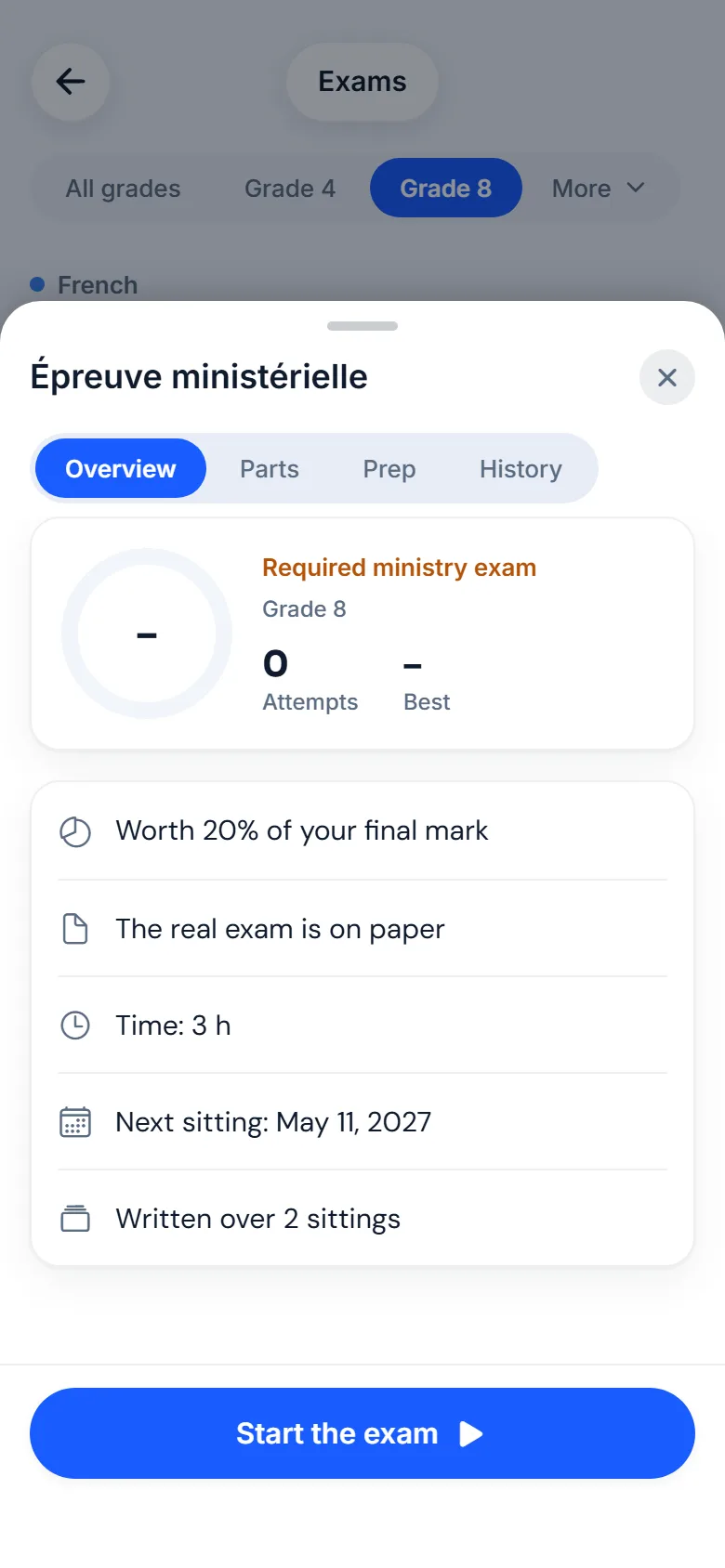 The exam in the app
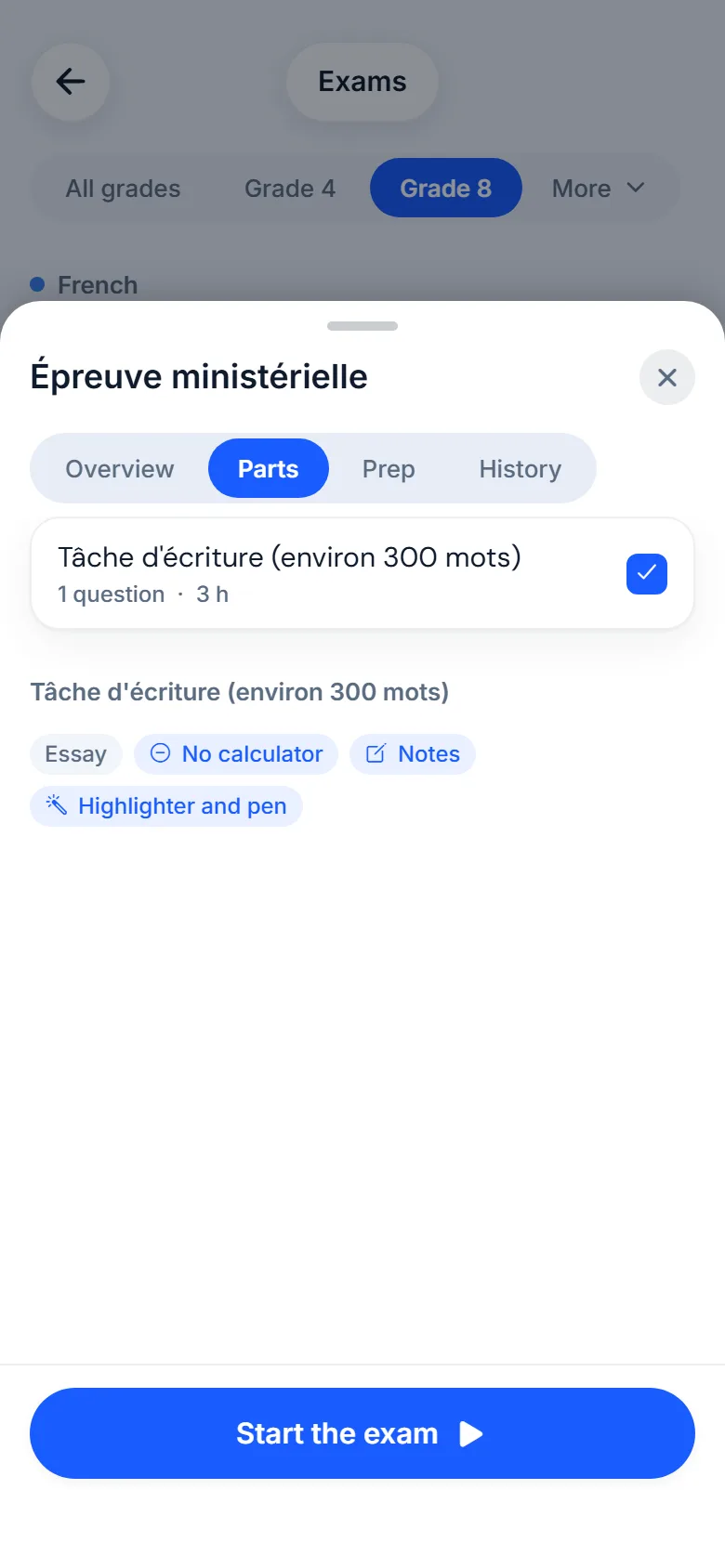 Its parts, and what you can use in each
 A question, timed, with the exam’s tools
 The marked result, part by part
A practice run of Saskatchewan’s Grade 9 math assessment.
Free with a MapleMind account
When
June 2027 session
- Tuesday, May 11, 20279:00 a.m.-11:30 a.m. · Écriture – activités préparatoires (132‑208)
- Wednesday, May 12, 20279:00 a.m.-12:00 p.m. · Écriture (132‑208)
The dates are Quebec’s own, read on September 28, 2026. See the official schedule (quebec.ca)
What’s on it
- Écrire des textes variés: describe and justify for an imposed addressee100%About 300 words
The skills it tests · 54 skills
- Découverte guidée : L’analyse et la production du genre — la cause (analysing and producing a text genre)
- Découverte guidée : L’identification des énonciateurs — Observer les ressemblances et les différences entre… (identifying the speakers in reported speech)
- Découverte guidée : Le nom et son sens — la phrase transformée de forme emphatique… (the noun (common / proper) and its sense)
- Découverte guidée : Les marques énonciatives — la répétition (enunciative marks (speaker/addressee presence))
- Découverte guidée : Les temps verbaux et leurs valeurs — le mode et les temps qui ont une valeur temporelle… (tenses and their values)
- L’adjectif et son accord — un GAdj ou un GN (the adjective and adjective agreement)
- L’harmonisation des temps verbaux autour du temps dominant
- L’identification des énonciateurs — les marques énonciatives qui renvoient à… (identifying the speakers in reported speech)
- L’identification des énonciateurs — les marques énonciatives qui renvoient au… (identifying the speakers in reported speech)
- L’identification des énonciateurs — par les rôles respectifs des énonciateurs (identifying the speakers in reported speech)
- La non-contradiction entre les raisons de la justification
- La phrase subordonnée — le subordonnant que (subordinate clauses)
- La précision du vocabulaire — un vocabulaire neutre ou expressif (precise and appropriate vocabulary)
- Le contexte de production et de réception — Prendre en considération le contexte de réception… (context of production and reception)
- Le discours direct — Les points de suspension entre crochets [...] pour… (direct reported speech)
- Le discours direct — par l’établissement de liens entre un commentaire… (direct reported speech)
- Le discours direct — Un contexte annonciateur avec ou sans la… (direct reported speech)
- Le discours indirect — les marques du discours indirect Un verbe… (indirect reported speech)
- Le groupe prépositionnel — GPrép, complément de l’adjectif (the prepositional group and its functions)
- Le groupe prépositionnel — la préposition se distingue de l’adverbe par un… (the prepositional group and its functions)
- Le groupe prépositionnel — une préposition + GN (the prepositional group and its functions)
- Le groupe verbal, prédicat — d’attribut du sujet (the verb group (predicate))
- Le nom et son sens — avec mais (the noun (common / proper) and its sense)
- Le nom et son sens — erreurs à corriger : éléments justaposés ou… (the noun (common / proper) and its sense)
- Le nom et son sens — la présence ou l’absence d’un déterminant (the noun (common / proper) and its sense)
- Le nom et son sens — par un GAdv : ici, là, là-bas (the noun (common / proper) and its sense)
- Le nom et son sens — phrases de forme négative (the noun (common / proper) and its sense)
- Le nom et son sens — pour les titres d’ouvrages (the noun (common / proper) and its sense)
- le passé simple : 3 personne (1 et 2 ); toutes les personnes des verbes à l’étude (4.3)
- Le pronom — le sujet est le pronom on (the pronoun as a naming/reprise device)
- Le titre neutre ou évocateur — , s’il y a lieu, un titre neutre ou évocateur (neutral or evocative title)
- Les compléments du verbe — complément indirect (verb complements (direct / indirect))
- Les compléments du verbe — la phrase subordonnée complétive, complément direct (verb complements (direct / indirect))
- Les figures de style — certains autres temps qui gravitent autour du… (figures of speech (comparison, metaphor, etc.))
- Les figures de style — Comprendre le sens et l’intérêt des figures… (figures of speech (comparison, metaphor, etc.))
- Les figures de style — l’emploi figuré des mots (figures of speech (comparison, metaphor, etc.))
- Les figures de style — La métaphore (figures of speech (comparison, metaphor, etc.))
- les indications typographiques (capitales, gras, italique)
- Les relations de sens entre les mots — par un terme générique (sense relations (synonym, antonym, families of words))
- Les temps verbaux et leurs valeurs — Avec les verbes exprimant un mouvement ou une… (tenses and their values)
- Les temps verbaux et leurs valeurs — falloir, mettre, sortir, venir, vivre (tenses and their values)
- Les temps verbaux et leurs valeurs — l’imparfait de narration : dans un récit au passé… (tenses and their values)
- Les temps verbaux et leurs valeurs — les mots et les groupes de mots qui situent Les… (tenses and their values)
- Les temps verbaux et leurs valeurs — un GAdv (tenses and their values)
- Prendre en compte son destinataire — sa connaissance du sujet (taking the addressee into account)
- Prendre en compte son destinataire — sa connaissance du sujet (taking the addressee into account)
- Prendre en compte son destinataire — sa connaissance du sujet, ses goûts (taking the addressee into account)
- Prendre en compte son destinataire — ses connaissances, ses champs d’intérêt, ses goûts (taking the addressee into account)
- sa connaissance du sujet, ses goûts et, si pertinent, ses valeurs
- ses caractéristiques : sa renommée, sa connaissance du sujet
- ses caractéristiques : son âge, sa connaissance du sujet, ses goûts
- subordonnée complétive complément direct ou indirect du verbe
- un plan temporel : les différents aspects sont des étapes ou des phases présentées selon leur déroulement dans le temps
- verbes en –ir qui ont un participe présent en –ant (comme couvrir, cueillir, dormir, offrir, servir, souffrir, ouvrir)

How it’s built
An essay.
- PréparationNot marked
- Time
- 150 min
- A task
- Tâche d'écriture (environ 300 mots)
- Time
- 180 min
- Question
- 1
- Marks
- 100
- Of the marks
- 100%
- Essay
Plan, write, revise and correct, on your own, a text of about 300 words that describes and justifies, for a set reader, using your notes notebook.
How it’s marked
Your school marks it out of 100, with the ministry's grid. There's no pass mark: the result counts for 20% of your final writing result.
On the day
- Day 1Preparation in class with a set of documents: you read and take notes, for about two and a half hours.
- Day 2Your text of about 300 words, in 3 hours.
On writing day, you keep only your notes notebook, a French dictionary, a grammar and a conjugation book. All the documents stay in class until the writing is done. Up to 15 more minutes if you need them.
Getting ready
2 official documents to practise with, and 3 tips.
Official practice
Tips from the people who write it
- Your notes notebook is the only document you keep on writing day: organize what you'll need in it.
- Describe and justify, for the reader you're given.
- Sentences and punctuation, together with spelling, are 45% of the mark: keep time to revise and correct.
The mark you need
Your class mark counts for 80% of the final mark, the exam for 20%. Quebec may moderate your class mark before it’s blended.
You need
50% on the exam
With 75% in class, your final mark lands between 60% (0 on the exam) and 80% (100% on it).
After the exam
- Results
Your school marks it, and the result is part of your final mark for the year.
- If you miss it
With a valid reason (a serious illness or accident with a medical note, the death of a close relative, a court summons), your final mark is worked out from your three terms. Without one, your school’s own rules apply.
From About the ministerial examinations (Quebec) (quebec.ca) and Administrative Guide for the Certification of Studies and Management of Ministerial Examinations (the edition Quebec links today) (cdn-contenu.quebec.ca), read on October 27, 2026.
More for you
Students
Start with the topics worth the most marks, then write full practice exams under the real time limit.
Practise itParents
Put the dates on the family calendar. The Parent Dashboard shows each practice exam’s result and the skills that need another look.
See the Parent DashboardEducators
The topic weights and the official practice above make a review plan. Students can practise each skill on its own in MapleMind, free with daily limits.
For schools
Questions about this exam
When is the Français, langue d'enseignement, Secondary II in 2026–27?
The next sitting is May 11, 2027, 9:00 a.m.-11:30 a.m..
How long is the Français, langue d'enseignement, Secondary II?
It takes 5 hours 30 minutes in all, over 1 part.
How many questions are on the Français, langue d'enseignement, Secondary II?
It has 1 marked questions.
Can you use a calculator on the Français, langue d'enseignement, Secondary II?
No. Calculators aren’t allowed.
How much does the Français, langue d'enseignement, Secondary II count?
It’s worth 20% of the final mark in Français, langue d’enseignement, 2e secondaire.
Where can I find practice tests for the Français, langue d'enseignement, Secondary II?
MapleMind builds a full practice exam in its format. Start it from this page, free with an account.

Practise for the Français, langue d'enseignement, Secondary II
Every skill on the Français, langue d'enseignement, Secondary II, taught one at a time, then practised on questions written like the real ones.