Ministerial exam · Quebec
Français, langue d'enseignement, Elementary Grade 4
Ministerial Examinations — Français, langue d'enseignement, Elementary Grade 4: Reading (014‑430) and Writing (014‑420)
- Grade 4
- Written in French
Dates and details can change. We do our best to keep this page up to date, but check the official sources before relying on it.
- Total time
- 8 h
- Marked questions
- 25
- Parts
- 2
- Counts for
- 20% of the final mark
- Calculator
- Not allowed
- Format
- On paper
Épreuve de français, 4e année du primaire practice test
The whole exam or the parts you choose, in its own format, on the clock.
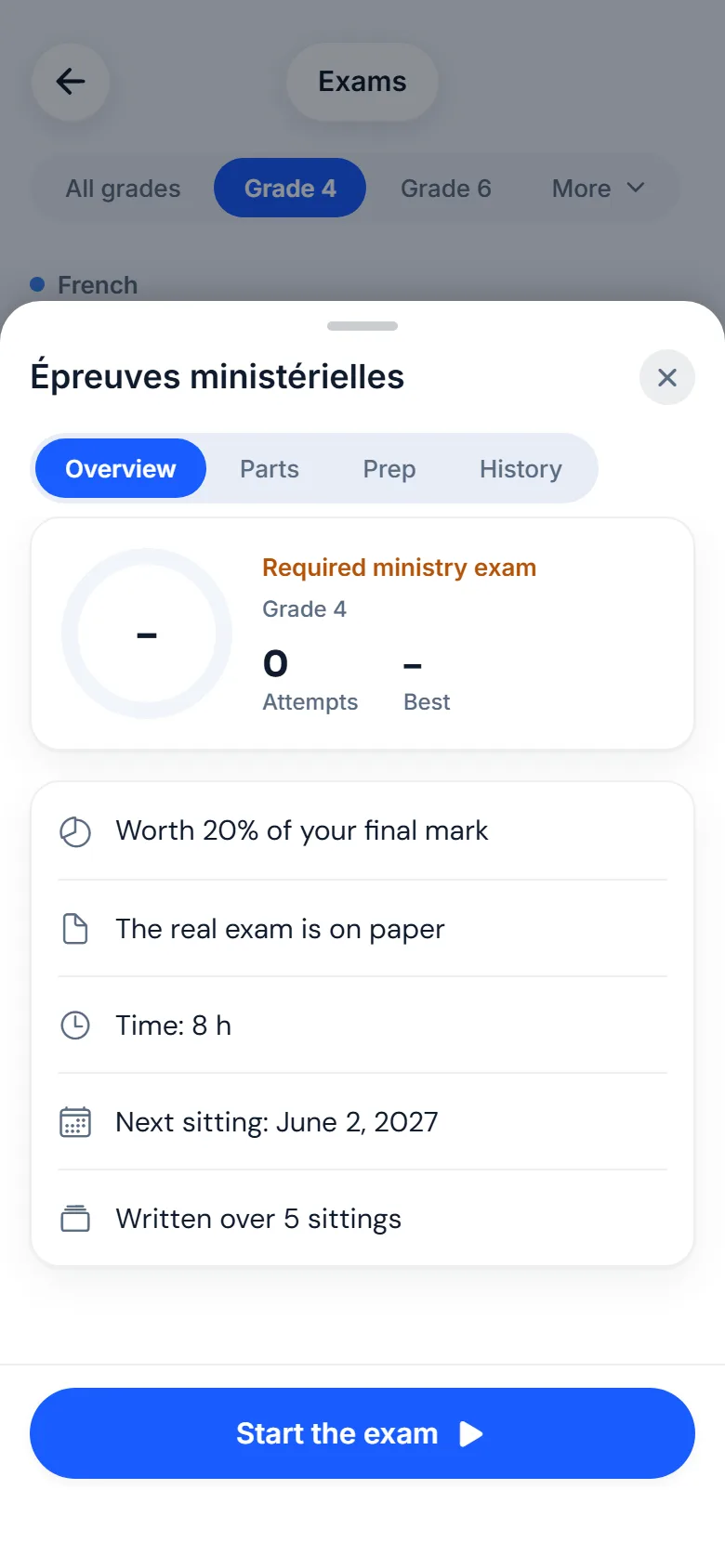 The exam in the app
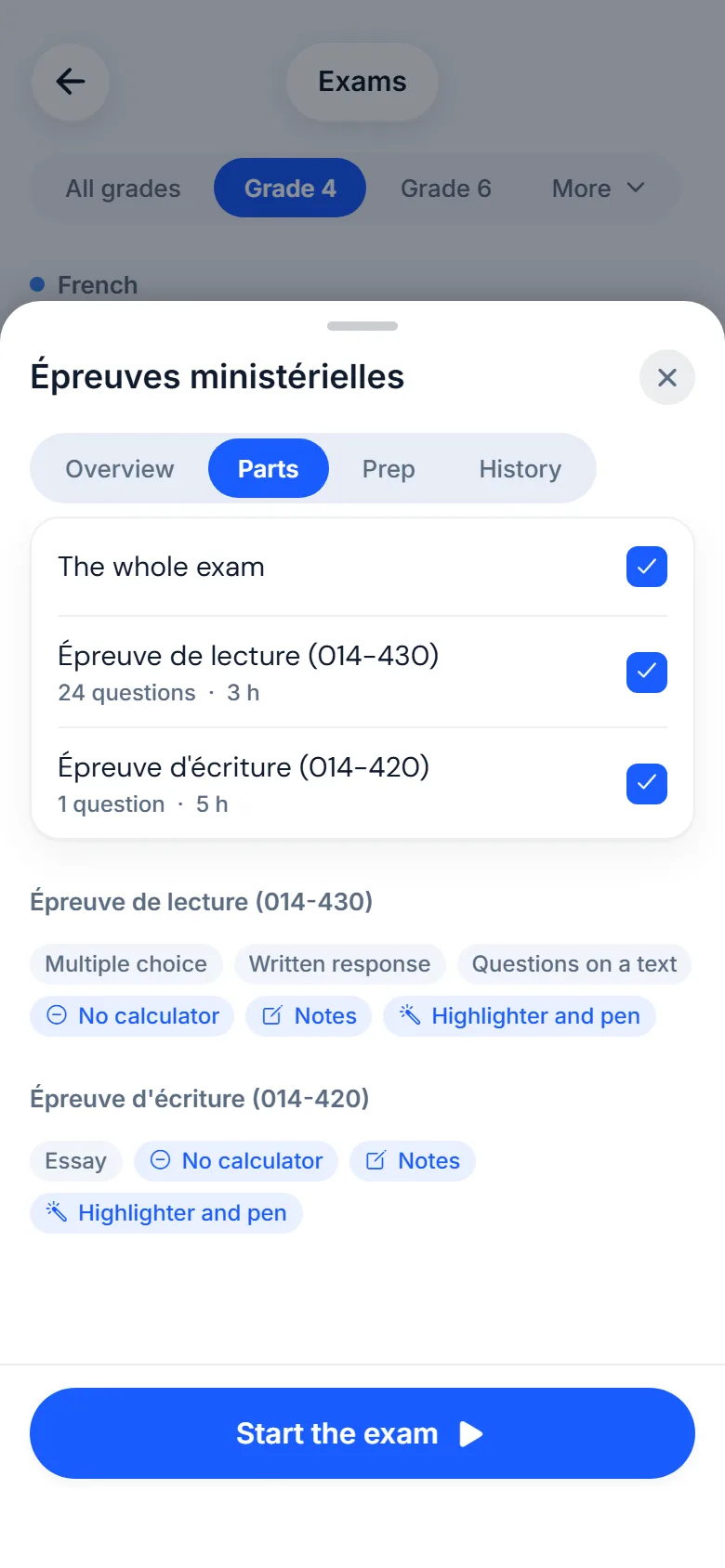 Its parts, and what you can use in each
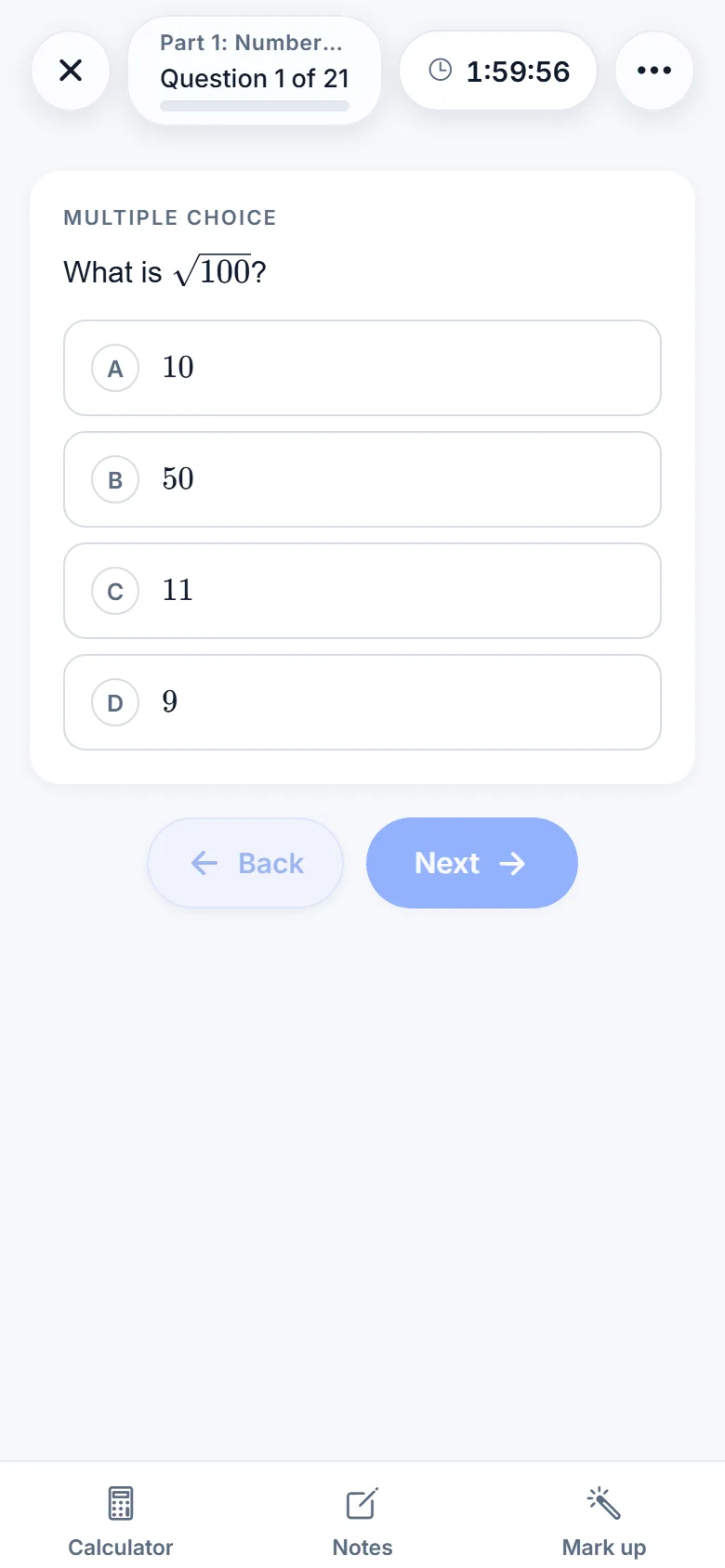 A question, timed, with the exam’s tools
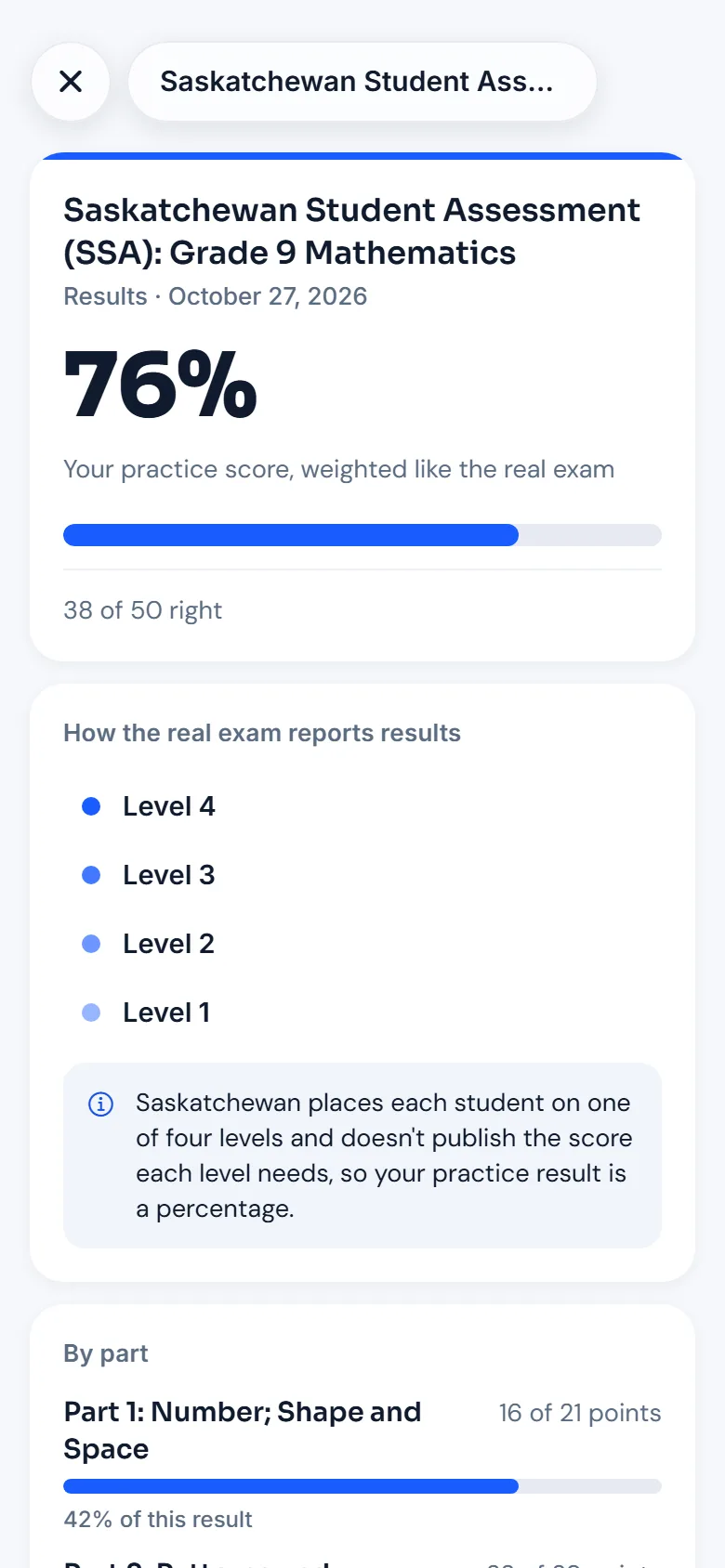 The marked result, part by part
A practice run of Saskatchewan’s Grade 9 math assessment.
Free with a MapleMind account
When
June 2027 session
- Wednesday, June 2, 2027Set by the school (about 1 h 30) · Lecture – texte littéraire (014‑430)
- Thursday, June 3, 2027Set by the school (about 1 h 30) · Lecture – texte courant (014‑430)
- June 7 to June 9, 2027Set by the school (about 1 h 30, 1 h 30 and 2 h) · Écriture (014‑420), three half-days
The dates are Quebec’s own, read on September 28, 2026. See the official schedule (quebec.ca)
What’s on it
- Lecture, tâche 1: texte littéraireAbout a dozen questionsNot published: the two tasks' points are added
- Lecture, tâche 2: texte courantAbout a dozen questionsNot published: the two tasks' points are added
- Écriture: a story planned from an illustration100%Of the writing result · Five criteria, 20% each
The skills it tests · 133 skills
- Ajouter un complément du nom formé de à ou de de et d’un groupe du nom (adding « à » or « de » complements to a noun)
- Apprécier une œuvre avec des critères : thème, valeurs, sonorités, style (appreciating a work with criteria)
- Appuyer ses réactions sur des passages du texte (backing reactions with passages)
- Choisir des œuvres grâce à ce qu’on sait des auteurs, des illustrateurs et des genres (choosing books by author, illustrator and genre)
- Choisir les bonnes stratégies selon la situation de lecture (choosing the right reading strategies)
- Choisir ses mots dans ses cartes thématiques et parmi des synonymes (choosing words with theme maps and synonyms)
- Commenter différents aspects d’une œuvre, ses forces et ses faiblesses (commenting on a work’s strengths and weaknesses)
- Comparer la couverture et la quatrième de couverture de plusieurs livres (comparing front and back covers)
- Comparer son appréciation avec celle des autres à l’oral (comparing your appreciation out loud)
- Comprendre un mot nouveau grâce à sa base, son préfixe ou son suffixe (using word parts to understand new words)
- Constater les ressemblances et les différences entre des œuvres (noticing similarities and differences between works)
- Constater que les avis sur une même œuvre varient (noticing that opinions differ)
- Découverte : Ce qu’exprime un temps de verbe dans un texte (what a verb tense expresses in a text)
- Découverte : Ce que dit le complément de phrase : temps, lieu, but, cause (what a sentence complement tells)
- Découverte : Ce qui fait une phrase déclarative : sujet, prédicat, point (what makes a statement)
- Découverte : Chercher avec des mots-clés et un moteur de recherche (searching with keywords and a search engine)
- Découverte : Classer des mots selon leur préfixe ou leur suffixe pour trouver leur sens (sorting words by prefix or suffix)
- Découverte : Comparer la façon de mener une intrigue (comparing how plots unfold)
- Découverte : Comprendre une longue phrase en déplaçant ou en mettant de côté des mots (making sense of long sentences)
- Découverte : D’autres négations : ne… plus, ne… rien (other kinds of negation)
- Découverte : Délimiter les phrases grâce au sujet et au prédicat (finding sentence boundaries with subject and predicate)
- Découverte : Des mots plus précis à la place des mots passe-partout (more precise words)
- Découverte : Deux entrées pour un même mot dans le dictionnaire (one spelling, two dictionary entries)
- Découverte : Distinguer ce qui est obligatoire et ce qui est facultatif dans une phrase (required and optional parts of a sentence)
- Découverte : Effacer et remplacer les compléments du nom pour trouver le noyau (erasing or swapping noun complements)
- Découverte : Enrichir un groupe du nom et nommer la sorte d’expansion (expanding a noun group and naming the expansion)
- Découverte : Identifier le sujet, le prédicat et le complément de phrase (identifying the three sentence functions)
- Découverte : Joindre deux phrases avec une virgule, et ou ou (joining sentences with a comma, « et » or « ou »)
- Découverte : Justifier l’analyse d’une phrase avec plusieurs manipulations (justifying a sentence analysis with several tests)
- Découverte : L’introduction, le développement et la conclusion d’un texte courant (the parts of an information text)
- Découverte : La bonne préposition après un verbe : aller à l’école, aller en Ontario (the right preposition after a verb)
- Découverte : La phrase impérative, une phrase sans sujet (the imperative sentence has no subject)
- Découverte : Le complément du nom dépend du nom noyau (the noun complement depends on the head noun)
- Découverte : Le noyau du groupe sujet donne l’accord au verbe (the subject’s head noun drives agreement)
- Découverte : Le prédicat contient le verbe conjugué (the predicate contains the conjugated verb)
- Découverte : Le pronom sujet, avant ou après le verbe, à tous les temps étudiés (subject pronouns before or after the verb)
- Découverte : Le trait d’union dans les questions : va-t-il ? sont-elles ? (hyphens in inverted questions)
- Découverte : Les causes et les conséquences, les problèmes et les solutions (cause and effect, problem and solution)
- Découverte : Les contraires et les parties d’un tout (opposites and parts of a whole)
- Découverte : Les façons de poser une question à l’écrit (ways to write a question)
- Découverte : Les marqueurs de conséquence, d’explication et d’opposition (linking words for consequence, explanation and contrast)
- Découverte : Les mots formés d’une base et d’un préfixe ou d’un suffixe (words built from a base, a prefix or a suffix)
- Découverte : Les régularités de l’orthographe : -eil ou -eille ? (spelling patterns such as -eil and -eille)
- Découverte : Les textes où l’on échange : clavardage, entretien, questions-réponses (texts with exchanges)
- Découverte : Les textes qui montrent des idées en images : caricature, murale, maquette, croquis (texts that show ideas in pictures)
- Découverte : Mon amie, cet arbre : les déterminants devant une voyelle (mon, ton, son and cet before a vowel)
- Découverte : Préciser ses idées en ajoutant des compléments de phrase (sharpening ideas with sentence complements)
- Découverte : Prouver l’accord du verbe en changeant le sujet (proving verb agreement by swapping the subject)
- Découverte : Relever les questions d’un texte et justifier son choix (finding questions in a text and explaining why)
- Découverte : Sujet, prédicat et complément de phrase dans la phrase déclarative et la question (the parts of statements and questions)
- Découverte : Transformer un récit en changeant le personnage, le moment ou le lieu (rewriting a story with a new character, time or place)
- Découverte : Trouver le sujet avec « C’est… qui » et le remplacer par un pronom (finding the subject)
- Découverte : Un manche, une manche : même forme, autre genre, autre sens (same word, different gender, different meaning)
- Découverte : Vérifier dans le dictionnaire les classes possibles d’un mot (checking a word’s possible classes in the dictionary)
- Découvrir des œuvres du Québec (discovering books from Quebec)
- Découvrir les collections, les séries et les maisons d’édition (discovering book collections and publishers)
- Défendre son interprétation avec des raisons (defending your interpretation with reasons)
- Des idées pertinentes, suffisantes et bien reprises (relevant, sufficient, well-linked ideas)
- Développer sa sensibilité à la langue : expressions imagées et jeux de sonorités (enjoying imagery and sound play)
- Dire ce qu’on aurait changé dans un texte (saying what you would have changed)
- Identifier le thème et les valeurs d’une histoire (identifying a story’s theme and values)
- Inférer l’implicite (inferring implicit meaning)
- Justifier l’accord de l’adjectif après être (explaining adjective agreement after « être »)
- Justifier l’accord du verbe par un raisonnement complet (explaining a verb agreement step by step)
- Justifier la classe d’un mot dans la phrase : nom, déterminant, adjectif ou verbe conjugué (justifying a word’s class in context)
- Justifier les virgules d’une énumération (explaining the commas in a list)
- L’accord de l’adjectif après le verbe être (adjective agreement after « être »)
- L’accord de l’adjectif avec le nom et la formation du féminin (adjective agreement and forming the feminine)
- L’apostrophe (l’élision) (the apostrophe (elision))
- L’infinitif, le participe présent et le truc du futur proche (infinitive, present participle and the near-future trick)
- L’ordre chronologique et l’ordre des étapes (time order and step order)
- La majuscule (capital-letter rules)
- La place, l’accord et le rôle facultatif du complément du nom (where the noun complement goes and how it agrees)
- La ponctuation du dialogue (dialogue punctuation)
- La règle d’accord dans le groupe du nom : le déterminant et l’adjectif suivent le nom (agreement in the noun group)
- La suite des événements dans l’intrigue (the sequence of events in the plot)
- La virgule dans une énumération (commas in a list)
- Le pluriel et le féminin des noms propres : les deux Étienne, une Espagnole (plural and feminine of proper nouns)
- Le présent des verbes modèles : aimer, céder, finir, aller, avoir, être (the present tense of model verbs)
- Le pronom de conjugaison sujet donne l’accord au verbe (the subject pronoun drives verb agreement)
- Le radical et la terminaison du verbe (verb stem and ending)
- Le rôle des points de suspension et des virgules en lecture (what ellipses and commas tell the reader)
- Le sens propre d’un mot et ses sens proches (a word’s literal meaning and related meanings)
- Le sujet peut être un pronom de conjugaison (a subject can be a pronoun)
- Les adverbes ne changent jamais : ici, lentement, souvent, très (adverbs never change)
- Les caractéristiques du nom (characteristics of the noun)
- Les caractéristiques du verbe : il se conjugue et reçoit l’accord du sujet (what makes a verb a verb)
- Les déterminants d’un mot ou de plusieurs mots : cet, la, beaucoup de, un million de (one-word and multi-word determiners)
- Les déterminants qui annoncent un nom : un, cette, mon, beaucoup de… (determiners that signal a noun)
- Les divisions d’un livre : sections, chapitres, intertitres et pages de garde (the parts inside a book)
- Les familles de mots : magie, magique, magicien (word families)
- Les genres de textes (text genres)
- Les indices graphiques : gras, italique, soulignement (visual clues to important information)
- Les lettres muettes qui marquent la personne : ils chantent (silent letters that mark the person)
- Les marques de genre et de nombre qu’on entend… ou pas (gender and number marks you can or can’t hear)
- Les mots à l’étude (banque orthographique) (the study-word spelling bank)
- Les mots de liaison ne changent jamais : et, mais, car, quand, lorsque (conjunctions never change)
- Les mots interrogatifs : qui, où, quand, combien, quel… (question words)
- Les noms à une seule forme pour les deux genres : un ou une artiste (nouns with one form for both genders)
- Les outils de référence : dictionnaire, lexique, tableau de conjugaison, catalogue (reference texts)
- Les prépositions ne changent jamais : à, de, pour, sur, à cause de (prepositions never change)
- Les stratégies orthographiques (spelling strategies)
- Les textes qui décrivent : la notice informative et la description (descriptive texts: information labels and descriptions)
- Les textes qui disent comment faire : marche à suivre, mode d’emploi, règles de jeu (how-to texts)
- Les textes qui expliquent : l’album documentaire et l’article (explanatory texts: information books and articles)
- Les textes qui jouent avec les mots : calligramme, acrostiche, proverbe, rébus, slogan (texts that play with words)
- Les textes qui veulent convaincre ou faire agir : publicité, affiche, invitation, petite annonce (texts that persuade or call to action)
- Les traits de caractère des personnages (character traits)
- Lire des œuvres pour explorer le monde : voyager dans l’espace et le temps (reading to explore places and times)
- Lire des textes courants pour répondre à ses questions et accomplir des tâches (reading to answer questions and get things done)
- Lire par groupes de mots grâce aux indices de grammaire (reading in meaningful word groups)
- Organiser ses idées : l’ordre et les paragraphes (organising ideas: order and paragraphs)
- Parler des livres avec les bons mots : auteur, illustrateur, collection, intrigue (talking about books with the right words)
- Participer à des expériences littéraires : cercle de lecture, rencontre d’auteur (taking part in literary activities)
- Ponctuer une phrase à deux verbes conjugués : quand, parce que, si (punctuating a two-verb sentence)
- Positive ou négative, et le ne qu’on oublie à l’oral (positive or negative, and the dropped « ne »)
- Préciser ses idées en ajoutant des compléments du nom (sharpening ideas with noun complements)
- Prédire la suite à partir de ce qu’on a lu (predicting what comes next)
- Reconnaître ses réussites et ses progrès de lecteur (recognising your progress as a reader)
- Reconnaître un adjectif : le remplacer par un autre ou ajouter très (spotting an adjective with tests)
- Reconnaître un verbe : ajouter un pronom, encadrer par ne… pas (spotting a verb with tests)
- Relier les informations répétées ou reprises dans un texte (linking information found in several places)
- Repérer la négation et les mots interrogatifs en lisant (spotting negation and question words when reading)
- Repérer les mots-clés porteurs de sens dans une phrase (finding the key words in a sentence)
- Repérer les répétitions, les ajouts et les oppositions dans un texte (spotting repetitions, build-ups and contrasts)
- Se dépanner avec la banque de stratégies (using the strategy bank)
- Se dépanner en lisant : demander l’aide de quelqu’un (getting help when stuck)
- Se servir de ses lectures pour réaliser des projets (using reading for projects)
- Situer un verbe sur la ligne du temps : imparfait, présent, futur simple (placing verbs on a timeline)
- Survoler un texte : intertitres, sections et chapitres (previewing a text)
- Transformer une phrase positive en phrase négative (turning a sentence negative)
- Trouver le groupe du nom et son nom noyau (finding the noun group and its head)
- Trouver un mot dans le dictionnaire et lire son entrée (finding a word and reading its entry)
How it’s built
Multiple-choice questions, written answers, questions in sets and an essay.
- Épreuve de lecture (014‑430)
- Time
- 180 min
- Questions
- 24
- Marks
- 100
- Of the marks
- 62.5%
- Multiple choice
- Written answers
- Questions in sets
Two reading tasks on two half-days, each in one block: a story on the first day and an informational text on the second, about 1,000 words each. Then about a dozen written questions on each, answered from the text.
- Épreuve d'écriture (014‑420)
- Time
- 300 min
- Question
- 1
- Marks
- 100
- Of the marks
- 37.5%
- Essay
Tell a story, planned from a picture, over three half-days: plan it, write and revise a draft, then correct it and write the final copy.
How it’s marked
Your school marks each exam out of 100, with the ministry's answer key and grid. There's no pass mark: each result counts for 20% of your final result in reading, and in writing.
On the day
- Day 1Reading: a literary text, about an hour and a half.
- Day 2Reading: an informational text, about an hour and a half.
- The next weekWriting, over three half-days: about an hour and a half, another hour and a half, then 2 hours.
Two exams, reading and writing, over several half-days. You may use a French dictionary, grammars, conjugation tables and your class's correction code. Phones and other devices aren't allowed, and no one may help you, even by rephrasing a question.
Getting ready
3 official documents to practise with, and 4 tips.
Official practice
Tips from the people who write it
- Back up every reading answer with the text, and make your explanations full and clear.
- At the end of each reading task, correct your sentences and spelling.
- Your writing is marked on five equal criteria: fitting the task, coherence, vocabulary, sentences and punctuation, and spelling.
- Practise with the tools allowed on the day: a French dictionary, grammars, conjugation tables and your class's correction code.
The mark you need
Your class mark counts for 80% of the final mark, the exam for 20%. Quebec may moderate your class mark before it’s blended.
You need
50% on the exam
With 75% in class, your final mark lands between 60% (0 on the exam) and 80% (100% on it).
After the exam
- Results
Your school marks it, and the result is part of your final mark for the year.
- If you miss it
With a valid reason (a serious illness or accident with a medical note, the death of a close relative, a court summons), your final mark is worked out from your three terms. Without one, your school’s own rules apply.
From About the ministerial examinations (Quebec) (quebec.ca) and Administrative Guide for the Certification of Studies and Management of Ministerial Examinations (the edition Quebec links today) (cdn-contenu.quebec.ca), read on October 27, 2026.
More for you
Students
Start with the topics worth the most marks, then write full practice exams under the real time limit.
Practise itParents
Put the dates on the family calendar. The Parent Dashboard shows each practice exam’s result and the skills that need another look.
See the Parent DashboardEducators
The topic weights and the official practice above make a review plan. Students can practise each skill on its own in MapleMind, free with daily limits.
For schools
Questions about this exam
When is the Français, langue d'enseignement, Elementary Grade 4 in 2026–27?
The next sitting is June 2, 2027, Set by the school (about 1 h 30).
How long is the Français, langue d'enseignement, Elementary Grade 4?
It takes 8 hours in all, over 2 parts.
How many questions are on the Français, langue d'enseignement, Elementary Grade 4?
It has 25 marked questions: 24 in Épreuve de lecture (014-430) and 1 in Épreuve d'écriture (014-420).
Can you use a calculator on the Français, langue d'enseignement, Elementary Grade 4?
No. Calculators aren’t allowed.
How much does the Français, langue d'enseignement, Elementary Grade 4 count?
It’s worth 20% of the final mark in Français, langue d’enseignement, 4e année.
Where can I find practice tests for the Français, langue d'enseignement, Elementary Grade 4?
Quebec publishes Guide à l'intention des parents (December 2025): sample texts, questions and answers. MapleMind also builds a full practice exam in its format, free with an account.

Practise for the Français, langue d'enseignement, Elementary Grade 4
Every skill on the Français, langue d'enseignement, Elementary Grade 4, taught one at a time, then practised on questions written like the real ones.