Provincial assessment · Ontario
EQAO Junior Division Assessment: Reading, Writing and Mathematics
EQAO Junior Division Assessment (Grade 6): Reading, Writing and Mathematics
- Grade 6
Dates and details can change. We do our best to keep this page up to date, but check the official sources before relying on it.
- Total time
- 4 h 10 min
- Marked questions
- 75
- Parts
- 3
- Calculator
- In some parts
- Format
- On a computer
EQAO Grade 6 practice test
The whole exam or the parts you choose, in its own format, on the clock.
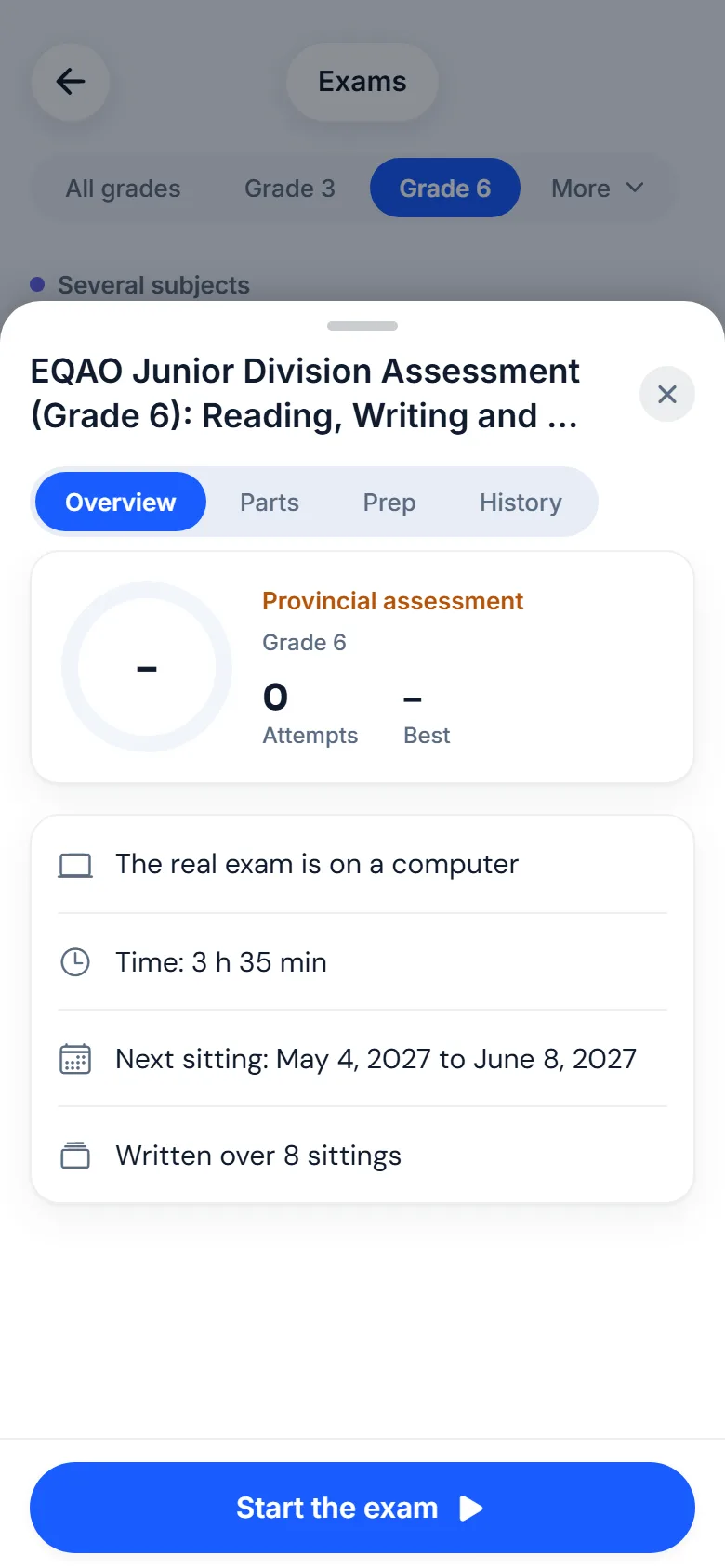 The exam in the app
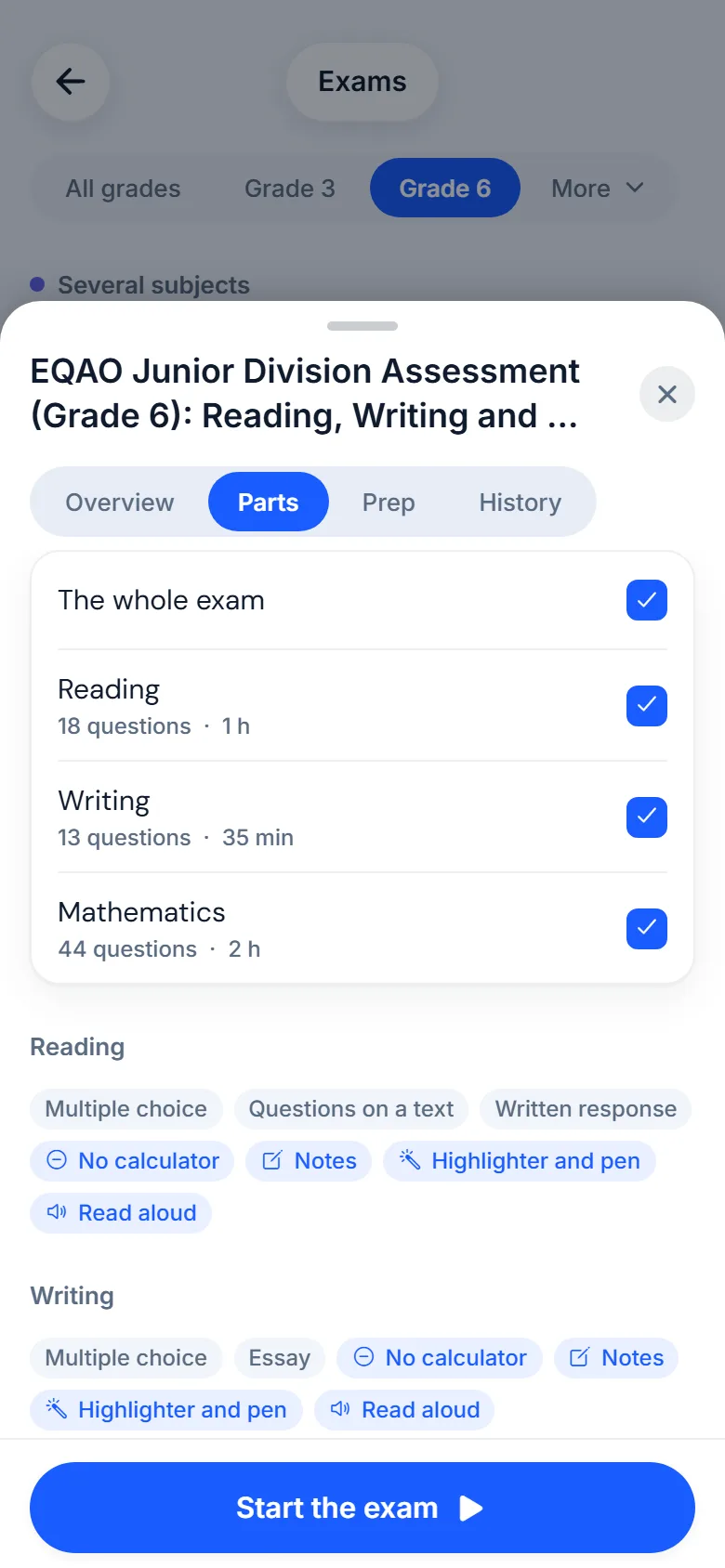 Its parts, and what you can use in each
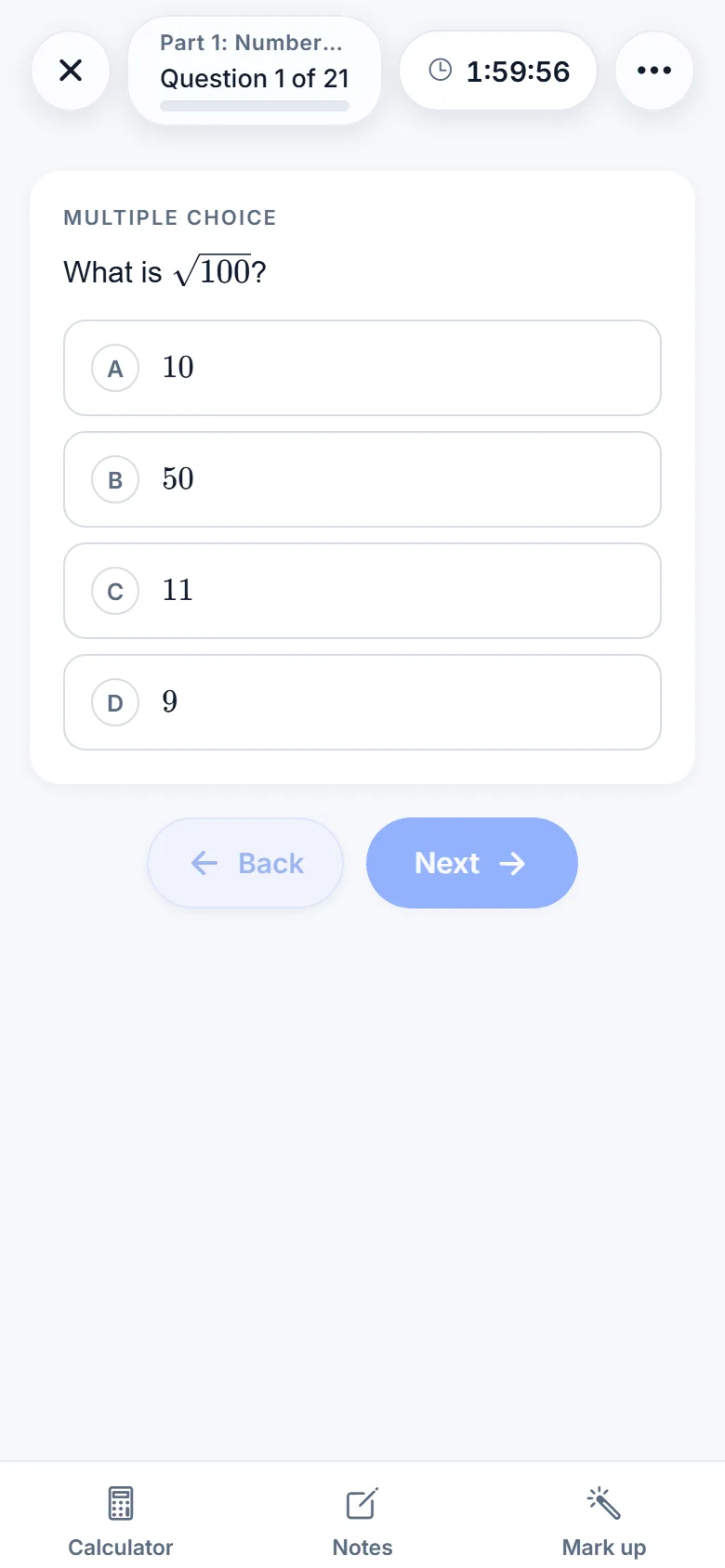 A question, timed, with the exam’s tools
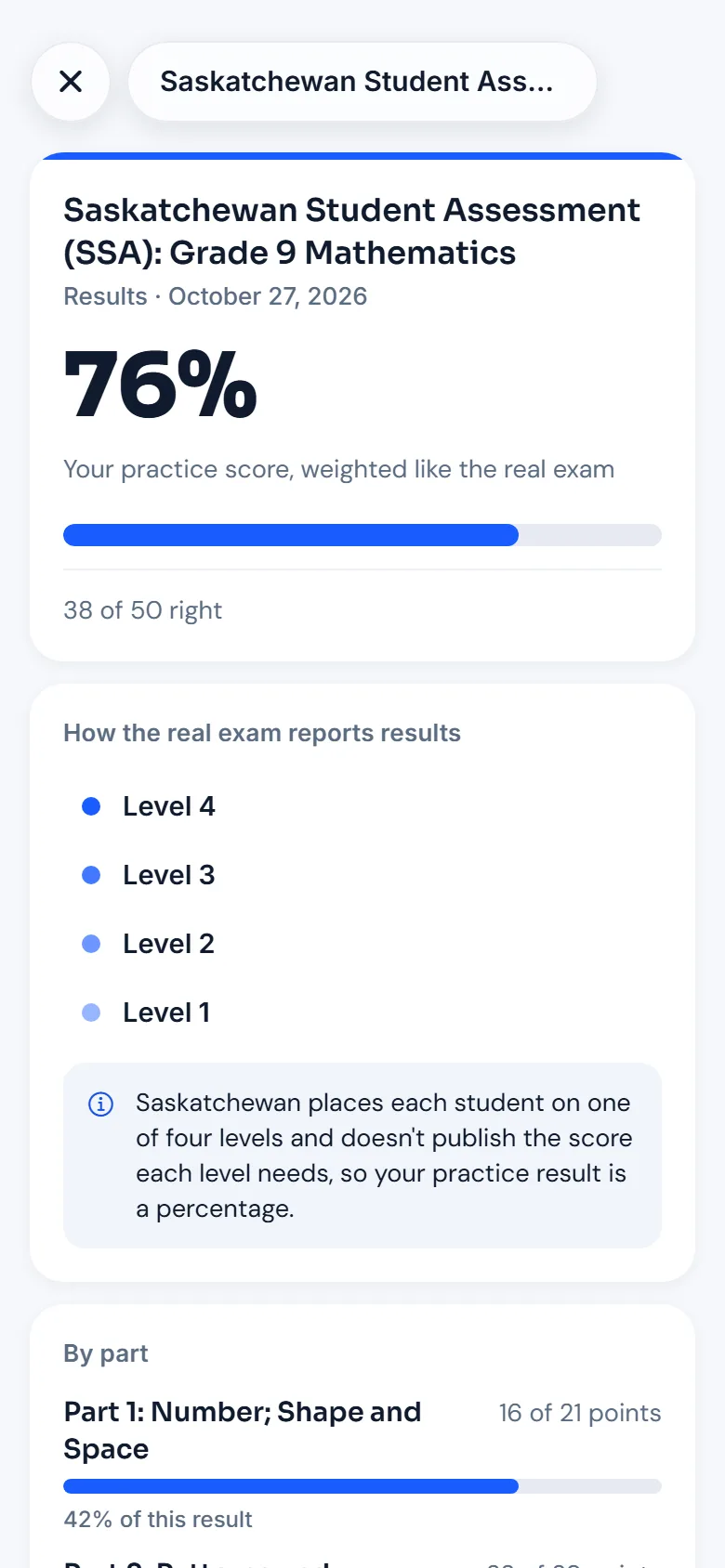 The marked result, part by part
A practice run of Saskatchewan’s Grade 9 math assessment.
Free with a MapleMind account
When
Spring 2027
- May 4 to June 8, 20276:00 a.m.–6:00 p.m. ET · Language sessions A–D and mathematics stages 1–4
The dates are Ontario’s own, read on September 28, 2026. See the official schedule (eqao.com)
What’s on it
- Reading18 scored questions, 31 raw score points; reported on its own (levels 1–4)
- Writing13 scored questions, 20 raw score points; reported on its own (levels 1–4)
Mathematics
- Number32%14 of 44
- Algebra20%9 of 44
- Data18%8 of 44
- Spatial Sense20%9 of 44
- Financial Literacy9%4 of 44
The skills it tests · 79 skills
- Active and passive voice
- Adding and subtracting fractions with like and unlike denominators
- Adding and subtracting whole and decimal numbers with estimation and algorithms
- Adding monomials with a degree of 1
- Analysing data in histograms, broken-line, and misleading graphs
- Analyzing text forms and genres
- Analyzing text patterns and features
- Analyzing texts for ideas and information
- Analyzing visuals and design
- Building and using vocabulary
- Collecting qualitative and quantitative data, organizing using intervals
- Colons in salutations and script dialogue
- Commas after transitional words
- Comparing and ordering integers, decimals, and fractions
- Complex sentences with adjective (relative) clauses
- Connecting text ideas to self, texts, and world
- Constructing 3D objects from top, front, and side views
- Creating an infographic using tables, histograms, and broken-line graphs
- Creating and translating patterns, including algebraic expressions for linear growing patterns
- Creating and using nets to show the relationship between faces and surface area
- Creating patterns to show relationships among whole and decimal numbers
- Cultural elements in texts
- Describing advantages and disadvantages of payment methods
- Describing the difference between discrete and continuous data
- Describing trading, lending, borrowing, and donating
- Determining and comparing probabilities of two independent events
- Determining areas of trapezoids, rhombuses, kites, and composite polygons
- Determining pattern rules and using algebra to solve for unknowns in linear patterns
- Determining range and measures of central tendency to compare data sets
- Determining surface areas of prisms and pyramids from their faces
- Dividing decimals to thousandths by whole numbers up to 10
- Dividing three-digit whole numbers by decimal tenths
- Dividing whole numbers by proper fractions
- Drafting texts in various genres
- Editing drafts
- Elements of style in texts
- Evaluating algebraic expressions with whole numbers and decimal tenths
- Explaining interest rates and fees on accounts and loans
- Generating and developing ideas
- Gerunds as nouns
- Identifying factors that help or interfere with reaching financial goals
- Identifying patterns and specifying which growing patterns are linear
- Identifying types of financial goals and key steps to achieve them
- Indigenous Storywork through First Nations, Métis, and Inuit texts
- Influences on First Nations, Métis, and Inuit texts
- Listing geometric properties of quadrilaterals
- Literary devices
- Making inferences
- Making predictions and posing questions
- Measuring with metric units and converting both ways
- Mental math: calculating percents of whole numbers
- Morphology: reading and spelling with word parts
- Multiplying three-digit whole numbers by decimal tenths
- Multiplying whole numbers by proper fractions
- Narrator's point of view
- Organizing and sequencing content
- Performing and predicting combined translations, reflections, and rotations up to 360°
- Perspectives and bias
- Plotting and reading coordinates in all four quadrants and describing translations
- Reading and altering code, describing effects on outcomes and efficiency
- Reading and comprehending texts
- Reading and representing integers on number lines
- Reading and representing numbers to one million
- Reading, representing, comparing, and ordering decimals to thousandths
- Representing composite numbers as products of prime factors
- Revising drafts
- Rounding terminating and repeating decimals
- Selecting and justifying a graph type, including histograms and broken-line graphs
- Showing equivalences between fractions and decimals to thousandths
- Solving and graphing two-operation inequalities up to 100
- Solving for unknown angles using angle relationship properties
- Solving multi-step problems with ratios, rates, and percents
- Solving multi-term equations with whole numbers
- Solving problems involving ratios, percents, and rates
- Summarizing
- Understanding and applying divisibility rules
- Using a protractor to measure and construct angles up to 360°
- Using fractions, decimals, and percents to express probability on a probability line
- Writing and running efficient code with conditionals and control structures
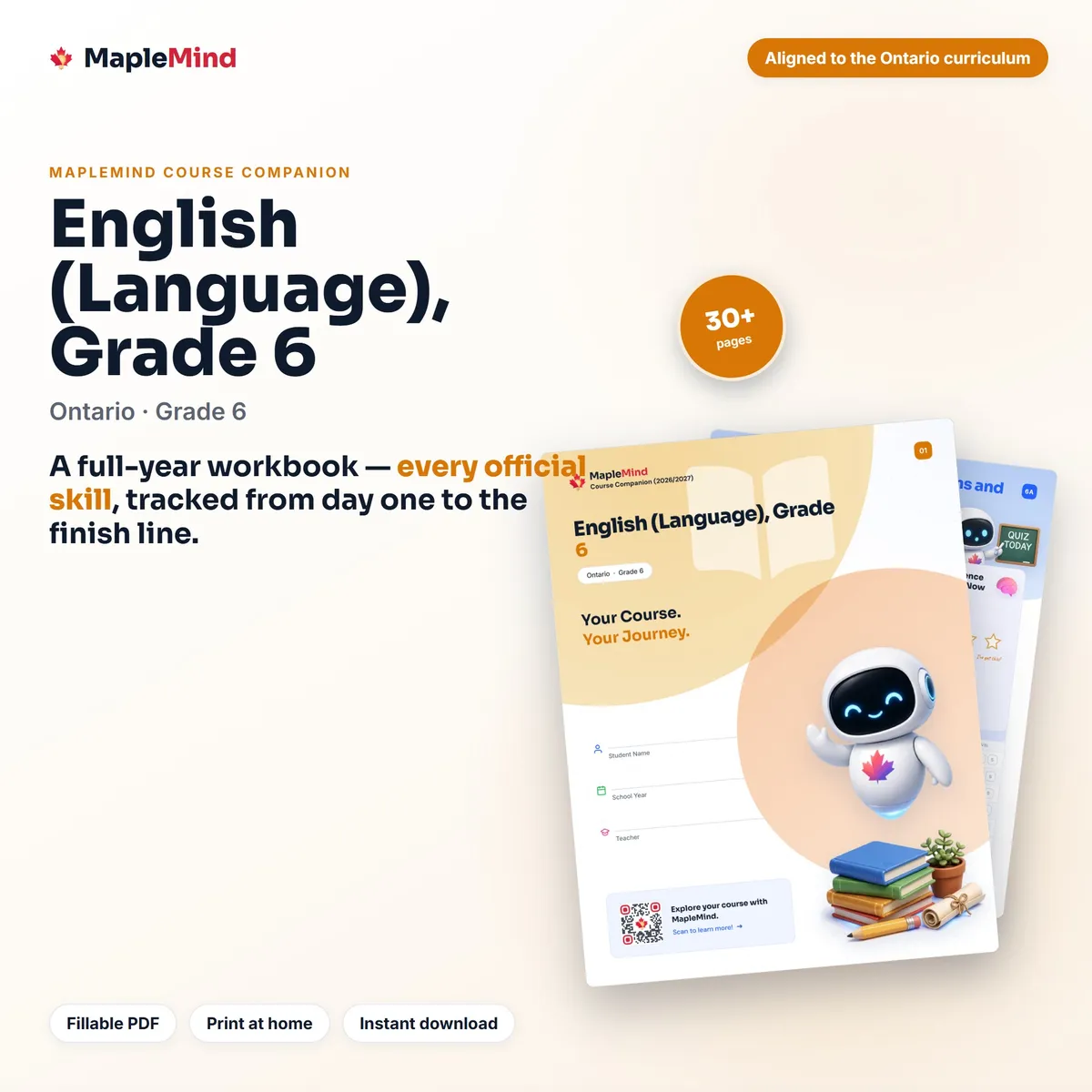
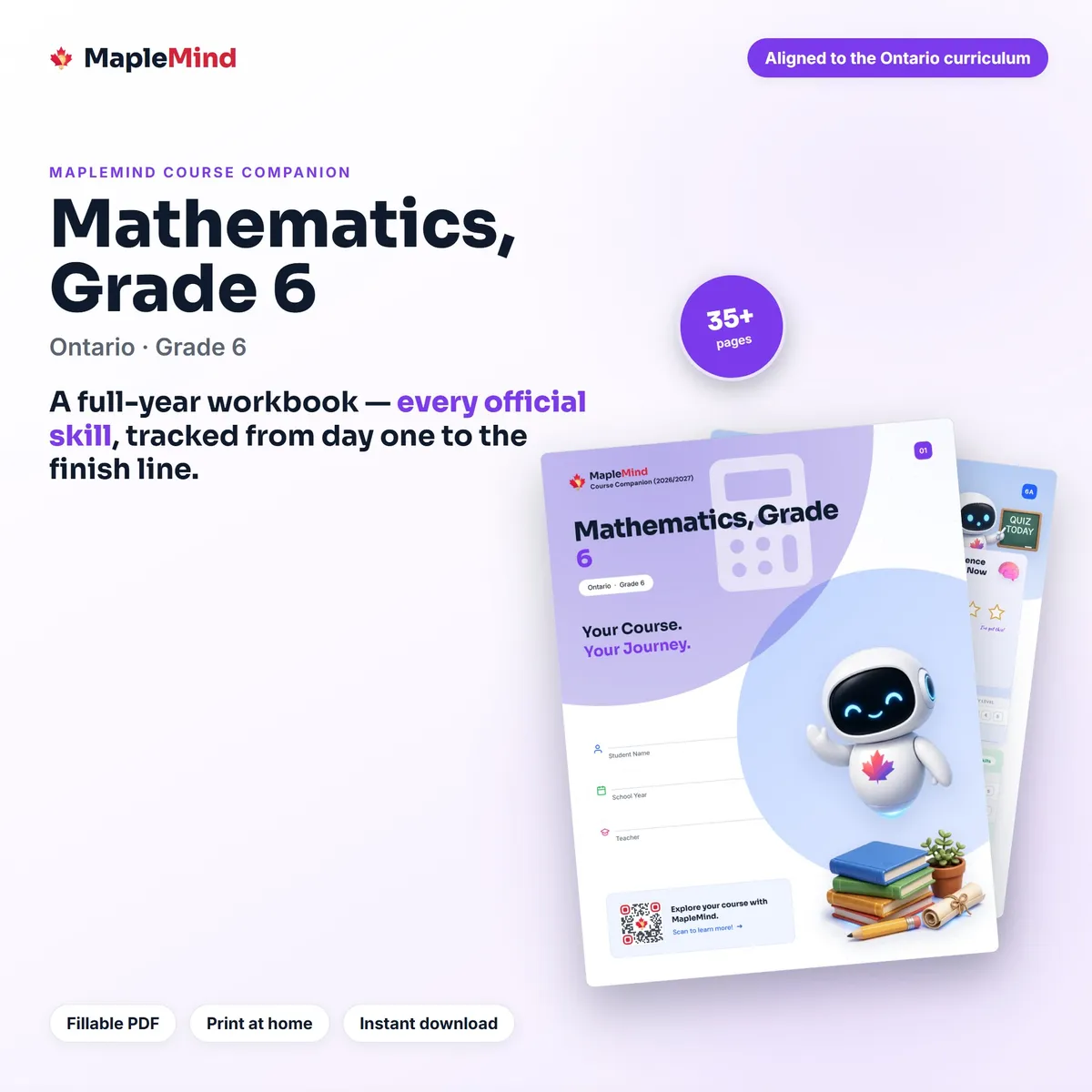
How it’s built
Multiple-choice questions, questions in sets, written answers and an essay.
- Reading
- Time
- 60 min
- Questions
- 18
- Marks
- 31
- Of the marks
- 33%
- Multiple choice
- Questions in sets
- Written answers
Read a story and an informational text, and answer questions: choose one or more answers, drag and drop, drop-down menus, and written answers.
- Writing
- Time
- 35 min
- Questions
- 13
- Marks
- 20
- Of the marks
- 33%
- Multiple choice
- Essay
Questions on planning, organizing and editing writing, and on spelling, grammar and punctuation. Then write one piece on a prompt, marked as a first draft.
- Mathematics
- Time
- 120 min
- Questions
- 44
- Marks
- 44
- Of the marks
- 34%
- Multiple choice
Math questions in four stages: drag and drop, putting things in order, drop-down menus, and choosing one or more answers. A calculator is built in.
How it’s marked
- Level 1
- Level 2
- Level 3
- Level 4
A computer marks the choice questions, and trained teachers mark your written answers. There's no pass or fail: you get a level from 1 to 4 in reading, writing and math, and Level 3 is the provincial standard.
On the day
- Provided
- EQAO Formula Sheet (Grade 6 mathematics: areas of geometric shapes)
- Over several daysYour school spreads eight short sessions across the window.
- Language sessions A to DReading in A (25 minutes) and C (35), writing in B (35), and reading or writing in D (35).
- Math stages 1 to 4About 30 minutes each.
Short online sessions that your school spreads over several days: four language sessions of 25 to 35 minutes, and four math stages of about 30 minutes. The platform has text-to-speech, zoom and a highlighter, and a calculator for math.
Getting ready
2 official documents to practise with, and 3 tips.
Official practice
Tips from the people who write it
- The sessions are short and spread out, so practise in short, focused bursts.
- Try EQAO's sample tests on the platform to get used to drag-and-drop and choose-all-that-apply questions.
- In math, a formula sheet for the areas of shapes and a calculator are on screen: practise using both.
After the exam
- Results
Your child’s Individual Student Report comes from the school by the end of September 2027.
- Marks
The results aren’t part of report card marks. EQAO says no preparation is needed beyond regular classwork.
- If you miss it
The last two days of the window are kept for students who missed their sessions. Some students are exempted if they meet EQAO’s criteria; the principal can say who.
From EQAO, Primary Division (Grade 3) (eqao.com) and EQAO, Navigating EQAO Assessments: A Friendly Guide for Parents and Guardians (eqao.com), read on October 27, 2026.
More for you
Students
Start with the topics worth the most marks, then write full practice exams under the real time limit.
Practise itParents
Put the dates on the family calendar. The Parent Dashboard shows each practice exam’s result and the skills that need another look.
See the Parent DashboardEducators
The topic weights and the official practice above make a review plan. Students can practise each skill on its own in MapleMind, free with daily limits.
For schools
Questions about this exam
When is the EQAO Junior Division Assessment: Reading, Writing and Mathematics in 2026–27?
The next sitting is May 4 to June 8, 2027.
How long is the EQAO Junior Division Assessment: Reading, Writing and Mathematics?
It takes 4 hours 10 minutes in all, over 3 parts.
How many questions are on the EQAO Junior Division Assessment: Reading, Writing and Mathematics?
It has 75 marked questions: 18 in Reading, 13 in Writing and 44 in Mathematics.
Can you use a calculator on the EQAO Junior Division Assessment: Reading, Writing and Mathematics?
In some parts only: Mathematics.
How are EQAO Junior Division Assessment: Reading, Writing and Mathematics results reported?
At 4 levels: Level 1, Level 2, Level 3 and Level 4.
Where can I find practice tests for the EQAO Junior Division Assessment: Reading, Writing and Mathematics?
MapleMind builds a full practice exam in its format. Start it from this page, free with an account.

Practise for the EQAO Junior Division Assessment: Reading, Writing and Mathematics
Every skill on the EQAO Junior Division Assessment: Reading, Writing and Mathematics, taught one at a time, then practised on questions written like the real ones.