Provincial assessment · Ontario
EQAO Grade 9 Assessment of Mathematics
- Grade 9
- MTH1W
Dates and details can change. We do our best to keep this page up to date, but check the official sources before relying on it.
- Total time
- 2 h
- Marked questions
- 50
- Parts
- 2
- Counts for
- 20% of the final mark
- Calculator
- Any calculator
- Format
- On a computer
EQAO Grade 9 Math practice test
The whole exam or the parts you choose, in its own format, on the clock.
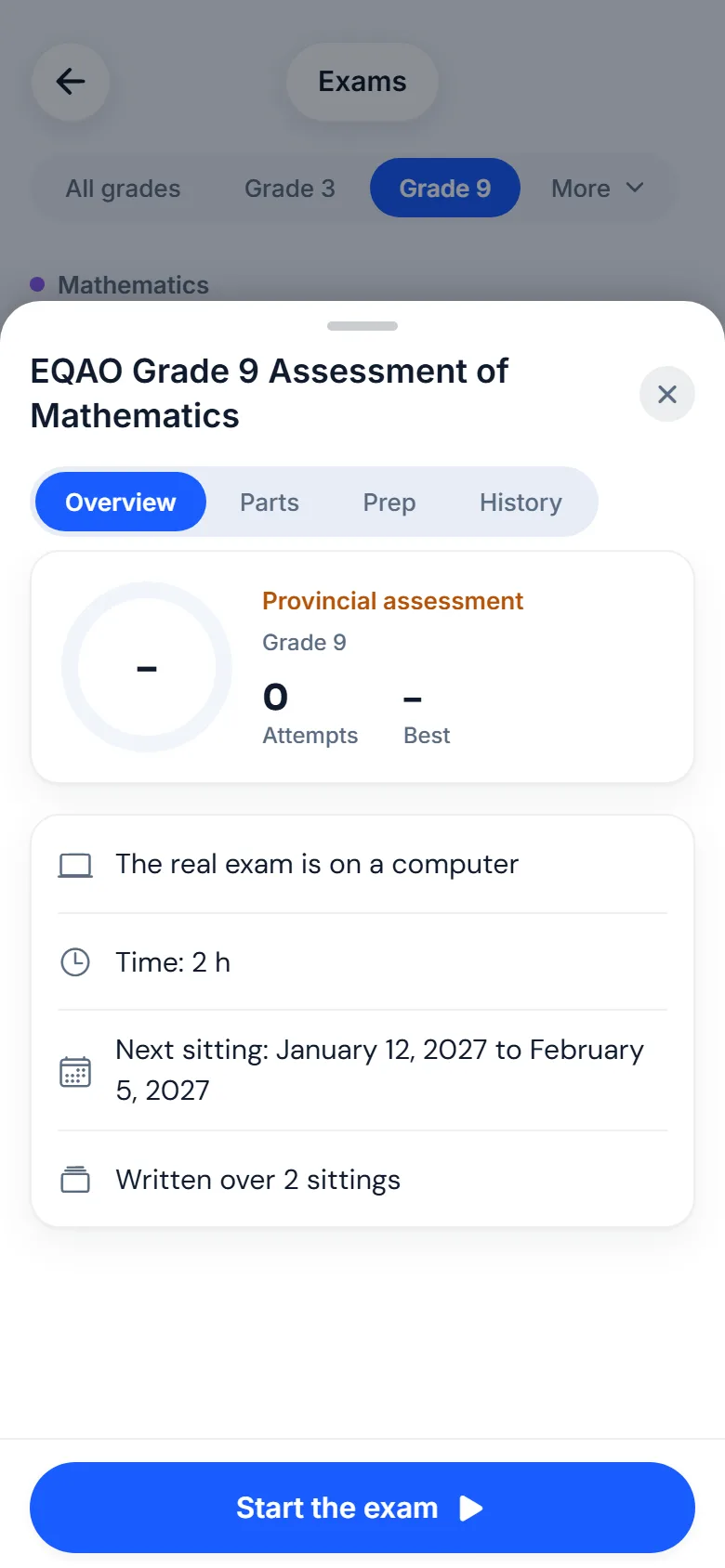 The exam in the app
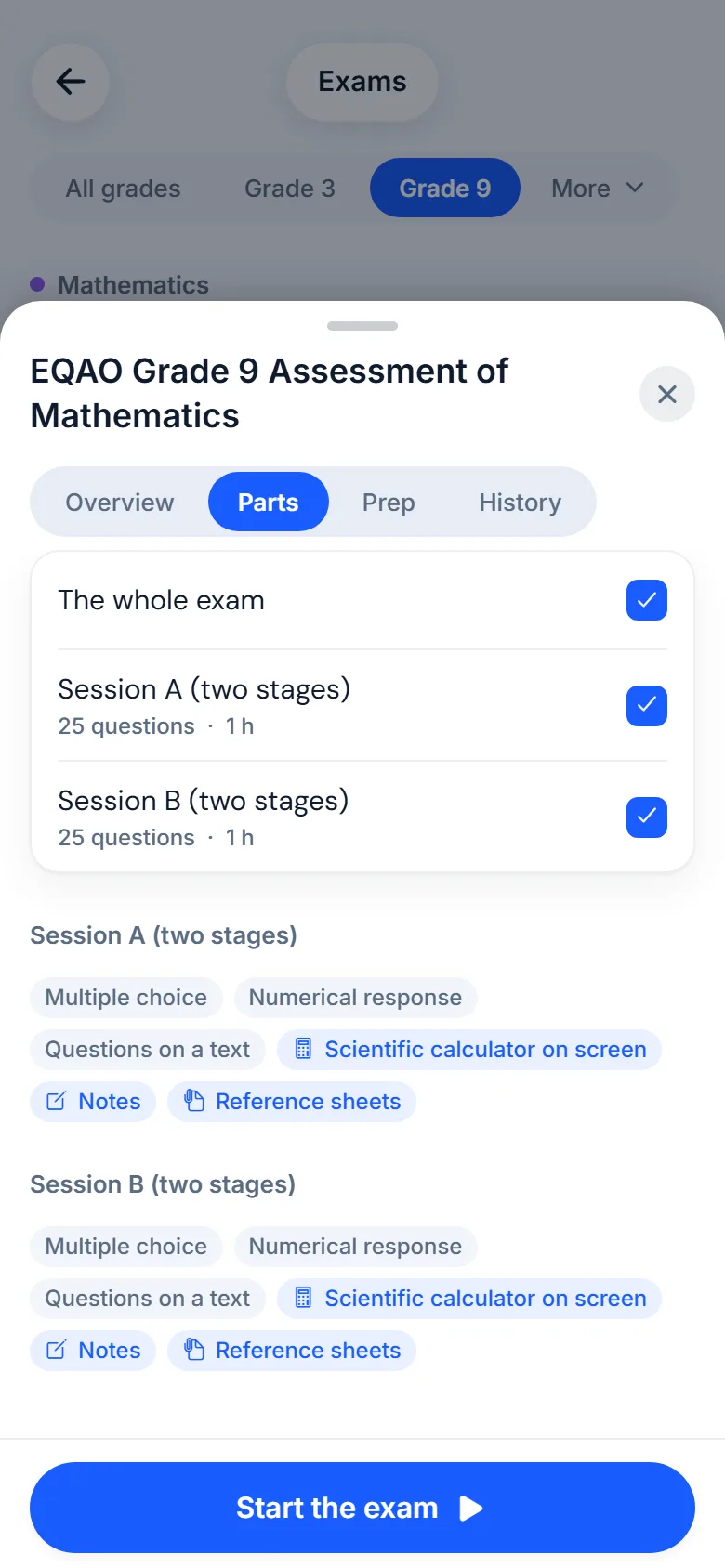 Its parts, and what you can use in each
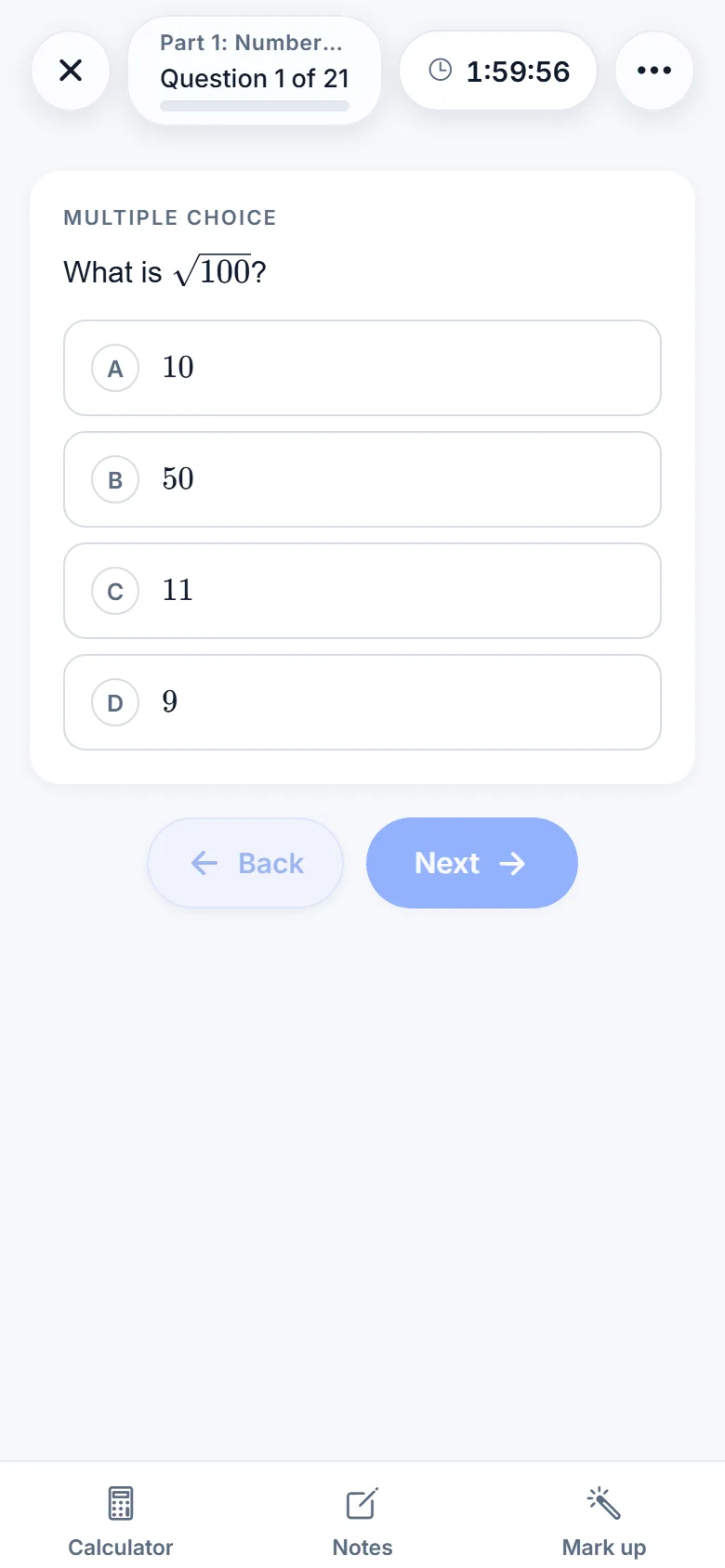 A question, timed, with the exam’s tools
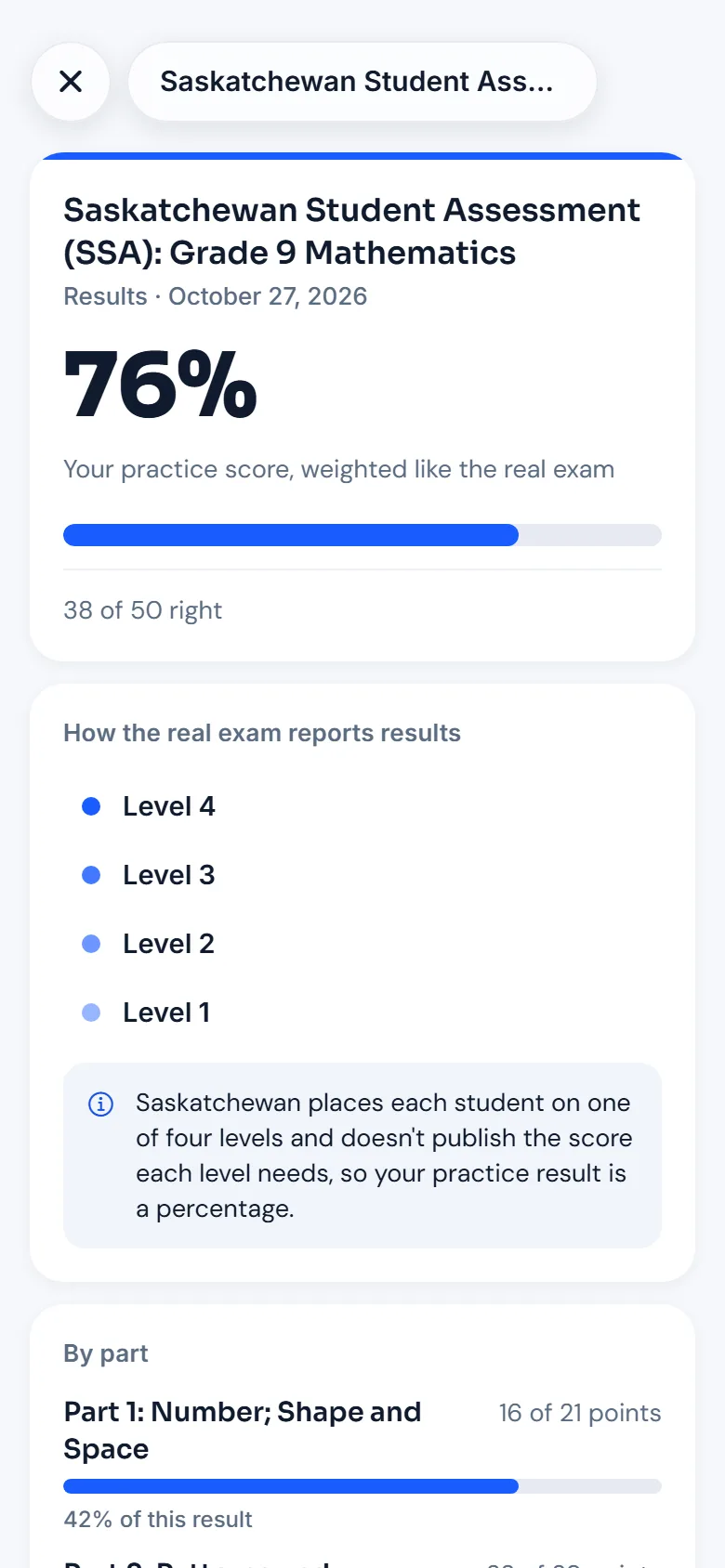 The marked result, part by part
A practice run of Saskatchewan’s Grade 9 math assessment.
Free with a MapleMind account
When
2 sessions this school year: winter and spring.
Winter 2027
- January 12 to February 5, 20276:00 a.m.–6:00 p.m. ET
Spring 2027
- June 8 to June 30, 20276:00 a.m.–6:00 p.m. ET
The dates are Ontario’s own, read on September 28, 2026. See the official schedule (eqao.com)
What’s on it
5 topics. Algebra counts most, at 36%.
- Number20%10 of 50
- Algebra36%18 of 50
- Data16%8 of 50
- Geometry and Measurement16%8 of 50
- Financial Literacy12%6 of 50
The skills it tests · 51 skills
- Analysing how the sign and size of an exponent affects the value of a power
- Analysing the relationships between exponents and operations with powers
- Applying integers to describe location, direction, amount, and change
- Applying the volume relationship between cylinders and cones
- Applying the volume relationship between prisms and pyramids
- Applying unit fractions and their relationship to other fractional amounts
- Comparing characteristics of graphs, tables of values, and equations
- Comparing expressions using concrete, numerical, graphical, and algebraic methods
- Comparing how borrowing time and down payment amount affect overall cost
- Comparing how interest rate and calculation method affect overall cost
- Comparing similarities and differences between number subsets
- Comparing the shapes of linear and non-linear graphs to describe rates of change
- Comparing two lines y = ax + b and interpreting their point of intersection
- Creating a plan to collect data, identifying assumptions and what varies
- Creating a scatter plot to represent a relationship between two variables
- Creating algebraic expressions from words, numbers, and visuals
- Creating and analysing designs using circle properties
- Creating and analysing designs using triangle and angle properties
- Creating and solving equations, and verifying solutions
- Creating code by decomposing a situation into computational steps
- Describing how subsets of a number system are defined
- Describing implications of collecting, storing, and using large amounts of data
- Describing the value of mathematical modelling in real life
- Determining a line’s equation from rate of change and initial value
- Determining correlation and testing regression models to make predictions
- Displaying and analysing data to build a mathematical model
- Explaining how a past or current financial situation informs decisions
- Explaining the effects of positive and negative signs on ratios, rates, fractions, and decimals
- Graphing relations of the forms x=k, y=k, x+y=k, x-y=k, ax+by=k, xy=k and their inequalities
- Identifying a question of interest and the information needed to answer it
- Modifying a budget to reflect changed circumstances, with a rationale
- Posing and solving problems involving rates, percentages, and proportions
- Reading code to predict its outcome and altering it for new situations
- Reporting how a model answers the question, its limitations, and what it predicts
- Representing and analysing single-variable data with quartiles and box plots
- Representing linear relations with materials, tables, graphs, and equations
- Showing how changing dimensions affects perimeter, area, surface area, and volume
- Simplifying algebraic expressions using properties of operations
- Solving problems converting units within and between measurement systems
- Solving problems with operations on positive and negative fractions and mixed numbers
- Solving right-triangle side-length problems in real life and composite shapes
- Telling the story of a geometric concept or measurement system across cultures
- Telling the story of a number concept across cultures
- Telling the story of an algebraic concept across cultures
- Translating, reflecting, and rotating lines y = ax
- Using coding to demonstrate variables, parameters, equations, and inequalities
- Using graphs to answer questions about appreciation and depreciation
- Using patterns to explain infinity and limit
- Using patterns to explain the density of a number set
- Using the exponent laws to simplify numeric and algebraic expressions
- Using the exponent relationship to write scientific notation and evaluate powers
How it’s built
Multiple-choice questions, numerical-response questions and questions in sets.
- Session A (two stages)
- Time
- 60 min
- Questions
- 25
- Marks
- 25
- Of the marks
- 50%
- Multiple choice
- Numerical response
- Questions in sets
Questions on number, algebra, data, geometry and measurement, and financial literacy, in two stages: drag and drop, drop-down menus, typed answers, and choosing one or more answers.
- Session B (two stages)
- Time
- 60 min
- Questions
- 25
- Marks
- 25
- Of the marks
- 50%
- Multiple choice
- Numerical response
- Questions in sets
More questions on the same strands, in two stages. Your first-stage results decide whether the second stage is easier or harder.
How it’s marked
- Level 1
- Level 2
- Level 3
- Level 4
A computer marks your answers, and your teacher gives you your report once you've written both sessions. There's no pass or fail: your result is reported against the provincial levels, and it counts toward your final MTH1W course mark.
On the day
- Provided
- EQAO Grade 9 formula sheet
- Session AAbout an hour, in two stages.
- Session BAnother hour or so, in two stages. Your school schedules both sessions inside the window.
Two online sessions of about an hour each, which your school schedules inside the window. The platform has a calculator, a formula sheet and tools such as text-to-speech and zoom. You may also use your own scientific or graphing calculator, and pencil and paper.
Getting ready
3 official documents to practise with, and 4 tips.
Tips from the people who write it
- It counts toward your course mark, so treat it like a real exam.
- Practise with EQAO's released questions and the formula sheet.
- Get used to drag-and-drop, drop-down and choose-all-that-apply questions before the day.
- Do your best in the first stage of each session: it decides how hard the second stage is.
After the exam
- Results
Your teacher gives you your Individual Student Report after the assessment sessions.
- Marks
It counts as the written final exam for your Grade 9 math course (MTH1W).
- If you miss it
Ask your school when a missed session can be made up.
From EQAO, Grade 9 Assessment of Mathematics (eqao.com) and Ontario, Growing Success: Updated EQAO Grade 9 mathematics assessment (September 2026) (ontario.ca), read on October 27, 2026.
More for you
Students
Start with the topics worth the most marks, then write full practice exams under the real time limit.
Practise itParents
Put the dates on the family calendar. The Parent Dashboard shows each practice exam’s result and the skills that need another look.
See the Parent DashboardEducators
The topic weights and the official practice above make a review plan. Students can practise each skill on its own in MapleMind, free with daily limits.
For schools
Questions about this exam
When is the EQAO Grade 9 Assessment of Mathematics in 2026–27?
The next sitting is January 12 to February 5, 2027. This school year it’s written in Winter 2027 and Spring 2027.
How long is the EQAO Grade 9 Assessment of Mathematics?
It takes 2 hours in all, over 2 parts.
How many questions are on the EQAO Grade 9 Assessment of Mathematics?
It has 50 marked questions: 25 in Session A (two stages) and 25 in Session B (two stages).
Can you use a calculator on the EQAO Grade 9 Assessment of Mathematics?
Yes, any calculator.
How much does the EQAO Grade 9 Assessment of Mathematics count?
It’s worth 20% of the final mark in Mathematics, Grade 9 (De-streamed).
How are EQAO Grade 9 Assessment of Mathematics results reported?
At 4 levels: Level 1, Level 2, Level 3 and Level 4.
Where can I find practice tests for the EQAO Grade 9 Assessment of Mathematics?
Ontario publishes Released questions 2025. MapleMind also builds a full practice exam in its format, free with an account.

Practise for the EQAO Grade 9 Assessment of Mathematics
Every skill on the EQAO Grade 9 Assessment of Mathematics, taught one at a time, then practised on questions written like the real ones.


