Provincial Achievement Test · Alberta
Grade 9 Mathematics Provincial Achievement Test
- Grade 9
Dates and details can change. We do our best to keep this page up to date, but check the official sources before relying on it.
- Total time
- 1 h 50 min
- Marked questions
- 60
- Parts
- 2
- Calculator
- In some parts
- Format
- On a computer
Grade 9 Math PAT practice test
The whole exam or the parts you choose, in its own format, on the clock.
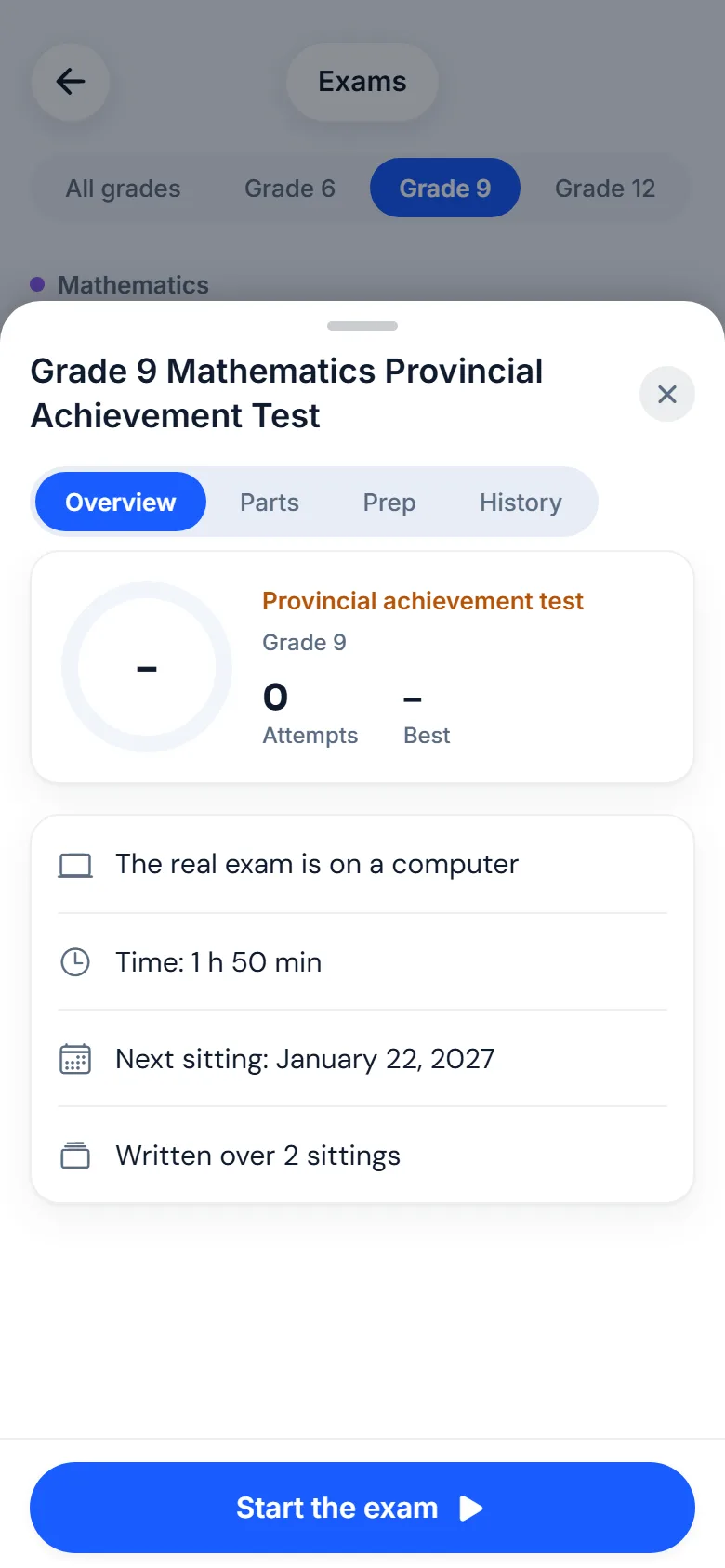 The exam in the app
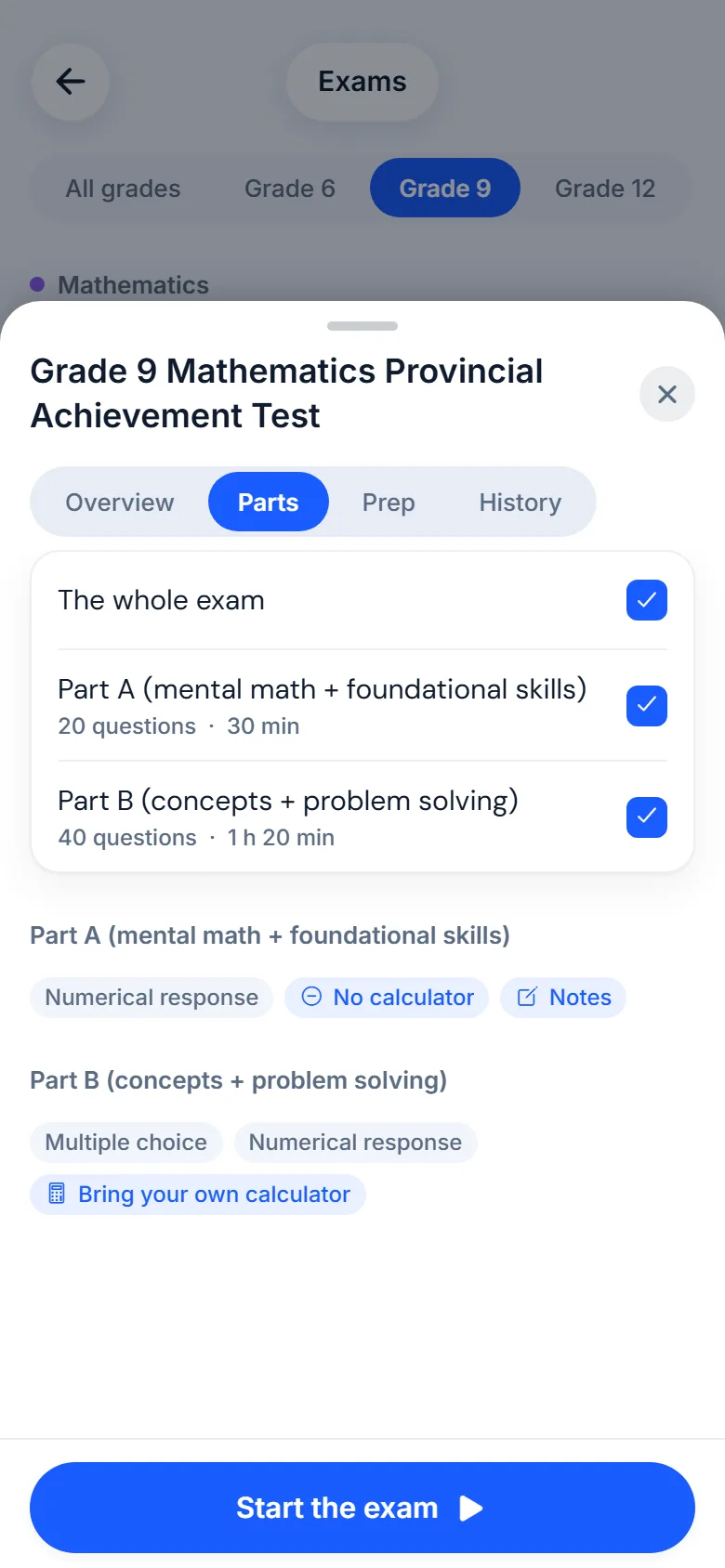 Its parts, and what you can use in each
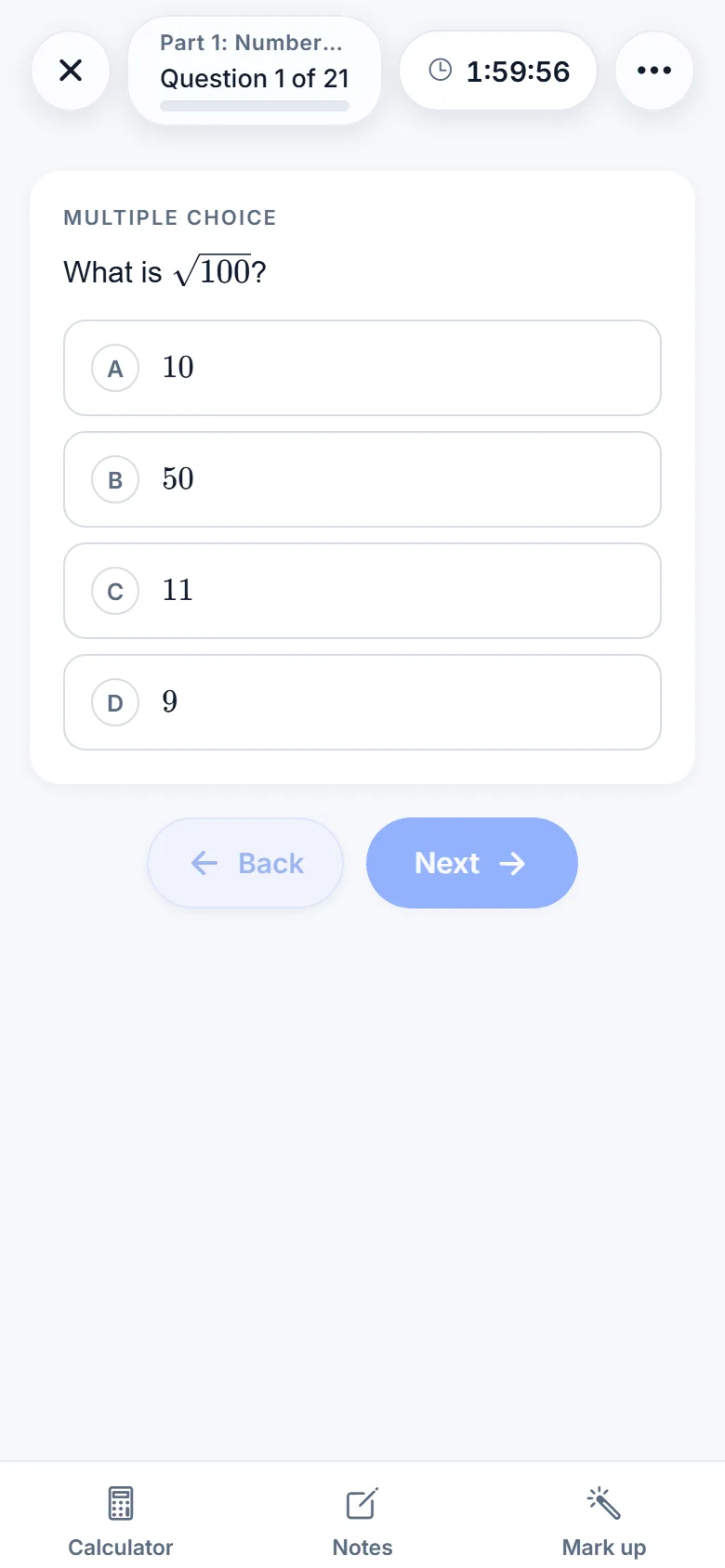 A question, timed, with the exam’s tools
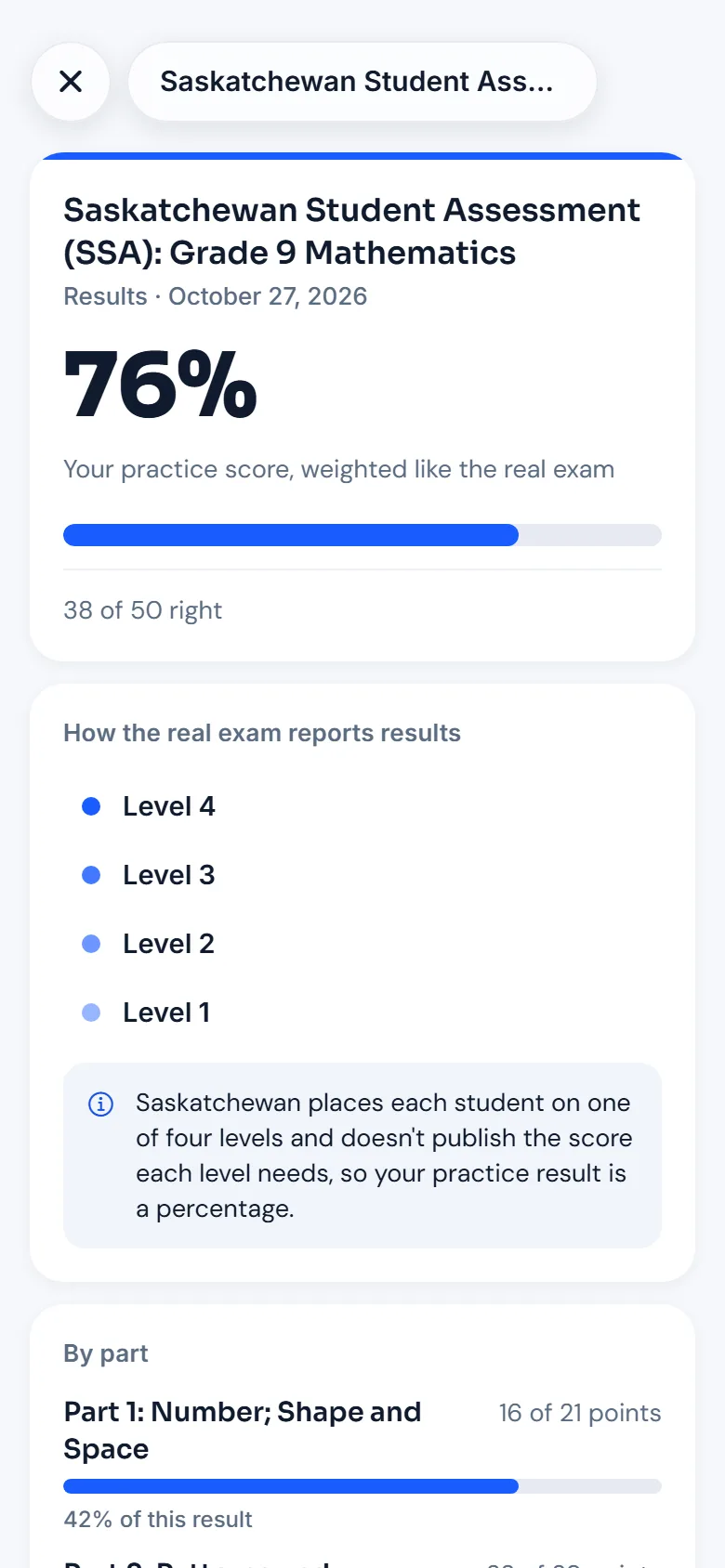 The marked result, part by part
A practice run of Saskatchewan’s Grade 9 math assessment.
Free with a MapleMind account
When
2 sessions this school year: January and June.
January 2027
- Friday, January 22, 20279:00–9:30 AM · Part A
- Monday, January 25, 20279:00–10:20 AM · Part B
June 2027
- Tuesday, June 15, 20279:00–9:30 AM · Part A
- Thursday, June 17, 20279:00–10:20 AM · Part B
The dates are Alberta’s own, read on September 28, 2026. See the official schedule (alberta.ca)
What’s on it
Part A
- Number70–80%
- Patterns and Relations20–30%
Part B
- Number25–35%
- Patterns and Relations35–45%
- Shape and Space20–30%
- Statistics and Probability5–10%
The skills it tests · 69 skills
- Adding and subtracting decimals
- Adding and subtracting fractions
- Adding polynomials
- Analyzing and concluding
- Approximating square roots
- Assumptions behind the numbers
- Bias, language and ethics
- Central and inscribed angles
- Collecting and displaying
- Combining circle properties
- Combining the laws
- Comparing and ordering
- Composite objects and overlap
- Cost, timing, privacy and culture
- Defending your choice
- Dividing by a monomial
- Drawing to scale
- Equations with brackets
- Equations with fractions and decimals
- Fraction and decimal perfect squares
- From pattern to equation
- Graphing a linear relation
- Inequalities in context
- Inscribed angles on the same arc
- Interpolate and extrapolate
- Like terms and equivalent expressions
- Line symmetry
- Modelling polynomials
- Modelling problems with equations
- Multiplying and dividing decimals
- Multiplying and dividing fractions
- Multiplying by a monomial
- One-step equations
- Order of operations with exponents
- Order of operations with rationals
- Perfect squares and their roots
- Planning the investigation
- Polynomial vocabulary
- Population vs. sample
- Power of a power
- Powers of products and quotients
- Powers with negative bases
- Probability in everyday decisions
- Problem solving with rationals
- Product law
- Quotient law
- Rationals between rationals
- Reading linear graphs
- Reading scale diagrams
- Roots between two values
- Rotation symmetry
- Solving chord problems
- Solving inequalities
- Solving problems with powers
- Solving with similarity
- Spotting linear patterns
- Subtracting polynomials
- Surface area foundations
- Surface-area problem solving
- Tangents and radii
- The perpendicular-to-a-chord property
- The zero exponent
- Two-step equations
- Variables on both sides
- Verify and predict
- What a power means
- What inequalities mean
- What makes polygons similar
- What rational numbers are
How it’s built
Numerical-response questions and multiple-choice questions.
- Part A (mental math + foundational skills)
- Time
- 30 min
- Questions
- 20
- Marks
- 20
- Of the marks
- 20%
- Numerical response
20 questions without a calculator: mental math, estimating, algebra, square roots, exponent laws and rational numbers.
- Part B (concepts + problem solving)
- Time
- 80 min
- Questions
- 40
- Marks
- 40
- Of the marks
- 80%
- Multiple choice
- Numerical response
40 multiple-choice and numerical-response questions where you recall ideas and reason through problems.
How it’s marked
- Below the acceptable standard
- Acceptable standard
- Standard of excellence
A computer marks every question. Your results are reported against two provincial standards: the acceptable standard and the standard of excellence.
On the day
- Calculator
- In Part B you may use a calculator, but not a graphing one, or one with stored notes, formulas, programs or communication features.
- First sittingPart A, mental math and basic skills with no calculator, set for 30 minutes.
- On another dayPart B, concepts and problem solving, set for 80 minutes.
Two parts, on the computer. Part A has no calculator; in Part B you may use your own. Everyone may take up to double the time: 60 minutes for Part A and 160 for Part B. Paper for rough work is given out and collected.
Getting ready
1 official document to practise with, and 3 tips.
Official practice
Tips from the people who write it
- Part A has no calculator: practise mental math, estimating, exponent laws, square roots and arithmetic with rational numbers.
- Questions range from simple to complex, so expect problems with several steps in Part B.
- You can't bring reference materials or a dictionary.
After the exam
- Results
The school shares early results with families by the end of the school year. The Individual Student Profile follows in early September 2027, on myPass and from the school.
- Marks
Whether the test counts in a school mark is up to the school authority.
- If you miss it
A student absent on test day writes it when they’re back, before the last scheduled day. The principal, with the parents, can ask for a student to be excused where writing would harm them or they can’t take part in a meaningful way.
From General Information Bulletin 2026–2027, Grades 6 and 9 Provincial Achievement Testing (alberta.ca), read on October 27, 2026.
More for you
Students
Start with the topics worth the most marks, then write full practice exams under the real time limit.
Practise itParents
Put the dates on the family calendar. The Parent Dashboard shows each practice exam’s result and the skills that need another look.
See the Parent DashboardEducators
The topic weights and the official practice above make a review plan. Students can practise each skill on its own in MapleMind, free with daily limits.
For schools
Questions about this exam
When is the Grade 9 Mathematics Provincial Achievement Test in 2026–27?
The next sitting is January 22, 2027, 9:00–9:30 AM. This school year it’s written in January 2027 and June 2027.
How long is the Grade 9 Mathematics Provincial Achievement Test?
It takes 1 hour 50 minutes in all, over 2 parts.
How many questions are on the Grade 9 Mathematics Provincial Achievement Test?
It has 60 marked questions: 20 in Part A (mental math + foundational skills) and 40 in Part B (concepts + problem solving).
Can you use a calculator on the Grade 9 Mathematics Provincial Achievement Test?
In some parts only: Part B (concepts + problem solving).
How are Grade 9 Mathematics Provincial Achievement Test results reported?
At 3 levels: Below the acceptable standard, Acceptable standard and Standard of excellence.
Where can I find practice tests for the Grade 9 Mathematics Provincial Achievement Test?
Alberta publishes Grade 9 math practice tests + parent guide. MapleMind also builds a full practice exam in its format, free with an account.

Practise for the Grade 9 Mathematics Provincial Achievement Test
Every skill on the Grade 9 Mathematics Provincial Achievement Test, taught one at a time, then practised on questions written like the real ones.


