Get help with Science, Grade 2
Most tutoring makes your child sit through material your child already knows. MapleMind flips that: pick the exact skill that's causing trouble — any of the 24 below — and the tutor teaches just that one, step by step, as many times as it takes. Ask questions in plain words, any time of day, in English, French, or 12 other languages.
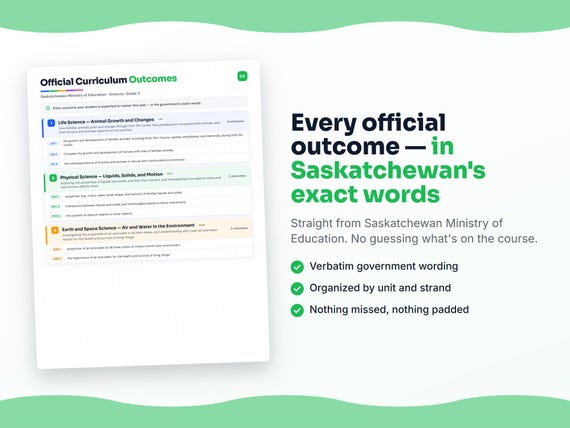
The official Saskatchewan Science, Grade 2 curriculum
Saskatchewan defines Science, Grade 2 by strands and outcomes. MapleMind teaches the same curriculum reorganized for one-skill-at-a-time tutoring — the table shows exactly where every official strand lands, and the ministry's own wording is quoted under each unit below.
Official source Saskatchewan's official curriculumRead it on the government site — curriculum.gov.sk.ca ↗| Official strand | Outcomes | Where MapleMind teaches it |
|---|---|---|
| Strand AN | 3 | Life Science — Animal Growth and Changes |
| Strand LS | 4 | Physical Science — Liquids, Solids, and Motion |
| Strand AW | 2 | Earth and Space Science — Air and Water in the Environment |
Every skill below, taught one on one.
 Try the first session free
How MapleMind teaches Science, Grade 2 — every unit, lesson, and skill
Every skill below runs as a short session: a plain-words lesson, a worked example, solving it together, then a five-question skill check that earns up to three stars. Guided Mode keeps it teaching instead of answer-handing — turning it off needs a parent's password.
Unit 1Life Science — Animal Growth and ChangesOfficial strand · Strand AN
How familiar animals grow and change through their life cycles, how people grow compared with animals, and how humans and animals depend on one another.
Animal Life Cycles
- Stages of an animal's lifeAN2.1 — Describe the stages of familiar animals' life cycles and name their offspring.
- What changes as animals growAN2.1 — Analyze which traits stay the same and which change as a familiar animal grows and develops.
- Predicting how big an animal will growAN2.1 — Predict how big an animal will grow using patterns, and represent its growth and changes.
How People Grow
- The stages of a person's lifeAN2.2 — Compare the stages of human growth with the growth of familiar animals.
- Food helps us growAN2.2 — Examine how food choices and eating habits affect the growth and development of people and animals.
Humans and Animals Together
- Where animals liveAN2.3 — Predict and observe where familiar animals live in natural and constructed environments.
- Helping and harming animalsAN2.3 — Analyze how human activities can help or harm wild and domesticated animals.
- Caring for animalsAN2.3 — Describe how to care for wild and domesticated animals, and identify careers related to animal care.
The official wording — 3 outcomes in this unit
- AN2.1
the growth and development of familiar animals, including birds, fish, insects, reptiles, amphibians, and mammals, during their life cycles
- AN2.2
Compare the growth and development of humans with that of familiar animals.
- AN2.3
the interdependence of humans and animals in natural and constructed environments
Unit 2Physical Science — Liquids, Solids, and MotionOfficial strand · Strand LS
Exploring the properties of liquids and solids and how they interact, and investigating how objects move and how friction affects them.
Liquids and Solids
- Sorting liquids and solidsLS2.1 — Classify familiar objects as liquids or solids in natural and constructed environments.
- Looking closely at liquids and solidsLS2.1 — Observe, record, and compare the physical properties of familiar liquids and solids.
- Liquids and solids are matterLS2.1 — Demonstrate that liquids and solids are matter because they have mass and take up space, and read hazard safety symbols.
Mixing, Sinking, and Floating
- Mixing and dissolvingLS2.2 — Investigate how liquids and solids change when mixed, including which solids dissolve in water.
- Thick liquids and soaking upLS2.2 — Investigate how thick different liquids are, and which materials absorb liquids best.
- Sinking and floatingLS2.2 — Explore why objects sink or float, and build an object that floats and carries a load.
Position and Motion
- Describing where things areMP2.1 — Describe the position of an object relative to other objects using position words.
- Giving directions and different viewsMP2.1 — Create and follow directions to a position, and represent an object's position from different perspectives.
- Ways things moveMP2.2 — Describe and represent different patterns of movement of natural and constructed objects, including self.
- Pushes and pullsMP2.2 — Demonstrate how pushes and pulls can make an object speed up, slow down, stop, or change direction.
- Friction on different surfacesMP2.2 — Investigate how friction from different surfaces affects motion, and technologies that make moving easier.
The official wording — 4 outcomes in this unit
- LS2.1
properties (e.g., colour, taste, smell, shape, and texture) of familiar liquids and solids
- LS2.2
interactions between liquids and solids, and technologies based on those interactions
- MP2.1
the position of objects relative to other objects
- MP2.2
the motion of natural and constructed objects, including self
Unit 3Earth and Space Science — Air and Water in the EnvironmentOfficial strand · Strand AW
Investigating the properties of air and water in all their states, and understanding why clean air and water matter for the health and survival of living things.
Air and Water All Around
- What air and water are likeAW2.1 — Observe the physical properties of air and water, including evidence that air takes up space and has mass.
- Ice, water, and steamAW2.1 — Categorize water by its state of matter and investigate changes of state like freezing, melting, and evaporation.
- Building with wind and water powerAW2.1 — Design and build a simple device that is powered by wind or moving water.
Why We Need Clean Air and Water
- Air and water keep us aliveAW2.2 — Explain how living things, including humans, need clean air and water to stay healthy and survive.
- Keeping air and water cleanAW2.2 — Explain how air and water can become polluted, and suggest ways to protect and improve their quality.
The official wording — 2 outcomes in this unit
- AW2.1
properties of air and water (in all three states of matter) within their environment
- AW2.2
the importance of air and water for the health and survival of living things
Printable workbook · A keepsake of the year
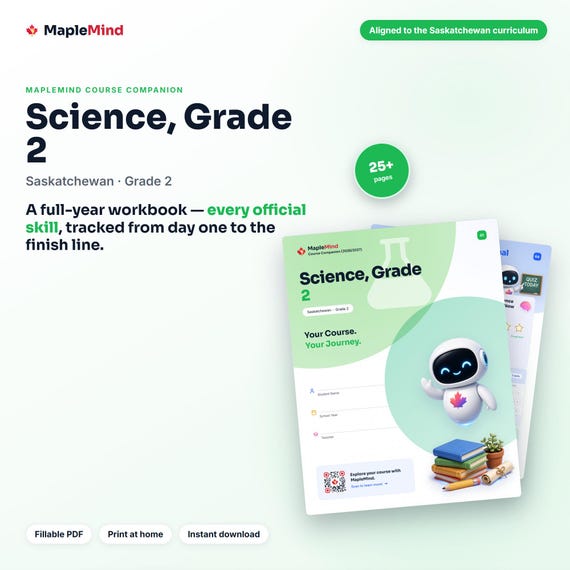
A Science, Grade 2 workbook worth keeping
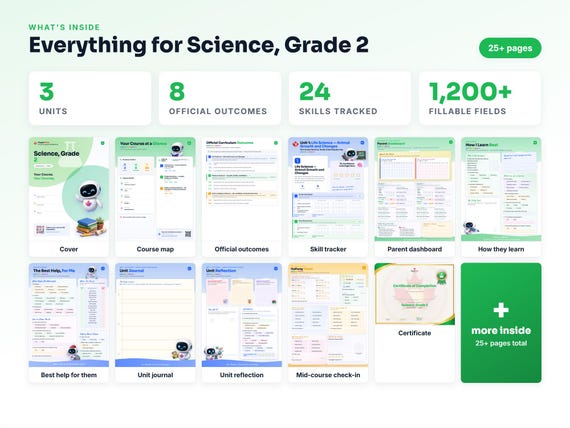
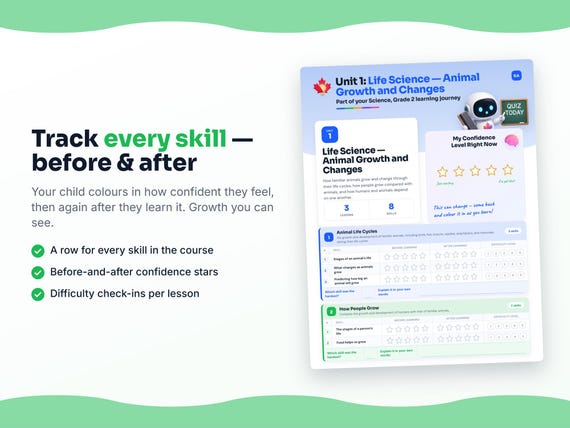
Built from the same official curriculum as this page. Before and after each skill above, your student colours in how sure they feel — so the two of you can see, on one page, what's clicking and what needs another look. It's a quiet way to follow how the year is really going.
By June it's full of their own handwriting: units worked through, confidence grown, a mid-year check-in, notes from parent-teacher night, and a certificate at the end. Less a worksheet, more a record of the year worth keeping on the shelf.
Instant download · see every page, reviews and the full description · five or more workbooks are $2.99 each
What it looks like in the app



Common questions
Can MapleMind help my child with Science, Grade 2?
Yes. MapleMind's AI tutor covers all 24 skills in Saskatchewan's Science, Grade 2 — your child picks the exact skill, and the tutor teaches it step by step: a short lesson, a worked example, solving together, then a skill check to show it stuck.
Is MapleMind aligned to Saskatchewan's official curriculum?
Yes. Every skill in this course maps to an official outcome code from Saskatchewan's Grade 2 Science curriculum, and the ministry's own wording is quoted under each unit on this page — with the official government source linked so you can check it yourself.
What does MapleMind cost?
It's free to start — 5 tutoring chats and a practice quiz every day, no credit card. A Pro subscription ($9.99/month or $49.99/year CAD, 7-day free trial) unlocks unlimited tutoring, practice, and exam simulations.
What if my child is stuck on just one topic?
That's the point of skill-level tutoring: open Science, Grade 2 in the app, tap the exact skill from the list on this page, and the tutor teaches just that — no wading through lessons your child doesn't need.
Does MapleMind work in French or other languages?
Yes — 14 languages, including French. Both the app and the tutor's explanations switch to the language your child chooses.
Where can I see the official Saskatchewan curriculum for Science, Grade 2?
The official source is linked on this page — Saskatchewan's official curriculum. The outline here follows it: every MapleMind skill carries its official outcome code, and the ministry's own wording is quoted under each unit.
Keep exploring
Ready when you are
Pick a skill from this page and see it taught properly — free, in the browser, in under a minute.