Get help with English Language Arts A30 / B30
Most tutoring makes you sit through material you already know. MapleMind flips that: pick the exact skill that's causing trouble — any of the 28 below — and the tutor teaches just that one, step by step, as many times as it takes. Ask questions in plain words, any time of day, in English, French, or 12 other languages.
The official Saskatchewan English Language Arts A30 / B30 curriculum
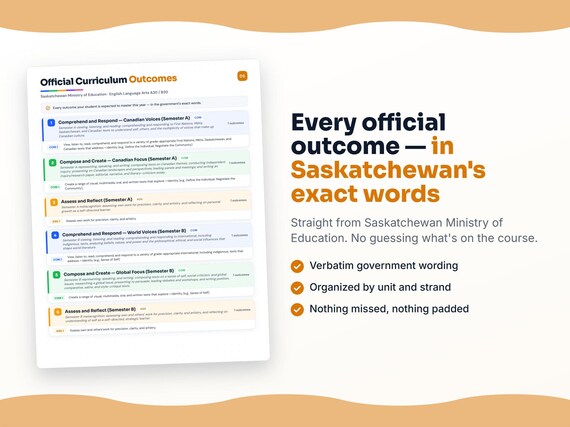
Saskatchewan defines English Language Arts A30 / B30 by strands and outcomes. MapleMind teaches the same curriculum reorganized for one-skill-at-a-time tutoring — the table shows exactly where every official strand lands, and the ministry's own wording is quoted under each unit below.
Official source Saskatchewan's official curriculumRead it on the government site — curriculum.gov.sk.ca ↗| Official strand | Outcomes | Where MapleMind teaches it |
|---|---|---|
| Strand CR | 8 | Comprehend and Respond — Canadian Voices (Semester A) · Comprehend and Respond — World Voices (Semester B) |
| Strand CC | 8 | Compose and Create — Canadian Focus (Semester A) · Compose and Create — Global Focus (Semester B) |
| Strand AR | 4 | Assess and Reflect (Semester A) · Assess and Reflect (Semester B) |
Every skill below, taught one on one.
 Try the first session free
How MapleMind teaches English Language Arts A30 / B30 — every unit, lesson, and skill
Every skill below runs as a short session: a plain-words lesson, a worked example, solving it together, then a five-question skill check that earns up to three stars. Guided Mode keeps it teaching instead of answer-handing — turning it off needs a parent's password.
Unit 1Comprehend and Respond — Canadian Voices (Semester A)Official strand · Strand CR
Semester A viewing, listening, and reading: comprehending and responding to First Nations, Métis, Saskatchewan, and Canadian texts to understand self, others, and the multiplicity of voices that make up Canadian culture.
Responding to First Nations, Métis, Saskatchewan, and Canadian Texts
- Responding to Canadian identity texts (Define the Individual)CR A 30.1 — View, listen to, read, comprehend, and respond to First Nations, Métis, Saskatchewan, and Canadian texts about identity, analyzing how they enhance understanding of self, others, and Canadian identity.
- Viewing and critically evaluating Canadian mediaCR A 30.2 — View and evaluate critically information and ideas from First Nations, Métis, Saskatchewan, and Canadian visual and multimedia texts, including an advertisement, news broadcast, poster, and film.
- Listening to Canadian speakers criticallyCR A 30.3 — Listen to, comprehend, and develop plausible interpretations of literary and informational texts created by First Nations, Métis, Saskatchewan, and Canadian speakers and authors from various communities.
- Reading Canadian literary and informational textsCR A 30.4 — Read, comprehend, and apply knowledge from informational (editorials, reviews, articles) and literary (fiction, script, poetry, non-fiction) texts by First Nations, Métis, Saskatchewan, and Canadian authors to understand the multiplicity of Canadian voices.
The official wording — 4 outcomes in this unit
- CR A 30.1
View, listen to, read, comprehend, and respond to a variety of grade-appropriate First Nations, Métis, Saskatchewan, and Canadian texts that address: • identity (e.g., Define the Individual, Negotiate the Community)
- CR A 30.2
View and evaluate critically information and ideas obtained from First Nations, Métis, Saskatchewan, and Canadian visual and multimedia texts including an advertisement, news broadcast, poster, and film.
- CR A 30.3
Listen to, comprehend, and develop coherent and plausible interpretations of grade-appropriate literary and informational texts created by First Nations, Métis, Saskatchewan, and Canadian speakers and authors from various communities.
- CR A 30.4
Read, demonstrate comprehension of, and apply knowledge from grade-appropriate informational (including editorials, reviews, and articles) and literary (including fiction, script, poetry, and non-fiction) texts from First Nations, Métis, Saskatchewan, and Canadian authors as a basis for understanding self and the multiplicity of voices and perspectives that make up Canadian culture.
Unit 2Compose and Create — Canadian Focus (Semester A)Official strand · Strand CC
Semester A representing, speaking, and writing: composing texts on Canadian themes; conducting independent inquiry; presenting on Canadian landscapes and perspectives; leading panels and meetings; and writing an inquiry/research paper, editorial, narrative, and literary-criticism essay.
Composing on Canadian Identity, Responsibility, and Action
- Composing Canadian identity texts (Define the Individual)CC A 30.1 — Create visual, multimedia, oral, and written texts that explore identity through Canadian themes, with a clear thesis and effective conclusion.
- Presenting a Canadian landscape or perspectiveCC A 30.2 — Create and present visual and multimedia representations, including using photographs, to explain contemporary course-related perspectives or landscapes.
- Presenting in panels and formal meetingsCC A 30.3 — Present and express ideas in formal (a panel presentation and a business or community meeting) and informal (discussions and collaborative work) situations for differing audiences and purposes.
- Writing an inquiry paper, editorial, narrative, and criticismCC A 30.4 — Create informational (an inquiry/research paper and an editorial) and literary (a real or invented narrative and a literary-criticism essay) texts appropriate to a variety of audiences and purposes.
The official wording — 4 outcomes in this unit
- CC A 30.1
Create a range of visual, multimedia, oral, and written texts that explore: • identity (e.g., Define the Individual, Negotiate the Community),
- CC A 30.2
Create and present visual and multimedia representations including using photographs to explain a range of contemporary course-related perspectives or landscapes.
- CC A 30.3
Present and express a range of ideas and information in formal (including a panel presentation and a business or community meeting) and informal (including discussions and collaborative work) situations for differing audiences and purposes.
- CC A 30.4
Create a variety of informational (including an inquiry/research paper and an editorial) and literary (including a real or invented narrative and a literary criticism essay) texts that are appropriate to a variety of audiences and purposes including informing, persuading, and entertaining.
Unit 3Assess and Reflect (Semester A)Official strand · Strand AR
Semester A metacognition: assessing own work for precision, clarity, and artistry, and reflecting on personal growth as a self-directed learner.
Assessing Own Work and Growth (Semester A)
- Assessing own work for precision, clarity, and artistryAR A 30.1 — Assess your own work for precision, clarity, and artistry, and identify skills, strategies, and steps to improve communication.
- Reflecting on growth as a self-directed learnerAR A 30.2 — Reflect on personal growth and successes in language learning and consider the role of language learning in developing goals and plans as a self-directed, self-appraising learner.
The official wording — 2 outcomes in this unit
- AR A 30.1
Assess own work for precision, clarity, and artistry.
- AR A 30.2
Reflect on personal growth and successes in language learning and consider the role and importance of language learning when developing personal goals and plans as a self-directed, curious, self-appraising, and open-minded learner.
Unit 4Comprehend and Respond — World Voices (Semester B)Official strand · Strand CR
Semester B viewing, listening, and reading: comprehending and responding to international, including indigenous, texts, analyzing beliefs, values, and power and the philosophical, ethical, and social influences that shape world literature.
Responding to International, Including Indigenous, Texts
- Responding to world identity texts (Sense of Self)CR B 30.1 — View, listen to, read, comprehend, and respond to international, including indigenous, texts about identity, connecting them to personal knowledge and the world.
- Viewing world media on beliefs, values, and powerCR B 30.2 — View, comprehend, and evaluate critically visual and multimedia texts by international, including indigenous, artists, identifying how they address beliefs, values, and power.
- Listening to world speakers and historic speechesCR B 30.3 — Listen to and comprehend informational and literary texts by international, including indigenous, speakers and authors, and analyze the perspectives, biases, beliefs, values, and power presented.
- Reading world literature across periodsCR B 30.4 — Read and comprehend contemporary and classical informational (position papers, articles, electronic communications) and literary (drama, novels, poetry, short stories, essays, biographies) texts from international, including indigenous, cultures, analyzing the influences that shape them.
The official wording — 4 outcomes in this unit
- CR B 30.1
View, listen to, read, comprehend, and respond to a variety of grade-appropriate international, including indigenous, texts that address: • identity (e.g., Sense of Self)
- CR B 30.2
View, comprehend, and evaluate critically a variety of visual and multimedia texts by international, including indigenous, artists and authors from various cultural communities, and identify how the texts address beliefs, values, and power.
- CR B 30.3
Listen to and comprehend grade-appropriate informational and literary texts created by international, including indigenous, speakers and authors, and analyze the perspectives, biases, beliefs, values, identities, and power presented in each text.
- CR B 30.4
Read and demonstrate comprehension of a range of contemporary and classical grade-appropriate informational (including position papers, magazine and newspaper articles, and electronic communications) and literary (including drama, novels, poetry, short stories, essays, biographies, and autobiographies) texts from various international, including indigenous, cultures and analyze the philosophical, ethical, and social influences that have shaped information, issues, characters, plots, and themes.
Unit 5Compose and Create — Global Focus (Semester B)Official strand · Strand CC
Semester B representing, speaking, and writing: composing texts on a sense of self, social criticism, and global issues; researching a global issue; presenting to persuade; leading debates and workshops; and writing position, comparative, satire, and style-critique texts.
Composing on Self, Criticism, and Global Issues
- Composing world identity texts (Sense of Self)CC B 30.1 — Create visual, multimedia, oral, and written texts that explore identity and a sense of self, articulating a defensible position with originality.
- Presenting to persuade action on a global issueCC B 30.2 — Create a visual or multimedia presentation that suits the topic, audience, and purpose, teaches others about a global social issue, and persuades them to act responsibly.
- Debating and leading workshops on global issuesCC B30.3 — Create and defend an informed critical response to a global issue in formal (a workshop presentation, a debate, an oral reading) and informal (discussion and collaborative group work) situations.
- Writing position, comparative, satire, and style-critique textsCC B 30.4 — Compose narrative, descriptive, expository, and persuasive writings including a position paper, a comparative essay, a letter of inquiry, a critique of an author's style, and a short story or essay using parody, satire, or irony.
The official wording — 4 outcomes in this unit
- CC B 30.1
Create a range of visual, multimedia, oral, and written texts that explore: • identity (e.g., Sense of Self)
- CC B 30.2
Create a visual or multimedia presentation that suits the topic, purpose, and audience; teaches others about a global social issue; and persuades them to act on the issue in a responsible manner.
- CC B30.3
Create and defend an informed critical response to a global issue in formal (including a workshop presentation, a debate, and an oral reading of poetry or a prose passage related to the issue) and informal (including discussion and collaborative group work) situations.
- CC B 30.4
Compose and create narrative, descriptive, expository, and persuasive writings that include a position paper, a comparative essay, a letter of inquiry, a critique of an author’s style, and a short story or essay that uses parody, satire, and/or irony.
Unit 6Assess and Reflect (Semester B)Official strand · Strand AR
Semester B metacognition: assessing own and others' work for precision, clarity, and artistry, and reflecting on understanding of self as a self-directed, strategic learner.
Assessing Work and Understanding Yourself as a Learner (Semester B)
- Assessing own and others' work for precision, clarity, and artistryAR B 30.1 — Assess your own and others' work for precision, clarity, and artistry, and identify skills, strategies, and steps to improve communication.
- Reflecting on yourself as a strategic learnerAR B 30.2 — Reflect on and assess your understanding of yourself as a self-directed, self-appraising, and strategic learner, selecting products that reflect your growth as a communicator.
The official wording — 2 outcomes in this unit
- AR B 30.1
Assess own and others’work for precision, clarity, and artistry.
- AR B 30.2
Reflect on and assess understanding of self as a self-directed, self-appraising, and strategic learner.
Printable workbook · A keepsake of the year
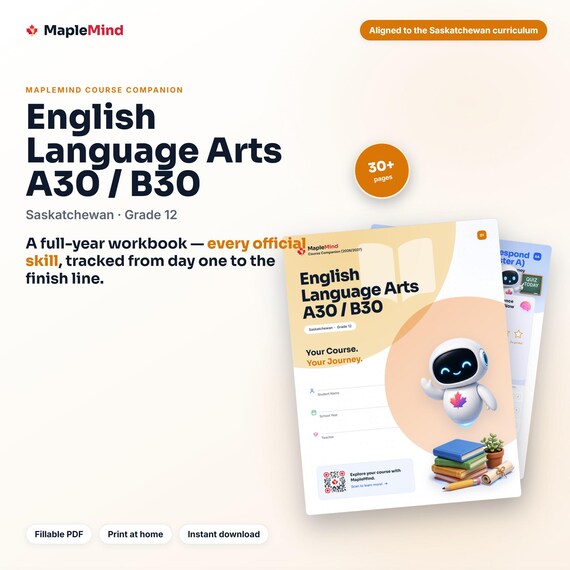
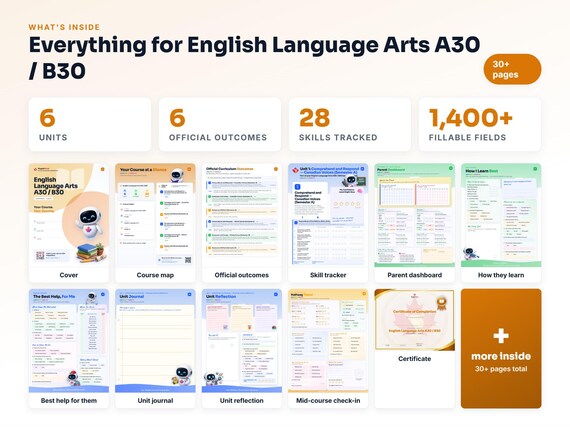
A English Language Arts A30 / B30 workbook worth keeping
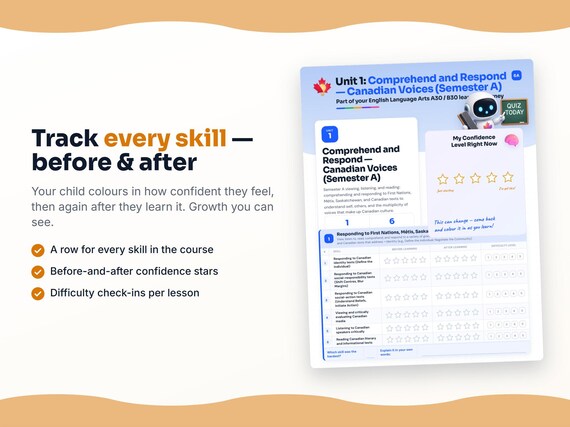
Built from the same official curriculum as this page. Before and after each skill above, your student colours in how sure they feel — so the two of you can see, on one page, what's clicking and what needs another look. It's a quiet way to follow how the year is really going.
By June it's full of their own handwriting: units worked through, confidence grown, a mid-year check-in, notes from parent-teacher night, and a certificate at the end. Less a worksheet, more a record of the year worth keeping on the shelf.
Instant download · see every page, reviews and the full description · five or more workbooks are $2.99 each
What it looks like in the app



Common questions
Can MapleMind help me with English Language Arts A30 / B30?
Yes. MapleMind's AI tutor covers all 28 skills in Saskatchewan's English Language Arts A30 / B30 — you pick the exact skill, and the tutor teaches it step by step: a short lesson, a worked example, solving together, then a skill check to show it stuck.
Is MapleMind aligned to Saskatchewan's official curriculum?
Yes. Every skill in this course maps to an official outcome code from Saskatchewan's Grade 12 English Language Arts curriculum, and the ministry's own wording is quoted under each unit on this page — with the official government source linked so you can check it yourself.
What does MapleMind cost?
It's free to start — 5 tutoring chats and a practice quiz every day, no credit card. A Pro subscription ($9.99/month or $49.99/year CAD, 7-day free trial) unlocks unlimited tutoring, practice, and exam simulations.
What if I'm stuck on just one topic?
That's the point of skill-level tutoring: open English Language Arts A30 / B30 in the app, tap the exact skill from the list on this page, and the tutor teaches just that — no wading through lessons you don't need.
Does MapleMind work in French or other languages?
Yes — 14 languages, including French. Both the app and the tutor's explanations switch to the language you choose.
Where can I see the official Saskatchewan curriculum for English Language Arts A30 / B30?
The official source is linked on this page — Saskatchewan's official curriculum. The outline here follows it: every MapleMind skill carries its official outcome code, and the ministry's own wording is quoted under each unit.
Keep exploring
Ready when you are
Pick a skill from this page and see it taught properly — free, in the browser, in under a minute.