Get help with English Language Arts, Grade 3
Most tutoring makes your child sit through material your child already knows. MapleMind flips that: pick the exact skill that's causing trouble — any of the 14 below — and the tutor teaches just that one, step by step, as many times as it takes. Ask questions in plain words, any time of day, in English, French, or 12 other languages.
The official Saskatchewan English Language Arts, Grade 3 curriculum
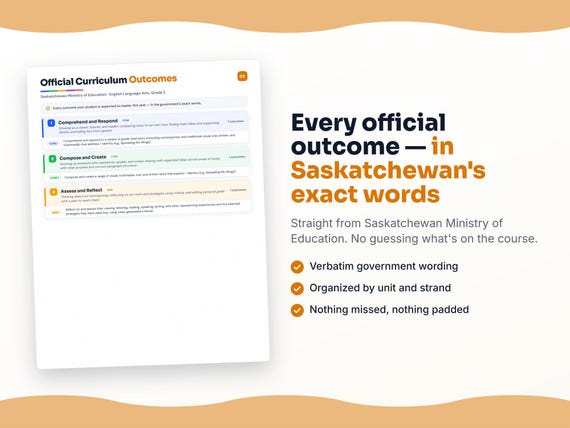
Saskatchewan defines English Language Arts, Grade 3 by strands and outcomes. MapleMind teaches the same curriculum reorganized for one-skill-at-a-time tutoring — the table shows exactly where every official strand lands, and the ministry's own wording is quoted under each unit below.
Official source Saskatchewan's official curriculumRead it on the government site — curriculum.gov.sk.ca ↗| Official strand | Outcomes | Where MapleMind teaches it |
|---|---|---|
| Strand CR | 4 | Comprehend and Respond |
| Strand CC | 4 | Compose and Create |
| Strand AR | 2 | Assess and Reflect |
Every skill below, taught one on one.
 Try the first session free
How MapleMind teaches English Language Arts, Grade 3 — every unit, lesson, and skill
Every skill below runs as a short session: a plain-words lesson, a worked example, solving it together, then a five-question skill check that earns up to three stars. Guided Mode keeps it teaching instead of answer-handing — turning it off needs a parent's password.
Unit 1Comprehend and RespondOfficial strand · Strand CR
Growing as a viewer, listener, and reader: comparing texts to our own lives, finding main ideas and supporting details, and telling fact from opinion.
Comparing Stories to My Own Life
- Comparing texts about identity to my lifeCR3.1 — Understand and respond to grade-level texts about identity, making comparisons with your personal experiences.
- Comparing texts about community to my lifeCR3.1 — Understand and respond to grade-level texts about community, making comparisons with your personal experiences.
- Explaining how visuals show humour, emotion, and moodCR3.2 — View and respond to visual and multimedia texts, explaining your reactions and connections and the visual features that convey humour, emotion, and mood.
- Listening for main ideas and telling fact from opinionCR3.3 — Listen to and understand information, identify main ideas and supporting details, compare different ideas and points of view, and explain connections between texts heard.
- Reading fluently and explaining my reactionsCR3.4 — Read fluently and understand grade-appropriate fiction, scripts, poetry, and non-fiction from various cultures and countries, explaining your reactions and connections to texts read.
The official wording — 4 outcomes in this unit
- CR3.1
Comprehend and respond to a variety of grade-level texts (including contemporary and traditional visual, oral, written, and multimedia) that address: • identity (e.g., Spreading My Wings)
- CR3.2
View and respond to grade-appropriate visual and multimedia texts (including videos, cartoons, illustrations, diagrams, charts, maps, and posters) explaining reactions and connections as well as visual features that convey humour, emotion, and mood.
- CR3.3
Listen to and understand information, identify main ideas and supporting details, compare different ideas and points of view, and explain connections made between texts heard.
- CR3.4
Read fluently and demonstrate comprehension of grade-appropriate fiction, script, poetry, and non-fiction from various cultures (including First Nations and Métis) and countries (including Canada) and explain reactions and connections to texts read.
Unit 2Compose and CreateOfficial strand · Strand CC
Growing as someone who represents, speaks, and writes: sharing well-organized ideas across areas of study, with clear purpose and correct paragraph structure.
Creating Texts That Connect Across My Learning
- Creating texts about identity across my learningCC3.1 — Compose and create visual, oral, and written texts that explore identity, making connections across areas of study.
- Creating texts about helping our communityCC3.1 — Compose and create visual, oral, and written texts that explore community, making connections across areas of study.
- Creating texts about communities around the worldCC3.1 — Compose and create visual, oral, and written texts that explore social responsibility, making connections across areas of study.
- Making clear representations with a purposeCC3.2 — Communicate ideas and information about topics, problems, questions, or issues by creating easy-to-follow representations with a clear purpose.
- Speaking in casual and more formal situationsCC3.3 — Speak to present ideas and information in casual situations and some formal ones, like giving explanations or short reports, for different audiences and purposes.
- Writing reports, stories, and letters in paragraphsCC3.4 — Write to communicate ideas and experiences by creating easy-to-follow writing — a report, procedure, letter, story, script, or poem — with a clear purpose, correct paragraph structure, and interesting detail.
The official wording — 4 outcomes in this unit
- CC3.1
Compose and create a range of visual, multimedia, oral, and written texts that explore: • identity (e.g., Spreading My Wings)
- CC3.2
Communicate ideas and information pertaining to topics, problems, questions, or issues by creating easy- to-follow representations with a clear purpose.
- CC3.3
Speak to present ideas and information appropriately in informal (e.g., interacting appropriately with others to share ideas and opinions, complete tasks, and discuss concerns or problems) and some formal situations (e.g., giving oral explanations, delivering short, simple reports, demonstrating and describing basic procedures) for different audiences and purposes.
- CC3.4
Write to communicate ideas, information, and experiences pertaining to a topic by creating easy-to-follow writing (including a short report, a procedure, a letter, a story, a short script, and a poem) with a clear purpose, correct paragraph structure, and interesting detail.
Unit 3Assess and ReflectOfficial strand · Strand AR
Thinking about our own learning: reflecting on our work and strategies using criteria, and setting personal goals with a plan to reach them.
Reflecting and Planning My Next Steps
- Reflecting on my work and strategies with criteriaAR3.1 — Reflect on and assess your viewing, listening, reading, speaking, writing, and representing and the strategies you used, using class-generated criteria.
- Setting a goal and a plan to reach itAR3.2 — Set personal goals to view, listen, read, speak, write, and represent more effectively, and discuss a plan for achieving them.
The official wording — 2 outcomes in this unit
- AR3.1
Reflect on and assess their viewing, listening, reading, speaking, writing, and other representing experiences and the selected strategies they have used (e.g., using class-generated criteria).
- AR3.2
Set personal goals to view, listen, read, speak, write, and use other forms of representing more effectively and discuss a plan for achieving them.
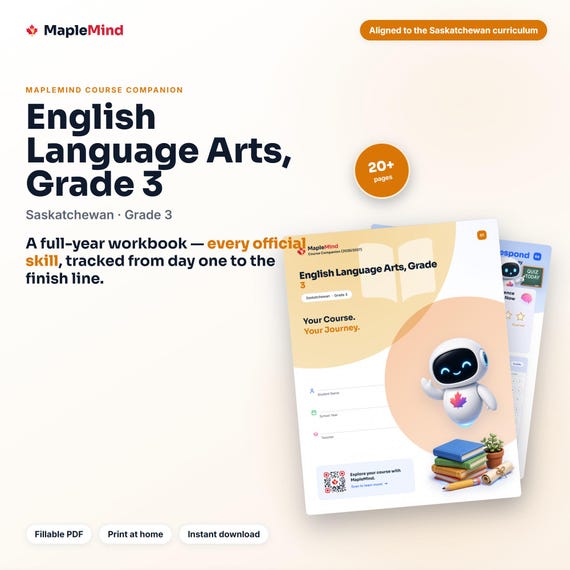
Printable workbook · A keepsake of the year
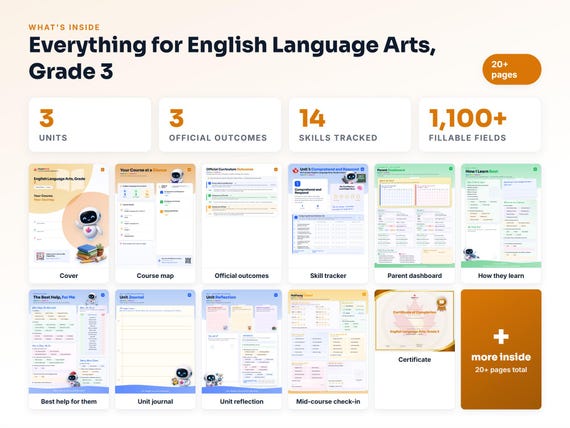
A English Language Arts, Grade 3 workbook worth keeping
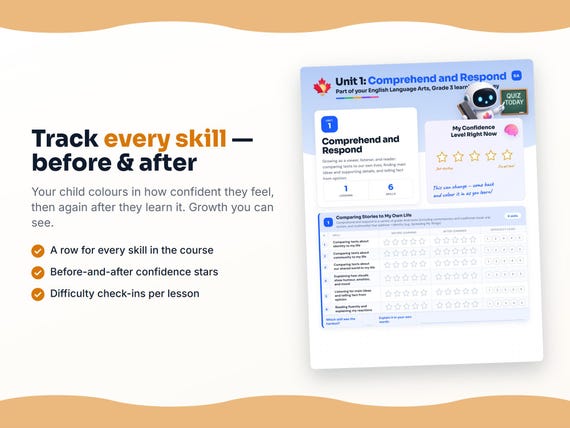
Built from the same official curriculum as this page. Before and after each skill above, your student colours in how sure they feel — so the two of you can see, on one page, what's clicking and what needs another look. It's a quiet way to follow how the year is really going.
By June it's full of their own handwriting: units worked through, confidence grown, a mid-year check-in, notes from parent-teacher night, and a certificate at the end. Less a worksheet, more a record of the year worth keeping on the shelf.
Instant download · see every page, reviews and the full description · five or more workbooks are $2.99 each
What it looks like in the app



Common questions
Can MapleMind help my child with English Language Arts, Grade 3?
Yes. MapleMind's AI tutor covers all 14 skills in Saskatchewan's English Language Arts, Grade 3 — your child picks the exact skill, and the tutor teaches it step by step: a short lesson, a worked example, solving together, then a skill check to show it stuck.
Is MapleMind aligned to Saskatchewan's official curriculum?
Yes. Every skill in this course maps to an official outcome code from Saskatchewan's Grade 3 English Language Arts curriculum, and the ministry's own wording is quoted under each unit on this page — with the official government source linked so you can check it yourself.
What does MapleMind cost?
It's free to start — 5 tutoring chats and a practice quiz every day, no credit card. A Pro subscription ($9.99/month or $49.99/year CAD, 7-day free trial) unlocks unlimited tutoring, practice, and exam simulations.
What if my child is stuck on just one topic?
That's the point of skill-level tutoring: open English Language Arts, Grade 3 in the app, tap the exact skill from the list on this page, and the tutor teaches just that — no wading through lessons your child doesn't need.
Does MapleMind work in French or other languages?
Yes — 14 languages, including French. Both the app and the tutor's explanations switch to the language your child chooses.
Where can I see the official Saskatchewan curriculum for English Language Arts, Grade 3?
The official source is linked on this page — Saskatchewan's official curriculum. The outline here follows it: every MapleMind skill carries its official outcome code, and the ministry's own wording is quoted under each unit.
Keep exploring
Ready when you are
Pick a skill from this page and see it taught properly — free, in the browser, in under a minute.