Get help with Science and Technology, Secondary 1
Most tutoring makes you sit through material you already know. MapleMind flips that: pick the exact skill that's causing trouble — any of the 33 below — and the tutor teaches just that one, step by step, as many times as it takes. Ask questions in plain words, any time of day, in English, French, or 12 other languages.
The official Quebec Science and Technology, Secondary 1 curriculum
Quebec defines Science and Technology, Secondary 1 by strands and outcomes. MapleMind teaches the same curriculum reorganized for one-skill-at-a-time tutoring — the table shows exactly where every official strand lands, and the ministry's own wording is quoted under each unit below.
Official source Québec's official education programRead it on the government site — quebec.ca ↗| Official strand | Outcomes | Where MapleMind teaches it |
|---|---|---|
| Strand MW | 9 | The Material World |
| Strand LW | 9 | The Living World |
| Strand ES | 9 | The Earth and Space |
| Strand TW | 6 | The Technological World |
Every skill below, taught one on one.
 Try the first session free
How MapleMind teaches Science and Technology, Secondary 1 — every unit, lesson, and skill
Every skill below runs as a short session: a plain-words lesson, a worked example, solving it together, then a five-question skill check that earns up to three stars. Guided Mode keeps it teaching instead of answer-handing — turning it off needs a parent's password.
Unit 1The Material WorldOfficial strand · Strand MW
Properties of matter, mixtures and changes, the atom, and the behaviour of substances — the PDA's Material World.
Mass and volume of matter
- What mass isMW.A.1 — Introduces mass as a measurable property of matter and how substances compare when volume is held constant.
Heat, temperature and particles
- Heat and particle motionMW.A.6 — Introduces the effect of heat on particle agitation and defines temperature in those terms.
States of matter and phase changes
- Naming the phase changesMW.A.9 — Introduces the named phase changes and interpreting a phase-change diagram for a pure substance.
Acids, bases and characteristic properties
- Acidic, basic and neutral solutionsMW.A.11 — Introduces observable properties of acids and bases and testing common substances.
- Characteristic properties identify substancesMW.A.13 — Introduces the idea of a characteristic property and using one to identify or group substances.
Mixtures and separating them
- Kinds of mixturesMW.B.2 — Introduces the properties of a mixture and distinguishing homogeneous from heterogeneous mixtures.
Physical and chemical changes
- Physical changesMW.B.8 — Introduces the characteristics of a physical change and recognizing examples.
- Chemical changes and their signsMW.B.15 — Introduces the indicators of a chemical change, explaining it by property change, and naming types; conservation of matter.
The atom and the elements
- Dalton's atomic modelMW.C.1 — Introduces Dalton's atomic model and representing molecules with it.
The official wording — 9 outcomes in this unit
- MW.A.1
Defines the concept of mass
- MW.A.6
Describes the effect of heat on the degree of agitation of particles
- MW.A.9
Names the different phase changes of matter
- MW.A.11
Determines the observable properties of acidic, basic or neutral solutions
- MW.A.13
Defines a characteristic property as a property that aids in the identification of a substance
- MW.B.2
Describes the properties of a mixture
- MW.B.8
Describes the characteristics of a physical change
- MW.B.15
Describes the indicators of a chemical change
- MW.C.1
Describes Dalton's atomic model
Unit 2The Living WorldOfficial strand · Strand LW
Ecology, the cell, life functions, and reproduction — the PDA's Living World.
Habitats, niches and species
- Habitat and ecological nicheLW.A.1 — Introduces the characteristics of a habitat and an ecological niche with examples.
- Species and populationsLW.A.5 — Introduces defining a species, distinguishing it from a population, and counting individuals.
Adaptation, evolution and classification
- Adaptations for survivalLW.A.30 — Introduces physical and behavioural adaptations that improve survival.
- Evolution and natural selectionLW.A.32 — Introduces the stages of evolution, natural selection, taxonomy, and the gene on a chromosome.
The cell and life functions
- The cell as the unit of lifeLW.B.2 — Introduces the cell as the structural unit of life, its vital functions, and the animal/plant distinction.
- Cell parts and what they doLW.B.5 — Introduces the main cellular components visible under a microscope and their roles.
Reproduction and human development
- Sexual and asexual reproductionLW.E.1 — Introduces the distinction between asexual and sexual reproduction and plant reproductive mechanisms.
- Human reproductive organs and gametesLW.E.5 — Introduces human reproductive organs, gametes, fertilization, and development stages (age-appropriate, factual).
- Contraception and preventing STBBIsLW.E.11 — Introduces contraceptive methods and responsible behaviours to prevent and respond to STBBIs (factual, health-focused).
The official wording — 9 outcomes in this unit
- LW.A.1
Names the characteristics that define a habitat
- LW.A.5
Names the characteristics that define a species
- LW.A.30
Describes physical adaptations that enable animals and plants to improve their chances of survival
- LW.A.32
Describes the stages in the evolution of living organisms
- LW.B.2
Defines the cell as the structural unit of life
- LW.B.5
Identifies the main cellular components visible under a microscope
- LW.E.1
Distinguishes between asexual and sexual reproduction
- LW.E.5
Names the main male and female reproductive organs
- LW.E.11
Describes contraceptive methods
Unit 3The Earth and SpaceOfficial strand · Strand ES
Earth's structure, geology, water, atmosphere, and space — the PDA's Earth and Space.
Earth's structure and relief
- Inside the EarthES.A.1 — Introduces the internal structure of the Earth and the lithosphere.
- Relief and human activityES.A.4 — Introduces relationships between relief and geological phenomena and its effect on human activity.
Rocks, minerals and soil
- The three rock typesES.A.13 — Introduces the formation and classification of igneous, metamorphic, and sedimentary rock, and rocks vs minerals.
- Classifying soilES.A.19 — Introduces classifying soils based on composition.
Water and air on Earth
- Fresh and salt waterES.A.31 — Introduces the distribution of fresh and salt water and hydrosphere-atmosphere interactions.
- Layers and composition of the atmosphereES.A.44 — Introduces the layers of the atmosphere, the composition of air, and links to human activity.
A changing Earth: plates, volcanoes, water cycle
- Plate tectonics and its effectsES.B.1 — Introduces plate tectonics and the phenomena it drives (mountains, volcanoes, earthquakes).
- Erosion, wind and the water cycleES.B.6 — Introduces erosion, the causes of wind, the water cycle, solar energy's role, and renewable vs nonrenewable resources.
Earth in space
- Gravitation and lightES.C.1 — Introduces gravitation as mutual attraction and light as radiant energy with its basic properties.
The official wording — 9 outcomes in this unit
- ES.A.1
Describes the main characteristics of the three parts of the internal structure of the Earth
- ES.A.4
Describes relationships between relief and geological and geophysical phenomena
- ES.A.13
Describes the formation of three types of rock: igneous, metamorphic, sedimentary
- ES.A.19
Classifies soils based on their composition
- ES.A.31
Describes the distribution of fresh water and salt water on the Earth's surface
- ES.A.44
Locates the main layers of the atmosphere
- ES.B.1
Describes the main elements of the theory of tectonic plates
- ES.B.6
Describes different types of erosion
- ES.C.1
Defines gravitation as a force of mutual attraction between bodies
Unit 4The Technological WorldOfficial strand · Strand TW
Technical objects, mechanical systems, materials, and design — the PDA's Technological World.
Reading technical diagrams
- Diagram of principlesTW.A.1 — Introduces the diagram of principles and using it to explain how a technical object operates.
Forces and simple machines
- Motion and force in objectsTW.B.1 — Introduces the ways parts move and the effects of a force in a technical object.
Technological systems and energy
- Parts of a technological systemTW.B.5 — Introduces identifying a system and describing its function, inputs/outputs, processes, control, and components; links and transmission/transformation systems.
- Energy transformations in objectsTW.B.10 — Introduces associating energy with radiation/heat/motion and identifying energy transformations in objects.
Materials and designing objects
- Materials in technical objectsTW.D.1 — Introduces raw vs unprocessed materials, the materials and their origins in an object, and the properties that justify a material's use.
- Tools, specifications and process sheetsTW.D.4 — Introduces tools and equipment, specifications, evaluating against them, and following a process/assembly sheet.
The official wording — 6 outcomes in this unit
- TW.A.1
Defines a diagram of principles as a representation used to effectively explain the operation of a technical object
- TW.B.1
Identifies parts that move in a specific way in a technical object
- TW.B.5
Identifies a system (set of connected elements that interact with each other) in a technical object
- TW.B.10
Associates energy with radiation, heat or motion
- TW.D.1
Associates raw materials with the unprocessed materials used in an industry
- TW.D.4
Defines tools and equipment as the elements needed to manufacture an object

Printable workbook · A keepsake of the year
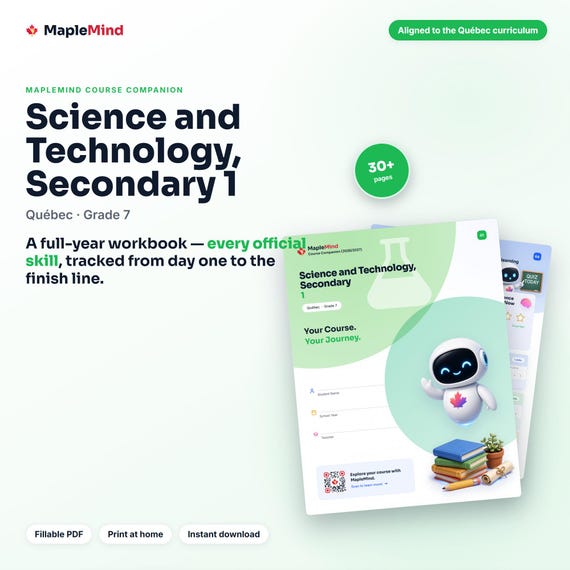
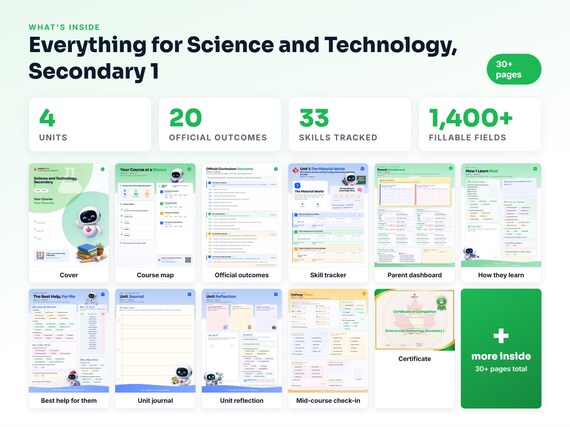
A Science and Technology, Secondary 1 workbook worth keeping
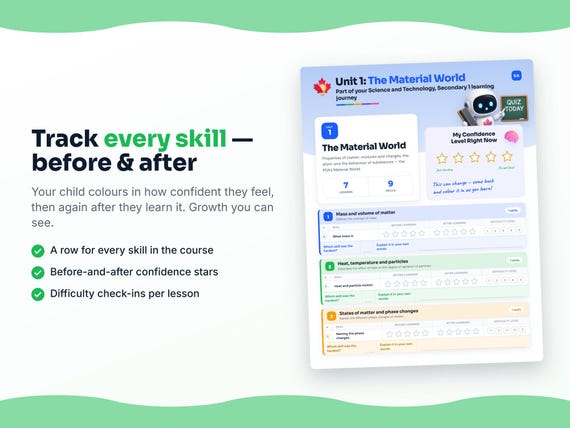
Built from the same official curriculum as this page. Before and after each skill above, your student colours in how sure they feel — so the two of you can see, on one page, what's clicking and what needs another look. It's a quiet way to follow how the year is really going.
By June it's full of their own handwriting: units worked through, confidence grown, a mid-year check-in, notes from parent-teacher night, and a certificate at the end. Less a worksheet, more a record of the year worth keeping on the shelf.
Instant download · see every page, reviews and the full description · five or more workbooks are $2.99 each
What it looks like in the app



Common questions
Can MapleMind help me with Science and Technology, Secondary 1?
Yes. MapleMind's AI tutor covers all 33 skills in Quebec's Science and Technology, Secondary 1 — you pick the exact skill, and the tutor teaches it step by step: a short lesson, a worked example, solving together, then a skill check to show it stuck.
Is MapleMind aligned to Quebec's official curriculum?
Yes. Every skill in this course maps to an official outcome code from Quebec's Grade 7 Science curriculum, and the ministry's own wording is quoted under each unit on this page — with the official government source linked so you can check it yourself.
What does MapleMind cost?
It's free to start — 5 tutoring chats and a practice quiz every day, no credit card. A Pro subscription ($9.99/month or $49.99/year CAD, 7-day free trial) unlocks unlimited tutoring, practice, and exam simulations.
What if I'm stuck on just one topic?
That's the point of skill-level tutoring: open Science and Technology, Secondary 1 in the app, tap the exact skill from the list on this page, and the tutor teaches just that — no wading through lessons you don't need.
Does MapleMind work in French or other languages?
Yes — 14 languages, including French. Both the app and the tutor's explanations switch to the language you choose.
Where can I see the official Quebec curriculum for Science and Technology, Secondary 1?
The official source is linked on this page — Québec's official education program. The outline here follows it: every MapleMind skill carries its official outcome code, and the ministry's own wording is quoted under each unit.
Keep exploring
Ready when you are
Pick a skill from this page and see it taught properly — free, in the browser, in under a minute.