Get help with Social Sciences (Geography, History and Citizenship Education), Grade 2
Most tutoring makes your child sit through material your child already knows. MapleMind flips that: pick the exact skill that's causing trouble — any of the 9 below — and the tutor teaches just that one, step by step, as many times as it takes. Ask questions in plain words, any time of day, in English, French, or 12 other languages.
The official Quebec Social Sciences (Geography, History and Citizenship Education), Grade 2 curriculum
Quebec defines Social Sciences (Geography, History and Citizenship Education), Grade 2 by strands and outcomes. MapleMind teaches the same curriculum reorganized for one-skill-at-a-time tutoring — the table shows exactly where every official strand lands, and the ministry's own wording is quoted under each unit below.
Official source Québec's official education programRead it on the government site — quebec.ca ↗| Official strand | Outcomes | Where MapleMind teaches it |
|---|---|---|
| ORG | 6 | Organization of a society in its territory · Organization of a society in its territory (natural elements) |
| DIV | 1 | Diversity of societies and their territories |
| RES | 2 | Researching and Techniques |
Every skill below, taught one on one.
 Try the first session free
How MapleMind teaches Social Sciences (Geography, History and Citizenship Education), Grade 2 — every unit, lesson, and skill
Every skill below runs as a short session: a plain-words lesson, a worked example, solving it together, then a five-question skill check that earns up to three stars. Guided Mode keeps it teaching instead of answer-handing — turning it off needs a parent's password.
Unit 1Organization of a society in its territoryOfficial strand · ORG
Describing the parts that make up a society - the people and their groups, languages, and beliefs; the work they do; the rules they live by - and the natural land they live on.
Groups and Culture in My World
- The groups I belong toORG.A.2.1.a — Name the groups you belong to, describe who is in them, and say about how many members they have.
- Languages, beliefs, and art around meORG.A.2.2.a — Name the languages spoken, the beliefs practised, the kinds of art, and the everyday objects found in your environment.
- Work and getting aroundORG.A.2.3.a — Name places where people work (like farms, factories, and ports), the needs that work meets, and the ways people and goods get around.
- Institutions and rulesORG.A.2.4.a — Name institutions in your environment (like city hall) and the rules that keep your groups orderly.
The official wording — 4 outcomes in this unit
- ORG.A.2.1.a
Names groups he/she belongs to (e.g. family, friends, sports teams, class)
- ORG.A.2.2.a
Names the language(s) spoken in his/her environment (e.g. French, English, Italian)
- ORG.A.2.3.a
Names elements of the landscape related to economic activities (e.g. farm, factory, bank, port)
- ORG.A.2.4.a
Names institutions (e.g. city hall, municipal council)
Unit 2Organization of a society in its territory (natural elements)Official strand · ORG
Describing the natural land a society lives on - its landforms, its weather, its waters, and its resources.
The Natural Land Around Us
- Landforms and weatherORG.A.3.a — Name types of landforms (like plains, valleys, and hills) and elements of climate (like rain and temperature) in your area.
- Water and natural resourcesORG.A.3.c — Name bodies of water (like rivers and lakes) and natural resources (like forests, water, soil, and minerals) around you.
The official wording — 2 outcomes in this unit
- ORG.A.3.a
Names types of relief (e.g. plain, valley, plateau, hill, mountain chain)
- ORG.A.3.c
Names bodies of water (e.g. river, lake)
Unit 3Diversity of societies and their territoriesOfficial strand · DIV
Comparing your own environment fairly with an unfamiliar one - noticing what is the same and what is different, without deciding one is better.
My World and a Different World
- Comparing my environment with an unfamiliar oneDIV.A.1 — Indicate the differences between your own environment and an unfamiliar one across everyday objects, transportation, economic activity, and the land itself.
The official wording — 1 outcome in this unit
- DIV.A.1
Indicates differences between his/her environment and an unfamiliar environment
Unit 4Researching and TechniquesOfficial strand · RES
Finding things out like a young geographer and historian - asking good questions, and building a simple time line.
Asking Good Questions and Making a Time Line
- Asking and choosing good questionsRES.-.2 — Ask questions about something you want to find out, sort them, and pick the ones that will help you most.
- Building a time lineTEC.-.2 — Build a simple time line: choose what to show, draw the line, mark it out in even steps, and add a title.
The official wording — 2 outcomes in this unit
- RES.-.2
Asks questions
- TEC.-.2
Constructs a time line
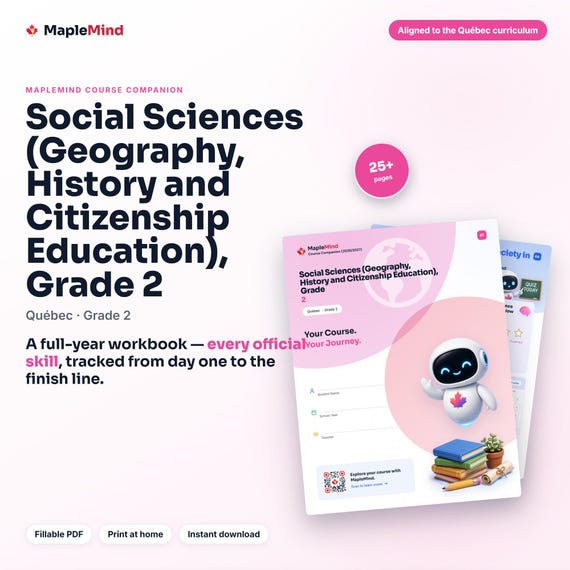
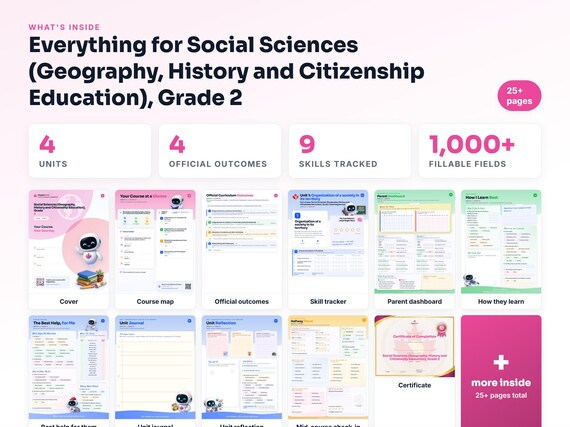
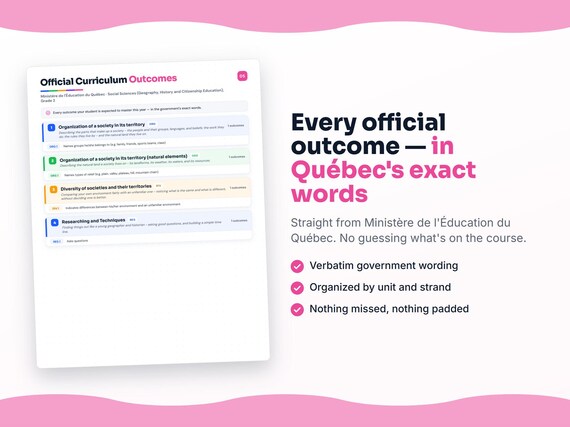
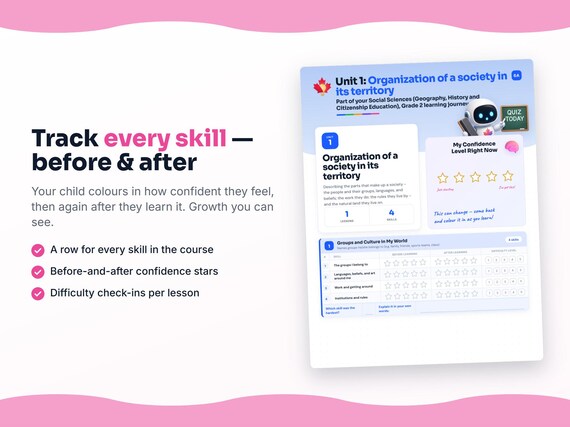
Printable workbook · A keepsake of the year
A Social Sciences (Geography, History and Citizenship Education), Grade 2 workbook worth keeping
Built from the same official curriculum as this page. Before and after each skill above, your student colours in how sure they feel — so the two of you can see, on one page, what's clicking and what needs another look. It's a quiet way to follow how the year is really going.
By June it's full of their own handwriting: units worked through, confidence grown, a mid-year check-in, notes from parent-teacher night, and a certificate at the end. Less a worksheet, more a record of the year worth keeping on the shelf.
Instant download · see every page, reviews and the full description · five or more workbooks are $2.99 each
What it looks like in the app



Common questions
Can MapleMind help my child with Social Sciences (Geography, History and Citizenship Education), Grade 2?
Yes. MapleMind's AI tutor covers all 9 skills in Quebec's Social Sciences (Geography, History and Citizenship Education), Grade 2 — your child picks the exact skill, and the tutor teaches it step by step: a short lesson, a worked example, solving together, then a skill check to show it stuck.
Is MapleMind aligned to Quebec's official curriculum?
Yes. Every skill in this course maps to an official outcome code from Quebec's Grade 2 Social Studies curriculum, and the ministry's own wording is quoted under each unit on this page — with the official government source linked so you can check it yourself.
What does MapleMind cost?
It's free to start — 5 tutoring chats and a practice quiz every day, no credit card. A Pro subscription ($9.99/month or $49.99/year CAD, 7-day free trial) unlocks unlimited tutoring, practice, and exam simulations.
What if my child is stuck on just one topic?
That's the point of skill-level tutoring: open Social Sciences (Geography, History and Citizenship Education), Grade 2 in the app, tap the exact skill from the list on this page, and the tutor teaches just that — no wading through lessons your child doesn't need.
Does MapleMind work in French or other languages?
Yes — 14 languages, including French. Both the app and the tutor's explanations switch to the language your child chooses.
Where can I see the official Quebec curriculum for Social Sciences (Geography, History and Citizenship Education), Grade 2?
The official source is linked on this page — Québec's official education program. The outline here follows it: every MapleMind skill carries its official outcome code, and the ministry's own wording is quoted under each unit.
Keep exploring
Ready when you are
Pick a skill from this page and see it taught properly — free, in the browser, in under a minute.