Get help with Français, langue d’enseignement, 1re année
Most tutoring makes your child sit through material your child already knows. MapleMind flips that: pick the exact skill that's causing trouble — any of the 44 below — and the tutor teaches just that one, step by step, as many times as it takes. Ask questions in plain words, any time of day, in English, French, or 12 other languages.
The official Quebec Français, langue d’enseignement, 1re année curriculum
Quebec defines Français, langue d’enseignement, 1re année by strands and outcomes. MapleMind teaches the same curriculum reorganized for one-skill-at-a-time tutoring — the table shows exactly where every official strand lands, and the ministry's own wording is quoted under each unit below.
Official source Québec's official education programRead it on the government site — quebec.ca ↗| Official strand | Outcomes | Where MapleMind teaches it |
|---|---|---|
| Strand B | 16 | Écrire — Section Organisation et cohérence du texte · Écrire — Section Lexique · Écrire — Section Orthographe d’usage · Écrire — Section Conjugaison · Écrire — Section Accords · Écrire — Section Syntaxe et ponctuation |
| Strand C | 14 | Compétence Lire des textes variés |
| Strand D | 6 | Compétence Apprécier des œuvres littéraires |
| Strand E | 8 | Compétence Communiquer oralement |
Every skill below, taught one on one.
 Try the first session free
How MapleMind teaches Français, langue d’enseignement, 1re année — every unit, lesson, and skill
Every skill below runs as a short session: a plain-words lesson, a worked example, solving it together, then a five-question skill check that earns up to three stars. Guided Mode keeps it teaching instead of answer-handing — turning it off needs a parent's password.
Unit 1Écrire — Section Organisation et cohérence du texteOfficial strand · Strand B
Text organisation & coherence within the writing competence.
Découvrir les genres de textes (discovering text genres)
- Découverte : Les genres de textes (text genres)P2.4 — Découverte guidée de « Les genres de textes » (text genres) en 1re année, Français L1 — premier contact accompagné par l’adulte, avant la maîtrise autonome.
Les petits mots qui relient les idées (little linking words)
- Découverte : Le texte et la cohérence (text and coherence)P2.49 — Découverte guidée de « Le texte et la cohérence » (text and coherence) en 1re année, Français L1 — premier contact accompagné par l’adulte, avant la maîtrise autonome.
The official wording — 2 outcomes in this unit
- P2.4
Observer qu’il existe une variété de genres de textes (ex. : affiche, annonce classée, article de journal, bande dessinée, biographie,
- P2.49
Écrire un court texte dans un contexte ludique en partant par exemple d’une illustration, d’un objet ou de quelques mots donnés qui
Unit 2Écrire — Section LexiqueOfficial strand · Strand B
Lexis: word formation, word meaning and dictionary use.
Explorer le dictionnaire et les mots amis (exploring dictionaries and word friends)
- Découverte : Les relations entre les mots (synonymes, antonymes, génériques) (relations between words)P3.39 — Découverte guidée de « Les relations entre les mots (synonymes, antonymes, génériques) » (relations between words) en 1re année, Français L1 — premier contact accompagné par l’adulte, avant la maîtrise autonome.
The official wording — 1 outcome in this unit
- P3.39
thématiques (ex. : visuel)
Unit 3Écrire — Section Orthographe d’usageOfficial strand · Strand B
Spelling: letters, grapheme–phoneme links and the growing spelling bank.
Les lettres et les signes
- Les lettres et les signes (letters and diacritical signs)P4.7 — Maîtrise de « Les lettres et les signes » (letters and diacritical signs) en 1re année, Français L1 — l’enfant l’emploie de façon autonome dans ses lectures, ses écrits et à l’oral.
Les mots à l’étude
- Découverte : Les correspondances graphème-phonème (letter-sound correspondences)P4.14 — Découverte guidée de « Les correspondances graphème-phonème » (letter-sound correspondences) en 1re année, Français L1 — premier contact accompagné par l’adulte, avant la maîtrise autonome.
Les familles de mots pour mieux orthographier (word families that help spelling)
- Découverte : Les stratégies orthographiques (spelling strategies)P4.48 — Découverte guidée de « Les stratégies orthographiques » (spelling strategies) en 1re année, Français L1 — premier contact accompagné par l’adulte, avant la maîtrise autonome.
Des stratégies pour mémoriser les mots (strategies to memorise words)
- Découverte : Les mots à l’étude (banque orthographique) (the study-word spelling bank)P4.57 — Découverte guidée de « Les mots à l’étude (banque orthographique) » (the study-word spelling bank) en 1re année, Français L1 — premier contact accompagné par l’adulte, avant la maîtrise autonome.
Consulter un outil de référence (checking a reference tool)
- Découverte : Les stratégies orthographiques (spelling strategies)P4.77 — Découverte guidée de « Les stratégies orthographiques » (spelling strategies) en 1re année, Français L1 — premier contact accompagné par l’adulte, avant la maîtrise autonome.
The official wording — 5 outcomes in this unit
- P4.7
Identifier les lettres de l’alphabet (minuscules et majuscules)
- P4.14
identifier un graphème dans un mot et le relier au son (phonème) qu’il représente (ex. : dans le mot grand, ce sont les lettres an qui
- P4.48
Inventer un moyen mnémotechnique (analogie, dessin, etc.) en l’absence d’explication basée sur le fonctionnement du système orthographique
- P4.57
Émettre oralement des hypothèses pour un mot dont l’orthographe est inconnue, les justifier en ayant recours à l’ensemble de ses
- P4.77
Relire attentivement la version finale de ses textes pour repérer et corriger les coquilles ou erreurs qui y restent
Unit 4Écrire — Section ConjugaisonOfficial strand · Strand B
Conjugation: the verb, its role and its endings.
La terminaison des verbes, première rencontre (first look at verb endings)
- Découverte : Les formes verbales fréquentes (être, avoir, aller…) (high-frequency verb forms)P5.14 — Découverte guidée de « Les formes verbales fréquentes (être, avoir, aller…) » (high-frequency verb forms) en 1re année, Français L1 — premier contact accompagné par l’adulte, avant la maîtrise autonome.
The official wording — 1 outcome in this unit
- P5.14
Mémoriser, sans découverte du système de la conjugaison, les formes verbales fréquentes à l’écrit des verbes aimer, aller, avoir, dire,
Unit 5Écrire — Section AccordsOfficial strand · Strand B
Agreement: the système d’accords across the groupe du nom and with the verb.
Les caractéristiques du nom (characteristics of the noun)
- Découverte : Le nom, donneur d’accord (the noun as the source of agreement)P6.11 — Découverte guidée de « Le nom, donneur d’accord » (the noun as the source of agreement) en 1re année, Français L1 — premier contact accompagné par l’adulte, avant la maîtrise autonome.
Identifier un nom par des manipulations (spotting a noun with little tests)
- Découverte : Le déterminant, receveur d’accord (the determiner (receiver of agreement))P6.24 — Découverte guidée de « Le déterminant, receveur d’accord » (the determiner (receiver of agreement)) en 1re année, Français L1 — premier contact accompagné par l’adulte, avant la maîtrise autonome.
Identifier un verbe par des manipulations (spotting a verb with little tests)
- Découverte : Le déterminant, receveur d’accord (the determiner (receiver of agreement))P6.80 — Découverte guidée de « Le déterminant, receveur d’accord » (the determiner (receiver of agreement)) en 1re année, Français L1 — premier contact accompagné par l’adulte, avant la maîtrise autonome.
La classe d’un mot selon la phrase (a word’s class in its sentence)
- Découverte : Le déterminant, receveur d’accord (the determiner (receiver of agreement))P6.126 — Découverte guidée de « Le déterminant, receveur d’accord » (the determiner (receiver of agreement)) en 1re année, Français L1 — premier contact accompagné par l’adulte, avant la maîtrise autonome.
The official wording — 4 outcomes in this unit
- P6.11
de genre et de nombre au déterminant de genre et de nombre à l’adjectif de personne et de nombre au verbe conjugué quand il est le noyau
- P6.24
remplacement d’un déterminant par un autre4 (ex. : plusieurs musiques/des musiques; beaucoup de bonbons/des bonbons)
- P6.80
le déterminant avant le nom donneur (ex. : la musique)
- P6.126
Répertorier un ensemble de mots appartenant à la classe des déterminants, des noms ou des adjectifs en recourant à la manipulation de
Unit 6Écrire — Section Syntaxe et ponctuationOfficial strand · Strand B
Syntax & punctuation: the sentence, its structure and its signs.
Les caractéristiques de la phrase (what makes a sentence)
- Découverte : Les caractéristiques de la phrase (characteristics of the sentence)P7.6 — Découverte guidée de « Les caractéristiques de la phrase » (characteristics of the sentence) en 1re année, Français L1 — premier contact accompagné par l’adulte, avant la maîtrise autonome.
Les sortes de point (kinds of end punctuation)
- Découverte : Les caractéristiques de la phrase (characteristics of the sentence)P7.193 — Découverte guidée de « Les caractéristiques de la phrase » (characteristics of the sentence) en 1re année, Français L1 — premier contact accompagné par l’adulte, avant la maîtrise autonome.
Le groupe du nom minimal dans la phrase (the smallest noun group)
- Découverte : Les caractéristiques de la phrase (characteristics of the sentence)P7.252 — Découverte guidée de « Les caractéristiques de la phrase » (characteristics of the sentence) en 1re année, Français L1 — premier contact accompagné par l’adulte, avant la maîtrise autonome.
The official wording — 3 outcomes in this unit
- P7.6
la présence d’au moins un verbe conjugué dans une très grande majorité de phrases
- P7.193
Ajouter la majuscule et le point dans une ou des phrases non ponctuées après avoir cerné le verbe conjugué
- P7.252
sans nommer la sorte4 (ex. : Les chats traversent la rue. Les chats noirs de mon voisin traversent la rue Bleury. J’aime les pommes. J’aime
Unit 7Compétence Lire des textes variésOfficial strand · Strand C
Read varied texts.
Reconnaître les mots fréquents au premier coup d’œil (recognising frequent words on sight)
- Reconnaître les genres de textes en lecture (recognising text genres in reading)P8.95 — Maîtrise de « Reconnaître les genres de textes en lecture » (recognising text genres in reading) en 1re année, Français L1 — l’enfant l’emploie de façon autonome dans ses lectures, ses écrits et à l’oral.
- Comprendre le sens d’un texte (understanding a text)P8.97 — Maîtrise de « Comprendre le sens d’un texte » (understanding a text) en 1re année, Français L1 — l’enfant l’emploie de façon autonome dans ses lectures, ses écrits et à l’oral.
Les textes qui racontent (texts that tell stories)
- Découverte : Reconnaître les genres de textes en lecture (recognising text genres in reading)P8.18 — Découverte guidée de « Reconnaître les genres de textes en lecture » (recognising text genres in reading) en 1re année, Français L1 — premier contact accompagné par l’adulte, avant la maîtrise autonome.
- Découverte : Les éléments du récit (personnages, temps, lieux) (story elements)P8.40 — Découverte guidée de « Les éléments du récit (personnages, temps, lieux) » (story elements) en 1re année, Français L1 — premier contact accompagné par l’adulte, avant la maîtrise autonome.
Les caractéristiques des personnages (character traits)
- Découverte : Les éléments du récit (personnages, temps, lieux) (story elements)P8.66 — Découverte guidée de « Les éléments du récit (personnages, temps, lieux) » (story elements) en 1re année, Français L1 — premier contact accompagné par l’adulte, avant la maîtrise autonome.
Différentes façons d’organiser les idées (ways of organising ideas)
- Découverte : Comprendre le sens d’un texte (understanding a text)P8.88 — Découverte guidée de « Comprendre le sens d’un texte » (understanding a text) en 1re année, Français L1 — premier contact accompagné par l’adulte, avant la maîtrise autonome.
Lire des mots qu’on connaît à l’oral (reading words you know by ear)
- Découverte : Reconnaître les genres de textes en lecture (recognising text genres in reading)P8.102 — Découverte guidée de « Reconnaître les genres de textes en lecture » (recognising text genres in reading) en 1re année, Français L1 — premier contact accompagné par l’adulte, avant la maîtrise autonome.
Découvrir les mots nouveaux grâce au contexte (new words from context)
- Découverte : Comprendre le sens d’un texte (understanding a text)P8.117 — Découverte guidée de « Comprendre le sens d’un texte » (understanding a text) en 1re année, Français L1 — premier contact accompagné par l’adulte, avant la maîtrise autonome.
L’information importante dans la phrase (the key information in a sentence)
- Découverte : Comprendre les mots nouveaux en contexte (understanding new words in context)P8.136 — Découverte guidée de « Comprendre les mots nouveaux en contexte » (understanding new words in context) en 1re année, Français L1 — premier contact accompagné par l’adulte, avant la maîtrise autonome.
Des indices pour trouver l’information importante (clues to the important information)
- Découverte : Les éléments du récit (personnages, temps, lieux) (story elements)P8.139 — Découverte guidée de « Les éléments du récit (personnages, temps, lieux) » (story elements) en 1re année, Français L1 — premier contact accompagné par l’adulte, avant la maîtrise autonome.
Les outils de référence du lecteur (a reader’s reference tools)
- Découverte : Comprendre le sens d’un texte (understanding a text)P8.156 — Découverte guidée de « Comprendre le sens d’un texte » (understanding a text) en 1re année, Français L1 — premier contact accompagné par l’adulte, avant la maîtrise autonome.
Réagir à toutes sortes de textes (reacting to all kinds of texts)
- Découverte : Réagir à un texte (reacting to a text)P8.178 — Découverte guidée de « Réagir à un texte » (reacting to a text) en 1re année, Français L1 — premier contact accompagné par l’adulte, avant la maîtrise autonome.
Pourquoi lire des histoires ? (why we read stories)
- Découverte : Réagir à un texte (reacting to a text)P8.194 — Découverte guidée de « Réagir à un texte » (reacting to a text) en 1re année, Français L1 — premier contact accompagné par l’adulte, avant la maîtrise autonome.
Chercher l’information dans les textes (finding information in texts)
- Découverte : Rechercher et sélectionner l’information (researching and selecting information)P8.205 — Découverte guidée de « Rechercher et sélectionner l’information » (researching and selecting information) en 1re année, Français L1 — premier contact accompagné par l’adulte, avant la maîtrise autonome.
The official wording — 14 outcomes in this unit
- P8.95
mots souvent répétés sur des affiches ou étiquettes (ex. : prénoms des élèves, mots désignant des objets étiquetés dans la classe, mots des
- P8.97
mots ou groupes de mots qui reviennent souvent dans un texte
- P8.18
marche à suivre, mode d’emploi, règles de jeux, conseils, suggestions
- P8.40
repérer les structures d’alternance ou d’opposition (ex. : J’aime…/Je n’aime pas…)
- P8.66
repérer les jeux de sonorité (ex. : rime, allitération, onomatopée, répétition)
- P8.88
repérer les mots qui servent à poser des questions (ex. : est-ce que, qui est-ce qui, qu’est-ce qui, quel/quelle, quand, comment, pourquoi,
- P8.102
outils de référence (ex. : dictionnaire mural, affiches, abécédaire, pictogrammes, cartes de sons)
- P8.117
2.2. Compréhension des phrases repérer les signes qui délimitent la phrase (majuscule et point)
- P8.136
identifier les mots auxquels renvoient les mots de substitution (ex. : pronom, synonyme, mot générique)
- P8.139
indices graphiques (ex. : grosseur des lettres, caractères gras ou italiques, soulignement)
- P8.156
mots-étiquettes, dictionnaire mural, cartes des sons, pictogrammes, illustrations
- P8.178
partager ses impressions à la suite de sa lecture (dire ce que l’on a aimé ou non)
- P8.194
le plaisir de lire et répondre à ses besoins d’évasion ou d’imaginaire
- P8.205
réaliser des projets (ex. : marionnettes, journal de classe, spectacle, exposition)
Unit 8Compétence Apprécier des œuvres littérairesOfficial strand · Strand D
Appreciate literary works.
Œuvres de littérature pour la jeunesse
- Les genres littéraires (comptine, poème, BD…) (literary genres)P9.28 — Maîtrise de « Les genres littéraires (comptine, poème, BD…) » (literary genres) en 1re année, Français L1 — l’enfant l’emploie de façon autonome dans ses lectures, ses écrits et à l’oral.
Explorer les livres de littérature jeunesse (exploring children’s books)
- Découverte : Connaître le livre (couverture, format) (the book's features)P9.10 — Découverte guidée de « Connaître le livre (couverture, format) » (the book's features) en 1re année, Français L1 — premier contact accompagné par l’adulte, avant la maîtrise autonome.
Présentation matérielle d’un livre
- Découverte : Comparer des œuvres (comparing works)P9.40 — Découverte guidée de « Comparer des œuvres » (comparing works) en 1re année, Français L1 — premier contact accompagné par l’adulte, avant la maîtrise autonome.
Appréciation des œuvres littéraires
- Découverte : S’inspirer des œuvres et développer sa sensibilité (drawing on literary works)P9.51 — Découverte guidée de « S’inspirer des œuvres et développer sa sensibilité » (drawing on literary works) en 1re année, Français L1 — premier contact accompagné par l’adulte, avant la maîtrise autonome.
S’ouvrir à des œuvres variées (opening up to varied works)
- Découverte : S’inspirer des œuvres et développer sa sensibilité (drawing on literary works)P9.74 — Découverte guidée de « S’inspirer des œuvres et développer sa sensibilité » (drawing on literary works) en 1re année, Français L1 — premier contact accompagné par l’adulte, avant la maîtrise autonome.
Dire ce qu’on pense d’une œuvre (saying what you think of a work)
- Découverte : Porter un jugement critique sur une œuvre (forming a critical judgment)P9.77 — Découverte guidée de « Porter un jugement critique sur une œuvre » (forming a critical judgment) en 1re année, Français L1 — premier contact accompagné par l’adulte, avant la maîtrise autonome.
The official wording — 6 outcomes in this unit
- P9.28
dégager quelques caractéristiques de la comptine (ex. : jeux de sonorités, création et répétition de mots, rythme)
- P9.10
relever les éléments de la page couverture (ex. : titre, auteur, illustrateur, maison d’édition, collection)
- P9.40
relever les ressemblances et les différences dans la façon de présenter les personnages (ex. : le loup dans différents albums; le détective
- P9.51
prendre conscience des émotions ressenties ou des sentiments éprouvés au contact des œuvres (ex. : plaisir, surprise, peur)
- P9.74
à des éléments littéraires (ex. : thème, sous-thème, séquence des événements, valeur, expression, jeu de sonorités et figure de style)
- P9.77
donner son opinion sur une œuvre lue, vue ou entendue à partir de ses premières impressions (ex. : C’est un bon livre.)
Unit 9Compétence Communiquer oralementOfficial strand · Strand E
Communicate orally.
Les éléments d’une situation d’interaction (the parts of a conversation)
- Découverte : Prendre la parole (speaking up)P10.8 — Découverte guidée de « Prendre la parole » (speaking up) en 1re année, Français L1 — premier contact accompagné par l’adulte, avant la maîtrise autonome.
Parler selon son intention (speaking with a purpose)
- Découverte : Participer à un échange (taking part in an exchange)P10.30 — Découverte guidée de « Participer à un échange » (taking part in an exchange) en 1re année, Français L1 — premier contact accompagné par l’adulte, avant la maîtrise autonome.
Des idées claires et bien organisées à l’oral (clear, well-organised ideas out loud)
- Découverte : Écouter et réagir (listening and responding)P10.52 — Découverte guidée de « Écouter et réagir » (listening and responding) en 1re année, Français L1 — premier contact accompagné par l’adulte, avant la maîtrise autonome.
Réagir à ce qu’on entend (reacting to what you hear)
- Découverte : Écouter et réagir (listening and responding)P10.86 — Découverte guidée de « Écouter et réagir » (listening and responding) en 1re année, Français L1 — premier contact accompagné par l’adulte, avant la maîtrise autonome.
Organiser ses propos quand on parle (organising what you say)
- Découverte : Prendre la parole (speaking up)P10.113 — Découverte guidée de « Prendre la parole » (speaking up) en 1re année, Français L1 — premier contact accompagné par l’adulte, avant la maîtrise autonome.
Expérimenter des intentions de parole et d’écoute (trying out reasons to speak and listen)
- Découverte : Prendre la parole (speaking up)P10.116 — Découverte guidée de « Prendre la parole » (speaking up) en 1re année, Français L1 — premier contact accompagné par l’adulte, avant la maîtrise autonome.
Réagir aux propos entendus (responding to what was said)
- Découverte : Écouter et réagir (listening and responding)P10.143 — Découverte guidée de « Écouter et réagir » (listening and responding) en 1re année, Français L1 — premier contact accompagné par l’adulte, avant la maîtrise autonome.
Les stratégies pour bien écouter (strategies for good listening)
- Découverte : Écouter et réagir (listening and responding)P10.156 — Découverte guidée de « Écouter et réagir » (listening and responding) en 1re année, Français L1 — premier contact accompagné par l’adulte, avant la maîtrise autonome.
The official wording — 8 outcomes in this unit
- P10.8
raconter ou se faire raconter une histoire ou un événement lire à haute voix1 ou se faire lire un texte littéraire ou courant réciter ou se
- P10.30
ajustement des propos selon les modalités retenues (ex. : audio/vidéo/visio5, public/privé, direct/différé, formel/informel)
- P10.52
écoute attentive selon la formule retenue (ex. : causerie, conversation, discussion, table ronde, jeu de rôle)
- P10.86
son intérêt ou son manque d’intérêt son accord ou son désaccord sa compréhension ou son incompréhension Interpréter le langage non verbal
- P10.113
mettre en valeur un texte littéraire ou courant, rédigé par soi ou par d’autres, en le lisant à haute voix (ex. : article de journal,
- P10.116
justifier ce qui a été fait (ex. : démarche mathématique, artistique ou scientifique, processus d’écriture, raisonnement grammatical,
- P10.143
Varier les intentions d’écoute (ex. : s’informer, se faire dire comment faire, accueillir des commentaires, explications ou arguments)
- P10.156
Recourir à des stratégies appropriées durant les interactions, au moment de la prise de parole et de l’écoute
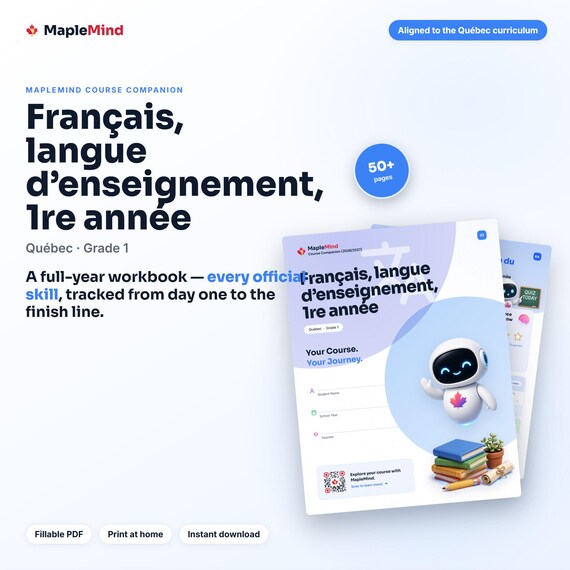
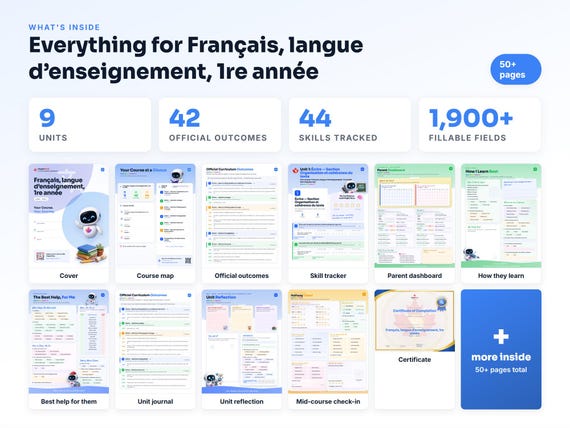
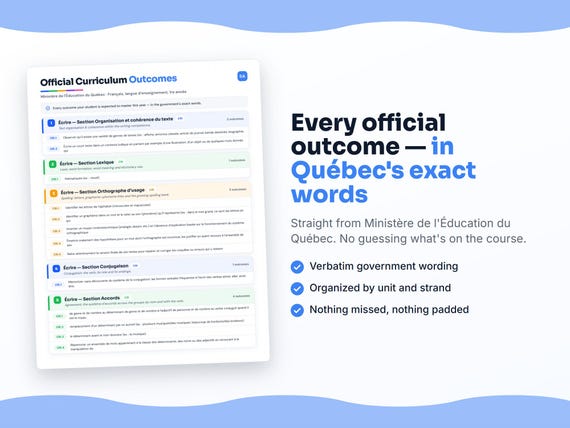
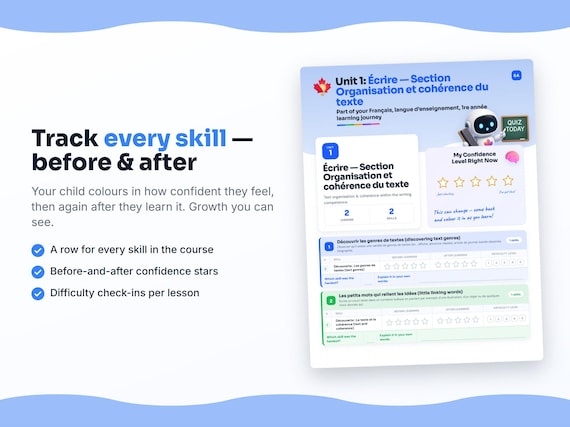
Printable workbook · A keepsake of the year
A Français, langue d’enseignement, 1re année workbook worth keeping
Built from the same official curriculum as this page. Before and after each skill above, your student colours in how sure they feel — so the two of you can see, on one page, what's clicking and what needs another look. It's a quiet way to follow how the year is really going.
By June it's full of their own handwriting: units worked through, confidence grown, a mid-year check-in, notes from parent-teacher night, and a certificate at the end. Less a worksheet, more a record of the year worth keeping on the shelf.
Instant download · see every page, reviews and the full description · five or more workbooks are $2.99 each
What it looks like in the app



Common questions
Can MapleMind help my child with Français, langue d’enseignement, 1re année?
Yes. MapleMind's AI tutor covers all 44 skills in Quebec's Français, langue d’enseignement, 1re année — your child picks the exact skill, and the tutor teaches it step by step: a short lesson, a worked example, solving together, then a skill check to show it stuck.
Is MapleMind aligned to Quebec's official curriculum?
Yes. Every skill in this course maps to an official outcome code from Quebec's Grade 1 French curriculum, and the ministry's own wording is quoted under each unit on this page — with the official government source linked so you can check it yourself.
What does MapleMind cost?
It's free to start — 5 tutoring chats and a practice quiz every day, no credit card. A Pro subscription ($9.99/month or $49.99/year CAD, 7-day free trial) unlocks unlimited tutoring, practice, and exam simulations.
What if my child is stuck on just one topic?
That's the point of skill-level tutoring: open Français, langue d’enseignement, 1re année in the app, tap the exact skill from the list on this page, and the tutor teaches just that — no wading through lessons your child doesn't need.
Does MapleMind work in French or other languages?
Yes — 14 languages, including French. Both the app and the tutor's explanations switch to the language your child chooses.
Where can I see the official Quebec curriculum for Français, langue d’enseignement, 1re année?
The official source is linked on this page — Québec's official education program. The outline here follows it: every MapleMind skill carries its official outcome code, and the ministry's own wording is quoted under each unit.
Keep exploring
Ready when you are
Pick a skill from this page and see it taught properly — free, in the browser, in under a minute.