Get help with Mathematics, Secondary 1
Most tutoring makes you sit through material you already know. MapleMind flips that: pick the exact skill that's causing trouble — any of the 113 below — and the tutor teaches just that one, step by step, as many times as it takes. Ask questions in plain words, any time of day, in English, French, or 12 other languages.
The official Quebec Mathematics, Secondary 1 curriculum
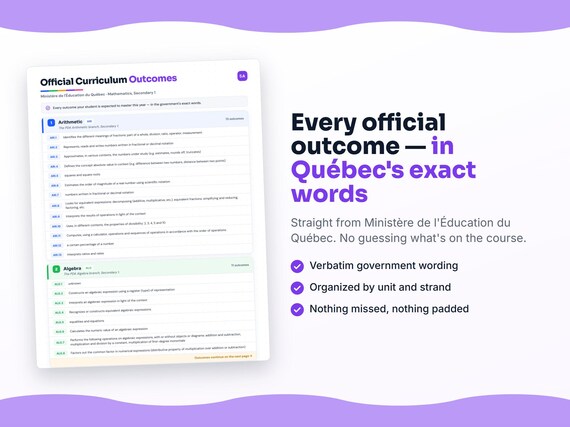
Quebec defines Mathematics, Secondary 1 by strands and outcomes. MapleMind teaches the same curriculum reorganized for one-skill-at-a-time tutoring — the table shows exactly where every official strand lands, and the ministry's own wording is quoted under each unit below.
Official source Québec's official education programRead it on the government site — quebec.ca ↗| Official strand | Outcomes | Where MapleMind teaches it |
|---|---|---|
| ARITH | 33 | Arithmetic |
| ALG | 22 | Algebra |
| GEOM | 38 | Geometry |
| ANALG | 2 | Analytic Geometry |
| STAT | 11 | Statistics |
| PROB | 7 | Probability |
Every skill below, taught one on one.
 Try the first session free
How MapleMind teaches Mathematics, Secondary 1 — every unit, lesson, and skill
Every skill below runs as a short session: a plain-words lesson, a worked example, solving it together, then a five-question skill check that earns up to three stars. Guided Mode keeps it teaching instead of answer-handing — turning it off needs a parent's password.
Unit 1ArithmeticOfficial strand · ARITH
The PDA Arithmetic branch, Secondary 1.
Meanings of a fraction: part of a whole, division, ratio, operator, measure
- Meanings of a fraction: part of a whole, division, ratio, operator, measureARITH.N2.b — The student can identify the different meanings of a fraction: part of a whole, a division, a ratio, an operator and a measurement.
- Choosing an operation to model a situationARITH.N2.b.2 — The student can choose and write the operation that represents a given situation, using the meaning of each operation.
- Recognizing ratios and ratesARITH.N2 — The student can recognize a ratio and a rate and tell the two apart.
Reading and writing numbers in fractional and decimal notation
- Reading and writing numbers in fractional and decimal notationARITH.N6 — The student can represent, read and write numbers in fractional and in decimal notation, and move between them.
- Translating a situation into a sequence of operationsARITH.N6.2 — The student can translate (mathematize) a situation into a sequence of operations with up to two levels of parentheses.
- Representing numbers in fractional or decimal notationARITH.N6.3 — The student can represent, read and write a number in fractional or decimal notation and choose the clearer form for a situation.
- Translating a situation with a ratio or a rateARITH.N6.4 — The student can translate a situation into a ratio or a rate and write it correctly.
Approximating numbers: estimating, rounding, truncating
- Approximating numbers: estimating, rounding, truncatingARITH.N7 — The student can approximate the numbers under study by estimating, rounding off or truncating, and choose the method that fits.
- Anticipating the result of an operationARITH.N7.2 — The student can anticipate the result of an operation before computing, to judge whether an answer is reasonable.
- Operating on decimals using the rules of signsARITH.N7.a — The student can carry out operations on numbers written in decimal notation, applying the rules of signs.
- Operating on positive fractionsARITH.N7.b — The student can carry out operations on positive numbers written in fractional notation, with or without objects or diagrams.
- Recognizing a proportional situationARITH.N7.3 — The student can recognize a proportional situation from its context, a table of values or a graph.
The concept of absolute value
- The concept of absolute valueARITH.N10 — The student can define and use absolute value as a distance, for example the difference between two numbers or the distance between two points.
Squares and square roots
- Squares and square rootsARITH.N11.b — The student can compute squares and square roots within a sequence of operations.
- Powers with integral exponentsARITH.N11.c — The student can compute numbers in exponential notation with integral exponents.
- Sequences of operations in the correct orderARITH.N11 — The student can compute, in writing, sequences of operations on decimals following the order of operations, with up to two levels of parentheses.
Order of magnitude with scientific notation
- Order of magnitude with scientific notationARITH.N13 — The student can estimate the order of magnitude of a real number using scientific notation.
Ordering and comparing fractions and decimals
- Ordering and comparing fractions and decimalsARITH.N15.a — The student can order and compare numbers written in fractional or decimal notation.
- Comparing numbers across notationsARITH.N15.b — The student can compare numbers expressed in different ways: fractional, decimal, exponential, percentage, square root and scientific notation.
Finding equivalent expressions
- Finding equivalent expressionsARITH.N5.2 — The student can find equivalent expressions by decomposing, using equivalent fractions, simplifying, reducing or factoring.
- Approximating the result of a calculationARITH.N5.3 — The student can approximate the result of an operation or a sequence of operations to check reasonableness.
- Comparing ratios and rates qualitativelyARITH.N5.a — The student can compare ratios and rates qualitatively (equivalent rates and ratios, unit rate).
- Comparing ratios and rates quantitativelyARITH.N5.b — The student can compare ratios and rates quantitatively using equivalent rates, ratios and unit rates.
Interpreting the result of an operation in context
- Interpreting the result of an operation in contextARITH.N8.2 — The student can interpret the result of an operation in light of the context.
- Computing sequences of operations in writingARITH.N8.3 — The student can compute, in writing, sequences of operations on decimals in the correct order, using properties of operations and up to two levels of parentheses.
- Representing a proportional situationARITH.N8.4 — The student can represent or interpret a proportional situation using a graph, a table of values or a proportion.
Divisibility rules for 2, 3, 4, 5 and 10
- Divisibility rules for 2, 3, 4, 5 and 10ARITH.N4.b.2 — The student can use the divisibility rules for 2, 3, 4, 5 and 10 in different contexts.
- Effect of changing a term in a ratio or rateARITH.N4.2 — The student can describe the effect of changing a term in a ratio or a rate.
Using a calculator for ordered operations
- Using a calculator for ordered operationsARITH.N9.2 — The student can compute operations and sequences of operations with a calculator following the order of operations.
- Solving proportional situations with strategiesARITH.N9.3 — The student can solve proportional situations (direct or inverse variation) using strategies such as the unit-rate method, factor of change, or a proportion.
Finding a percentage of a number
- Finding a percentage of a numberARITH.N1.a.4 — The student can find a certain percentage of a number.
- Finding the whole from a percentageARITH.N1.b.4 — The student can find the value corresponding to 100 per cent when given a part and its percentage.
Interpreting ratios and rates
- Interpreting ratios and ratesARITH.N3 — The student can interpret a ratio or a rate in context and explain what it tells us.
The official wording — 33 outcomes in this unit
- ARITH.N2.b
Identifies the different meanings of fractions: part of a whole, division, ratio, operator, measurement
- ARITH.N2.b.2
Uses an operation to represent a situation (use of different meanings of operations)
- ARITH.N2
Recognizes ratios and rates
- ARITH.N6
Represents, reads and writes numbers written in fractional or decimal notation
- ARITH.N6.2
Translates (mathematizes) a situation using a sequence of operations (no more than two levels of parentheses)
- ARITH.N6.3
Represents, reads and writes numbers written in fractional or decimal notation
- ARITH.N6.4
Translates a situation using a ratio or rate
- ARITH.N7
Approximates, in various contexts, the numbers under study (e.g. estimates, rounds off, truncates)
- ARITH.N7.2
Anticipates the results of operations
- ARITH.N7.a
numbers written in decimal notation, using rules of signs
- ARITH.N7.b
positive numbers written in fractional notation, with or without the use of objects or diagrams
- ARITH.N7.3
Recognizes a proportional situation using the context, a table of values or a graph
- ARITH.N10
Defines the concept absolute value in context (e.g. difference between two numbers, distance between two points)
- ARITH.N11.b
squares and square roots
- ARITH.N11.c
numbers in exponential notation (integral exponent)
- ARITH.N11
Computes, in writing, sequences of operations (numbers written in decimal notation) in accordance with the order of operations, using equivalent ways of writing numbers and the properties of operations (with no more than two levels of parentheses) Computes, using a calculator, operations and sequences of operations in accordance with the order of operations Switches, as needed, from one way of writing numbers to another: from fractional to percentage notation, from decimal to fractional notation, from decimal to percentage notation, and vice versa Switches, as needed, from one way of writing numbers to another
- ARITH.N13
Estimates the order of magnitude of a real number using scientific notation
- ARITH.N15.a
numbers written in fractional or decimal notation
- ARITH.N15.b
numbers expressed in different ways (fractional, decimal, exponential [integral exponent], percentage, square root, scientific notation)
- ARITH.N5.2
Looks for equivalent expressions: decomposing (additive, multiplicative, etc.), equivalent fractions, simplifying and reducing, factoring, etc.
- ARITH.N5.3
Approximates the result of an operation or sequence of operations
- ARITH.N5.a
ratios and rates qualitatively (equivalent rates and ratios, unit rate)
- ARITH.N5.b
ratios and rates quantitatively (equivalent rates and ratios, unit rate)
- ARITH.N8.2
Interprets the results of operations in light of the context
- ARITH.N8.3
Computes, in writing, sequences of operations (numbers written in decimal notation) in accordance with the order of operations, using equivalent ways of writing numbers and the properties of operations (with no more than two levels of parentheses)
- ARITH.N8.4
Represents or interprets a proportional situation using a graph, a table of values or a proportion
- ARITH.N4.b.2
Uses, in different contexts, the properties of divisibility: 2, 3, 4, 5 and 10
- ARITH.N4.2
Describes the effect of changing a term in a ratio or rate
- ARITH.N9.2
Computes, using a calculator, operations and sequences of operations in accordance with the order of operations
- ARITH.N9.3
Solves proportional situations (direct or inverse variation) by using different strategies (e.g. unit-rate method, factor of change, proportionality ratio, additive procedure, constant product [inverse variation])
- ARITH.N1.a.4
a certain percentage of a number
- ARITH.N1.b.4
the value corresponding to 100 per cent
- ARITH.N3
Interprets ratios and rates
Unit 2AlgebraOfficial strand · ALG
The PDA Algebra branch, Secondary 1.
The idea of an unknown
- The idea of an unknownALG.N4.a — The student can identify and use an unknown — a specific value a letter stands for that we solve to find.
- Variables and constantsALG.N4.b — The student can identify variables and constants in an expression or situation.
- The idea of a parameterALG.N4.c — The student can identify a parameter — a constant in a rule that sets its shape but can be changed between situations.
- Vocabulary of algebraic expressionsALG.N4.d — The student can use the terms coefficient, degree, term, constant term and like terms correctly.
- Distinguishing an unknown from a variableALG.N4.a.3 — The student can distinguish an unknown (a value to find) from a variable (a quantity that varies).
Building an algebraic expression
- Building an algebraic expressionALG.N5 — The student can construct an algebraic expression from a situation using an appropriate representation.
- Representing an equation another wayALG.N5.a.2 — The student can represent an equation using another type of representation when it helps.
Interpreting an algebraic expression in context
- Interpreting an algebraic expression in contextALG.N6 — The student can interpret an algebraic expression in light of the context it models.
Equivalent algebraic expressions
- Equivalent algebraic expressionsALG.N7 — The student can recognize or construct equivalent algebraic expressions.
- Transforming equalities to keep them balancedALG.N7.3 — The student can transform equalities and equations to maintain equivalence, and justify each step.
Transforming equalities and equations
- Transforming equalities and equationsALG.N8.a — The student can transform equalities and equations to maintain equivalence and justify the steps.
Evaluating an algebraic expression
- Evaluating an algebraic expressionALG.N1.2 — The student can calculate the numeric value of an algebraic expression for given values.
- Describing a pattern with an equationALG.N1.a — The student can describe, in words and in mathematical language, a numerical pattern using an equation.
Operating on algebraic expressions
- Operating on algebraic expressionsALG.N2.2 — The student can add, subtract, multiply and divide algebraic expressions by a constant, and multiply first-degree monomials.
- Describing relations or formulasALG.N2.a — The student can describe, in words and mathematical language, a series of numbers using relations or formulas.
- Analyzing a situation across representationsALG.N2.4 — The student can analyze a situation using different types of representation and move between them.
Factoring out a common factor
- Factoring out a common factorALG.N3.2 — The student can factor out the common factor in numerical or algebraic expressions using distributivity.
- Manipulating and rearranging formulasALG.N3.3 — The student can manipulate relations or formulas, for example isolating one element.
- Representing a situation with a graphALG.N3.4 — The student can represent a situation generally using a graph.
Solving first-degree equations ax + b = cx + d
- Solving first-degree equations ax + b = cx + dALG.N9 — The student can use different methods to solve first-degree equations of the form ax + b = cx + d.
Validating a solution by substitution
- Validating a solution by substitutionALG.N13 — The student can validate a solution, with or without technological tools, by substituting it back.
Interpreting solutions and making decisions
- Interpreting solutions and making decisionsALG.N15 — The student can interpret solutions or make decisions, if necessary, depending on the context.
The official wording — 22 outcomes in this unit
- ALG.N4.a
unknown
- ALG.N4.b
variable, constant
- ALG.N4.c
parameter
- ALG.N4.d
coefficient, degree, term, constant term, like terms
- ALG.N4.a.3
unknown
- ALG.N5
Constructs an algebraic expression using a register (type) of representation
- ALG.N5.a.2
an equation using another register (type) of representation, if necessary
- ALG.N6
Interprets an algebraic expression in light of the context
- ALG.N7
Recognizes or constructs equivalent algebraic expressions
- ALG.N7.3
Transforms arithmetic equalities and equations to maintain equivalence (properties and rules for transforming equalities) and justifies the steps followed, if necessary
- ALG.N8.a
equalities and equations
- ALG.N1.2
Calculates the numeric value of an algebraic expression
- ALG.N1.a
an equation
- ALG.N2.2
Performs the following operations on algebraic expressions, with or without objects or diagrams: addition and subtraction, multiplication and division by a constant, multiplication of first-degree monomials
- ALG.N2.a
relations or formulas
- ALG.N2.4
Analyzes situations using different registers (types) of representation
- ALG.N3.2
Factors out the common factor in numerical expressions (distributive property of multiplication over addition or subtraction)
- ALG.N3.3
Manipulates relations or formulas (e.g. isolates an element)
- ALG.N3.4
Represents a situation generally using a graph
- ALG.N9
Uses different methods to solve first-degree equations with one unknown of the form ax + b = cx + d : trial and error, drawings, arithmetic methods (inverse or equivalent operations), algebraic methods (balancing equations or hidden terms)
- ALG.N13
Validates a solution, with or without technological tools, by substitution
- ALG.N15
Interprets solutions or makes decisions, if necessary, depending on the context
Unit 3GeometryOfficial strand · GEOM
The PDA Geometry branch, Secondary 1.
Recognizing and naming regular convex polygons
- Recognizing and naming regular convex polygonsGEOM.N5 — The student can recognize and name regular convex polygons.
- Recognizing a dilatationGEOM.N5.3 — The student can recognize a dilatation (enlargement or reduction) with a positive scale factor.
- Angles in a triangleGEOM.N5.a — The student can use the fact that the measures of the angles in a triangle sum to 180°.
- Central angles and arcsGEOM.N5.b — The student can find degree measures of central angles and their arcs.
- Segments and lengths in a plane figureGEOM.N5.b.2 — The student can identify and measure segments in a plane figure: circumference, radius, diameter, arc length, and segments from an isometry or similarity.
Decomposing plane figures
- Decomposing plane figuresGEOM.N6 — The student can decompose plane figures into circles (sectors), triangles or quadrilaterals to measure them.
- Right prisms, cylinders and pyramidsGEOM.N6.a — The student can identify right prisms, right cylinders and right pyramids and their parts.
- Constructing the image under a dilatationGEOM.N6.2 — The student can construct the image of a figure under a dilatation with a positive scale factor.
- Justifying statements about lengthsGEOM.N6.5 — The student can justify statements concerning measures of length.
- Area of circles and sectorsGEOM.N6.a.2 — The student can compute the area of circles and of sectors.
- Area of composite figuresGEOM.N6.b — The student can compute the area of figures that split into circles (sectors), triangles or quadrilaterals.
- Lateral and total area of prisms, cylinders, pyramidsGEOM.N6.c — The student can compute the lateral or total surface area of right prisms, right cylinders and right pyramids.
- Surface area of decomposable solidsGEOM.N6.d — The student can compute the lateral or total area of solids that split into right prisms, cylinders or pyramids.
- Area under an isometryGEOM.N6.e — The student can find the area of figures resulting from an isometry.
Describing circles and sectors
- Describing circles and sectorsGEOM.N7 — The student can describe circles and sectors and their parts.
- Justifying statements about areaGEOM.N7.5 — The student can justify statements concerning measures of area.
Lines and segments in figures
- Lines and segments in figuresGEOM.N8.a — The student can identify a diagonal, altitude, median, perpendicular bisector, bisector, apothem, radius, diameter and chord.
- Justifying with congruence, similarity, equivalenceGEOM.N8 — The student can justify statements using definitions or properties of congruent, similar or equivalent figures.
- Justifying with angle propertiesGEOM.N8.2 — The student can justify statements using definitions or properties associated with angles and their measures.
Properties of plane figures via transformations
- Properties of plane figures via transformationsGEOM.N9 — The student can identify properties of plane figures using geometric transformations and constructions.
Justifying with properties of plane figures and solids
- Justifying with properties of plane figures and solidsGEOM.N10 — The student can justify statements using definitions or properties of plane figures and solids.
Nets of a solid
- Nets of a solidGEOM.N2.2 — The student can determine the possible nets of a solid.
- Properties and invariants of transformationsGEOM.N2.3 — The student can identify properties and invariants resulting from geometric constructions and transformations.
- Recognizing congruent or similar figuresGEOM.N2.4 — The student can recognize congruent or similar figures.
Naming the solid from a net
- Naming the solid from a netGEOM.N3.2 — The student can name the solid that corresponds to a given net.
- Identifying congruence via transformationsGEOM.N3.3 — The student can identify congruence (translation, rotation and reflection) between two figures.
- Recognizing the transformation between a figure and its imageGEOM.N3.4 — The student can recognize the geometric transformation(s) linking a figure and its image.
- Types of angles formed by linesGEOM.N3.7 — The student can describe complementary, supplementary, adjacent, vertically opposite, alternate and corresponding angles.
- SI units of lengthGEOM.N3.b — The student can use and convert measures of length in the International System (SI).
- Relationships between SI units of areaGEOM.N3.8 — The student can establish relationships between SI units of area.
Altitude, apothem and lateral face
- Altitude, apothem and lateral faceGEOM.N4.b — The student can identify the altitude, the apothem and the lateral face of a solid.
- Constructing the image under a transformationGEOM.N4.2 — The student can construct the image of a figure under a translation, rotation or reflection.
- Properties and invariants of congruent or similar figuresGEOM.N4.3 — The student can determine the properties and invariants of congruent or similar figures.
- Duration versus position in timeGEOM.N4.4 — The student can distinguish between duration and position in time.
- Finding angle measures using angle propertiesGEOM.N4.5 — The student can determine angle measures using properties of complementary, supplementary, vertically opposite, alternate and corresponding angles.
- Perimeter and circumference relationsGEOM.N4.6 — The student can construct and use relations to calculate the perimeter or circumference of figures.
- Constructing area relationsGEOM.N4.7 — The student can construct and use relations to calculate the area of quadrilaterals, triangles and circles (sectors).
Metric relations in plane figures
- Metric relations in plane figuresGEOM.N1.11 — The student can determine, through exploration or deduction, different metric relations in plane figures.
The official wording — 38 outcomes in this unit
- GEOM.N5
Recognizes and names regular convex polygons
- GEOM.N5.3
Recognizes dilatation with a positive scale factor
- GEOM.N5.a
measures of angles in a triangle
- GEOM.N5.b
degree measures of central angles and arcs
- GEOM.N5.b.2
a segment in a plane figure, circumference, radius, diameter, length of an arc, a segment resulting from an isometry or a similarity transformation
- GEOM.N6
Decomposes plane figures into circles (sectors), triangles or quadrilaterals
- GEOM.N6.a
right prisms, right cylinders, right pyramids
- GEOM.N6.2
Constructs the image of a figure under a dilatation with a positive scale factor
- GEOM.N6.5
Justifies statements concerning measures of length
- GEOM.N6.a.2
area of circles and sectors
- GEOM.N6.b
area of figures that can be split into circles (sectors), triangles or quadrilaterals
- GEOM.N6.c
lateral or total area of right prisms, right cylinders and right pyramids
- GEOM.N6.d
lateral or total area of solids that can be split into right prisms, right cylinders or right pyramids
- GEOM.N6.e
area of figures resulting from an isometry
- GEOM.N7
Describes circles and sectors
- GEOM.N7.5
Justifies statements concerning measures of area
- GEOM.N8.a
diagonal, altitude, median, perpendicular bisector, bisector, apothem, radius, diameter, chord
- GEOM.N8
Justifies statements using definitions or properties of congruent, similar or equivalent figures, depending on the cycle and year
- GEOM.N8.2
Justifies statements using definitions or properties associated with angles and their measures
- GEOM.N9
Identifies the properties of plane figures using geometric transformations and constructions
- GEOM.N10
Justifies statements using definitions or properties1 of plane figures B. Solids 6 1 2 3 4 5
- GEOM.N2.2
Determines the possible nets of a solid
- GEOM.N2.3
Identifies properties and invariants resulting from geometric constructions and transformations
- GEOM.N2.4
Recognizes congruent or similar figures
- GEOM.N3.2
Names the solid corresponding to a net
- GEOM.N3.3
Identifies congruence (translation, rotation and reflection) between two figures
- GEOM.N3.4
Recognizes the geometric transformation(s) linking a figure and its image
- GEOM.N3.7
Describes the characteristics of different types of angles: complementary, supplementary, adjacent, vertically opposite, alternate interior, alternate exterior and corresponding
- GEOM.N3.b
measures of length of the international system (SI)
- GEOM.N3.8
Establishes relationships between SI units of area
- GEOM.N4.b
altitude, apothem, lateral face
- GEOM.N4.2
Constructs the image of a figure under a translation, rotation and reflection
- GEOM.N4.3
Determines the properties and invariants of congruent or similar figures
- GEOM.N4.4
Distinguishes between duration and position in time
- GEOM.N4.5
Determines measures of angles using the properties of the following angles: complementary, supplementary, vertically opposite, alternate interior, alternate exterior and corresponding
- GEOM.N4.6
Constructs relations that can be used to calculate the perimeter or circumference of figures
- GEOM.N4.7
Constructs relations that can be used to calculate the area of plane figures: quadrilateral, triangle, circle (sectors)
- GEOM.N1.11
Determines, through exploration or deduction, different metric relations associated with plane figures
Unit 4Analytic GeometryOfficial strand · ANALG
The PDA Analytic Geometry branch, Secondary 1.
Locating numbers on an axis
- Locating numbers on an axisANGEO.N1 — The student can locate objects or numbers on an axis, based on the types of numbers studied.
Locating points in the Cartesian plane
- Locating points in the Cartesian planeANGEO.N2 — The student can locate points in a Cartesian plane using x- and y-coordinates.
The official wording — 2 outcomes in this unit
- ANGEO.N1
Locates objects/numbers on an axis, based on the types of numbers studied
- ANGEO.N2
Locates points in a Cartesian plane, based on the types of numbers studied (x- and y-coordinates of a point)
Unit 5StatisticsOfficial strand · STAT
The PDA Statistics branch, Secondary 1.
Stratified and cluster sampling
- Stratified and cluster samplingSTAT.N1.b.ii — The student can choose and describe stratified and cluster sampling methods.
- Choosing a representative sampleSTAT.N1.c — The student can choose a representative sample of a population.
Recognizing sources of bias
- Recognizing sources of biasSTAT.N2 — The student can recognize possible sources of bias in a survey or study.
Types of statistical variables
- Types of statistical variablesSTAT.N4 — The student can distinguish qualitative, discrete quantitative and continuous quantitative variables.
Frequency tables and circle graphs
- Frequency tables and circle graphsSTAT.N6.b — The student can represent data in a table of variables or frequencies, or using a circle (pie) graph.
Comparing one-variable distributions
- Comparing one-variable distributionsSTAT.N7 — The student can compare two one-variable distributions.
The concept of the arithmetic mean
- The concept of the arithmetic meanSTAT.N9 — The student can describe the arithmetic mean as a levelling or balance point.
Calculating and interpreting the mean
- Calculating and interpreting the meanSTAT.N10 — The student can calculate and interpret an arithmetic mean.
Range and interquartile range
- Range and interquartile rangeSTAT.N11.b.ii — The student can find the range of each part of a box-and-whisker plot and the interquartile range.
- PercentilesSTAT.N11.c.ii — The student can find and interpret a percentile.
Choosing the appropriate statistical measure
- Choosing the appropriate statistical measureSTAT.N12 — The student can choose the appropriate statistical measures for a given situation.
The official wording — 11 outcomes in this unit
- STAT.N1.b.ii
stratified, cluster
- STAT.N1.c
Chooses a representative sample
- STAT.N2
Recognizes possible sources of bias
- STAT.N4
Distinguishes different types of statistical variables: qualitative, discrete or continuous quantitative
- STAT.N6.b
a table presenting variables or frequencies, or using a circular graph
- STAT.N7
Compares one-variable distributions
- STAT.N9
Describes the concept of arithmetic mean (levelling or balance point)
- STAT.N10
Calculates and interprets an arithmetic mean
- STAT.N11.b.ii
range of each part of a box-and whisker plot, interquartile range
- STAT.N11.c.ii
percentile
- STAT.N12
Chooses the appropriate statistical measures for a given situation
Unit 6ProbabilityOfficial strand · PROB
The PDA Probability branch, Secondary 1.
Multi-step random experiments
- Multi-step random experimentsPROB.N7 — The student can conduct or simulate random experiments involving one or more steps (with or without replacement, with or without order).
Networks, tables and Venn diagrams
- Networks, tables and Venn diagramsPROB.N9.b — The student can use networks, tables and Venn diagrams to organize outcomes.
- Odds versus probabilityPROB.N9 — The student can choose and apply the concept of odds (odds for and odds against).
Types of events
- Types of eventsPROB.N10 — The student can recognize certain, probable, impossible, simple, complementary and compatible events.
Mutually exclusive and independent events
- Mutually exclusive and independent eventsPROB.N11 — The student can distinguish mutually exclusive from non-mutually-exclusive events, and dependent from independent events.
Theoretical versus experimental probability
- Theoretical versus experimental probabilityPROB.N3 — The student can distinguish theoretical from experimental probability.
Calculating the probability of an event
- Calculating the probability of an eventPROB.N4.2 — The student can calculate the probability of an event.
The official wording — 7 outcomes in this unit
- PROB.N7
Conducts or simulates random experiments involving one or more steps (with or without replacement, with or without order)
- PROB.N9.b
networks, tables, diagrams, Venn diagrams
- PROB.N9
Chooses and applies the concept of odds/chance (odds for and odds against) or
- PROB.N10
Recognizes certain, probable, impossible, simple, complementary, compatible,
- PROB.N11
incompatible, dependent, independents events Distinguishes between mutually exclusive and non-mutually exclusive, and
- PROB.N3
Distinguishes between theoretical and experimental probability
- PROB.N4.2
Calculates the probability of an event

Printable workbook · A keepsake of the year
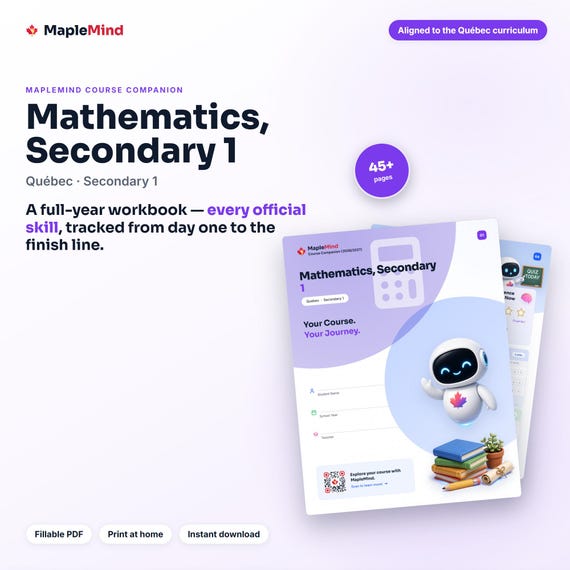
A Mathematics, Secondary 1 workbook worth keeping
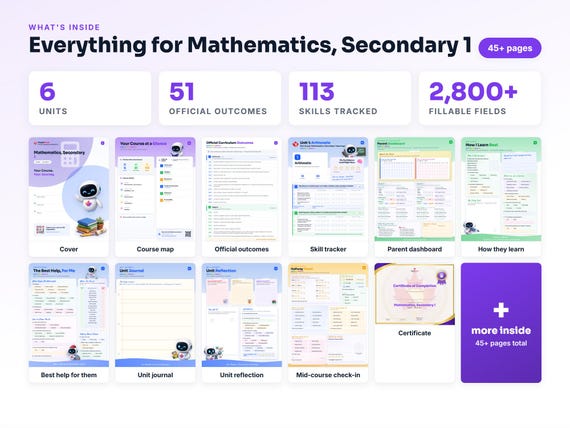
Built from the same official curriculum as this page. Before and after each skill above, your student colours in how sure they feel — so the two of you can see, on one page, what's clicking and what needs another look. It's a quiet way to follow how the year is really going.
By June it's full of their own handwriting: units worked through, confidence grown, a mid-year check-in, notes from parent-teacher night, and a certificate at the end. Less a worksheet, more a record of the year worth keeping on the shelf.
Instant download · see every page, reviews and the full description · five or more workbooks are $2.99 each
What it looks like in the app



Common questions
Can MapleMind help me with Mathematics, Secondary 1?
Yes. MapleMind's AI tutor covers all 113 skills in Quebec's Mathematics, Secondary 1 — you pick the exact skill, and the tutor teaches it step by step: a short lesson, a worked example, solving together, then a skill check to show it stuck.
Is MapleMind aligned to Quebec's official curriculum?
Yes. Every skill in this course maps to an official outcome code from Quebec's Secondary 1 Mathematics curriculum, and the ministry's own wording is quoted under each unit on this page — with the official government source linked so you can check it yourself.
What does MapleMind cost?
It's free to start — 5 tutoring chats and a practice quiz every day, no credit card. A Pro subscription ($9.99/month or $49.99/year CAD, 7-day free trial) unlocks unlimited tutoring, practice, and exam simulations.
What if I'm stuck on just one topic?
That's the point of skill-level tutoring: open Mathematics, Secondary 1 in the app, tap the exact skill from the list on this page, and the tutor teaches just that — no wading through lessons you don't need.
Does MapleMind work in French or other languages?
Yes — 14 languages, including French. Both the app and the tutor's explanations switch to the language you choose.
Where can I see the official Quebec curriculum for Mathematics, Secondary 1?
The official source is linked on this page — Québec's official education program. The outline here follows it: every MapleMind skill carries its official outcome code, and the ministry's own wording is quoted under each unit.
Keep exploring
Ready when you are
Pick a skill from this page and see it taught properly — free, in the browser, in under a minute.