Get help with English Language Arts, Grade 9
Most tutoring makes you sit through material you already know. MapleMind flips that: pick the exact skill that's causing trouble — any of the 40 below — and the tutor teaches just that one, step by step, as many times as it takes. Ask questions in plain words, any time of day, in English, French, or 12 other languages.
The official Prince Edward Island English Language Arts, Grade 9 curriculum
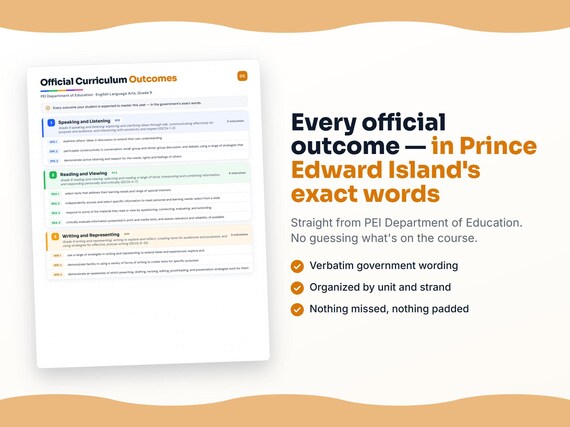
Prince Edward Island defines English Language Arts, Grade 9 by strands and outcomes. MapleMind teaches the same curriculum reorganized for one-skill-at-a-time tutoring — the table shows exactly where every official strand lands, and the ministry's own wording is quoted under each unit below.
Official source Prince Edward Island's official curriculumRead it on the government site — princeedwardisland.ca ↗| Official strand | Outcomes | Where MapleMind teaches it |
|---|---|---|
| Strand S | 12 | Speaking and Listening |
| Strand R | 14 | Reading and Viewing |
| Strand W | 14 | Writing and Representing |
Every skill below, taught one on one.
 Try the first session free
How MapleMind teaches English Language Arts, Grade 9 — every unit, lesson, and skill
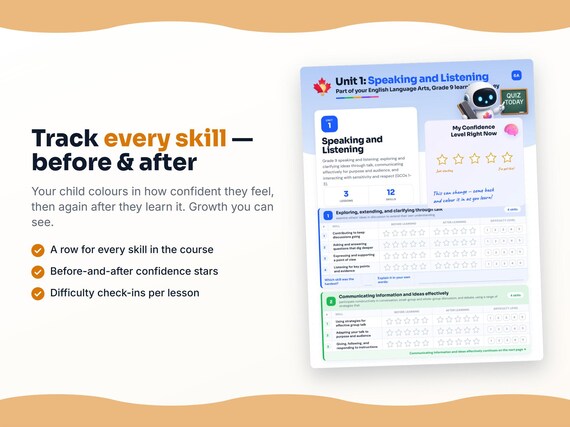
Every skill below runs as a short session: a plain-words lesson, a worked example, solving it together, then a five-question skill check that earns up to three stars. Guided Mode keeps it teaching instead of answer-handing — turning it off needs a parent's password.
Unit 1Speaking and ListeningOfficial strand · Strand S
Grade 9 speaking and listening: exploring and clarifying ideas through talk, communicating effectively for purpose and audience, and interacting with sensitivity and respect (GCOs 1-3).
Exploring, extending, and clarifying through talk
- Contributing to keep discussions goingPEI-ELA-9.SCO1.1 — examine others’ ideas in discussion to extend their own understanding
- Asking and answering questions that dig deeperPEI-ELA-9.SCO1.2 — ask relevant questions calling for elaboration, clarification, or qualification, and respond thoughtfully to such questions
- Expressing and supporting a point of viewPEI-ELA-9.SCO1.3 — articulate, advocate, and support points of view, presenting viewpoints in a convincing manner
- Listening for key points and evidencePEI-ELA-9.SCO1.4 — listen critically to assess the adequacy of evidence speakers give to evaluate the integrity of information presented
Communicating information and ideas effectively
- Using strategies for effective group talkPEI-ELA-9.SCO2.1 — participate constructively in conversation, small-group and whole-group discussion, and debate, using a range of strategies that contribute to effective talk
- Adapting your talk to purpose and audiencePEI-ELA-9.SCO2.2 — adapt vocabulary, sentence structure, and rate of speech to the speaking occasion
- Giving, following, and responding to instructionsPEI-ELA-9.SCO2.3 — give and follow instructions and respond to questions and directions of increasing complexity
- Evaluating the effectiveness of talkPEI-ELA-9.SCO2.4 — evaluate their own and others’ use of spoken language in a range of contexts, recognizing the effects of significant verbal and non-verbal language features
Interacting with sensitivity and respect
- Practising active speaking and listeningPEI-ELA-9.SCO3.1 — demonstrate active listening and respect for the needs, rights and feelings of others
- Expressing opinions with respect for othersPEI-ELA-9.SCO3.2 — demonstrate a respect for others by developing effective ways to express personal opinions such that they reflect sensitivity to others, including differences in culture and language
- Seeing how language influences and manipulatesPEI-ELA-9.SCO3.3 — demonstrate an awareness of the power of spoken language to influence and manipulate, and to reveal ideas, values, and attitudes
- Matching talk to the situation and culturePEI-ELA-9.SCO3.4 — demonstrate an awareness that spoken language has different conventions in different situations and cultures, and use language appropriate to the situation
The official wording — 12 outcomes in this unit
- PEI-ELA-9.SCO1.1
examine others’ ideas in discussion to extend their own understanding
- PEI-ELA-9.SCO1.2
ask relevant questions calling for elaboration, clarification, or qualification, and respond thoughtfully to such questions
- PEI-ELA-9.SCO1.3
articulate, advocate, and support points of view, presenting viewpoints in a convincing manner
- PEI-ELA-9.SCO1.4
listen critically to assess the adequacy of evidence speakers give to evaluate the integrity of information
- PEI-ELA-9.SCO2.1
participate constructively in conversation, small-group and whole-group discussion, and debate, using a range of strategies that
- PEI-ELA-9.SCO2.2
adapt vocabulary, sentence structure, and rate of speech to the speaking occasion
- PEI-ELA-9.SCO2.3
give and follow instructions and respond to questions and directions of increasing complexity
- PEI-ELA-9.SCO2.4
evaluate their own and others’ use of spoken language in a range of contexts, recognizing the
- PEI-ELA-9.SCO3.1
demonstrate active listening and respect for the needs, rights and feelings of others
- PEI-ELA-9.SCO3.2
demonstrate a respect for others by developing effective ways to express personal opinions such that they
- PEI-ELA-9.SCO3.3
demonstrate an awareness of the power of spoken language to influence and manipulate, and to reveal
- PEI-ELA-9.SCO3.4
demonstrate an awareness that spoken language has different conventions in different situations and cultures, and use
Unit 2Reading and ViewingOfficial strand · Strand R
Grade 9 reading and viewing: selecting and reading a range of texts, interpreting and combining information, and responding personally and critically (GCOs 4-7).
Selecting, reading, and viewing a range of texts
- Choosing texts for your needs and interestsPEI-ELA-9.SCO4.1 — select texts that address their learning needs and range of special interests
- Reading widely across genres and placesPEI-ELA-9.SCO4.2 — read widely and experience a variety of young adult fiction and literature from different provinces and countries
- Using cueing systems and reading strategiesPEI-ELA-9.SCO4.4 — use cueing systems and a variety of strategies to construct meaning in reading and viewing increasingly complex print and media texts
- Talking about your own reading processesPEI-ELA-9.SCO4.5 — articulate their own processes and strategies for reading and viewing texts of increasing complexity
Interpreting, selecting, and combining information
- Identifying and accessing what you needPEI-ELA-9.SCO5.1 — independently access and select specific information to meet personal and learning needs: select from a wide range of sources appropriate to their purposes; use the electronic network; employ strategies to conduct their research
- Using a range of print and non-print sourcesPEI-ELA-9.SCO5.2 — experiment with and rely upon a range of print and non-print sources for accessing and selecting information
- Using research strategies to guide inquiryPEI-ELA-9.SCO5.3 — employ various relevant research strategies, such as like generating questions, drafting an outline, or interviewing peers to determine what questions they would like answered by their research
Responding personally to texts
- Extending your personal responses to textsPEI-ELA-9.SCO6.1 — respond to some of the material they read or view by questioning, connecting, evaluating, and extending: move beyond initial understanding to more thoughtful interpretations
- Making evaluations and stating viewpointsPEI-ELA-9.SCO6.2 — express and support points of view about texts and about issues, themes, and situations within texts, citing appropriate evidence
- Finding evidence in texts to support viewsPEI-ELA-9.SCO6.3 — with increasing confidence and flexibility, find evidence in texts to support personal claims and viewpoints about issues, themes, and situations
Responding critically to texts
- Recognizing bias in print and media textsPEI-ELA-9.SCO7.1 — critically evaluate information presented in print and media texts, and assess relevance and reliability of available information to answer their questions
- Seeing how texts are built for readers and purposesPEI-ELA-9.SCO7.2 — demonstrate that print and media texts are constructed for particular purposes and particular audiences: describe how specific text and genre characteristics contribute to meaning and effect
- Responding critically to a range of textsPEI-ELA-9.SCO7.3 — respond critically to texts of increasing complexity: analyse and evaluate a text in terms of its form, structure, and content; recognize how their own ideas and perceptions are framed by what they read and view; demonstrate an awareness that personal values and points of view influence both the c...
The official wording — 14 outcomes in this unit
- PEI-ELA-9.SCO4.1
select texts that address their learning needs and range of special interests
- PEI-ELA-9.SCO4.2
read widely and experience a variety of young adult fiction and literature from different provinces and
- PEI-ELA-9.SCO4.3
demonstrate an understanding that information texts are constructed for particular purposes
- PEI-ELA-9.SCO4.4
use cueing systems and a variety of strategies to construct meaning in reading and viewing increasingly
- PEI-ELA-9.SCO4.5
articulate their own processes and strategies for reading and viewing texts of increasing complexity
- PEI-ELA-9.SCO5.1
independently access and select specific information to meet personal and learning needs: select from a wide
- PEI-ELA-9.SCO5.2
experiment with and rely upon a range of print and non-print sources for accessing and selecting
- PEI-ELA-9.SCO5.3
employ various relevant research strategies, such as like generating questions, drafting an outline, or interviewing peers
- PEI-ELA-9.SCO6.1
respond to some of the material they read or view by questioning, connecting, evaluating, and extending
- PEI-ELA-9.SCO6.2
express and support points of view about texts and about issues, themes, and situations within texts
- PEI-ELA-9.SCO6.3
with increasing confidence and flexibility, find evidence in texts to support personal claims and viewpoints about
- PEI-ELA-9.SCO7.1
critically evaluate information presented in print and media texts, and assess relevance and reliability of available
- PEI-ELA-9.SCO7.2
demonstrate that print and media texts are constructed for particular purposes and particular audiences
- PEI-ELA-9.SCO7.3
respond critically to texts of increasing complexity: analyse and evaluate a text in terms of its
Unit 3Writing and RepresentingOfficial strand · Strand W
Grade 9 writing and representing: writing to explore and reflect, creating texts for audiences and purposes, and using strategies for effective, precise writing (GCOs 8-10).
Using writing and representing to explore and reflect
- Using writing strategies to explore learningPEI-ELA-9.SCO8.1 — use a range of strategies in writing and representing to extend ideas and experiences: explore and reflect on their feelings, values, and attitudes; consider others’ perspectives; reflect on problems and responses to problems; describe and evaluate their learning processes and strategies; and reflec...
- Reflecting on the strategies that help you learnPEI-ELA-9.SCO8.2 — identify and reflect upon strategies that are effective in helping them to learn, and to describe their personal growth as language learners and language users
- Using note-making for different purposesPEI-ELA-9.SCO8.3 — use note-making to reconstruct knowledge and select effective strategies appropriate to the task
- Adding interesting effects to imaginative writingPEI-ELA-9.SCO8.4 — make informed choices of language to create a range of interesting effects in imaginative writing and representing
Creating texts for a range of audiences and purposes
- Producing a range of writing formsPEI-ELA-9.SCO9.1 — demonstrate facility in using a variety of forms of writing to create texts for specific purposes and audiences, and represent their ideas in other forms (including visual arts, music, drama) to achieve their purposes
- Choosing a form that fits purpose and readerPEI-ELA-9.SCO9.2 — consider and choose writing forms that match both the writing purpose (to define, report, persuade, compare) and the reader for whom the text is intended (understand why language choice, organization, and voice used in an essay differ from those used in a media advertisement)
- Representing ideas in more than one wayPEI-ELA-9.SCO9.3 — understand that ideas can be represented in more than one way and used with other forms of representing (speeches, demonstrations, and plays)
- Fitting content and style to the readerPEI-ELA-9.SCO9.4 — demonstrate an awareness of the effect of context on writing and representing, and make appropriate choices of form, style, and content for specific audiences and purposes
- Using reader feedback to shape your draftsPEI-ELA-9.SCO9.5 — analyse and assess responses to their writing and media productions
Using strategies to develop effective writing
- Using prewriting-to-presentation strategiesPEI-ELA-9.SCO10.1 — demonstrate an awareness of which prewriting, drafting, revising, editing, proofreading, and presentation strategies work for them with various writings and representations
- Using the conventions of written languagePEI-ELA-9.SCO10.2 — consistently use the conventions of written language in final products
- Using technologies to communicatePEI-ELA-9.SCO10.3 — experiment with the use of technology in communicating for a range of purposes with a variety of audiences
- Committing to crafting your writingPEI-ELA-9.SCO10.4 — demonstrate a commitment to crafting pieces of writing and representations
- Combining information from several sourcesPEI-ELA-9.SCO10.5 — integrate information from several sources to construct and communicate meaning
The official wording — 14 outcomes in this unit
- PEI-ELA-9.SCO8.1
use a range of strategies in writing and representing to extend ideas and experiences: explore and
- PEI-ELA-9.SCO8.2
identify and reflect upon strategies that are effective in helping them to learn, and to describe
- PEI-ELA-9.SCO8.3
use note-making to reconstruct knowledge and select effective strategies appropriate to the task
- PEI-ELA-9.SCO8.4
make informed choices of language to create a range of interesting effects in imaginative writing and
- PEI-ELA-9.SCO9.1
demonstrate facility in using a variety of forms of writing to create texts for specific purposes
- PEI-ELA-9.SCO9.2
consider and choose writing forms that match both the writing purpose
- PEI-ELA-9.SCO9.3
understand that ideas can be represented in more than one way and used with other forms
- PEI-ELA-9.SCO9.4
demonstrate an awareness of the effect of context on writing and representing, and make appropriate choices
- PEI-ELA-9.SCO9.5
analyse and assess responses to their writing and media productions
- PEI-ELA-9.SCO10.1
demonstrate an awareness of which prewriting, drafting, revising, editing, proofreading, and presentation strategies work for them
- PEI-ELA-9.SCO10.2
consistently use the conventions of written language in final products
- PEI-ELA-9.SCO10.3
experiment with the use of technology in communicating for a range of purposes with a variety
- PEI-ELA-9.SCO10.4
demonstrate a commitment to crafting pieces of writing and representations
- PEI-ELA-9.SCO10.5
integrate information from several sources to construct and communicate meaning
Printable workbook · A keepsake of the year
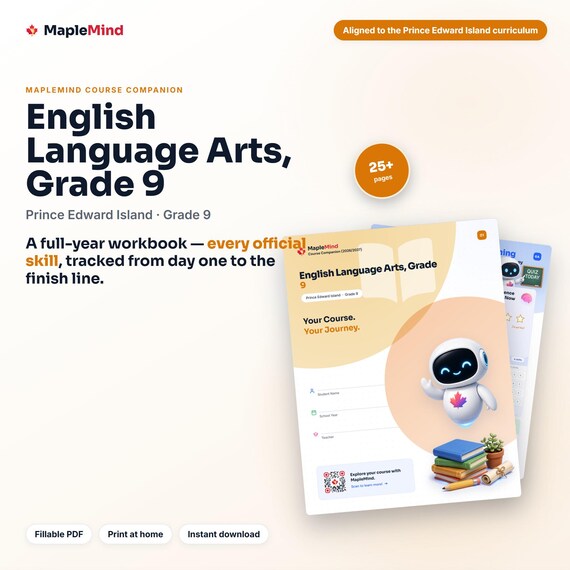
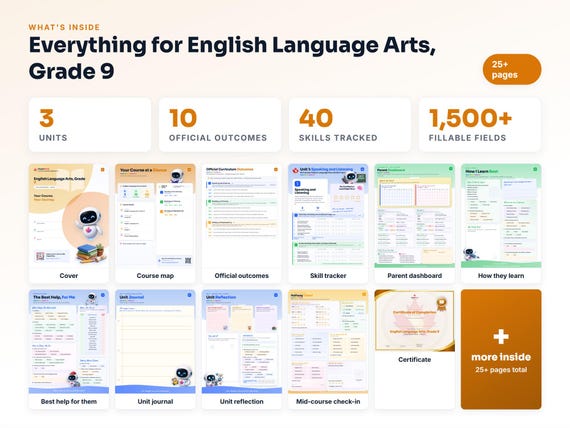
A English Language Arts, Grade 9 workbook worth keeping
Built from the same official curriculum as this page. Before and after each skill above, your student colours in how sure they feel — so the two of you can see, on one page, what's clicking and what needs another look. It's a quiet way to follow how the year is really going.
By June it's full of their own handwriting: units worked through, confidence grown, a mid-year check-in, notes from parent-teacher night, and a certificate at the end. Less a worksheet, more a record of the year worth keeping on the shelf.
Instant download · see every page, reviews and the full description · five or more workbooks are $2.99 each
What it looks like in the app



Common questions
Can MapleMind help me with English Language Arts, Grade 9?
Yes. MapleMind's AI tutor covers all 40 skills in Prince Edward Island's English Language Arts, Grade 9 — you pick the exact skill, and the tutor teaches it step by step: a short lesson, a worked example, solving together, then a skill check to show it stuck.
Is MapleMind aligned to Prince Edward Island's official curriculum?
Yes. Every skill in this course maps to an official outcome code from Prince Edward Island's Grade 9 English Language Arts curriculum, and the ministry's own wording is quoted under each unit on this page — with the official government source linked so you can check it yourself.
What does MapleMind cost?
It's free to start — 5 tutoring chats and a practice quiz every day, no credit card. A Pro subscription ($9.99/month or $49.99/year CAD, 7-day free trial) unlocks unlimited tutoring, practice, and exam simulations.
What if I'm stuck on just one topic?
That's the point of skill-level tutoring: open English Language Arts, Grade 9 in the app, tap the exact skill from the list on this page, and the tutor teaches just that — no wading through lessons you don't need.
Does MapleMind work in French or other languages?
Yes — 14 languages, including French. Both the app and the tutor's explanations switch to the language you choose.
Where can I see the official Prince Edward Island curriculum for English Language Arts, Grade 9?
The official source is linked on this page — Prince Edward Island's official curriculum. The outline here follows it: every MapleMind skill carries its official outcome code, and the ministry's own wording is quoted under each unit.
Keep exploring
Ready when you are
Pick a skill from this page and see it taught properly — free, in the browser, in under a minute.