Get help with Social Studies, Grade 4
Most tutoring makes your child sit through material your child already knows. MapleMind flips that: pick the exact skill that's causing trouble — any of the 24 below — and the tutor teaches just that one, step by step, as many times as it takes. Ask questions in plain words, any time of day, in English, French, or 12 other languages.
The official Ontario Social Studies, Grade 4 curriculum
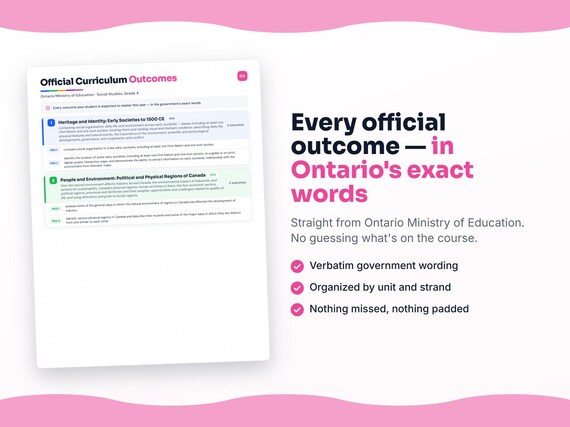
Ontario defines Social Studies, Grade 4 by strands and outcomes. MapleMind teaches the same curriculum reorganized for one-skill-at-a-time tutoring — the table shows exactly where every official strand lands, and the ministry's own wording is quoted under each unit below.
Official source Ontario's official curriculumRead it on the government site — dcp.edu.gov.on.ca ↗| Official strand | Outcomes | Where MapleMind teaches it |
|---|---|---|
| Strand A | 14 | Heritage and Identity: Early Societies to 1500 CE |
| Strand B | 10 | People and Environment: Political and Physical Regions of Canada |
Every skill below, taught one on one.
 Try the first session free
How MapleMind teaches Social Studies, Grade 4 — every unit, lesson, and skill
Every skill below runs as a short session: a plain-words lesson, a worked example, solving it together, then a five-question skill check that earns up to three stars. Guided Mode keeps it teaching instead of answer-handing — turning it off needs a parent's password.
Unit 1Heritage and Identity: Early Societies to 1500 CEOfficial strand · Strand A
Comparing social organization, daily life, and environment across early societies — always including at least one First Nation and one Inuit society; locating them and reading visual and thematic evidence; describing daily life, physical features and natural events, the importance of the environment, scientific and technological developments, governance, and cooperation and conflict.
Comparing Early Societies
- My life vs. young people long agoA1.3 — Describe ways their daily life differs from that of young people from different backgrounds in early societies.
- Early societies and the environmentA1.4 — Compare early societies' relationship with the environment and describe similarities and differences with present-day Canada.
Daily Life, Environment, and Governance
- Locating early societies and reading mapsA3.1 — Locate early societies on maps and extract information on their relationship with the environment from thematic maps.
- Reading daily life from visual evidenceA3.2 — Extract information on daily life in early societies from visual evidence.
- Daily life in early societiesA3.3 — Describe significant aspects of daily life in early societies, including at least one First Nation and one Inuit society.
- Physical features and natural eventsA3.4 — Describe significant physical features, natural processes, and events in early societies and how they affected the societies' sustainability and food production.
- The environment and meeting needsA3.5 — Describe the importance of the environment for early societies, focusing on how the local environment affected how people met their physical needs.
- Science and technology in early societiesA3.6 — Identify and describe major scientific and technological developments in the ancient and medieval world, including from a First Nation and Inuit society.
- How early societies were governedA3.7 — Describe how early societies were governed, including at least one First Nation and one Inuit society.
- Why societies cooperated or clashedA3.9 — Describe reasons why different groups in early societies cooperated or came into conflict.
- Making peace and cooperationA3.10 — Describe attempts within early societies to deal with conflict and establish greater cooperation.
The official wording — 14 outcomes in this unit
- A1.1
compare social organization in a few early societies, including at least one First Nation and one Inuit society
- A1.2
compare aspects of the daily lives of different groups within a few early societies, including at least one First Nation and one Inuit society and explain how differences were related to the social organization of that society
- A1.3
describe some of the ways in which their daily life differs from the lives of young people from different backgrounds in a few early societies, including at least one First Nation and one Inuit society
- A1.4
compare a few early societies, including at least one First Nation and one Inuit society, in terms of their relationship with the environment and describe some key similarities and differences in environmental practices between these societies and present-day Canada
- A3.1
identify the location of some early societies, including at least one First Nation and one Inuit society, on a globe or on print, digital, and/or interactive maps, and demonstrate the ability to extract information on early societies’ relationship with the environment from thematic maps
- A3.2
demonstrate the ability to extract information on daily life in a few early societies, including at least one First Nation and one Inuit society, from visual evidence
- A3.3
describe significant aspects of daily life in a few early societies, including at least one First Nation and one Inuit society
- A3.4
describe significant physical features and natural processes and events in a few early societies, including at least one First Nation and one Inuit society and how they affected these societies, with a focus on the societies’ sustainability and food production
- A3.5
describe the importance of the environment for a few early societies, including at least one First Nation and one Inuit society, with a particular focus on how the local environment affected the ways in which people met their physical needs
- A3.6
identify and describe some of the major scientific and technological developments in the ancient and medieval world, including some from at least one First Nation and one Inuit society
- A3.7
describe how a few early societies, including at least one First Nation and one Inuit society, were governed
- A3.8
describe the social organization of a few different types of early societies, including at least one First Nation and one Inuit society and the role and status of some significant social and work-related groups in these societies
- A3.9
describe some key reasons why different groups in a few early societies, including at least one First Nation and one Inuit society, cooperated or came into conflict at different times
- A3.10
describe some attempts within a few early societies, including at least one First Nation and one Inuit society, to deal with conflict and to establish greater cooperation
Unit 2People and Environment: Political and Physical Regions of CanadaOfficial strand · Strand B
How the natural environment affects industry across Canada, the environmental impact of industries, and actions for sustainability; Canada's physical regions, human activities in them, the four economic sectors, political regions, provinces and territories and their peoples, opportunities and challenges related to quality of life, and using directions and grids to locate regions.
Environment, Industry, and Sustainability
- How the environment shapes industryB1.1 — Analyse ways the natural environment of regions in Canada has affected the development of industry.
- Industries and their impactB1.2 — Assess the environmental impact of different industries in two or more regions of Canada.
- Actions for sustainabilityB1.3 — Describe actions taken by industries and citizens for more sustainable use of land and resources and assess their effectiveness.
Canada's Physical and Political Regions
- Canada's physical regionsB3.1 — Identify various physical regions in Canada and describe their location and how they are distinct and similar.
- Human activities in physical regionsB3.2 — Identify main human activities, including industry and recreation, in various physical regions of Canada.
- The four economic sectorsB3.3 — Describe the four main economic sectors and identify industries associated with each.
- Canada's political regionsB3.4 — Identify types of political regions in Canada and describe their similarities and differences.
- Provinces, territories, and their peoplesB3.5 — Identify Canada's provinces and territories and their capitals and describe them by location and peoples.
- Quality of life across regionsB3.6 — Describe opportunities and challenges related to quality of life in Canada's political regions.
- Directions and grids on mapsB3.7 — Demonstrate an understanding of cardinal and intermediate directions and use directions and grids to locate regions of Canada.
The official wording — 10 outcomes in this unit
- B1.1
analyse some of the general ways in which the natural environment of regions in Canada has affected the development of industry
- B1.2
assess aspects of the environmental impact of different industries in two or more physical and/or political regions of Canada
- B1.3
describe some key actions taken by both industries and citizens to address the need for more sustainable use of land and resources and assess their effectiveness
- B3.1
identify various physical regions in Canada and describe their location and some of the major ways in which they are distinct from and similar to each other
- B3.2
identify some of the main human activities, including industrial development and recreational activities, in various physical regions of Canada
- B3.3
describe the four main economic sectors and identify some industries that are commonly associated with each sector
- B3.4
identify various types of political regions in Canada and describe some of their basic similarities and differences
- B3.5
identify Canada’s provinces and territories and their capital cities, and describe them with reference to their location and some of the peoples who live in them
- B3.6
describe significant opportunities and challenges related to quality of life in some of Canada’s political regions
- B3.7
demonstrate an understanding of cardinal and intermediate directions and use these directions as well as number and letter grids to locate selected political and physical regions of Canada on a variety of print and digital/interactive maps
Printable workbook · A keepsake of the year
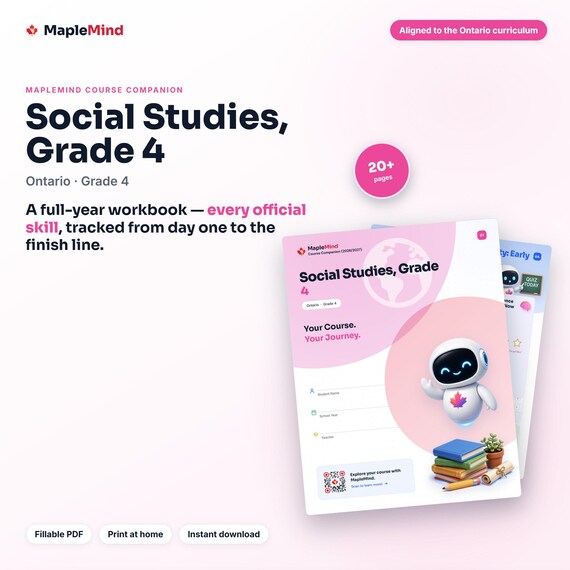
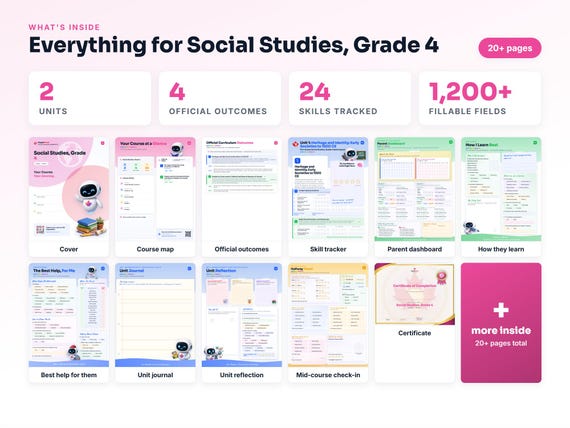
A Social Studies, Grade 4 workbook worth keeping
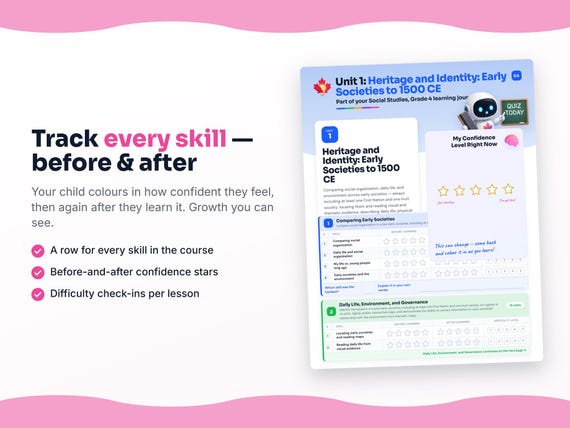
Built from the same official curriculum as this page. Before and after each skill above, your student colours in how sure they feel — so the two of you can see, on one page, what's clicking and what needs another look. It's a quiet way to follow how the year is really going.
By June it's full of their own handwriting: units worked through, confidence grown, a mid-year check-in, notes from parent-teacher night, and a certificate at the end. Less a worksheet, more a record of the year worth keeping on the shelf.
Instant download · see every page, reviews and the full description · five or more workbooks are $2.99 each
What it looks like in the app



Common questions
Can MapleMind help my child with Social Studies, Grade 4?
Yes. MapleMind's AI tutor covers all 24 skills in Ontario's Social Studies, Grade 4 — your child picks the exact skill, and the tutor teaches it step by step: a short lesson, a worked example, solving together, then a skill check to show it stuck.
Is MapleMind aligned to Ontario's official curriculum?
Yes. Every skill in this course maps to an official outcome code from Ontario's Grade 4 Social Studies curriculum, and the ministry's own wording is quoted under each unit on this page — with the official government source linked so you can check it yourself.
What does MapleMind cost?
It's free to start — 5 tutoring chats and a practice quiz every day, no credit card. A Pro subscription ($9.99/month or $49.99/year CAD, 7-day free trial) unlocks unlimited tutoring, practice, and exam simulations.
What if my child is stuck on just one topic?
That's the point of skill-level tutoring: open Social Studies, Grade 4 in the app, tap the exact skill from the list on this page, and the tutor teaches just that — no wading through lessons your child doesn't need.
Does MapleMind work in French or other languages?
Yes — 14 languages, including French. Both the app and the tutor's explanations switch to the language your child chooses.
Where can I see the official Ontario curriculum for Social Studies, Grade 4?
The official source is linked on this page — Ontario's official curriculum. The outline here follows it: every MapleMind skill carries its official outcome code, and the ministry's own wording is quoted under each unit.
Keep exploring
Ready when you are
Pick a skill from this page and see it taught properly — free, in the browser, in under a minute.