Get help with English (Language), Grade 5
Most tutoring makes your child sit through material your child already knows. MapleMind flips that: pick the exact skill that's causing trouble — any of the 60 below — and the tutor teaches just that one, step by step, as many times as it takes. Ask questions in plain words, any time of day, in English, French, or 12 other languages.
The official Ontario English (Language), Grade 5 curriculum
Ontario defines English (Language), Grade 5 by strands and outcomes. MapleMind teaches the same curriculum reorganized for one-skill-at-a-time tutoring — the table shows exactly where every official strand lands, and the ministry's own wording is quoted under each unit below.
Official source Ontario's official curriculumRead it on the government site — dcp.edu.gov.on.ca ↗| Official strand | Outcomes | Where MapleMind teaches it |
|---|---|---|
| Strand A | 9 | Literacy Connections and Applications |
| Strand B | 11 | Foundations of Language |
| Strand C | 22 | Comprehension: Understanding and Responding to Texts |
| Strand D | 14 | Composition: Expressing Ideas and Creating Texts |
Every skill below, taught one on one.
 Try the first session free
How MapleMind teaches English (Language), Grade 5 — every unit, lesson, and skill
Every skill below runs as a short session: a plain-words lesson, a worked example, solving it together, then a five-question skill check that earns up to three stars. Guided Mode keeps it teaching instead of answer-handing — turning it off needs a parent's password.
Unit 1Literacy Connections and ApplicationsOfficial strand · Strand A
Digital and media literacy — building a safe, positive online identity, researching and analyzing media texts, and using digital tools to solve real problems — together with exploring identity, belonging, and the voices of First Nations, Métis, and Inuit and other diverse communities.
Digital Rights, Identity, and Safety
- Rights, responsibilities, and digital identityA2.1 — Explain their rights and responsibilities online, and make choices that build a positive digital identity for themselves and their community.
- Staying safe and protecting privacy onlineA2.2 — Show how to move through online spaces safely, protect personal data and privacy, and interact in ways that support everyone's well-being.
- Researching and evaluating informationA2.3 — Gather, judge, and use information from sources, weighing how valid, credible, and accurate it is and whose perspective it shows.
- Reading and analyzing digital and media textsA2.4 — Understand the forms, conventions, and techniques of digital and media texts and how they affect an audience, and apply this when analyzing and creating texts.
- How form, message, and audience connectA2.5 — Understand how a text's form, message, and context, its intended audience, and its purpose are all connected.
- Using digital tools to solve real problemsA2.6 — Choose and use digital and media tools within a design process to solve authentic, real-world problems with creative solutions.
- Collaborating safely and respectfully onlineA2.7 — Communicate and collaborate with online communities safely, respectfully, and inclusively, showing cultural awareness.
Identity, Belonging, and Indigenous Voices
- Identity and belonging in diverse textsA3.2 — Understand the historical contexts, contributions, and lived experiences of a diversity of individuals and communities, including in Canada, by exploring identity, self, and belonging in culturally responsive texts.
- Themes in First Nations, Métis, and Inuit culturesA3.3 — Explain themes in First Nations, Métis, and Inuit cultures to understand the varied identities, perspectives, relationships, legacies, truths, and ways of knowing, being, and doing.
The official wording — 9 outcomes in this unit
- A2.1
rights and responsibilities when interacting online with appropriate permission, and make decisions that contribute positively to the development of their digital identity
- A2.2
navigate online environments safely, manage their privacy and personal data, and interact in a way that supports their well-being and that of others
- A2.3
gather, evaluate, and use information, considering validity, credibility, accuracy, and perspectives
- A2.4
forms, conventions, and techniques of digital and media texts, consider the impact on the audience, and apply this understanding when analyzing and creating texts
- A2.5
interrelationships between the form, message, and context of texts, the intended audience, and the purpose for production
- A2.6
select and use appropriate digital and media tools to support the design process and address authentic, relevant, real-world problems by developing innovative solutions
- A2.7
communicate and collaborate with various communities in a safe, respectful, responsible, and inclusive manner when using online platforms and environments
- A3.2
historical contexts, contributions, lived experiences, and perspectives of a diversity of individuals and communities, including those in Canada, by exploring the concepts of identity, self, and sense of belonging
- A3.3
explain themes explored in First Nations, Métis, and Inuit cultures to demonstrate an understanding of the varied identities, perspectives, relationships, legacies, truths, and ways of knowing, being, and doing
Unit 2Foundations of LanguageOfficial strand · Strand B
The building blocks of language: listening and speaking for different purposes and audiences; reading and spelling complex words through morphology, vocabulary, and fluency; and the sentence structure, grammar, and punctuation conventions introduced at this grade.
Oral and Non-Verbal Communication
- Active listening in discussionsB1.1 — Use effective listening skills — asking questions and responding to others — in formal and informal group discussions.
- Listening strategies before, during, and afterB1.2 — Use listening strategies before, during, and after listening to understand messages and develop a response.
- Speaking for purpose and audienceB1.3 — Identify the purpose and audience for speaking in formal and informal contexts, and use speaking strategies to communicate clearly.
- Non-verbal communication strategiesB1.4 — Use oral and non-verbal strategies — expression, gestures, body language — and explain how they support understanding and communication.
- Precise word choice when speakingB1.5 — Use effective word choice — new vocabulary, varied adjectives and adverbs, and varied sentence types — when communicating.
Word-Level Reading, Vocabulary, and Fluency
- Morphology: reading and spelling with word partsB2.1 — Use knowledge of word parts — bases, prefixes, and suffixes — to read and spell words accurately and automatically.
- Building and using vocabularyB2.2 — Understand a variety of words, acquire and use taught vocabulary across subjects, and use morphological knowledge to figure out new words in context.
- Reading fluently with expressionB2.3 — Read a variety of texts fluently — with accuracy, appropriate pace, and expression matched to purpose when reading aloud.
Sentence Structure: Compound-Complex and Error Correction
- Compound-complex sentencesB3.1 — Build compound-complex sentences that join independent and dependent clauses to express layered ideas.
- Fixing sentence fragments and run-onsB3.1 — Recognize and correct sentence fragments and run-on sentences so writing is clear and complete.
Grammar: Objects, Pronouns, and Conjunctions
- Direct objectsB3.2 — Identify and use direct objects for nouns — the noun that receives the action of a verb.
- Intensive and reflexive pronounsB3.2 — Use intensive and reflexive pronouns (myself, herself, themselves) correctly.
- Proper adjectives and correlative conjunctionsB3.2 — Use proper adjectives and correlative conjunctions to add precision and balance to sentences.
Punctuation: Commas and Colons
- Commas for appositives and participial phrasesB3.3 — Use commas to set off advanced phrases or clauses, such as appositives and participles.
- Colons to introduce a listB3.3 — Use a colon to introduce a list after a complete sentence.
The official wording — 11 outcomes in this unit
- B1.1
use effective listening skills, including expressing interest in what is being said at appropriate times, asking questions to encourage a speaker to elaborate, and responding to the contributions of others
- B1.2
select and use a variety of listening strategies before, during, and after listening to comprehend information
- B1.3
identify the purpose and audience for speaking in formal and informal contexts, and use appropriate speaking strategies, including paraphrasing and restating
- B1.4
identify and use oral and non-verbal communication strategies, including expression, gestures, and body language, and explain how these strategies help them understand or communicate ideas and meaning
- B1.5
use appropriate word choice, including new vocabulary, varied adjectives and adverbs to elaborate, a variety of sentence types
- B2.1
knowledge of the meanings of words and morphemes (i.e., bases, prefixes, and suffixes) to read and spell words with accuracy and automaticity
- B2.2
demonstrate an understanding of a variety of words, acquire and use explicitly taught vocabulary in various contexts, including other subject areas
- B2.3
read a variety of texts fluently, with accuracy and appropriate pacing
- B3.1
identify and construct various sentence types and forms, including compound-complex sentences
- B3.2
functions of parts of speech in sentences, including direct objects for nouns
- B3.3
commas to set off advanced phrases or clauses such as appositives and participles
Unit 3Comprehension: Understanding and Responding to TextsOfficial strand · Strand C
Reading as an analyst and critic: knowing how text forms, patterns, visuals, style, and narration create meaning; using comprehension strategies to build and monitor understanding; and thinking critically about devices, inferences, perspectives, bias, cultural elements, and Indigenous voices.
Knowledge About Texts
- Reading and comprehending textsC1.1 — Read and comprehend various texts, using knowledge of words, grammar, cohesive ties, sentence structures, and background knowledge.
- Characteristics of text forms and genresC1.2 — Describe characteristics of various text forms and genres, including cultural text forms, and explain how they communicate meaning.
- Text patterns and featuresC1.3 — Identify text patterns (such as cause and effect in a persuasive text) and text features (such as a preface and glossary), and explain how they help understanding.
- How visuals create meaningC1.4 — Explain how images, graphics, and visual design create, communicate, and contribute to meaning in a variety of texts.
- Elements of style in textsC1.5 — Describe elements of style — voice, word choice, word patterns, sentence structure — and analyze how each creates meaning and suits the form and genre.
- Narrator's point of viewC1.6 — Identify the narrator's point of view (first, second, or third person) and describe its advantages and disadvantages.
- Indigenous Storywork through First Nations, Métis, and Inuit textsC1.7 — Read, listen to, and view texts by diverse First Nations, Métis, and Inuit creators to make meaning through Indigenous Storywork.
Comprehension Strategies
- Using prior knowledgeC2.1 — Identify and explain prior knowledge — from personal experience and other subjects — to make connections and understand new texts.
- Purposes for reading and choosing textsC2.2 — Identify purposes for engaging with texts and select texts from diverse creators suited to those purposes.
- Making predictions and posing questionsC2.3 — Make predictions using background knowledge, text features, and evidence, and pose questions to check them.
- Monitoring comprehensionC2.4 — Use strategies — adjusting reading rate, visualizing, reading ahead, asking questions, consulting sources — to monitor and confirm understanding.
- Connecting text ideas to self, texts, and worldC2.5 — Describe how ideas in texts connect to their knowledge and experiences, other texts, and the world.
- SummarizingC2.6 — Summarize the main idea and supporting details in sequence and draw a well-supported conclusion.
- Reflecting on comprehension strategiesC2.7 — Explain how strategies such as visualizing, predicting, summarizing, and connecting helped comprehension.
Critical Thinking About Texts
- Literary devicesC3.1 — Describe literary devices, including imagery and humour, and explain how they create meaning and suit the purpose and audience.
- Making inferencesC3.2 — Make local and global inferences, using explicit and implicit evidence, to extend understanding of texts.
- Analyzing texts for ideas and informationC3.3 — Analyze literary and informational texts by identifying main and supporting ideas, sequencing events, recording information, and explaining cause and effect.
- Cultural elements in textsC3.4 — Identify cultural elements represented in texts, investigate their meanings, and connect them to lived experience.
- Perspectives and biasC3.5 — Identify explicit and implicit perspectives in texts, explain how they are conveyed, give evidence of bias, and suggest how bias could influence an audience.
- Topics such as diversity, inclusion, and accessibilityC3.6 — Explain how topics such as diversity, inclusion, and accessibility are addressed in texts and what insights are conveyed.
- Influences on First Nations, Métis, and Inuit textsC3.7 — Explain how texts by First Nations, Métis, and Inuit creators are influenced by historical periods, cultural experiences, and events, and how they relate to current lived experiences.
- Reflecting on critical thinking skillsC3.8 — Identify the critical thinking skills used to analyze and evaluate texts and explain how they helped understanding.
The official wording — 22 outcomes in this unit
- C1.1
read and comprehend various texts, using knowledge of words, grammar, cohesive ties, sentence structures, and background knowledge
- C1.2
describe some characteristics of various text forms and genres, including cultural text forms, and explain how they help communicate meaning
- C1.3
identify text patterns, such as cause and effect in a persuasive text, and text features, such as a preface and glossary
- C1.4
explain how images, graphics, and visual design create, communicate, and contribute to meaning in a variety of texts
- C1.5
describe various elements of style in texts, including voice, word choice, word patterns, and sentence structure, and analyze how each element helps create meaning
- C1.6
identify the narrator’s point of view, including first, second, or third person, in a variety of texts, and describe the advantages and disadvantages of the approach used in each story
- C1.7
read, listen to, and view various forms of texts by diverse First Nations, Métis, and Inuit creators to make meaning through Indigenous Storywork
- C2.1
identify and explain prior knowledge from various sources, including personal experiences, that they can use to make connections and understand new texts
- C2.2
identify a variety of purposes for engaging with texts, and select texts from diverse creators that are suitable for the purposes
- C2.3
make predictions using background knowledge, text features, and evidence from the text, and pose questions to check whether their predictions were correct
- C2.4
use strategies such as adjusting reading rate, visualizing, reading ahead, asking questions, and consulting references and other texts or sources of information, to monitor and confirm their understanding
- C2.5
describe how the ideas expressed in texts connect to their knowledges and lived experiences, the ideas in other texts, and the world around them
- C2.6
summarize the main idea of a text and the supporting details in sequence, and draw a well- supported conclusion
- C2.7
explain how strategies such as visualizing, making predictions, summarizing, and connecting to their experiences have helped them comprehend various texts
- C3.1
describe literary devices, including imagery and humour, in a variety of texts, and explain how they help create meaning
- C3.2
make local and global inferences, using explicit and implicit evidence, to extend their understanding of various texts
- C3.3
analyze various texts, including literary and informational texts, by identifying main and supporting ideas, sequencing the events of multiple plots, recording relevant information, and explaining cause and effect
- C3.4
identify cultural elements that are represented in various texts, including, norms, values, artifacts, sports, and music, investigate the meanings of these elements, and make connections to their lived experience and culture
- C3.5
identify explicit and implicit perspectives communicated in various texts, explain how these perspectives are conveyed, give some evidence of any biases the texts may contain, and suggest how such biases could influence an audience
- C3.6
explain how various topics, such as diversity, inclusion, and accessibility, are addressed in texts, and describe what insights or messages are conveyed
- C3.7
explain how texts created by First Nations, Métis, and Inuit individuals, communities, groups, or nations are influenced by historical periods, cultural experiences, and events, and how they relate to current lived experiences
- C3.8
identify the critical thinking skills they used to analyze and evaluate various texts, and explain how these skills have helped them better understand the texts
Unit 4Composition: Expressing Ideas and Creating TextsOfficial strand · Strand D
Creating texts end to end: planning topic, audience, ideas, sources, and structure; drafting across genres with a clear voice; revising and editing; and producing, publishing, and reflecting on finished work.
Planning Texts
- Planning topic, purpose, and audienceD1.1 — Identify the topic, purpose, and audience for a text and explain why the chosen form, genre, and medium suit them.
- Generating and developing ideasD1.2 — Generate and develop ideas and details about various topics, including diversity, equity, and inclusion and other subjects, using varied strategies and resources.
- Gathering information and citing sourcesD1.3 — Gather and record information from multiple textual sources, verify their reliability, and record the creator and source of others' content.
- Organizing and sequencing contentD1.4 — Select and classify ideas and information and sequence content to suit the chosen form, genre, and medium.
- Reflecting on planning strategiesD1.5 — Describe the strategies and tools that helped develop ideas and organize content, and explain how they improved you as a text creator.
Drafting, Voice, Revising, and Editing
- Drafting texts in various genresD2.1 — Draft texts of various forms and genres, including narrative, persuasive, and informational texts, using varied media, tools, and strategies.
- Transcription: cursive and word processingD2.2 — Write in fluent cursive, begin keyboarding with automaticity, and apply word-processing skills, including font choice, to produce texts.
- Establishing voice in writingD2.3 — Establish a personal voice, using varied language and elements of style to express thoughts and opinions with a tone suited to the form and genre.
- Point of view, perspective, and bias in own textsD2.4 — Identify the point of view, perspectives, and bias conveyed in their texts and explain how audiences with different perspectives might interpret them.
- Revising draftsD2.5 — Revise the content and elements of style of a draft — adding or deleting sentences — to improve clarity, focus, and coherence, seeking feedback.
- Editing draftsD2.6 — Edit draft texts for spelling, punctuation, grammar, and format, and use a word processor to edit texts.
Publishing, Presenting, and Reflecting
- Producing final textsD3.1 — Produce final texts using a variety of techniques and tools, including digital design and production tools, to achieve the intended effect.
- Publishing and presenting textsD3.2 — Publish and present texts using selected media and tools, and explain how each helped communicate the message.
- Reflecting on publishing and presentingD3.3 — Describe the strategies and tools that helped communicate the message when publishing and presenting, and suggest future improvements.
The official wording — 14 outcomes in this unit
- D1.1
identify the topic, purpose, and audience for various texts they plan to create, and explain why the chosen text form, genre, and medium suit the purpose and audience
- D1.2
generate and develop ideas and details about various topics, such as topics related to diversity, equity, and inclusion and to other subject areas, using a variety of strategies
- D1.3
gather and record information and content relevant to a topic, using multiple textual sources; verify the reliability of sources, using simple criteria; and record the creator and source of all content created by others
- D1.4
select and classify ideas and collected information, using appropriate strategies and tools, and sequence content, taking into account the chosen text form, genre, and medium
- D1.5
describe the strategies and tools that helped them develop ideas and organize content for texts of the chosen forms, genres, and media, and explain how they helped them improve as a text creator
- D2.1
draft texts of various forms and genres, including narrative, persuasive, and informational texts, using a variety of media, tools, and strategies
- D2.2
write in fluent cursive, begin to keyboard with automaticity, and apply word-processing skills, including selecting appropriate fonts, to produce and enhance texts of various lengths
- D2.3
establish a personal voice in their texts, using varied language and elements of style to express their thoughts, feelings, and opinions about a topic, and using a tone appropriate to the form and genre
- D2.4
identify the point of view, implicit and explicit perspectives, and bias conveyed in their texts, and explain how their messages might be interpreted by audiences with different perspectives
- D2.5
make revisions to the content of draft texts and to elements of style, such as word choice, and add or delete sentences, to improve clarity, focus, and coherence, seeking feedback
- D2.6
edit draft texts to improve accuracy and style, checking for errors in spelling, punctuation, grammar, and format; use a word processor to edit texts
- D3.1
produce final texts using a variety of techniques and tools, including digital design and production tools, to achieve the intended effect
- D3.2
publish and present texts they have created, using selected media and tools, and explain how each helped them communicate their intended message
- D3.3
describe various strategies and tools that helped them communicate their intended message when publishing and presenting texts, and suggest steps for future improvement as a text creator
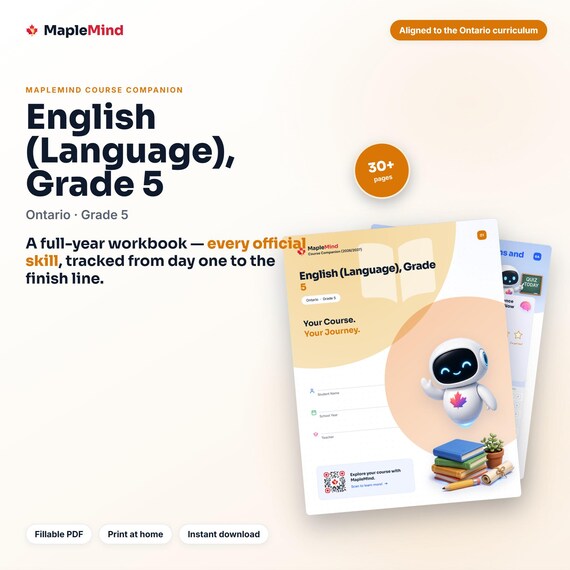
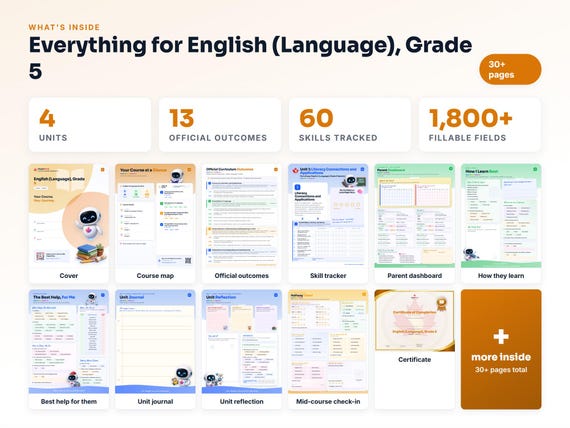
Printable workbook · A keepsake of the year
A English (Language), Grade 5 workbook worth keeping
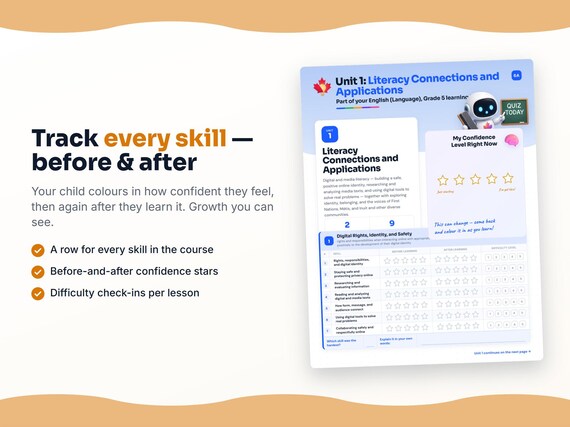
Built from the same official curriculum as this page. Before and after each skill above, your student colours in how sure they feel — so the two of you can see, on one page, what's clicking and what needs another look. It's a quiet way to follow how the year is really going.
By June it's full of their own handwriting: units worked through, confidence grown, a mid-year check-in, notes from parent-teacher night, and a certificate at the end. Less a worksheet, more a record of the year worth keeping on the shelf.
Instant download · see every page, reviews and the full description · five or more workbooks are $2.99 each
What it looks like in the app



Common questions
Can MapleMind help my child with English (Language), Grade 5?
Yes. MapleMind's AI tutor covers all 60 skills in Ontario's English (Language), Grade 5 — your child picks the exact skill, and the tutor teaches it step by step: a short lesson, a worked example, solving together, then a skill check to show it stuck.
Is MapleMind aligned to Ontario's official curriculum?
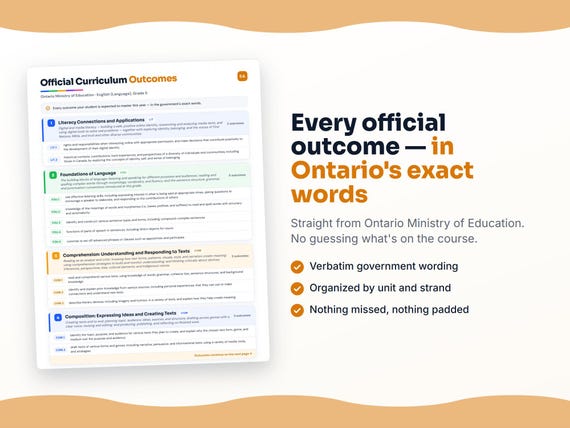
Yes. Every skill in this course maps to an official outcome code from Ontario's Grade 5 English Language Arts curriculum, and the ministry's own wording is quoted under each unit on this page — with the official government source linked so you can check it yourself.
What does MapleMind cost?
It's free to start — 5 tutoring chats and a practice quiz every day, no credit card. A Pro subscription ($9.99/month or $49.99/year CAD, 7-day free trial) unlocks unlimited tutoring, practice, and exam simulations.
What if my child is stuck on just one topic?
That's the point of skill-level tutoring: open English (Language), Grade 5 in the app, tap the exact skill from the list on this page, and the tutor teaches just that — no wading through lessons your child doesn't need.
Does MapleMind work in French or other languages?
Yes — 14 languages, including French. Both the app and the tutor's explanations switch to the language your child chooses.
Where can I see the official Ontario curriculum for English (Language), Grade 5?
The official source is linked on this page — Ontario's official curriculum. The outline here follows it: every MapleMind skill carries its official outcome code, and the ministry's own wording is quoted under each unit.
Keep exploring
Ready when you are
Pick a skill from this page and see it taught properly — free, in the browser, in under a minute.