Get help with Language, Grade 1
Most tutoring makes your child sit through material your child already knows. MapleMind flips that: pick the exact skill that's causing trouble — any of the 67 below — and the tutor teaches just that one, step by step, as many times as it takes. Ask questions in plain words, any time of day, in English, French, or 12 other languages.
The official Ontario Language, Grade 1 curriculum
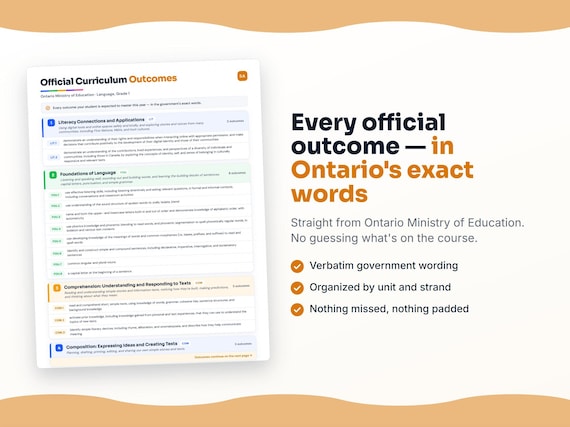
Ontario defines Language, Grade 1 by strands and outcomes. MapleMind teaches the same curriculum reorganized for one-skill-at-a-time tutoring — the table shows exactly where every official strand lands, and the ministry's own wording is quoted under each unit below.
Official source Ontario's official curriculumRead it on the government site — dcp.edu.gov.on.ca ↗| Official strand | Outcomes | Where MapleMind teaches it |
|---|---|---|
| Strand A | 9 | Literacy Connections and Applications |
| Strand B | 16 | Foundations of Language |
| Strand C | 22 | Comprehension: Understanding and Responding to Texts |
| Strand D | 13 | Composition: Expressing Ideas and Creating Texts |
Every skill below, taught one on one.
 Try the first session free
How MapleMind teaches Language, Grade 1 — every unit, lesson, and skill
Every skill below runs as a short session: a plain-words lesson, a worked example, solving it together, then a five-question skill check that earns up to three stars. Guided Mode keeps it teaching instead of answer-handing — turning it off needs a parent's password.
Unit 1Literacy Connections and ApplicationsOfficial strand · Strand A
Using digital tools and online spaces safely and kindly, and exploring stories and voices from many communities, including First Nations, Métis, and Inuit cultures.
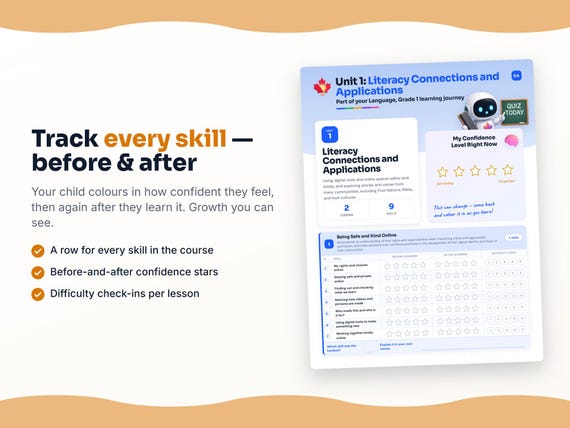
Being Safe and Kind Online
- My rights and choices onlineA2.1 — Understand that a child has rights and responsibilities when using online spaces with a grown-up's permission, and that their choices online help build who they are.
- Staying safe and private onlineA2.2 — Understand simple ways to stay safe online, keep private things private, and be kind to others, always with permission from a grown-up.
- Finding out and checking what we learnA2.3 — Look for information from more than one place, think about whether it makes sense, and use it to learn something new.
- Noticing how videos and pictures are madeA2.4 — Notice simple features of digital and media things, like videos or picture books, and use that to think about what they show.
- Who made this and who is it for?A2.5 — Notice that a video or picture is made by someone, for someone, to share a message.
- Using digital tools to make something newA2.6 — Use a digital tool, like a drawing app, to help make or solve something, following simple steps.
- Working together kindly onlineA2.7 — Talk and work with others in a safe, kind, and respectful way when using online tools and platforms, and notice different cultures in the group.
Stories From Many Voices
- Seeing identity and belonging in storiesA3.2 — Explore ideas about who we are and where we belong through stories from many different people and communities, including in Canada.
- Learning from First Nations, Métis, and Inuit storiesA3.3 — Notice themes in First Nations, Métis, and Inuit stories that show different ways of knowing, being, and living.
The official wording — 9 outcomes in this unit
- A2.1
demonstrate an understanding of their rights and responsibilities when interacting online with appropriate permission, and make decisions that contribute positively to the development of their digital identity and those of their communities
- A2.2
demonstrate an understanding of how to navigate online environments safely, manage their privacy, and interact in a way that supports their well-being and that of others, including seeking appropriate permission
- A2.3
gather, evaluate, and use information, considering various perspectives, to construct knowledge and demonstrate learning
- A2.4
demonstrate an understanding of the forms, conventions, and techniques of digital and media texts, and apply this understanding when analyzing texts
- A2.5
demonstrate an understanding of the interrelationships between the form, message, and context of a text, the audience, and the creator
- A2.6
use digital and media tools to support stages of the design process and to develop creative solutions to authentic, real-world problems
- A2.7
communicate and collaborate with various communities in a safe, respectful, responsible, and inclusive manner when using online platforms and environments, including digital and media tools, and demonstrate cultural awareness with members of the community
- A3.2
demonstrate an understanding of the contributions, lived experiences, and perspectives of a diversity of individuals and communities, including those in Canada, by exploring the concepts of identity, self, and sense of belonging in culturally responsive and relevant texts
- A3.3
identify themes explored in First Nations, Métis, and Inuit cultures to demonstrate an understanding of the varied identities, perspectives, relationships, legacies, truths, and ways of knowing, being, and doing
Unit 2Foundations of LanguageOfficial strand · Strand B
Listening and speaking well, sounding out and building words, and learning the building blocks of sentences: capital letters, punctuation, and simple grammar.
Listening and Speaking With Others
- Listening carefully and asking questionsB1.1 — Listen attentively during conversations and classroom activities, and ask questions about what was said.
- Using tricks to understand what I hearB1.2 — Use simple listening strategies before, during, and after listening to understand spoken and non-verbal messages.
- Taking turns and knowing how much to sayB1.3 — Notice who is listening and why we're talking, and use speaking strategies like taking turns and knowing when and how much to say.
- Choosing good words when I talkB1.5 — Use good word choices, new vocabulary, and full sentences when speaking to share ideas clearly.
Hearing the Sounds in Words
- Blending sounds into a wordB2.1 — Listen to sounds said slowly and blend them together to say the whole word, starting with 2 sounds and working up to more.
- Breaking a word into its soundsB2.1 — Say a spoken word slowly, breaking it apart into each separate sound, starting with 2 sounds and working up to more.
Letters and Their Sounds
- Naming and writing letters quicklyB2.2 — Name and form upper- and lowercase letters, in and out of order, quickly and automatically, and know alphabetical order.
- Matching letters to their soundsB2.3 — Quickly and correctly identify, read, and spell the most common letter-sound matches for consonants and vowels.
Reading and Spelling Words
- Sounding out words to read and spellB2.4 — Use phonics knowledge and blending to read words, and use segmenting to spell words that follow regular sound patterns.
- Choosing the right spelling for a soundB2.5 — Use growing knowledge of spelling patterns, like where a sound sits in a word, to choose the right spelling or pronounce a word correctly.
Word Parts, New Words, and Reading Smoothly
- Word parts that change meaningB2.6 — Use growing knowledge of word parts, like bases, prefixes, and suffixes, to help read and spell words.
- Learning and using new wordsB2.7 — Understand common words, learn and use new taught vocabulary in different subjects, and use word parts to figure out new words.
- Reading smoothly and with expressionB2.8 — Read simple words, sentences, and paragraphs accurately, at a good pace, and read aloud with expression to help understanding.
Kinds of Sentences
- Telling, asking, commanding, and exclaiming sentencesB3.1 — Identify and build simple sentences that tell, ask, command, or show excitement.
- Joining two sentences with 'and'B3.1 — Build a compound sentence by joining two simple sentences together, such as with 'and.'
Naming Words, Action Words, and Describing Words
- One thing or more than oneB3.2 — Notice and use common nouns that name one thing (singular) or more than one thing (plural).
- Using the word "I"B3.2 — Use the pronoun "I" correctly, always capitalized, when talking about oneself.
- Talking about yesterday, today, and tomorrowB3.2 — Use verbs that show whether something happened in the past, is happening now, or will happen in the future.
- Describing words for things and actionsB3.2 — Use common adjectives to describe things, and notice words that describe actions.
- Joining words like "and" and "so"B3.2 — Use common joining words, like "when," "so," "whether," and "unless," to connect ideas.
Starting and Ending Sentences
- Starting a sentence with a capital letterB3.3 — Begin every sentence with a capital letter.
- Choosing the right end punctuation markB3.3 — Choose the correct punctuation mark — period, question mark, or exclamation mark — to end a sentence.
The official wording — 16 outcomes in this unit
- B1.1
use effective listening skills, including listening attentively and asking relevant questions, in formal and informal contexts, including conversations and classroom activities
- B1.2
identify and use listening strategies before, during, and after listening to comprehend information communicated orally and non-verbally
- B1.3
identify the purpose and audience for speaking in formal and informal contexts, and use appropriate speaking strategies, including taking turns, understanding when to speak, and knowing how much to say, to communicate clearly and coherently
- B1.4
identify and use oral and non-verbal communication strategies, including expression, gestures, and body language, to interpret or contribute to the meaning of messages
- B1.5
use appropriate word choice, including new vocabulary, grammar, and cohesive phrases and sentences when speaking and communicating ideas
- B2.1
use understanding of the sound structure of spoken words to orally isolate, blend
- B2.2
name and form the upper- and lowercase letters both in and out of order and demonstrate knowledge of alphabetic order, with automaticity
- B2.3
identify, read, and spell most common grapheme-phoneme correspondences of consonants and vowels, with automaticity
- B2.4
use phonics knowledge and phonemic blending to read words, and phonemic segmentation to spell phonetically regular words, in isolation and various text contexts
- B2.5
use developing orthographic knowledge, including position-based tendencies, to make a spelling choice or accurately pronounce a word when reading
- B2.6
use developing knowledge of the meanings of words and common morphemes (i.e., bases, prefixes, and suffixes) to read and spell words
- B2.7
demonstrate an understanding of commonly used words, acquire and use explicitly taught vocabulary in various contexts, including other subject areas, and use their developing morphological knowledge to analyze and understand new words in context
- B2.8
read simple words, short sentences, and paragraphs in a variety of texts fluently, with accuracy and appropriate pacing to support comprehension, and read aloud with expression
- B3.1
identify and construct simple and compound sentences, including declarative, imperative, interrogative, and exclamatory sentences
- B3.2
common singular and plural nouns
- B3.3
a capital letter at the beginning of a sentence
Unit 3Comprehension: Understanding and Responding to TextsOfficial strand · Strand C
Reading and understanding simple stories and information texts, noticing how they're built, making predictions, and thinking about what they mean.
Reading and Understanding Simple Texts
- Reading and understanding short storiesC1.1 — Read and understand short, simple texts using knowledge of words, grammar, sentence structure, and what they already know.
- Story books and information booksC1.2 — Notice the difference between simple story texts (like fairy tales) and information texts (like a book about animals).
- How pictures and titles help us readC1.3 — Notice simple text patterns, like the order events happen in, and text features like pictures, symbols, and titles that help readers understand.
- How pictures connect to the wordsC1.4 — Understand how a simple picture or image connects to and supports the words in a text.
- Noticing how a story sounds and feelsC1.5 — Notice simple things about how a text is written, like its voice, word choice, and sentence patterns, and how they help share meaning.
- Whose voice is telling the story?C1.6 — Notice who is telling a story (the narrator's point of view) and suggest a different way the story could be told.
- Reading and viewing First Nations, Métis, and Inuit storiesC1.7 — Read, listen to, and view texts by First Nations, Métis, and Inuit creators to understand their histories, cultures, and lived experiences.
Tricks for Understanding What We Read
- Using what I already know to understandC2.1 — Use what is already known from personal experiences and other texts to help understand a new text's topic.
- Why are we reading this?C2.2 — Identify a reason for reading or viewing a text, such as for enjoyment or to find information.
- Guessing what happens nextC2.3 — Make predictions about a text using background knowledge, text features, and clues from the text itself.
- Fixing up a confusing partC2.4 — Use strategies like rereading, picturing the story, and asking questions to check and fix understanding of a simple text.
- Connecting a story to my life and other storiesC2.5 — Notice connections between ideas in a simple text and one's own life, other familiar texts, and the world.
- Finding the big idea in a storyC2.6 — Notice important information in a simple text, including its main idea.
- Naming which trick helped me understandC2.7 — Name which comprehension strategy, like activating prior knowledge or visualizing, helped understand a text.
Thinking Deeply About Stories
- Rhyme, alliteration, and fun sound tricksC3.1 — Notice simple literary devices, like rhyme, alliteration, and onomatopoeia, and explain how they help share meaning.
- Figuring out clues the story doesn't sayC3.2 — Make simple inferences by combining what the text says with what is already known.
- Putting story events in orderC3.3 — Look closely at a simple text by finding and sequencing its important information and events.
- Noticing symbols and values in storiesC3.4 — Notice simple cultural elements, like symbols and values, in texts and explain how they add to the meaning.
- Whose perspective is being shown?C3.5 — Notice clear and hidden perspectives shown in a text and describe how they could affect the audience.
- Sharing my own thoughts and feelings about a storyC3.6 — Share personal thoughts and feelings about ideas in texts, including ideas about diversity, inclusion, and accessibility.
- Connecting First Nations, Métis, and Inuit stories to todayC3.7 — Notice ways First Nations, Métis, and Inuit texts share about history and culture, and connect them to life today.
- Naming the thinking skill that helped meC3.8 — Name a thinking skill, like comparing or predicting, that helped understand a simple text.
The official wording — 22 outcomes in this unit
- C1.1
read and comprehend short, simple texts, using knowledge of words, grammar, cohesive ties, sentence structures, and background knowledge
- C1.2
identify simple literary and informational text forms and their associated genres
- C1.3
identify some text patterns, such as sequencing and chronological order, and text features, including illustrations, symbols, and titles, associated with various text forms, and explain how they help readers, listeners, and viewers understand the meaning
- C1.4
demonstrate an understanding of the relationship between simple illustrations, images, and graphics and the text
- C1.5
identify some simple elements of style in texts, including voice, word choice, word patterns, and sentence structure, and describe how they help communicate meaning
- C1.6
identify the narrator’s point of view in a variety of texts, and suggest an alternative point of view to tell the story
- C1.7
read, listen to, and view various forms of texts by diverse First Nations, Métis, and Inuit creators to demonstrate understanding of various aspects of First Nations, Métis, and Inuit histories, cultures, relationships, communities, groups, nations, and lived experiences
- C2.1
activate prior knowledge, including knowledge gained from personal and text experiences, that they can use to understand the topics of new texts
- C2.2
identify purposes for engaging with texts, including enjoyment or finding information
- C2.3
make predictions using background knowledge, text features, and evidence from the text
- C2.4
use strategies such as rereading, visualizing, and asking questions, to monitor their understanding of simple texts
- C2.5
identify connections between ideas expressed in simple texts and their knowledges and lived experiences, the ideas in other familiar texts, and the world around them
- C2.6
identify important information in a simple text, including the main idea
- C2.7
identify strategies, such as activating prior knowledge and visualizing, that have helped them comprehend texts
- C3.1
identify simple literary devices, including rhyme, alliteration, and onomatopoeia, and describe how they help communicate meaning
- C3.2
make simple inferences, using stated and implied information and ideas, to understand simple texts
- C3.3
analyze simple texts, including literary and informational texts, by identifying and sequencing important information and events
- C3.4
identify some cultural elements represented in various texts, including symbols and values, and explain how these elements contribute to the meaning
- C3.5
identify explicit and implicit perspectives communicated in a text, and describe how these perspectives could influence an audience
- C3.6
express personal thoughts and feelings about ideas presented in texts, such as ideas about diversity, inclusion, and accessibility
- C3.7
identify some ways in which texts created by First Nations, Métis, and Inuit individuals, communities, groups, or nations communicate about historical periods, cultural experiences, and events, and how they relate to current lived experiences
- C3.8
identify thinking skills that helped them understand simple texts
Unit 4Composition: Expressing Ideas and Creating TextsOfficial strand · Strand D
Planning, drafting, printing, editing, and sharing our own simple stories and texts.
Planning What to Write
- Choosing a topic, purpose, and audienceD1.1 — Identify the topic, purpose, and audience for a simple text being planned.
- Coming up with ideas to write aboutD1.2 — Generate ideas about topics using simple strategies and drawing on personal experiences and other subjects.
- Finding facts from one sourceD1.3 — Gather information relevant to a topic using a single source.
- Putting my ideas in orderD1.4 — Sort and put ideas and information in order, thinking about the kind of text being written.
- Naming the trick that helped me planD1.5 — Name a strategy, like brainstorming, that helped develop ideas for a text.
Writing and Printing My Text
- Writing a first try of my textD2.1 — Draft short, simple texts of different kinds, like personal stories, persuasive texts, and how-to texts, using various tools and strategies.
- Printing letters and words neatlyD2.2 — Print letters and words with the correct shape, size, placement, and spacing.
- Showing my own feelings in my writingD2.3 — Show a personal voice in writing by choosing words that express thoughts, feelings, and opinions about the topic.
- Writing as "I"D2.4 — Notice when a text is written from the first-person point of view, using "I."
- Fixing up my writingD2.5 — Make simple edits to draft texts, like fixing capitalization, punctuation, and spelling.
Sharing My Finished Text
- Making a final copy of my textD3.1 — Produce a final version of a simple text using simple techniques to achieve the intended effect.
- Reading my text aloud with expressionD3.2 — Present a finished text using strategies like reading aloud with expression.
- Naming what helped me present wellD3.3 — Name a strategy that was helpful when presenting a text.
The official wording — 13 outcomes in this unit
- D1.1
identify the topic, purpose, and audience for various simple texts they plan to create
- D1.2
generate ideas about given and chosen topics, using simple strategies and drawing on various resources, including their own lived experiences, and learning from other subject areas
- D1.3
gather information and content relevant to a topic, using a single source
- D1.4
sort and sequence ideas and information, taking into account the text form and genre to be used
- D1.5
identify the strategies that helped them to develop ideas for texts
- D2.1
draft short, simple texts of various forms and genres, including personal narratives, persuasive texts, and procedural texts, using a variety of media, tools, and strategies
- D2.2
print letters and words with appropriate formation patterns, size, placement, and spacing
- D2.3
demonstrate a personal voice in their texts, with a focus on using words that express their thoughts, feelings, and opinions about the topic
- D2.4
identify the point of view, including first person, used in their texts
- D2.5
make simple edits to draft texts, such as changes to capitalization, punctuation, and spelling
- D3.1
produce final texts, using simple techniques, to achieve the intended effect
- D3.2
present the texts they have created using appropriate strategies, including by reading aloud with expression
- D3.3
identify a strategy they found helpful when presenting texts
Printable workbook · A keepsake of the year
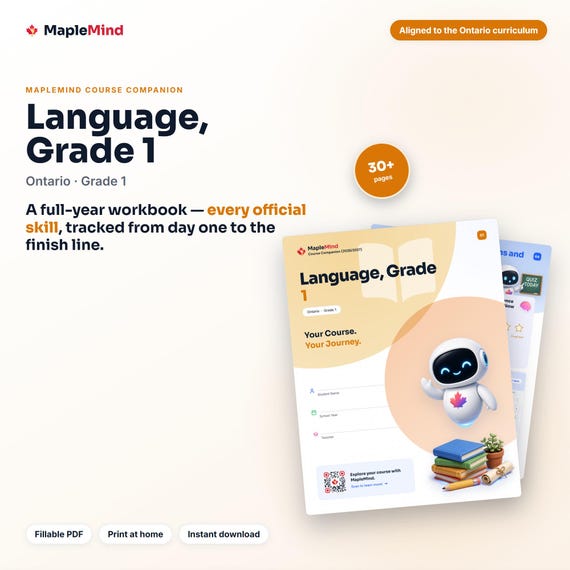
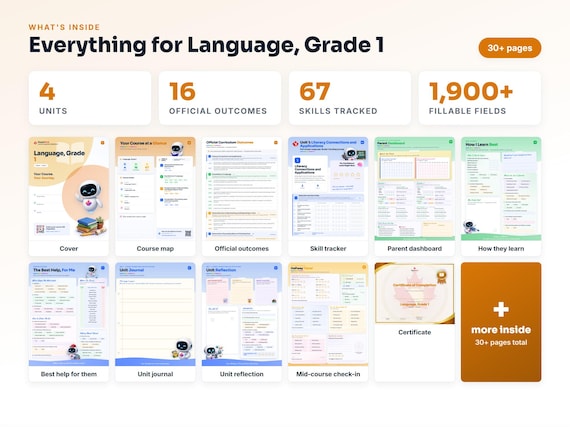
A Language, Grade 1 workbook worth keeping
Built from the same official curriculum as this page. Before and after each skill above, your student colours in how sure they feel — so the two of you can see, on one page, what's clicking and what needs another look. It's a quiet way to follow how the year is really going.
By June it's full of their own handwriting: units worked through, confidence grown, a mid-year check-in, notes from parent-teacher night, and a certificate at the end. Less a worksheet, more a record of the year worth keeping on the shelf.
Instant download · see every page, reviews and the full description · five or more workbooks are $2.99 each
What it looks like in the app



Common questions
Can MapleMind help my child with Language, Grade 1?
Yes. MapleMind's AI tutor covers all 67 skills in Ontario's Language, Grade 1 — your child picks the exact skill, and the tutor teaches it step by step: a short lesson, a worked example, solving together, then a skill check to show it stuck.
Is MapleMind aligned to Ontario's official curriculum?
Yes. Every skill in this course maps to an official outcome code from Ontario's Grade 1 English Language Arts curriculum, and the ministry's own wording is quoted under each unit on this page — with the official government source linked so you can check it yourself.
What does MapleMind cost?
It's free to start — 5 tutoring chats and a practice quiz every day, no credit card. A Pro subscription ($9.99/month or $49.99/year CAD, 7-day free trial) unlocks unlimited tutoring, practice, and exam simulations.
What if my child is stuck on just one topic?
That's the point of skill-level tutoring: open Language, Grade 1 in the app, tap the exact skill from the list on this page, and the tutor teaches just that — no wading through lessons your child doesn't need.
Does MapleMind work in French or other languages?
Yes — 14 languages, including French. Both the app and the tutor's explanations switch to the language your child chooses.
Where can I see the official Ontario curriculum for Language, Grade 1?
The official source is linked on this page — Ontario's official curriculum. The outline here follows it: every MapleMind skill carries its official outcome code, and the ministry's own wording is quoted under each unit.
Keep exploring
Ready when you are
Pick a skill from this page and see it taught properly — free, in the browser, in under a minute.