Get help with Mathematics, Grade 2
Most tutoring makes your child sit through material your child already knows. MapleMind flips that: pick the exact skill that's causing trouble — any of the 33 below — and the tutor teaches just that one, step by step, as many times as it takes. Ask questions in plain words, any time of day, in English, French, or 12 other languages.
The official Nova Scotia Mathematics, Grade 2 curriculum
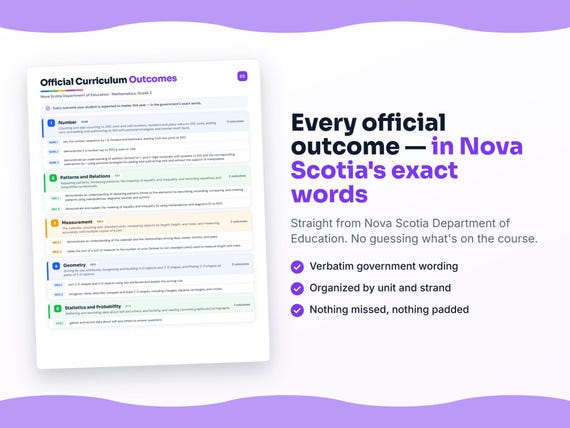
Nova Scotia defines Mathematics, Grade 2 by strands and outcomes. MapleMind teaches the same curriculum reorganized for one-skill-at-a-time tutoring — the table shows exactly where every official strand lands, and the ministry's own wording is quoted under each unit below.
Official source Nova Scotia's official curriculumRead it on the government site — curriculum.novascotia.ca ↗| Official strand | Outcomes | Where MapleMind teaches it |
|---|---|---|
| Strand N | 9 | Number |
| Strand PR | 4 | Patterns and Relations |
| Strand M | 4 | Measurement |
| Strand G | 4 | Geometry |
| Strand SP | 2 | Statistics and Probability |
Every skill below, taught one on one.
 Try the first session free
How MapleMind teaches Mathematics, Grade 2 — every unit, lesson, and skill
Every skill below runs as a short session: a plain-words lesson, a worked example, solving it together, then a five-question skill check that earns up to three stars. Guided Mode keeps it teaching instead of answer-handing — turning it off needs a parent's password.
Unit 1NumberOfficial strand · Strand N
Counting and skip-counting to 200, even and odd numbers, numbers and place value to 100, coins, adding zero, and adding and subtracting to 100 with personal strategies and mental-math facts.
Counting and Skip-Counting to 200
- Counting by 1s to 200N01 — Say the number sequence by 1s, forward and backward, starting from any point up to 200.
- Skip-counting by 2s, 5s, and 10sN01 — Skip-count by 2s to 100, by 5s and 10s to 100, and by 10s starting from any point, forward and backward.
Even, Odd, and Numbers to 100
- Even and odd numbersN02 — Determine whether a number up to 100 is even or odd using concrete materials or a hundred chart.
- Showing numbers to 100N04 — Represent numbers to 100 using base-ten materials, coins, tallies, pictures, and expressions, and read and record numbers in symbolic and word form.
- Breaking numbers into partsN04 — Partition numbers to 100 into parts, including tens and ones and other equivalent combinations.
- Comparing and ordering to 100N05 — Compare and order numbers up to 100 in ascending or descending order, and verify using a hundred chart, number line, or place value.
- Estimating amounts to 100N06 — Estimate quantities to 100 by using referents, including estimating the number of groups of ten.
- Place value: tens and onesN07 — Illustrate concretely and pictorially the meaning of place value for numerals to 100, showing tens and ones.
- Adding and subtracting zeroN08 — Demonstrate and explain the effect of adding zero to or subtracting zero from any number.
Adding and Subtracting to 100
- Personal strategies for adding and subtractingN09 — Use personal strategies, with and without manipulatives, to add and subtract 1- and 2-digit numbers with answers to 100.
- Making and solving math storiesN09 — Create and solve addition and subtraction story problems to 100, modelling with materials and writing matching number sentences.
- Does order matter?N09 — Explain and demonstrate that the order of adding numbers does not change the sum, but the order of subtracting matters when finding a difference.
- Recalling addition facts to 18N10 — Apply mental-mathematics strategies such as doubles, near doubles, and make-ten to quickly recall basic addition facts to 18.
- Think-addition to subtractN10 — Determine related subtraction facts to 18 using the think-addition strategy and fact families.
The official wording — 9 outcomes in this unit
- N01
say the number sequence by ▪ 1s, forward and backward, starting from any point to 200
- N02
demonstrate if a number (up to 100) is even or odd.
- N04
represent and partition numbers to 100.
- N05
compare and order numbers up to 100.
- N06
estimate quantities to 100 by using referents.
- N07
illustrate, concretely and pictorially, the meaning of place value for numerals to 100.
- N08
demonstrate and explain the effect of adding zero to or subtracting zero from any number.
- N09
demonstrate an understanding of addition (limited to 1- and 2-digit numerals) with answers to 100 and the corresponding subtraction by: ▪ using personal strategies for adding and subtracting with and without the support of manipulates
- N10
apply mental mathematics strategies to quickly recall basic addition facts to 18 and determine related subtraction facts.
Unit 2Patterns and RelationsOfficial strand · Strand PR
Repeating patterns, increasing patterns, the meaning of equality and inequality, and recording equalities and inequalities symbolically.
Repeating and Increasing Patterns
- Describing and extending repeating patternsPR01 — Describe, extend, and compare repeating patterns of three to five elements, including identifying the core.
- Creating and translating repeating patternsPR01 — Create repeating patterns using manipulatives, sounds, and actions, and translate a repeating pattern from one mode to another.
- Describing and extending increasing patternsPR02 — Identify, describe, and extend increasing numerical and non-numerical patterns, and determine missing terms.
- Creating increasing patternsPR02 — Create increasing patterns, explain the pattern rule, and represent an increasing pattern in another mode.
Equality and Inequality
- What equality and inequality meanPR03 — Demonstrate and explain the meaning of equality and inequality using manipulatives and diagrams for numbers 0 to 100.
- Writing = and ≠PR04 — Record equalities and inequalities symbolically using the equal symbol (=) or not-equal symbol (≠), and justify the choice.
The official wording — 4 outcomes in this unit
- PR01
demonstrate an understanding of repeating patterns (three to five elements) by describing, extending, comparing, and creating patterns using manipulatives, diagrams, sounds, and actions.
- PR02
demonstrate an understanding of increasing patterns by describing, extending, and creating numerical patterns (numbers to 100) and non-numerical patterns using manipulatives, diagrams, sounds, and actions.
- PR03
demonstrate and explain the meaning of equality and inequality by using manipulatives and diagrams (0 to 100).
- PR04
record equalities and inequalities symbolically, using the equal symbol or not equal symbol.
Unit 3MeasurementOfficial strand · Strand M
The calendar, choosing non-standard units, comparing objects by length, height, and mass, and measuring accurately with multiple copies of a unit.
The Calendar
- Days, weeks, months, and yearsM01 — Understand the calendar and the relationships among days, weeks, months, and years, and solve simple time problems.
Measuring with Non-Standard Units
- Choosing a unit to measureM02 — Relate the size of a non-standard unit to the number of units needed, and choose a suitable unit for measuring length or mass.
- Comparing objects by length, height, and massM03 — Compare and order objects by length, height, and mass using non-standard units, and make statements of comparison.
- Measuring accurately with copies of a unitM04 — Measure length to the nearest non-standard unit by using multiple copies of a unit laid end to end without gaps or overlaps.
The official wording — 4 outcomes in this unit
- M01
demonstrate an understanding of the calendar and the relationships among days, weeks, months, and years.
- M02
relate the size of a unit of measure to the number of units (limited to non-standard units) used to measure length and mass.
- M03
compare and order objects by length, height, and mass using non- standard units and make statements of comparison.
- M04
measure length to the nearest non-standard unit by using multiple copies of a unit.
Unit 4GeometryOfficial strand · Strand G
Sorting by two attributes, recognizing and building 3-D objects and 2-D shapes, and finding 2-D shapes as parts of 3-D objects.
Sorting and 3-D Objects
- Sorting by two attributesG01 — Sort 2-D shapes and 3-D objects using two attributes and explain the sorting rule.
- Naming and describing 3-D objectsG02 — Recognize, name, and describe 3-D objects, including cubes and other prisms, spheres, cones, cylinders, and pyramids.
- Comparing and building 3-D objectsG02 — Compare and build 3-D objects, creating representations with materials such as modelling clay.
2-D Shapes
- Naming and describing 2-D shapesG03 — Recognize, name, and describe 2-D shapes, including triangles, squares, rectangles, and circles.
- Comparing and building 2-D shapesG03 — Compare and build 2-D shapes, creating models and pictorial representations.
- Finding 2-D shapes on 3-D objectsG04 — Identify 2-D shapes as parts of 3-D objects in the environment, naming the 2-D faces of a 3-D object.
The official wording — 4 outcomes in this unit
- G01
sort 2-D shapes and 3-D objects using two attributes and explain the sorting rule.
- G02
recognize, name, describe, compare, and build 3-D objects, including cubes and other prisms, spheres, cones, cylinders, and pyramids.
- G03
recognize, name, describe, compare and build 2-D shapes, including triangles, squares, rectangles, and circles.
- G04
identify 2-D shapes as part of 3-D objects in the environment.
Unit 5Statistics and ProbabilityOfficial strand · Strand SP
Gathering and recording data about self and others, and building and reading concrete graphs and pictographs.
Collecting Data and Making Graphs
- Asking a question and collecting dataSP01 — Formulate a question and gather and record data about self and others using tallies, charts, or lists to answer it.
- Building and reading concrete graphsSP02 — Construct and interpret concrete graphs to display data and solve problems.
- Building and reading pictographsSP02 — Construct and interpret pictographs using one-to-one correspondence to display data and solve problems.
The official wording — 2 outcomes in this unit
- SP01
gather and record data about self and others to answer questions.
- SP02
construct and interpret concrete graphs and pictographs to solve problems.
Printable workbook · A keepsake of the year
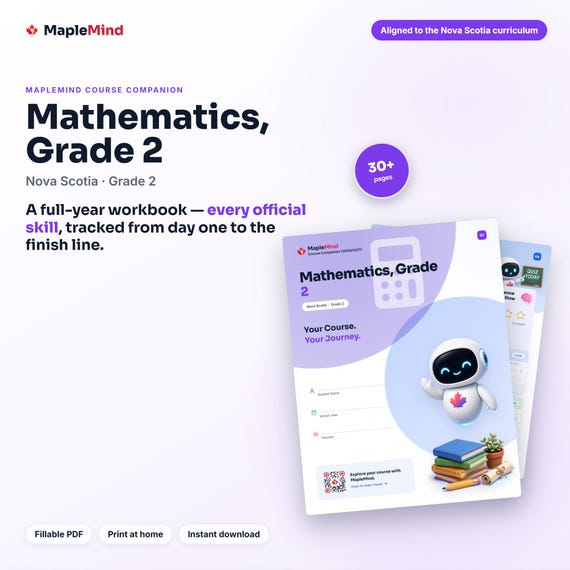
A Mathematics, Grade 2 workbook worth keeping
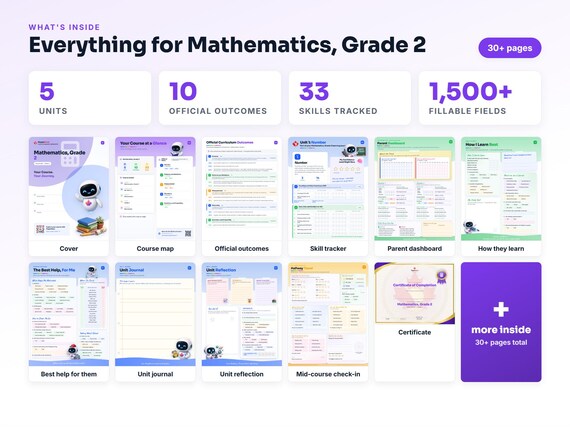
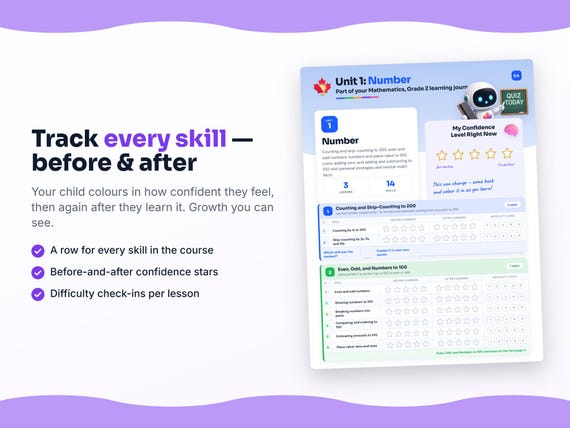
Built from the same official curriculum as this page. Before and after each skill above, your student colours in how sure they feel — so the two of you can see, on one page, what's clicking and what needs another look. It's a quiet way to follow how the year is really going.
By June it's full of their own handwriting: units worked through, confidence grown, a mid-year check-in, notes from parent-teacher night, and a certificate at the end. Less a worksheet, more a record of the year worth keeping on the shelf.
Instant download · see every page, reviews and the full description · five or more workbooks are $2.99 each
What it looks like in the app



Common questions
Can MapleMind help my child with Mathematics, Grade 2?
Yes. MapleMind's AI tutor covers all 33 skills in Nova Scotia's Mathematics, Grade 2 — your child picks the exact skill, and the tutor teaches it step by step: a short lesson, a worked example, solving together, then a skill check to show it stuck.
Is MapleMind aligned to Nova Scotia's official curriculum?
Yes. Every skill in this course maps to an official outcome code from Nova Scotia's Grade 2 Mathematics curriculum, and the ministry's own wording is quoted under each unit on this page — with the official government source linked so you can check it yourself.
What does MapleMind cost?
It's free to start — 5 tutoring chats and a practice quiz every day, no credit card. A Pro subscription ($9.99/month or $49.99/year CAD, 7-day free trial) unlocks unlimited tutoring, practice, and exam simulations.
What if my child is stuck on just one topic?
That's the point of skill-level tutoring: open Mathematics, Grade 2 in the app, tap the exact skill from the list on this page, and the tutor teaches just that — no wading through lessons your child doesn't need.
Does MapleMind work in French or other languages?
Yes — 14 languages, including French. Both the app and the tutor's explanations switch to the language your child chooses.
Where can I see the official Nova Scotia curriculum for Mathematics, Grade 2?
The official source is linked on this page — Nova Scotia's official curriculum. The outline here follows it: every MapleMind skill carries its official outcome code, and the ministry's own wording is quoted under each unit.
Keep exploring
Ready when you are
Pick a skill from this page and see it taught properly — free, in the browser, in under a minute.