Get help with Science, Grade 4
Most tutoring makes your child sit through material your child already knows. MapleMind flips that: pick the exact skill that's causing trouble — any of the 25 below — and the tutor teaches just that one, step by step, as many times as it takes. Ask questions in plain words, any time of day, in English, French, or 12 other languages.
The official Newfoundland and Labrador Science, Grade 4 curriculum
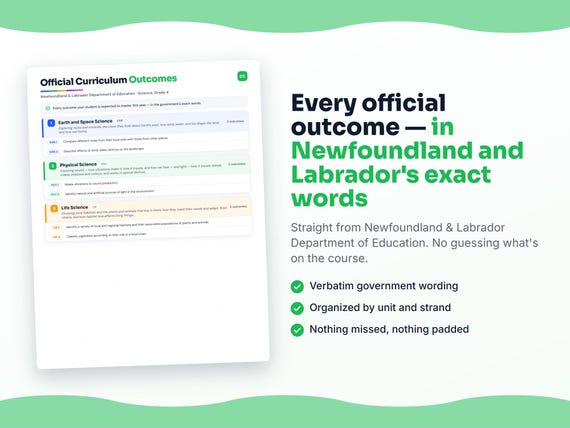
Newfoundland and Labrador defines Science, Grade 4 by strands and outcomes. MapleMind teaches the same curriculum reorganized for one-skill-at-a-time tutoring — the table shows exactly where every official strand lands, and the ministry's own wording is quoted under each unit below.
Official source Newfoundland and Labrador's official curriculumRead it on the government site — gov.nl.ca ↗| Official strand | Outcomes | Where MapleMind teaches it |
|---|---|---|
| Strand 6 | 8 | Earth and Space Science |
| Strand 8 | 11 | Physical Science |
| Strand 10 | 6 | Life Science |
Every skill below, taught one on one.
 Try the first session free
How MapleMind teaches Science, Grade 4 — every unit, lesson, and skill
Every skill below runs as a short session: a plain-words lesson, a worked example, solving it together, then a five-question skill check that earns up to three stars. Guided Mode keeps it teaching instead of answer-handing — turning it off needs a parent's password.
Unit 1Earth and Space ScienceOfficial strand · Strand 6
Exploring rocks and minerals, the clues they hold about Earth's past, how wind, water, and ice shape the land, and how soil forms.
Rocks and Minerals
- Comparing local and faraway rockssci-4.2.2.1 — Compare different rocks from the local area with those from other places.
- Describing rocks by their propertiessci-4.2.2.2 — Describe rocks according to their physical properties.
- Clues about Earth's history in rockssci-4.2.2.3 — Identify and describe clues about Earth's history contained in rocks.
- Minerals and their propertiessci-4.2.2.4 — Describe minerals according to their physical properties.
- Uses of rocks and mineralssci-4.2.2.5 — Relate the characteristics of rocks and minerals to their uses.
How the Land Changes
- Wind, water, and ice shaping the landsci-4.2.2.6 — Describe the effects of wind, water, and ice on the landscape, and model weathering and erosion.
- How soil forms from rockssci-4.2.2.8 — Describe how soil is formed from rocks.
- Fast changes to the landsci-4.2.2.9 — Describe natural events that cause rapid and significant changes to the landscape.
The official wording — 8 outcomes in this unit
- sci-4.2.2.1
Compare different rocks from their local area with those from other places
- sci-4.2.2.2
Describe rocks according to their physical properties
- sci-4.2.2.3
Identify and describe clues about Earth’s history contained in rocks
- sci-4.2.2.4
Describe minerals according to their physical properties
- sci-4.2.2.5
Relate the characteristics of rocks and minerals to their uses
- sci-4.2.2.6
Describe effects of wind, water, and ice on the landscape
- sci-4.2.2.8
Describe how soil is formed from rocks
- sci-4.2.2.9
Describe natural phenomena that cause rapid and significant changes to the landscape
Unit 2Physical ScienceOfficial strand · Strand 8
Exploring sound — how vibrations make it, how it travels, and how we hear — and light — how it travels, bends, makes shadows and colours, and works in optical devices.
Sound and Vibrations
- Sound comes from vibrationssci-4.3.2.2 — Relate vibrations to the production of sound and identify objects by the sounds they make.
- How sound travelssci-4.3.2.3 — Compare how vibrations travel differently through solids, liquids, and air.
- How we hearsci-4.3.2.4 — Investigate and describe how the human ear is designed to detect vibrations.
- Changing pitch and loudnesssci-4.3.2.5 — Demonstrate and describe how the pitch and loudness of sounds can be changed.
- What different ears can hearsci-4.3.2.6 — Compare the range of sounds heard by humans to that heard by other animals.
Light
- Light sources and seeingsci-4.3.2.7 — Identify natural and artificial light sources and distinguish objects that emit light from those seen by reflected light.
- How light travels and meets objectssci-4.3.2.8 — Demonstrate that light travels in all directions from a source and investigate how a beam interacts with objects.
- Shadowssci-4.3.2.11 — Investigate and predict how to change the location, shape, and size of an object's shadow.
- Bending lightsci-4.3.2.12 — Explore how a variety of media may change the direction of light.
- Colours in white lightsci-4.3.2.13 — Demonstrate that white light may be separated into colours.
- Optical devicessci-4.3.2.14 — Compare how light interacts with a variety of optical devices.
The official wording — 11 outcomes in this unit
- sci-4.3.2.2
Relate vibrations to sound production
- sci-4.3.2.3
Compare how vibrations travel differently through a variety of solids and liquids and through air
- sci-4.3.2.4
Investigate and describe how the human ear is designed to detect vibrations
- sci-4.3.2.5
Demonstrate and describe how the pitch and loudness of sounds can be modified
- sci-4.3.2.6
Compare the range of sounds heard by humans to that heard by other animals
- sci-4.3.2.7
Identify natural and artificial sources of light in the environment
- sci-4.3.2.8
Demonstrate that light travels in all directions from a source
- sci-4.3.2.11
Investigate and predict how to change the location, shape, and size of an object’s shadow
- sci-4.3.2.12
Explore how a variety of media may change the direction of light
- sci-4.3.2.13
Demonstrate that white light may be separated into colours
- sci-4.3.2.14
Compare how light interacts with a variety of optical devices
Unit 3Life ScienceOfficial strand · Strand 10
Studying local habitats and the plants and animals that live in them, how they meet their needs and adapt, food chains, and how habitat loss affects living things.
Habitats and Adaptations
- Local habitats and their living thingssci-4.4.2.1 — Identify a variety of local and regional habitats and their populations of plants and animals.
- How animals meet their needssci-4.4.2.2 — Investigate and describe how local animals meet their basic needs in their habitat.
- Plant adaptationssci-4.4.2.3 — Compare the structural adaptations of plants that enable them to thrive in different kinds of places.
- Animal adaptationssci-4.4.2.4 — Compare the structural and behavioural adaptations of animals that help them survive in different kinds of places.
Food Chains and Habitat Change
- Food chainssci-4.4.2.5 — Classify organisms according to their role in a food chain.
- When habitats changesci-4.4.2.6 — Predict how removing a population affects a community, and relate habitat loss to endangerment and extinction.
The official wording — 6 outcomes in this unit
- sci-4.4.2.1
Identify a variety of local and regional habitats and their associated populations of plants and animals
- sci-4.4.2.2
Investigate and describe how a variety of local animals are able to meet their basic needs in their habitat
- sci-4.4.2.3
Compare the structural adaptations of plants that enable them to thrive in different kinds of places
- sci-4.4.2.4
Compare the structural and behavioural adaptations of animals that help them survive in different kinds of places
- sci-4.4.2.5
Classify organisms according to their role in a food chain
- sci-4.4.2.6
Predict how reduction or removal of a plant or animal population affects the rest of the community
Printable workbook · A keepsake of the year
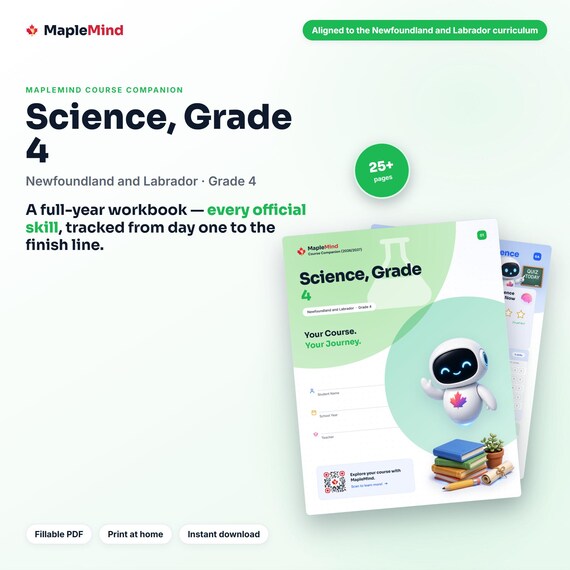
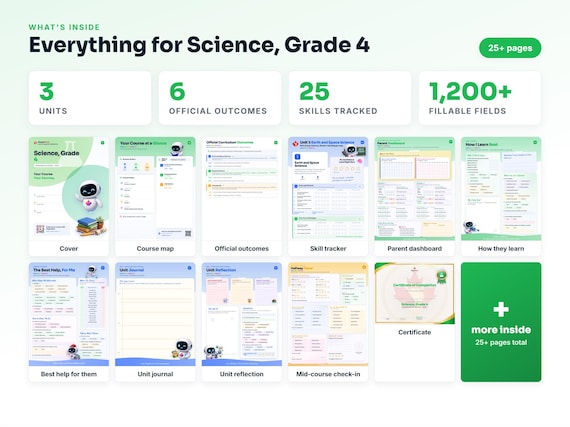
A Science, Grade 4 workbook worth keeping
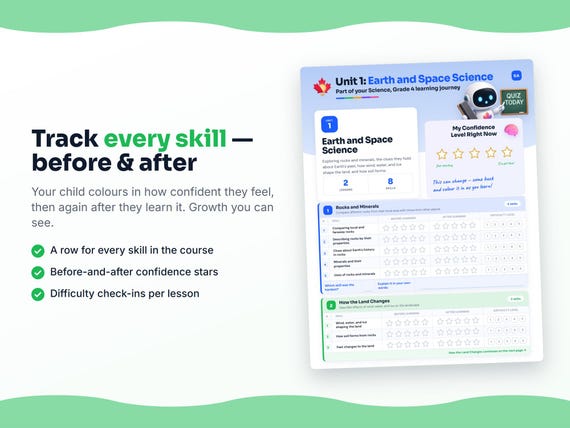
Built from the same official curriculum as this page. Before and after each skill above, your student colours in how sure they feel — so the two of you can see, on one page, what's clicking and what needs another look. It's a quiet way to follow how the year is really going.
By June it's full of their own handwriting: units worked through, confidence grown, a mid-year check-in, notes from parent-teacher night, and a certificate at the end. Less a worksheet, more a record of the year worth keeping on the shelf.
Instant download · see every page, reviews and the full description · five or more workbooks are $2.99 each
What it looks like in the app



Common questions
Can MapleMind help my child with Science, Grade 4?
Yes. MapleMind's AI tutor covers all 25 skills in Newfoundland and Labrador's Science, Grade 4 — your child picks the exact skill, and the tutor teaches it step by step: a short lesson, a worked example, solving together, then a skill check to show it stuck.
Is MapleMind aligned to Newfoundland and Labrador's official curriculum?
Yes. Every skill in this course maps to an official outcome code from Newfoundland and Labrador's Grade 4 Science curriculum, and the ministry's own wording is quoted under each unit on this page — with the official government source linked so you can check it yourself.
What does MapleMind cost?
It's free to start — 5 tutoring chats and a practice quiz every day, no credit card. A Pro subscription ($9.99/month or $49.99/year CAD, 7-day free trial) unlocks unlimited tutoring, practice, and exam simulations.
What if my child is stuck on just one topic?
That's the point of skill-level tutoring: open Science, Grade 4 in the app, tap the exact skill from the list on this page, and the tutor teaches just that — no wading through lessons your child doesn't need.
Does MapleMind work in French or other languages?
Yes — 14 languages, including French. Both the app and the tutor's explanations switch to the language your child chooses.
Where can I see the official Newfoundland and Labrador curriculum for Science, Grade 4?
The official source is linked on this page — Newfoundland and Labrador's official curriculum. The outline here follows it: every MapleMind skill carries its official outcome code, and the ministry's own wording is quoted under each unit.
Keep exploring
Ready when you are
Pick a skill from this page and see it taught properly — free, in the browser, in under a minute.