Get help with Social Studies, Grade 2
Most tutoring makes your child sit through material your child already knows. MapleMind flips that: pick the exact skill that's causing trouble — any of the 18 below — and the tutor teaches just that one, step by step, as many times as it takes. Ask questions in plain words, any time of day, in English, French, or 12 other languages.
The official Newfoundland and Labrador Social Studies, Grade 2 curriculum
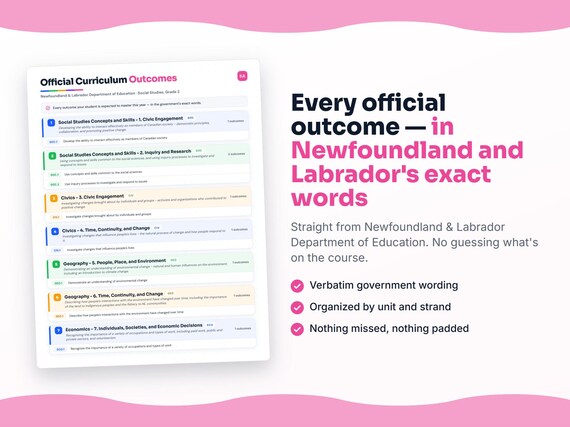
Newfoundland and Labrador defines Social Studies, Grade 2 by strands and outcomes. MapleMind teaches the same curriculum reorganized for one-skill-at-a-time tutoring — the table shows exactly where every official strand lands, and the ministry's own wording is quoted under each unit below.
Official source Newfoundland and Labrador's official curriculumRead it on the government site — gov.nl.ca ↗| Official strand | Outcomes | Where MapleMind teaches it |
|---|---|---|
| Strand 1 | 1 | Social Studies Concepts and Skills - 1. Civic Engagement |
| Strand 2 | 2 | Social Studies Concepts and Skills - 2. Inquiry and Research |
| Strand 3 | 1 | Civics - 3. Civic Engagement |
| Strand 4 | 1 | Civics - 4. Time, Continuity, and Change |
| Strand 5 | 1 | Geography - 5. People, Place, and Environment |
| Strand 6 | 1 | Geography - 6. Time, Continuity, and Change |
| Strand 7 | 1 | Economics - 7. Individuals, Societies, and Economic Decisions |
| Strand 8 | 1 | Economics - 8. Time, Continuity, and Change |
| Strand 9 | 1 | Politics - 9. Citizenship, Power, and Governance |
| Strand 10 | 1 | Politics - 10. Civic Engagement |
Every skill below, taught one on one.
 Try the first session free
How MapleMind teaches Social Studies, Grade 2 — every unit, lesson, and skill
Every skill below runs as a short session: a plain-words lesson, a worked example, solving it together, then a five-question skill check that earns up to three stars. Guided Mode keeps it teaching instead of answer-handing — turning it off needs a parent's password.
Unit 1Social Studies Concepts and Skills - 1. Civic EngagementOfficial strand · Strand 1
Developing the ability to interact effectively as members of Canadian society - democratic principles, collaboration, and promoting positive change.
Getting Along and Making Change
- Fairness and group decisionsNL-SS-2.1 — Apply democratic principles - fairness, taking turns, and making group decisions - as a member of the community.
- Working together to help othersNL-SS-2.1 — Collaborate as an active group member and promote positive change by finding ways to help others and the community.
The official wording — 1 outcome in this unit
- NL-SS-2.1
Develop the ability to interact effectively as members of Canadian society
Unit 2Social Studies Concepts and Skills - 2. Inquiry and ResearchOfficial strand · Strand 2
Using concepts and skills common to the social sciences, and using inquiry processes to investigate and respond to issues.
Ways Social Scientists Think
- Evidence, comparison, causality, and perspectiveNL-SS-2.2 — Use the four social-science forms of analysis: using evidence, making comparisons, understanding causality, and considering perspectives.
The Inquiry Process
- Asking, gathering, and respondingNL-SS-2.3 — Use the inquiry process - asking questions, gathering and organizing information, interpreting it, drawing conclusions, and communicating ideas - to respond to an issue.
The official wording — 2 outcomes in this unit
- NL-SS-2.2
Use concepts and skills common to the social sciences
- NL-SS-2.3
Use inquiry processes to investigate and respond to issues
Unit 3Civics - 3. Civic EngagementOfficial strand · Strand 3
Investigating changes brought about by individuals and groups - activists and organizations who contributed to positive change.
People Who Make Change
- Individuals and groups who bring changeNL-SS-2.4 — Investigate individuals and groups who brought about positive change, examining the problem, who was involved, and how change happened.
- How I can help bring changeNL-SS-2.4 — Identify how one's own interests and strengths can contribute, through collaboration and teamwork, to positive change.
The official wording — 1 outcome in this unit
- NL-SS-2.4
Investigate changes brought about by individuals and groups
Unit 4Civics - 4. Time, Continuity, and ChangeOfficial strand · Strand 4
Investigating changes that influence people's lives - the natural process of change and how people respond to it.
Changes in People's Lives
- Changes that influence our livesNL-SS-2.5 — Investigate changes that influence people's lives, how they can affect us, and understand change as a natural process.
The official wording — 1 outcome in this unit
- NL-SS-2.5
Investigate changes that influence people's lives
Unit 5Geography - 5. People, Place, and EnvironmentOfficial strand · Strand 5
Demonstrating an understanding of environmental change - natural and human influences on the environment, including an introduction to climate change.
How the Environment Changes
- Natural and human influences on the environmentNL-SS-2.6 — Understand natural and human influences that change the environment and how the environment shapes lifestyle and culture.
- An introduction to climate changeNL-SS-2.6 — Recognize climate change as a factor that influences the environment and as an issue with global implications.
The official wording — 1 outcome in this unit
- NL-SS-2.6
Demonstrate an understanding of environmental change
Unit 6Geography - 6. Time, Continuity, and ChangeOfficial strand · Strand 6
Describing how people's interactions with the environment have changed over time, including the importance of the land to Indigenous peoples and the fishery to NL communities.
How We Use the Environment Has Changed
- Interactions, culture, and the landNL-SS-2.7 — Describe how human-environmental interactions connect to culture, including the importance of the land to Indigenous peoples and the fishery to NL communities.
- Sustainable, balanced interactionsNL-SS-2.7 — Understand that our interactions have consequences and the importance of sustainable, balanced ways of interacting with the natural world.
The official wording — 1 outcome in this unit
- NL-SS-2.7
Describe how people's interactions with the environment have changed over time
Unit 7Economics - 7. Individuals, Societies, and Economic DecisionsOfficial strand · Strand 7
Recognizing the importance of a variety of occupations and types of work, including paid work, public and private sectors, and volunteerism.
Many Kinds of Work
- Goods, services, and sectors of workNL-SS-2.8 — Recognize a variety of paid occupations - goods and services, public and private sector - and their importance to the community.
- Unpaid work and volunteeringNL-SS-2.8 — Recognize the importance of unpaid work and volunteerism and the benefits it provides to the community.
The official wording — 1 outcome in this unit
- NL-SS-2.8
Recognize the importance of a variety of occupations and types of work
Unit 8Economics - 8. Time, Continuity, and ChangeOfficial strand · Strand 8
Demonstrating an understanding of how the nature of work has changed over time, including technology, changing social norms, and gender diversity in the workforce.
How Work Has Changed
- Work changing with time and technologyNL-SS-2.9 — Understand how work has changed over time through technology, location, and changes in population and demand.
- Changing ideas about who does which workNL-SS-2.9 — Understand how changing social norms have opened all fields of work to both men and women, with gender diversity in the workforce.
The official wording — 1 outcome in this unit
- NL-SS-2.9
Demonstrate an understanding of how the nature of work has changed over time
Unit 9Politics - 9. Citizenship, Power, and GovernanceOfficial strand · Strand 9
Demonstrating an understanding of citizenship and governance at the community level - rights and responsibilities of citizens, elections, and the roles of municipal and Indigenous leaders in Newfoundland and Labrador.
Citizenship in My Community
- Rights and responsibilities of citizensNL-SS-2.10 — Understand citizenship at the community level - the rights and responsibilities of citizens and their mutual benefit.
- Elections and community leadersNL-SS-2.10 — Explore the electoral process and the roles of community leaders - mayor and councillor in municipal government, and the leaders of Qalipu, Miawpukek, and Innu First Nations, the Nunatsiavut Government, and the NunatuKavut Community Council.
The official wording — 1 outcome in this unit
- NL-SS-2.10
Demonstrate an understanding of citizenship and governance at the community level
Unit 10Politics - 10. Civic EngagementOfficial strand · Strand 10
Developing decision-making skills in the context of the local community - applying an inquiry-based decision-making model to community issues.
Making Decisions in My Community
- Using a decision-making modelNL-SS-2.11 — Develop decision-making skills by applying an inquiry-based decision-making model to local community issues.
The official wording — 1 outcome in this unit
- NL-SS-2.11
Develop decision-making skills in the context of the local community
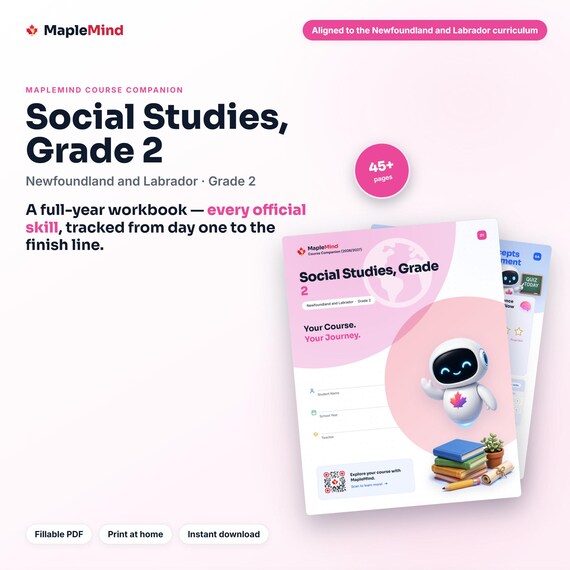
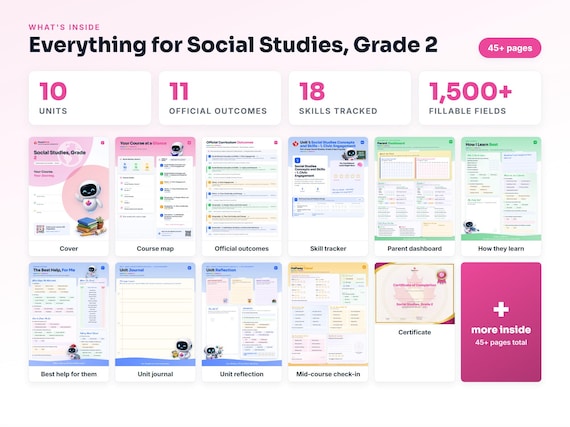
Printable workbook · A keepsake of the year
A Social Studies, Grade 2 workbook worth keeping
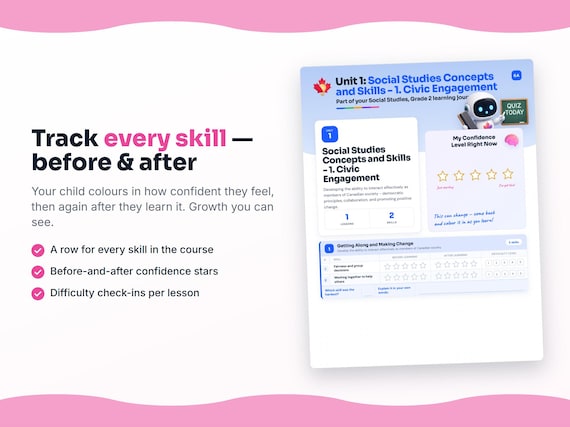
Built from the same official curriculum as this page. Before and after each skill above, your student colours in how sure they feel — so the two of you can see, on one page, what's clicking and what needs another look. It's a quiet way to follow how the year is really going.
By June it's full of their own handwriting: units worked through, confidence grown, a mid-year check-in, notes from parent-teacher night, and a certificate at the end. Less a worksheet, more a record of the year worth keeping on the shelf.
Instant download · see every page, reviews and the full description · five or more workbooks are $2.99 each
What it looks like in the app



Common questions
Can MapleMind help my child with Social Studies, Grade 2?
Yes. MapleMind's AI tutor covers all 18 skills in Newfoundland and Labrador's Social Studies, Grade 2 — your child picks the exact skill, and the tutor teaches it step by step: a short lesson, a worked example, solving together, then a skill check to show it stuck.
Is MapleMind aligned to Newfoundland and Labrador's official curriculum?
Yes. Every skill in this course maps to an official outcome code from Newfoundland and Labrador's Grade 2 Social Studies curriculum, and the ministry's own wording is quoted under each unit on this page — with the official government source linked so you can check it yourself.
What does MapleMind cost?
It's free to start — 5 tutoring chats and a practice quiz every day, no credit card. A Pro subscription ($9.99/month or $49.99/year CAD, 7-day free trial) unlocks unlimited tutoring, practice, and exam simulations.
What if my child is stuck on just one topic?
That's the point of skill-level tutoring: open Social Studies, Grade 2 in the app, tap the exact skill from the list on this page, and the tutor teaches just that — no wading through lessons your child doesn't need.
Does MapleMind work in French or other languages?
Yes — 14 languages, including French. Both the app and the tutor's explanations switch to the language your child chooses.
Where can I see the official Newfoundland and Labrador curriculum for Social Studies, Grade 2?
The official source is linked on this page — Newfoundland and Labrador's official curriculum. The outline here follows it: every MapleMind skill carries its official outcome code, and the ministry's own wording is quoted under each unit.
Keep exploring
Ready when you are
Pick a skill from this page and see it taught properly — free, in the browser, in under a minute.