Get help with Core French, Grade 9
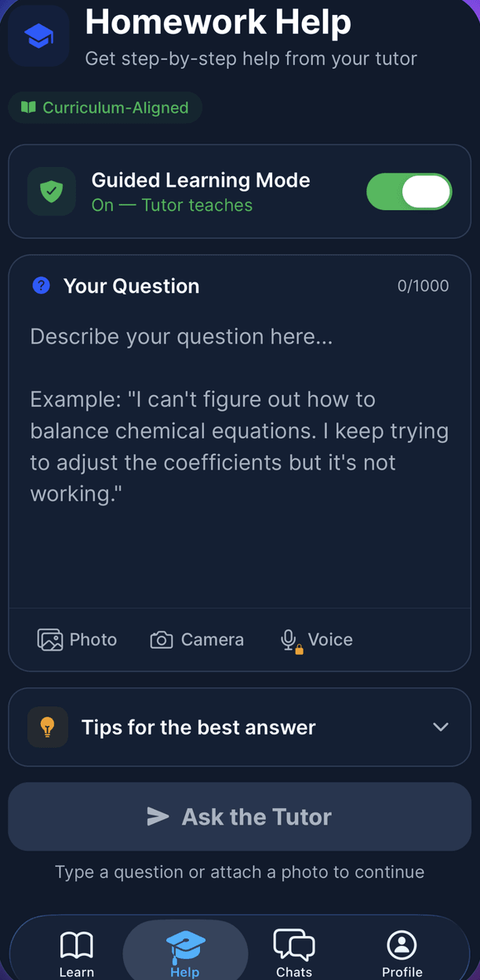
Most tutoring makes you sit through material you already know. MapleMind flips that: pick the exact skill that's causing trouble — any of the 31 below — and the tutor teaches just that one, step by step, as many times as it takes. Ask questions in plain words, any time of day, in English, French, or 12 other languages.
The official Newfoundland and Labrador Core French, Grade 9 curriculum
Newfoundland and Labrador defines Core French, Grade 9 by strands and outcomes. MapleMind teaches the same curriculum reorganized for one-skill-at-a-time tutoring — the table shows exactly where every official strand lands, and the ministry's own wording is quoted under each unit below.
Official source Newfoundland and Labrador's official curriculumRead it on the government site — gov.nl.ca ↗| Official strand | Outcomes | Where MapleMind teaches it |
|---|---|---|
| Strand 1 | 13 | Communication |
| Strand 2 | 6 | Culture |
| Strand 3 | 12 | General Language Education |
Every skill below, taught one on one.
 Try the first session free
How MapleMind teaches Core French, Grade 9 — every unit, lesson, and skill
Every skill below runs as a short session: a plain-words lesson, a worked example, solving it together, then a five-question skill check that earns up to three stars. Guided Mode keeps it teaching instead of answer-handing — turning it off needs a parent's password.
Unit 1CommunicationOfficial strand · Strand 1
The Communication strand: Grade 9 learners engage in conversations for varied purposes, ask and answer questions and justify responses, discuss with greater detail, use the present tense frequently and past and future tenses occasionally, comprehend and extract information, evaluate media messages, describe events, read aloud familiar and new language, read for pleasure, create texts of 75-80 words, and critique and respond to creative works.
Conversing and Justifying
- Conversations for varied purposesNL.CF9.1.1 — Engage in short French conversations for a variety of purposes.
- Asking, answering, and justifyingNL.CF9.1.2 — Ask and answer questions in French and justify your responses.
- Discussing with greater detailNL.CF9.1.3 — Discuss your activities and interests in French with greater detail.
- Present with occasional past and futureNL.CF9.1.4 — Engage in familiar oral and written French activities, using the present tense frequently and the past and future tenses occasionally.
Comprehending and Evaluating Texts
- Global comprehension of textsNL.CF9.1.5 — Demonstrate global comprehension of oral, written, and visual French texts on familiar topics from a variety of sources.
- Extracting specific informationNL.CF9.1.6 — Extract specific information from oral, written, and visual French texts to complete meaningful tasks.
- Evaluating media messagesNL.CF9.1.7 — Identify and evaluate messages in diverse French media contexts.
- Describing events in time and placeNL.CF9.1.8 — Describe events in French in terms of time and place.
Reading and Critiquing Creative Works
- Reading aloud familiar and new languageNL.CF9.1.9 — Read aloud short French texts of familiar and new language with good pronunciation, intonation, and expression.
- Reading for information and pleasureNL.CF9.1.10 — Read a variety of French resources for information and pleasure.
- Creating and publishing texts (75-80 words)NL.CF9.1.11 — Create, present, and publish oral and written French texts of 75-80 words, individually and in groups.
- Critiquing a creative workNL.CF9.1.12 — Critique a French creative work following a model.
- Responding creatively and critically to artNL.CF9.1.13 — Respond creatively and critically to various forms of French artistic expression.
The official wording — 13 outcomes in this unit
- NL.CF9.1.1
Engage in short conversations for a variety of purposes
- NL.CF9.1.2
Ask and answer questions and justify responses.
- NL.CF9.1.3
Discuss activities and interests with greater detail.
- NL.CF9.1.4
Engage in familiar oral and written activities, frequently using the present tense and occasionally using the past and future tenses.
- NL.CF9.1.5
Demonstrate global comprehension of oral, written, and visual texts on familiar topics from a variety of sources.
- NL.CF9.1.6
Extract specific information from oral, written, and visual texts to complete meaningful tasks.
- NL.CF9.1.7
Identify and evaluate messages in diverse media contexts.
- NL.CF9.1.8
Describe events in terms of time and place.
- NL.CF9.1.9
Read aloud with good pronunciation, intonation, and expression, short texts composed of familiar and new language.
- NL.CF9.1.10
Read a variety of resources for information and pleasure.
- NL.CF9.1.11
Create, present, and publish oral and written texts individually and in groups. (Written texts: 75-80 words.)
- NL.CF9.1.12
Critique, following a model, a creative work.
- NL.CF9.1.13
Respond creatively and critically to various forms of artistic expression.
Unit 2CultureOfficial strand · Strand 2
The Culture strand: Grade 9 learners identify the advantages of knowing both official languages, discuss personal and local celebrations, compare their own celebrations and customs to those of francophone cultures, recognize the presence of francophone cultures in Canada and elsewhere, discuss the contributions of prominent francophones, and use cultural resources to complete a task.
Comparing Cultures and Using Resources
- Advantages of both official languagesNL.CF9.2.1 — Identify the advantages of knowing both official languages in Canada.
- Discussing local celebrationsNL.CF9.2.2 — Identify and discuss personal and local celebrations, customs, and routines.
- Comparing customs to francophone culturesNL.CF9.2.3 — Compare your own celebrations, customs, and routines to those of francophone cultures.
- Francophone cultures in Canada and elsewhereNL.CF9.2.4 — Recognize the presence of francophone cultures in Canada and elsewhere.
- Discussing prominent francophonesNL.CF9.2.5 — Identify and discuss the contributions of prominent francophones.
- Using cultural resources for a taskNL.CF9.2.6 — Use information from French cultural resources to complete a task.
The official wording — 6 outcomes in this unit
- NL.CF9.2.1
Identify the advantages of knowing both official languages in Canada.
- NL.CF9.2.2
Identify and discuss personal and local celebrations, customs and routines.
- NL.CF9.2.3
Compare their own celebrations, customs, and routines to those of francophone cultures.
- NL.CF9.2.4
Recognize the presence of francophone cultures in Canada and elsewhere.
- NL.CF9.2.5
Identify and discuss the contributions of prominent francophones.
- NL.CF9.2.6
Use information from cultural resources to complete a task.
Unit 3General Language EducationOfficial strand · Strand 3
The General Language Education strand: Grade 9 learners extend their strategy toolkit - decoding with cues, predicting with contextual clues and organizers, gathering and organizing information, applying language patterns, using references, working from models, checking for errors, using the writing process, applying oral-presentation and print-text strategies, and (new at Grade 9) using self-assessment techniques. (Statements 3.1-3.11 spiral from Grade 8; each is pitched here to Grade 9's present/past/future, 75-80-word level, with the Grade-8 skill chained as a prerequisite.)
Decoding and Predicting Meaning
- Decoding with cuesNL.CF9.3.1 — Use visual, verbal, and non-verbal cues to decode meaning in French.
- Predicting with contextual cluesNL.CF9.3.2 — Use contextual clues such as cognates, word families, and word associations to predict meaning in French.
- Using advance organizersNL.CF9.3.3 — Use advance organizers to predict and construct meaning in French.
Organizing Information and Conventions
- Gathering and organizing informationNL.CF9.3.4 — Gather and organize French information individually and in groups.
- Applying language patternsNL.CF9.3.5 — Apply patterns in pronunciation, spelling, phrase structure, and other conventions to improve French communication.
- Using reference materialsNL.CF9.3.6 — Use dictionary, glossary, and other French reference materials.
Models, Process, Presenting, and Self-Assessment
- Using a modelNL.CF9.3.7 — Use a model to complete oral and written French tasks.
- Checking for errorsNL.CF9.3.8 — Recognize the importance of checking French work for errors.
- Using the writing processNL.CF9.3.9 — Use the writing process to complete a French task.
- Oral presentation strategiesNL.CF9.3.10 — Use oral presentation strategies (voice, music, sound, gestures) to enhance French communication.
- Applying print-text featuresNL.CF9.3.11 — Apply features of print text (font, colour, headings) to published French works.
- Using self-assessment techniquesNL.CF9.3.12 — Use self-assessment techniques in French learning.
The official wording — 12 outcomes in this unit
- NL.CF9.3.1
Use visual, verbal, and non-verbal cues to decode meaning.
- NL.CF9.3.2
Use contextual clues such as cognates, word families, and word associations to predict meaning.
- NL.CF9.3.3
Use advance organizers to predict and construct meaning.
- NL.CF9.3.4
Gather and organize information individually, and in groups.
- NL.CF9.3.5
Apply patterns in pronunciation, spelling, phrase structure, and other conventions to improve oral and written communication.
- NL.CF9.3.6
Use dictionary, glossary, and other reference materials.
- NL.CF9.3.7
Use a model to complete oral and written tasks.
- NL.CF9.3.8
Recognize the importance of checking for errors
- NL.CF9.3.9
Use the writing process to complete a task.
- NL.CF9.3.10
Use oral presentation strategies (voice, music, sound, gestures) to enhance communication.
- NL.CF9.3.11
Apply features of print text (font, colour, headings) to published works.
- NL.CF9.3.12
Use self-assessment techniques.

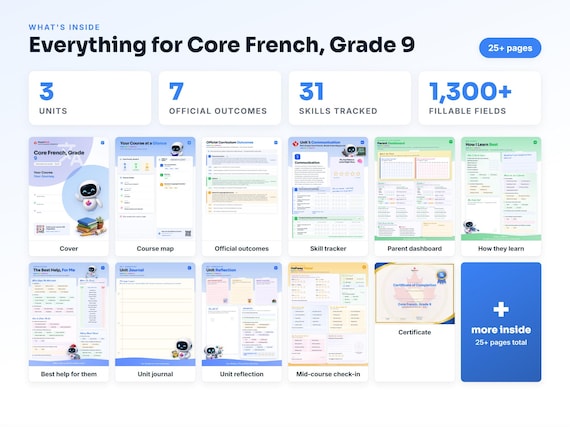
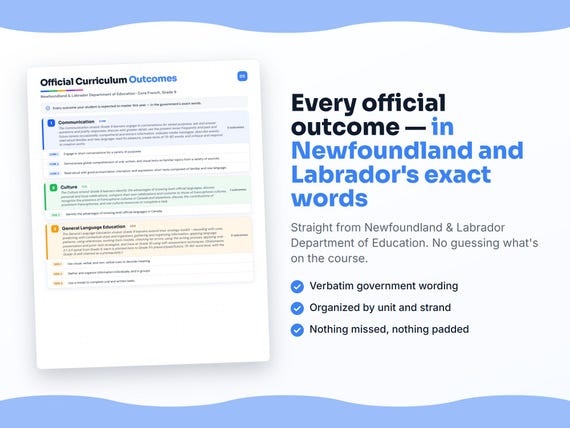
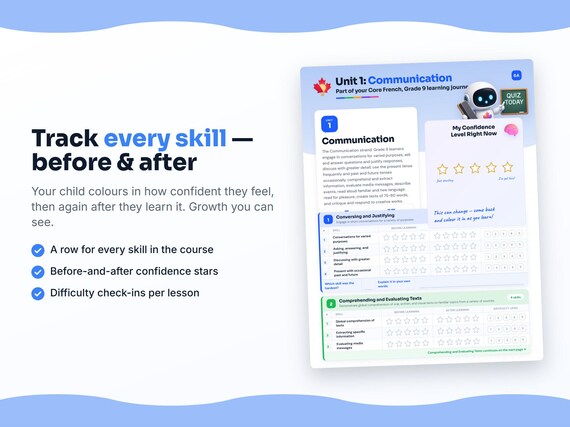
Printable workbook · A keepsake of the year
A Core French, Grade 9 workbook worth keeping
Built from the same official curriculum as this page. Before and after each skill above, your student colours in how sure they feel — so the two of you can see, on one page, what's clicking and what needs another look. It's a quiet way to follow how the year is really going.
By June it's full of their own handwriting: units worked through, confidence grown, a mid-year check-in, notes from parent-teacher night, and a certificate at the end. Less a worksheet, more a record of the year worth keeping on the shelf.
Instant download · see every page, reviews and the full description · five or more workbooks are $2.99 each
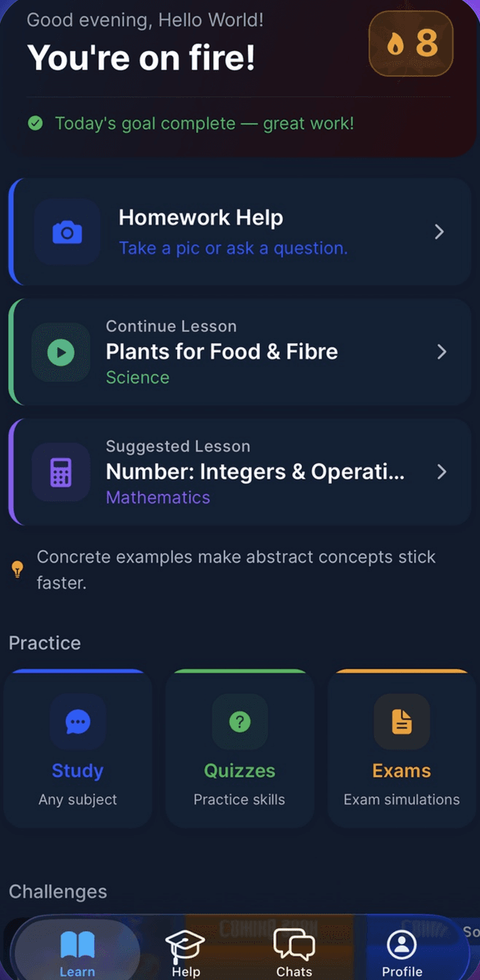
What it looks like in the app
Common questions
Can MapleMind help me with Core French, Grade 9?
Yes. MapleMind's AI tutor covers all 31 skills in Newfoundland and Labrador's Core French, Grade 9 — you pick the exact skill, and the tutor teaches it step by step: a short lesson, a worked example, solving together, then a skill check to show it stuck.
Is MapleMind aligned to Newfoundland and Labrador's official curriculum?
Yes. Every skill in this course maps to an official outcome code from Newfoundland and Labrador's Grade 9 French curriculum, and the ministry's own wording is quoted under each unit on this page — with the official government source linked so you can check it yourself.
What does MapleMind cost?
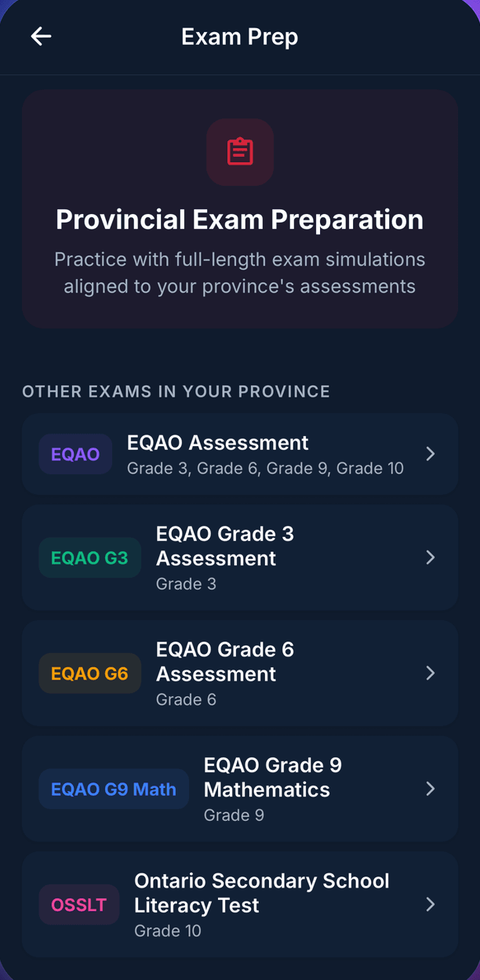
It's free to start — 5 tutoring chats and a practice quiz every day, no credit card. A Pro subscription ($9.99/month or $49.99/year CAD, 7-day free trial) unlocks unlimited tutoring, practice, and exam simulations.
What if I'm stuck on just one topic?
That's the point of skill-level tutoring: open Core French, Grade 9 in the app, tap the exact skill from the list on this page, and the tutor teaches just that — no wading through lessons you don't need.
Does MapleMind work in French or other languages?
Yes — 14 languages, including French. Both the app and the tutor's explanations switch to the language you choose.
Where can I see the official Newfoundland and Labrador curriculum for Core French, Grade 9?
The official source is linked on this page — Newfoundland and Labrador's official curriculum. The outline here follows it: every MapleMind skill carries its official outcome code, and the ministry's own wording is quoted under each unit.
Keep exploring
Ready when you are
Pick a skill from this page and see it taught properly — free, in the browser, in under a minute.