Get help with Core French 2200
Most tutoring makes you sit through material you already know. MapleMind flips that: pick the exact skill that's causing trouble — any of the 38 below — and the tutor teaches just that one, step by step, as many times as it takes. Ask questions in plain words, any time of day, in English, French, or 12 other languages.
The official Newfoundland and Labrador Core French 2200 curriculum
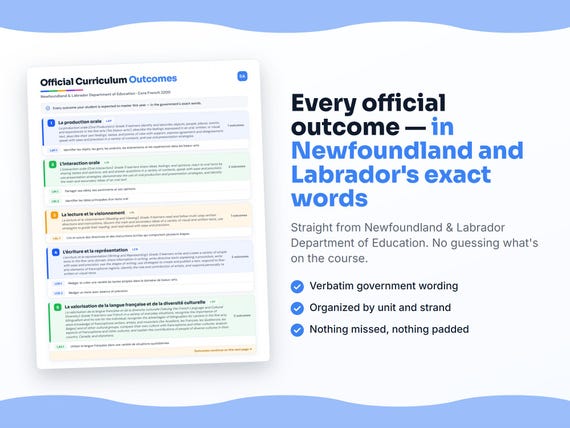
Newfoundland and Labrador defines Core French 2200 by strands and outcomes. MapleMind teaches the same curriculum reorganized for one-skill-at-a-time tutoring — the table shows exactly where every official strand lands, and the ministry's own wording is quoted under each unit below.
Official source Newfoundland and Labrador's official curriculumRead it on the government site — gov.nl.ca ↗| Official strand | Outcomes | Where MapleMind teaches it |
|---|---|---|
| Strand 1 | 7 | La production orale |
| Strand 2 | 8 | L’interaction orale |
| Strand 4 | 5 | La lecture et le visionnement |
| Strand 5 | 9 | L’écriture et la représentation |
| Strand 7 | 9 | La valorisation de la langue française et de la diversité culturelle |
Every skill below, taught one on one.
 Try the first session free
How MapleMind teaches Core French 2200 — every unit, lesson, and skill
Every skill below runs as a short session: a plain-words lesson, a worked example, solving it together, then a five-question skill check that earns up to three stars. Guided Mode keeps it teaching instead of answer-handing — turning it off needs a parent's password.
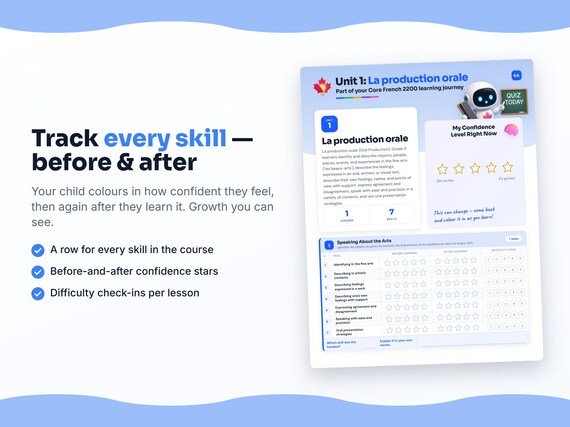
Unit 1La production oraleOfficial strand · Strand 1
La production orale (Oral Production): Grade 11 learners identify and describe objects, people, places, events, and experiences in the fine arts ('les beaux-arts'), describe the feelings expressed in an oral, written, or visual text, describe their own feelings, tastes, and points of view with support, express agreement and disagreement, speak with ease and precision in a variety of contexts, and use oral presentation strategies.
Speaking About the Arts
- Identifying in the fine artsNL.CF2200.1.1 — Identify objects, people, places, events, and experiences in the fine arts ('les beaux-arts') in French.
- Describing in artistic contextsNL.CF2200.1.2 — Describe objects, people, places, events, and experiences in a variety of artistic French contexts.
- Describing feelings expressed in a workNL.CF2200.1.3 — Describe the feelings expressed in an oral, written, or visual French text.
- Describing one's own feelings with supportNL.CF2200.1.4 — Describe one's own feelings, tastes, and points of view with support in French.
- Expressing agreement and disagreementNL.CF2200.1.5 — Express agreement and disagreement in French.
- Speaking with ease and precisionNL.CF2200.1.6 — Speak French with ease and precision in a variety of contexts.
- Oral presentation strategiesNL.CF2200.1.7 — Use oral presentation strategies in French.
The official wording — 7 outcomes in this unit
- NL.CF2200.1.1
Identifier les objets, les gens, les endroits, les événements et les expériences dans les beaux-arts
- NL.CF2200.1.2
Décrire les objets, les gens, les endroits, les événements et les expériences dans une variété de contextes artistiques
- NL.CF2200.1.3
Décrire les sentiments exprimés dans un texte oral, écrit ou visuel
- NL.CF2200.1.4
Décrire ses sentiments, ses goûts, et ses points de vue avec appuie
- NL.CF2200.1.5
Exprimer accord et désaccord
- NL.CF2200.1.6
Parler avec aisance et précision dans une variété de contextes
- NL.CF2200.1.7
Se servir des strategies de présentation orale
Unit 2L’interaction oraleOfficial strand · Strand 2
L'interaction orale (Oral Interaction): Grade 11 learners share ideas, feelings, and opinions, react to oral texts by sharing tastes and opinions, ask and answer questions in a variety of contexts, speak with ease and precision, use presentation strategies, demonstrate the use of oral production and presentation strategies, and identify the main and secondary ideas of an oral text.
Sharing and Reacting
- Sharing ideas, feelings, and opinionsNL.CF2200.2.1 — Share one's ideas, feelings, and opinions in French.
- Reacting to oral textsNL.CF2200.2.2 — React to a variety of oral French texts by sharing one's tastes and opinions.
- Asking and answering questionsNL.CF2200.2.3 — Ask and answer questions in a variety of French contexts.
- Speaking with ease and precision in exchangesNL.CF2200.2.4 — Speak French with ease and precision in a variety of contexts, within interaction.
- Using presentation strategies in interactionNL.CF2200.2.5 — Use oral presentation strategies within French interaction.
- Demonstrating oral production and presentation strategiesNL.CF2200.2.6 — Demonstrate the use of oral production and presentation strategies in French.
Listening for Main and Secondary Ideas
- Identifying main ideas of an oral textNL.CF2200.3.1 — Identify the main ideas of a French oral text.
- Identifying secondary ideas of an oral textNL.CF2200.3.2 — Identify the secondary ideas of a French oral text.
The official wording — 8 outcomes in this unit
- NL.CF2200.2.1
Partager ses idées, ses sentiments et ses opinions
- NL.CF2200.2.2
Réagir à une variété de textes oraux en partageant ses goûts et ses opinions
- NL.CF2200.2.3
Poser et répondre aux questions dans une variété de contextes
- NL.CF2200.2.4
Parler avec aisance et précision dans une variété de contextes
- NL.CF2200.2.5
Se servir des stratégies de présentation orale
- NL.CF2200.2.6
Démontrer l’usage des stratégies de la production/présentation orale
- NL.CF2200.3.1
Identifier les idées principales d’un texte oral
- NL.CF2200.3.2
Identifier les idées secondaires d’un texte oral
Unit 3La lecture et le visionnementOfficial strand · Strand 4
La lecture et le visionnement (Reading and Viewing): Grade 11 learners read and follow multi-step written directions and instructions, discern the main and secondary ideas of a variety of visual and written texts, use strategies to guide their reading, and read aloud with ease and precision.
Reading and Viewing Arts Texts
- Following multi-step written directionsNL.CF2200.4.1 — Read and follow multi-step written directions and instructions in French.
- Discerning main ideas of textsNL.CF2200.4.2 — Discern the main idea or ideas of a variety of visual and written French texts.
- Discerning secondary ideas of textsNL.CF2200.4.3 — Discern the secondary idea or ideas of a variety of visual and written French texts.
- Using reading strategiesNL.CF2200.4.4 — Use strategies to guide one's French reading.
- Reading aloud with ease and precisionNL.CF2200.4.5 — Read aloud in French with ease and precision.
The official wording — 5 outcomes in this unit
- NL.CF2200.4.1
Lire et suivre des directives et des instructions écrites qui comportent plusieurs étapes
- NL.CF2200.4.2
Discerner l’idée ou les idées principales d’une variété de textes visuels et de textes écrits
- NL.CF2200.4.3
Discerner l’idée ou les idées secondaires d’une variété de textes visuels et de textes écrits
- NL.CF2200.4.4
Se servir des stratégies pour orienter sa lecture
- NL.CF2200.4.5
Lire à haute voix avec aisance et précision
Unit 4L’écriture et la représentationOfficial strand · Strand 5
L'ecriture et la representation (Writing and Representing): Grade 11 learners write and create a variety of simple texts in the fine-arts domain, share information in writing, write directive texts explaining a procedure, write with ease and precision, use the stages of writing, use strategies to create and publish a text, respond to fine-arts elements of francophone regions, identify the role and contribution of artists, and respond personally to written or visual texts.
Writing Arts Texts
- Creating texts in the fine-arts domainNL.CF2200.5.1 — Write and create a variety of simple French texts in the fine-arts domain.
- Sharing information in writingNL.CF2200.5.2 — Share information in writing in French.
- Writing a directive textNL.CF2200.5.3 — Write a directive French text explaining a simple procedure or set of steps.
Process, Publishing, and Arts Response
- Writing with ease and precisionNL.CF2200.5.4 — Write a French text with ease and precision.
- Using the stages of writingNL.CF2200.5.5 — Use the stages of the writing process in French.
- Creating and publishing a textNL.CF2200.5.6 — Use strategies to create and publish a French text.
- Responding to francophone fine-arts elementsNL.CF2200.5.7 — Respond to the fine-arts elements of French-speaking regions.
- Identifying the role and contribution of artistsNL.CF2200.5.8 — Identify the role and contribution of artists in French.
- Responding personally to textsNL.CF2200.6.1 — Respond personally to written or visual French texts using various modes of representation.
The official wording — 9 outcomes in this unit
- NL.CF2200.5.1
Rédiger et créer une variété de textes simples dans la domaine de beaux-arts.
- NL.CF2200.5.2
Partager de l’information à l’écrit
- NL.CF2200.5.3
Rédiger un texte directif pour expliquer une procédure simple ou une marche à suivre
- NL.CF2200.5.4
Rédiger un texte avec aisance et précision
- NL.CF2200.5.5
Se servir des étapes d’écriture
- NL.CF2200.5.6
Se servir des stratégies pour créer et publier un texte
- NL.CF2200.5.7
Répondre aux éléments des beaux-arts des régions francophones
- NL.CF2200.5.8
Identifier le rôle et la contribution des artistes
- NL.CF2200.6.1
Réagir à des textes écrits ou visuels d’une façon personnelle au moyen de divers modes de représentation.
Unit 5La valorisation de la langue française et de la diversité culturelleOfficial strand · Strand 7
La valorisation de la langue francaise et de la diversite culturelle (Valuing the French Language and Cultural Diversity): Grade 11 learners use French in a variety of everyday situations, recognize the importance of bilingualism and its role for the individual, recognize the advantages of bilingualism for careers in the fine arts, show knowledge of francophone writers, artists, and musicians (les Acadiens, les Francais, les Quebecois, les Belges) and of other cultural groups, compare their own culture with francophone and other cultures, analyze aspects of francophone and other cultures, and explain the contributions of people of diverse cultures in their country, Canada, and elsewhere.
Valuing French and Bilingualism
- Using French in everyday situationsNL.CF2200.7.1 — Use the French language in a variety of everyday situations.
- Recognizing the importance of bilingualismNL.CF2200.7.2 — Recognize the importance of bilingualism and the role it can play for the individual.
- Bilingualism and careers in the artsNL.CF2200.7.3 — Recognize the advantages of bilingualism for careers in the fine arts.
Knowing and Comparing Francophone Cultures
- Knowing francophone writers, artists, and musiciansNL.CF2200.8.1 — Show knowledge of various writers, artists, and musicians of the world francophonie (for example, Acadians, French, Quebecois, Belgians).
- Knowing artists of other cultural groupsNL.CF2200.8.2 — Show knowledge of writers, artists, musicians, and other cultural groups.
- Comparing one's own and other culturesNL.CF2200.9.1 — Compare one's own culture with those of francophones and other cultural groups.
- Analyzing aspects of francophone cultureNL.CF2200.9.2 — Analyze certain aspects of francophone culture (education, food, festivals and celebrations, traditions and customs, fine arts, music, folk songs).
- Analyzing aspects of other cultural groupsNL.CF2200.9.3 — Analyze certain aspects of other cultural groups (education, food, festivals and celebrations, traditions and customs, fine arts, music, folk songs).
- Explaining contributions of diverse culturesNL.CF2200.9.4 — Recognize and explain the contribution of certain people of diverse cultures in one's country, Canada, and other countries.
The official wording — 9 outcomes in this unit
- NL.CF2200.7.1
Utiliser la langue française dans une variété de situations quotidiennes
- NL.CF2200.7.2
Reconnaître l’importance du bilinguisme et le rôle qu’il peut jouer comme individu bilingue
- NL.CF2200.7.3
Reconnaître les avantages du bilinguisme pour les carrières dans les beaux arts
- NL.CF2200.8.1
Démontrer une connaissance des divers écrivains, artistes, musiciens de la francophonie mondiale (par exemple, les Acadiens, les Français, les Québécois, les Belges)
- NL.CF2200.8.2
Démontrer une connaissance des écrivains, des artistes, des musciens et des autres groupes culturels
- NL.CF2200.9.1
Comparer sa culture et celles des francophones et d’autres groupes culturels
- NL.CF2200.9.2
Analyser certains aspects de la culture francophone (l’éducation, la nourriture, les fêtes et les célébrations, les traditions et les coutumes, les beaux-arts, la musique, les chansons folkloriques)
- NL.CF2200.9.3
Analyser certains aspects des autres groupes culturels (l’éducation, la nourriture, les fêtes et les célébrations, les traditions et les coutumes, les beaux-arts, la musique, les chansons folkloriques)
- NL.CF2200.9.4
Reconnaître et expliquer la contribution de certaines personnes de diverses cultures dans son pays, le Canada et d’autres pays
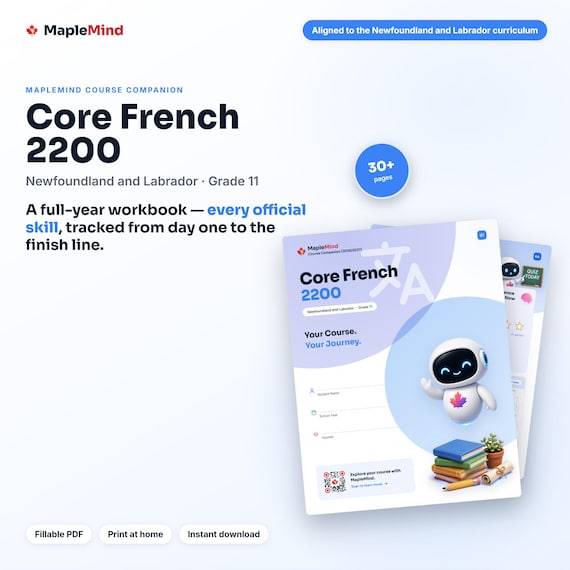
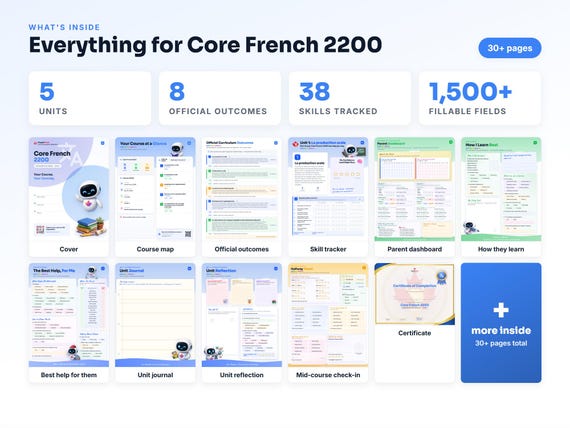
Printable workbook · A keepsake of the year
A Core French 2200 workbook worth keeping
Built from the same official curriculum as this page. Before and after each skill above, your student colours in how sure they feel — so the two of you can see, on one page, what's clicking and what needs another look. It's a quiet way to follow how the year is really going.
By June it's full of their own handwriting: units worked through, confidence grown, a mid-year check-in, notes from parent-teacher night, and a certificate at the end. Less a worksheet, more a record of the year worth keeping on the shelf.
Instant download · see every page, reviews and the full description · five or more workbooks are $2.99 each
What it looks like in the app



Common questions
Can MapleMind help me with Core French 2200?
Yes. MapleMind's AI tutor covers all 38 skills in Newfoundland and Labrador's Core French 2200 — you pick the exact skill, and the tutor teaches it step by step: a short lesson, a worked example, solving together, then a skill check to show it stuck.
Is MapleMind aligned to Newfoundland and Labrador's official curriculum?
Yes. Every skill in this course maps to an official outcome code from Newfoundland and Labrador's Grade 11 French curriculum, and the ministry's own wording is quoted under each unit on this page — with the official government source linked so you can check it yourself.
What does MapleMind cost?
It's free to start — 5 tutoring chats and a practice quiz every day, no credit card. A Pro subscription ($9.99/month or $49.99/year CAD, 7-day free trial) unlocks unlimited tutoring, practice, and exam simulations.
What if I'm stuck on just one topic?
That's the point of skill-level tutoring: open Core French 2200 in the app, tap the exact skill from the list on this page, and the tutor teaches just that — no wading through lessons you don't need.
Does MapleMind work in French or other languages?
Yes — 14 languages, including French. Both the app and the tutor's explanations switch to the language you choose.
Where can I see the official Newfoundland and Labrador curriculum for Core French 2200?
The official source is linked on this page — Newfoundland and Labrador's official curriculum. The outline here follows it: every MapleMind skill carries its official outcome code, and the ministry's own wording is quoted under each unit.
Keep exploring
Ready when you are
Pick a skill from this page and see it taught properly — free, in the browser, in under a minute.