Get help with Core French 10
Most tutoring makes you sit through material you already know. MapleMind flips that: pick the exact skill that's causing trouble — any of the 22 below — and the tutor teaches just that one, step by step, as many times as it takes. Ask questions in plain words, any time of day, in English, French, or 12 other languages.
The official British Columbia Core French 10 curriculum
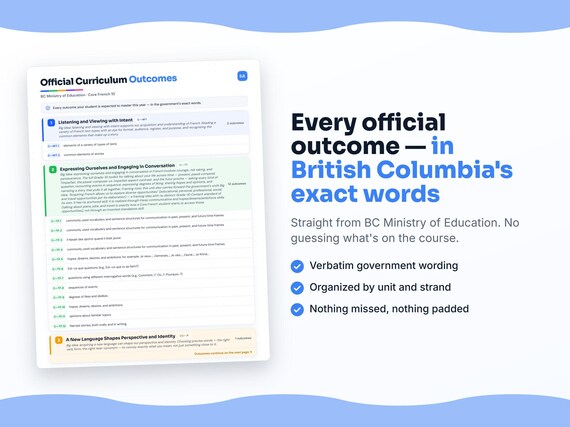
British Columbia defines Core French 10 by strands and outcomes. MapleMind teaches the same curriculum reorganized for one-skill-at-a-time tutoring — the table shows exactly where every official strand lands, and the ministry's own wording is quoted under each unit below.
Official source BC's official curriculumRead it on the government site — curriculum.gov.bc.ca ↗| Official strand | Outcomes | Where MapleMind teaches it |
|---|---|---|
| Content — Working with texts | 2 | Listening and Viewing with Intent |
| Content — Time frames, Asking questions, Communicative functions | 12 | Expressing Ourselves and Engaging in Conversation |
| Curricular Competency — Precision in French | 1 | A New Language Shapes Perspective and Identity |
| Content — Idiomatic French, Francophone cultures | 4 | Cultural Expression Takes Many Forms |
| Content — Francophone cultures; Curricular Competency — Language, culture, and First Peoples | 3 | Interacting with the Francophone World |
Every skill below, taught one on one.
 Try the first session free
How MapleMind teaches Core French 10 — every unit, lesson, and skill
Every skill below runs as a short session: a plain-words lesson, a worked example, solving it together, then a five-question skill check that earns up to three stars. Guided Mode keeps it teaching instead of answer-handing — turning it off needs a parent's password.
Unit 1Listening and Viewing with IntentOfficial strand · Content — Working with texts
Big Idea: listening and viewing with intent supports our acquisition and understanding of French. Reading a variety of French text types with an eye for format, audience, register, and purpose, and recognizing the common elements that make up a story.
Reading a Variety of Text Types
- Reading a variety of text types: format, audience, register, purpose10.TEXT.1 — Recognize the elements that shape a variety of French text types — format, language, context, audience, register, and purpose — to read unfamiliar texts like letters, emails, and articles with real understanding.
Common Elements of Stories
- Common elements of stories: place, characters, plot, problem and resolution10.STORY.1 — Identify the common elements of a story told or written in French — place, characters, plot, and a problem and its resolution — to follow and later retell a story.
The official wording — 2 outcomes in this unit
- 10.TEXT.1
elements of a variety of types of texts
- 10.STORY.1
common elements of stories
Unit 2Expressing Ourselves and Engaging in ConversationOfficial strand · Content — Time frames, Asking questions, Communicative functions
Big Idea: expressing ourselves and engaging in conversation in French involves courage, risk taking, and perseverance. The full Grade-10 toolkit for talking about your life across time — present, passé composé, l'imparfait, the passé-composé-vs-imparfait aspect contrast, and the futur proche — asking every kind of question, recounting events in sequence, expressing degrees of liking, sharing hopes and opinions, and narrating a story that pulls it all together. Framing note: this unit also carries forward the government's sixth Big Idea, "Acquiring French allows us to explore diverse opportunities" (educational, personal, professional, social, and travel opportunities per its elaboration) — a framing idea with no distinct Grade-10 Content standard of its own. It has no anchored skill; it is realized through these communicative and hopes/dreams/ambitions skills (talking about plans, jobs, and travel is exactly how a Core French student starts to access those opportunities), not through an invented standalone skill.
The Present Tense as a System
- The present tense as a system: describing what happens now10.TENSE.1 — Use the present tense as a connected system — regular and common irregular verbs, everyday routines and facts — to describe what happens now with confidence and accuracy.
The Passé Composé
- The passé composé: narrating completed past events10.TENSE.2 — Build and use the passé composé (avoir/être + past participle) to narrate a completed past event — something that happened and finished, like J'ai étudié pour mon test hier soir.
L'imparfait
- L'imparfait: describing ongoing and habitual past states10.TENSE.3 — Build and use l'imparfait to describe an ongoing state, a habit, or a repeated action in the past — a background condition rather than a single completed event, like Il faisait des sports quand il était jeune.
Passé Composé vs Imparfait: Choosing the Right Past Tense
- Passé composé vs imparfait: choosing the right past tense (aspect)10.TENSE.4 — Choose correctly between the passé composé and l'imparfait by judging ASPECT — was the action a single completed event, or an ongoing/habitual background state — rather than guessing from an English translation.
The Futur Proche
- The futur proche: talking about the near future and plans10.TENSE.5 — Use the futur proche and related future expressions — Je veux…; J'aimerais…; Je vais…; J'aurai…; Je finirai… — to talk about hopes, dreams, desires, and near-future plans.
Asking Yes/No Questions
- Asking yes/no questions: intonation and Est-ce que10.QUES.1 — Ask yes/no questions in French two ways — rising intonation and Est-ce que — and choose between them depending on how formal or casual the moment is.
Asking Questions with Inversion and Interrogative Words
- Asking questions with inversion and interrogative words10.QUES.2 — Ask questions using inversion and a full range of interrogative words — Comment…?; Où…?; Pourquoi…? — to get specific information from someone, not just a yes or no.
Recounting Sequences of Events
- Recounting sequences of events with connectors (tout d'abord, ensuite, enfin)10.FUNC.1 — Recount a sequence of events in order using connector words — tout d'abord, ensuite, enfin — so a listener can follow what happened first, next, and last.
Expressing Degrees of Liking
- Expressing degrees of liking (J'aime bien... / Je n'aime pas du tout...)10.FUNC.2 — Express a whole range of liking and disliking — not just like/dislike, but degrees like J'aime bien... and Je n'aime pas du tout... — to give a more honest, nuanced reaction.
Hopes, Dreams, Desires, and Ambitions
- Talking about hopes, dreams, desires, and ambitions10.FUNC.3 — Talk about your own hopes, dreams, desires, and ambitions in French — what you want to become, where you want to travel, what you want to achieve.
Giving Opinions About Familiar Topics
- Giving opinions about familiar topics10.FUNC.4 — Give and support an opinion about a familiar topic in French, using an opener like je pense que or à mon avis plus a reason.
Narrating a Story Across Time Frames
- Narrating a story across past, present, and future time frames10.NARR.1 — Narrate a story, both orally and in writing, moving accurately across past, present, and future time frames — pulling together the whole Grade-10 tense toolkit into one connected narrative.
The official wording — 12 outcomes in this unit
- 10.TENSE.1
commonly used vocabulary and sentence structures for communication in past, present, and future time frames
- 10.TENSE.2
commonly used vocabulary and sentence structures for communication in past, present, and future time frames
- 10.TENSE.3
Il faisait des sports quand il était jeune
- 10.TENSE.4
commonly used vocabulary and sentence structures for communication in past, present, and future time frames
- 10.TENSE.5
hopes, dreams, desires, and ambitions: for example, Je veux…; J'aimerais…; Je vais…; J'aurai…; Je finirai…
- 10.QUES.1
Est-ce que questions (e.g., Est-ce que tu as faim?)
- 10.QUES.2
questions using different interrogative words (e.g., Comment…?; Où…?; Pourquoi…?)
- 10.FUNC.1
sequences of events
- 10.FUNC.2
degrees of likes and dislikes
- 10.FUNC.3
hopes, dreams, desires, and ambitions
- 10.FUNC.4
opinions about familiar topics
- 10.NARR.1
Narrate stories, both orally and in writing
Unit 3A New Language Shapes Perspective and IdentityOfficial strand · Curricular Competency — Precision in French
Big Idea: acquiring a new language can shape our perspective and identity. Choosing precise words — the right verb form, the right near-synonym — to convey exactly what you mean, not just something close to it.
Word Choice: Verb-Form Nuance and Near-Synonyms
- Word choice: verb-form nuance and near-synonyms (sortir vs partir)10.WORD.1 — Make precise word choices to convey meaning — telling apart close verb-form nuances like J'avais peur versus J'ai eu peur, and near-synonyms like sortir versus partir — instead of picking the first word that comes to mind.
The official wording — 1 outcome in this unit
- 10.WORD.1
nuances of different verb forms (e.g., J'avais peur versus J'ai eu peur)
Unit 4Cultural Expression Takes Many FormsOfficial strand · Content — Idiomatic French, Francophone cultures
Big Idea: cultural expression can take many different forms. Colourful idiomatic French — expressions with avoir, faire, and être, regional slang, and figurative sayings — plus the ethics of using someone else's cultural material with care and proper attribution.
Idioms with Avoir, Faire, and Être
- Idioms with avoir, faire, and être10.IDIOM.1 — Recognize and use common French idioms built on avoir, faire, and être — avoir besoin de, faire beau, être d'accord — as fixed expressions, not literal translations.
Slang Expressions (l'Argot) Across la Francophonie
- Slang expressions (l'argot) across la francophonie10.IDIOM.2 — Recognize slang expressions from l'argot — like jaser for bavarder — and understand that they belong to informal, spoken French across the Francophone world.
Figurative Idiomatic Expressions
- Figurative idiomatic expressions and their meanings10.IDIOM.3 — Recognize figurative idiomatic expressions — coûter les yeux de la tête, c'est dommage, un coup de foudre — and explain what they actually mean versus what they say literally.
Ethics of Cultural Appropriation and Plagiarism
- Ethics of cultural appropriation and plagiarism (attribution and citation)10.ETHIC.1 — Explain the ethics of cultural appropriation and plagiarism — using someone else's cultural material, story, or work without permission, context, or credit — and why attribution and citation matter when engaging with Francophone culture.
The official wording — 4 outcomes in this unit
- 10.IDIOM.1
expressions using avoir, faire, être (e.g., avoir besoin de, faire beau, être d'accord)
- 10.IDIOM.2
expressions from l'argot (e.g., jaser for bavarder)
- 10.IDIOM.3
other expressions (e.g., coûter les yeux de la tête, c'est dommage, un coup de foudre)
- 10.ETHIC.1
ethics of cultural appropriation and plagiarism
Unit 5Interacting with the Francophone WorldOfficial strand · Content — Francophone cultures; Curricular Competency — Language, culture, and First Peoples
Big Idea: acquiring French allows us to interact with the Francophone world. The lives and contributions of Francophone Canadians, and the deep historical interactions between First Peoples and Francophone communities in Canada — including the Michif language and Chinook Jargon.
Lives and Contributions of Francophone Canadians
- Lives and contributions of Francophone Canadians10.CULT.1 — Describe the lives of Francophone Canadians — including First Nations, Métis, and Inuit people, immigrants to Canada, and Canadians of diverse backgrounds — and their contributions to society.
Exploring the Lives and Contributions of Francophone Canadians
- Exploring the lives and contributions of Francophone Canadians10.FCAN.1 — Explore, through French-language sources and activities, the lives and contributions of Francophone Canadians across the country — connecting the language you are learning to real people and communities.
First Peoples and French: Michif and Chinook Jargon
- First Peoples and French: Michif and Chinook Jargon10.FPFR.1 — Recognize that language and culture in Canada have been shaped by interactions between First Peoples and Francophone communities — including the Michif language (First Nations and French vocabulary and structures, expressing a distinctive Métis culture) and Chinook Jargon (used for trading along the West Coast).
The official wording — 3 outcomes in this unit
- 10.CULT.1
lives of Francophone Canadians and their contributions
- 10.FCAN.1
Explore the lives and contributions of Francophone Canadians
- 10.FPFR.1
the Michif language, which includes First Nations and French vocabulary and structures and expresses a distinctive Métis culture
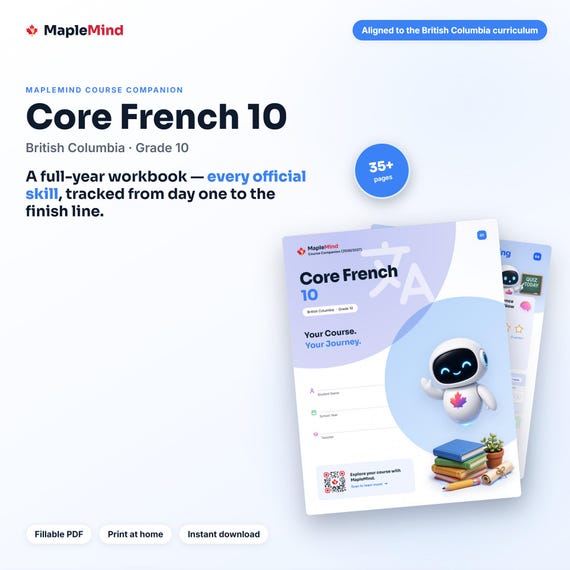
Printable workbook · A keepsake of the year
A Core French 10 workbook worth keeping
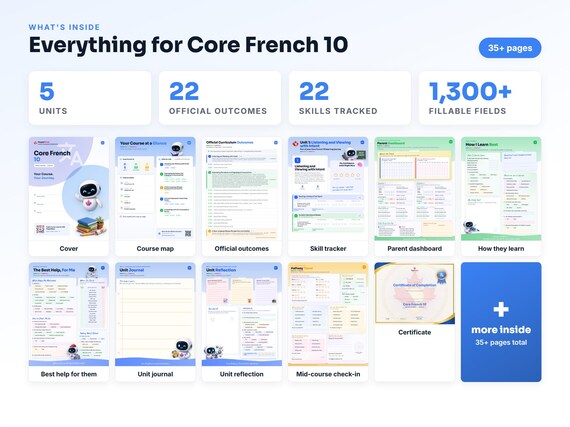
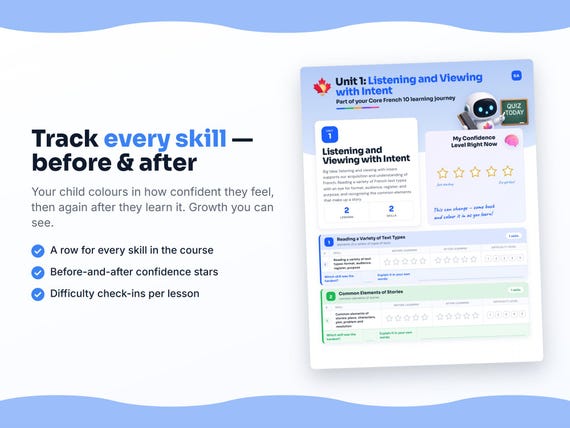
Built from the same official curriculum as this page. Before and after each skill above, your student colours in how sure they feel — so the two of you can see, on one page, what's clicking and what needs another look. It's a quiet way to follow how the year is really going.
By June it's full of their own handwriting: units worked through, confidence grown, a mid-year check-in, notes from parent-teacher night, and a certificate at the end. Less a worksheet, more a record of the year worth keeping on the shelf.
Instant download · see every page, reviews and the full description · five or more workbooks are $2.99 each
What it looks like in the app



Common questions
Can MapleMind help me with Core French 10?
Yes. MapleMind's AI tutor covers all 22 skills in British Columbia's Core French 10 — you pick the exact skill, and the tutor teaches it step by step: a short lesson, a worked example, solving together, then a skill check to show it stuck.
Is MapleMind aligned to British Columbia's official curriculum?
Yes. Every skill in this course maps to an official outcome code from British Columbia's Grade 10 French curriculum, and the ministry's own wording is quoted under each unit on this page — with the official government source linked so you can check it yourself.
What does MapleMind cost?
It's free to start — 5 tutoring chats and a practice quiz every day, no credit card. A Pro subscription ($9.99/month or $49.99/year CAD, 7-day free trial) unlocks unlimited tutoring, practice, and exam simulations.
What if I'm stuck on just one topic?
That's the point of skill-level tutoring: open Core French 10 in the app, tap the exact skill from the list on this page, and the tutor teaches just that — no wading through lessons you don't need.
Does MapleMind work in French or other languages?
Yes — 14 languages, including French. Both the app and the tutor's explanations switch to the language you choose.
Where can I see the official British Columbia curriculum for Core French 10?
The official source is linked on this page — BC's official curriculum. The outline here follows it: every MapleMind skill carries its official outcome code, and the ministry's own wording is quoted under each unit.
Keep exploring
Ready when you are
Pick a skill from this page and see it taught properly — free, in the browser, in under a minute.