Get help with English Language Arts 4
Most tutoring makes your child sit through material your child already knows. MapleMind flips that: pick the exact skill that's causing trouble — any of the 23 below — and the tutor teaches just that one, step by step, as many times as it takes. Ask questions in plain words, any time of day, in English, French, or 12 other languages.
The official Alberta English Language Arts 4 curriculum
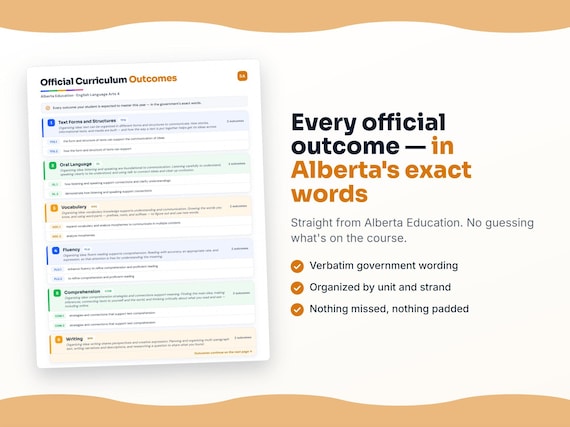
Alberta defines English Language Arts 4 by strands and outcomes. MapleMind teaches the same curriculum reorganized for one-skill-at-a-time tutoring — the table shows exactly where every official strand lands, and the ministry's own wording is quoted under each unit below.
Official source Alberta's official programs of studyRead it on the government site — alberta.ca ↗| Official strand | Outcomes | Where MapleMind teaches it |
|---|---|---|
| Text Forms and Structures | 1 | Text Forms and Structures |
| Oral Language | 1 | Oral Language |
| Vocabulary | 1 | Vocabulary |
| Fluency | 1 | Fluency |
| Comprehension | 1 | Comprehension |
| Writing | 1 | Writing |
| Conventions | 1 | Conventions |
Every skill below, taught one on one.
 Try the first session free
How MapleMind teaches English Language Arts 4 — every unit, lesson, and skill
Every skill below runs as a short session: a plain-words lesson, a worked example, solving it together, then a five-question skill check that earns up to three stars. Guided Mode keeps it teaching instead of answer-handing — turning it off needs a parent's password.
Unit 1Text Forms and StructuresOfficial strand · Text Forms and Structures
Organizing idea: text can be organized in different forms and structures to communicate. How stories, informational texts, and media are built — and how the way a text is put together helps get its ideas across.
How Texts Are Built
- The shape of a story4.TF.1 — Recognize how a narrative is organized — beginning, middle, and end; problem and solution; setting, characters, and events — and how that structure helps the story make sense.
- Features of informational texts4.TF.1 — Identify how informational texts use features like headings, captions, diagrams, and paragraphs to organize and present ideas and information clearly.
Choosing the Right Form
- Matching form to purpose4.TF.1 — Explain how the form of a text (a letter, a poem, a report, a comic, a set of instructions) is chosen to fit its purpose and support the message.
The official wording — 1 outcome in this unit
- 4.TF.1
the form and structure of texts can support the communication of ideas
Unit 2Oral LanguageOfficial strand · Oral Language
Organizing idea: listening and speaking are foundational to communication. Listening carefully to understand, speaking clearly to be understood, and using talk to connect ideas and clear up confusion.
Listening to Understand
- Active listening4.OL.1 — Listen closely to a speaker — giving attention, asking questions, and restating in your own words — so that understandings become clear.
Speaking to Connect
- Speaking clearly and on topic4.OL.1 — Speak clearly, at a good pace and volume, staying on topic so that a listener can follow and connect to what you mean.
- Using talk to connect ideas4.OL.1 — Build on what others say — agreeing, adding, or asking a follow-up question — to make connections and clarify understandings in a conversation.
The official wording — 1 outcome in this unit
- 4.OL.1
how listening and speaking support connections and clarify understandings
Unit 3VocabularyOfficial strand · Vocabulary
Organizing idea: vocabulary knowledge supports understanding and communication. Growing the words you know, and using word parts — prefixes, roots, and suffixes — to figure out and use new words.
Building Word Power
- New words in different subjects4.V.1 — Expand vocabulary by collecting and using new words met in reading, in different subjects, and in everyday life across multiple contexts.
Word Parts as Clues
- Prefixes, roots, and suffixes4.V.1 — Analyze morphemes — prefixes, roots, and suffixes — to work out the meaning of an unfamiliar word (un-, re-, -ful, -less).
- Using new words to communicate4.V.1 — Use newly learned words accurately when speaking and writing, choosing words that fit the context to communicate ideas precisely.
The official wording — 1 outcome in this unit
- 4.V.1
expand vocabulary and analyze morphemes to communicate in multiple contexts
Unit 4FluencyOfficial strand · Fluency
Organizing idea: fluent reading supports comprehension. Reading with accuracy, an appropriate rate, and expression, so that attention is free for understanding the meaning.
Reading with Flow
- Smooth, expressive reading4.F.1 — Read aloud with accuracy, a smooth rate, and expression — using punctuation and phrasing so the reading sounds like natural talking.
When Fluency Helps You Understand
- Fluency that sharpens understanding4.F.1 — Notice how reading smoothly frees your mind to think about the meaning, and reread a tricky part to refine comprehension.
The official wording — 1 outcome in this unit
- 4.F.1
enhance fluency to refine comprehension and proficient reading
Unit 5ComprehensionOfficial strand · Comprehension
Organizing idea: comprehension strategies and connections support meaning. Finding the main idea, making inferences, connecting texts to yourself and the world, and thinking critically about what you read and see — including online.
Making Meaning from Texts
- Main idea and summarizing4.C.1 — Find the main idea of a text and summarize it by picking out the important points — not by retelling every single detail.
- Reading between the lines4.C.1 — Make an inference by combining clues in the text with what you already know, to understand something the author did not state outright.
Connections and Thinking Critically
- Connecting texts to your world4.C.1 — Make text-to-self, text-to-text, and text-to-world connections to deepen understanding and remember what you read.
- Is everything online true?4.C.1 — Begin to think critically about media and online texts — asking who made it and why, and checking whether a claim is backed up.
The official wording — 1 outcome in this unit
- 4.C.1
strategies and connections that support text comprehension
Unit 6WritingOfficial strand · Writing
Organizing idea: writing shares perspectives and creative expression. Planning and organizing multi-paragraph text, writing narratives and descriptions, and researching a question to share what you found.
Organizing a Piece of Writing
- Planning multi-paragraph writing4.W.1 — Plan and organize writing into paragraphs — a beginning that hooks, a middle grouped by idea, and an ending — so ideas flow in order.
- Researching a question4.W.1 — Ask a research question, gather information from a couple of sources, and organize the findings into your own words to share what you learned.
Narrative and Descriptive Writing
- Writing a story4.W.1 — Write a narrative with a clear beginning, middle, and end, a problem to solve, and details that bring the characters and setting to life.
- Painting a picture with words4.W.1 — Write a description that uses sensory details and strong word choices so the reader can picture what you are describing — developing creative expression.
The official wording — 1 outcome in this unit
- 4.W.1
construct and organize text to share perspectives
Unit 7ConventionsOfficial strand · Conventions
Organizing idea: conventions support effective written communication. Grammar and parts of speech, sentence variety, and the spelling and punctuation that make writing clear for a reader.
Grammar and Sentence Variety
- Nouns, verbs, adjectives, and adverbs4.CV.1 — Identify and use nouns, verbs, adjectives, and adverbs correctly, understanding the job each part of speech does in a sentence.
- Complete sentences and sentence variety4.CV.1 — Write complete sentences (not fragments or run-ons) and vary sentence length and openings to make writing more interesting.
Spelling and Punctuation
- Punctuation that guides the reader4.CV.1 — Use end punctuation, commas in a series, and apostrophes for contractions and possessives so a reader can follow the writing easily.
- Spelling strategies4.CV.1 — Apply spelling patterns and word-part knowledge to spell familiar and new words, and check spelling when editing written work.
The official wording — 1 outcome in this unit
- 4.CV.1
apply conventions to develop effective written communication
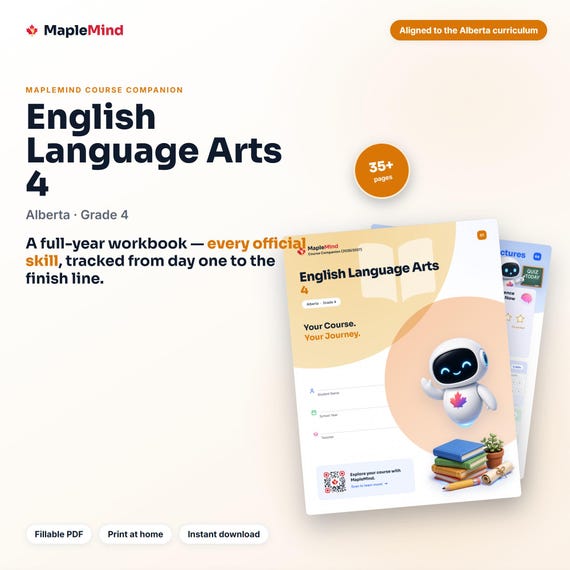
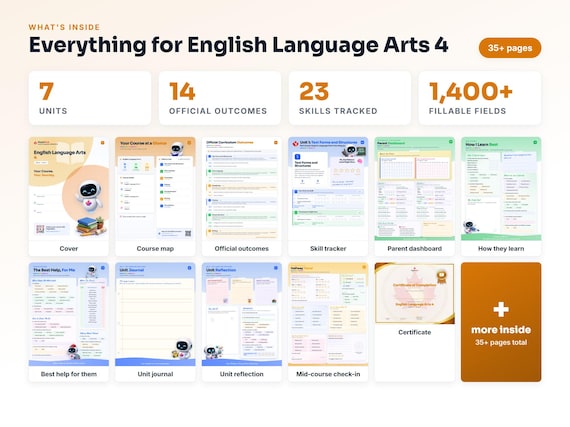
Printable workbook · A keepsake of the year
A English Language Arts 4 workbook worth keeping
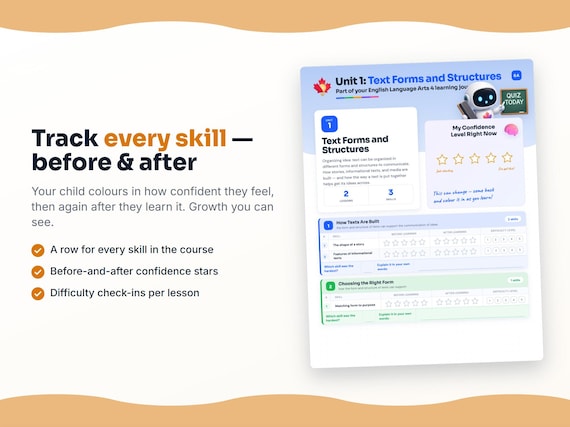
Built from the same official curriculum as this page. Before and after each skill above, your student colours in how sure they feel — so the two of you can see, on one page, what's clicking and what needs another look. It's a quiet way to follow how the year is really going.
By June it's full of their own handwriting: units worked through, confidence grown, a mid-year check-in, notes from parent-teacher night, and a certificate at the end. Less a worksheet, more a record of the year worth keeping on the shelf.
Instant download · see every page, reviews and the full description · five or more workbooks are $2.99 each
What it looks like in the app



Common questions
Can MapleMind help my child with English Language Arts 4?
Yes. MapleMind's AI tutor covers all 23 skills in Alberta's English Language Arts 4 — your child picks the exact skill, and the tutor teaches it step by step: a short lesson, a worked example, solving together, then a skill check to show it stuck.
Is MapleMind aligned to Alberta's official curriculum?
Yes. Every skill in this course maps to an official outcome code from Alberta's Grade 4 English Language Arts curriculum, and the ministry's own wording is quoted under each unit on this page — with the official government source linked so you can check it yourself.
What does MapleMind cost?
It's free to start — 5 tutoring chats and a practice quiz every day, no credit card. A Pro subscription ($9.99/month or $49.99/year CAD, 7-day free trial) unlocks unlimited tutoring, practice, and exam simulations.
What if my child is stuck on just one topic?
That's the point of skill-level tutoring: open English Language Arts 4 in the app, tap the exact skill from the list on this page, and the tutor teaches just that — no wading through lessons your child doesn't need.
Does MapleMind work in French or other languages?
Yes — 14 languages, including French. Both the app and the tutor's explanations switch to the language your child chooses.
Where can I see the official Alberta curriculum for English Language Arts 4?
The official source is linked on this page — Alberta's official programs of study. The outline here follows it: every MapleMind skill carries its official outcome code, and the ministry's own wording is quoted under each unit.
Keep exploring
Ready when you are
Pick a skill from this page and see it taught properly — free, in the browser, in under a minute.