Get help with English Language Arts 3
Most tutoring makes your child sit through material your child already knows. MapleMind flips that: pick the exact skill that's causing trouble — any of the 34 below — and the tutor teaches just that one, step by step, as many times as it takes. Ask questions in plain words, any time of day, in English, French, or 12 other languages.
The official Alberta English Language Arts 3 curriculum
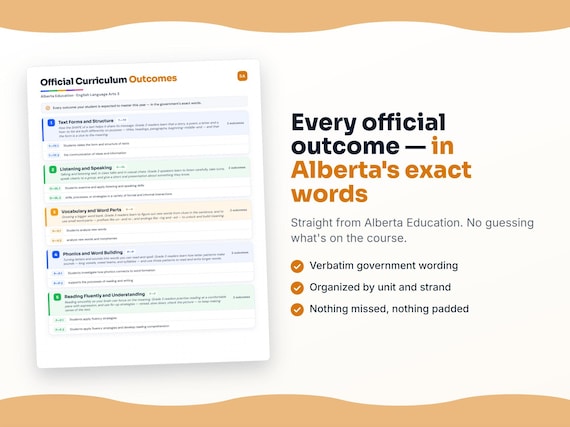
Alberta defines English Language Arts 3 by strands and outcomes. MapleMind teaches the same curriculum reorganized for one-skill-at-a-time tutoring — the table shows exactly where every official strand lands, and the ministry's own wording is quoted under each unit below.
Official source Alberta's official programs of studyRead it on the government site — alberta.ca ↗| Official strand | Outcomes | Where MapleMind teaches it |
|---|---|---|
| TF — Text Forms and Structure | 1 | Text Forms and Structure |
| OL — Oral Language | 1 | Listening and Speaking |
| V — Vocabulary | 1 | Vocabulary and Word Parts |
| PH — Phonics | 1 | Phonics and Word Building |
| F — Fluency | 1 | Reading Fluently and Understanding |
| C — Comprehension | 1 | Understanding and Connecting to Texts |
| W — Writing | 1 | Writing and Research |
| CV — Conventions | 1 | Grammar and Punctuation |
Every skill below, taught one on one.
 Try the first session free
How MapleMind teaches English Language Arts 3 — every unit, lesson, and skill
Every skill below runs as a short session: a plain-words lesson, a worked example, solving it together, then a five-question skill check that earns up to three stars. Guided Mode keeps it teaching instead of answer-handing — turning it off needs a parent's password.
Unit 1Text Forms and StructureOfficial strand · TF — Text Forms and Structure
How the SHAPE of a text helps it share its message. Grade 3 readers learn that a story, a poem, a letter and a how-to list are built differently on purpose — titles, headings, paragraphs, beginning-middle-end — and that the form is a clue to the meaning.
Different Kinds of Texts
- Recognizing text forms3.TF.1 — Recognize common text forms — story, poem, letter, list, how-to — and tell what each one is usually for.
- How the form fits the message3.TF.1 — Explain how a text is built to fit its job — a how-to uses numbered steps, a story flows in order, a poem uses short lines.
Parts That Organize a Text
- Titles and headings as signposts3.TF.1 — Use titles, headings and pictures to find your way around a text and predict what a part will be about.
- Beginning, middle and end3.TF.1 — Notice how a text is put in order — a story has a beginning, middle and end; instructions go step by step from first to last.
The official wording — 1 outcome in this unit
- 3.TF.1
Students relate the form and structure of texts
Unit 2Listening and SpeakingOfficial strand · OL — Oral Language
Talking and listening well, in class talks and in casual chats. Grade 3 speakers learn to listen carefully, take turns, speak clearly to a group, and give a short oral presentation about something they know.
Listening and Taking Turns
- Listening to understand3.OL.1 — Listen carefully to a speaker, look at them, and show you understood by asking a question or saying it back.
- Taking turns in a conversation3.OL.1 — Take turns in a group talk — wait for a pause, build on what someone said, and stay on the topic.
Speaking to a Group
- Speaking clearly and loudly enough3.OL.1 — Speak in a clear voice, loud enough for everyone to hear, and match how you talk to whether it is a class talk or a friendly chat.
- Giving a short presentation3.OL.1 — Plan and give a short talk about a topic you know, with an opening, a few facts in order, and a closing.
The official wording — 1 outcome in this unit
- 3.OL.1
Students examine and apply listening and speaking skills
Unit 3Vocabulary and Word PartsOfficial strand · V — Vocabulary
Growing a bigger word bank. Grade 3 readers learn to figure out new words from clues in the sentence, and to use small word parts — prefixes like un- and re-, and endings like -ing and -ed — to unlock and build meaning.
Figuring Out New Words
- Using clues in the sentence3.V.1 — Work out what a new word means from the other words around it and from the pictures.
- Collecting and using new words3.V.1 — Collect interesting new words you meet in reading and use them when you talk and write.
Word Parts: Prefixes and Endings
- Prefixes change the meaning3.V.1 — Use common prefixes to unlock meaning — un- means "not" (unhappy), re- means "again" (redo).
- Endings that change a word3.V.1 — Use common endings — -ing, -ed, -s, -ful — to figure out or build a word (jump → jumping, jumped).
The official wording — 1 outcome in this unit
- 3.V.1
Students analyze new words
Unit 4Phonics and Word BuildingOfficial strand · PH — Phonics
Turning letters and sounds into words you can read and spell. Grade 3 readers learn how letter patterns make sounds — long vowels, vowel teams, and syllables — and use those patterns to read and write longer words.
Letter Patterns and Sounds
- Vowel teams and long-vowel patterns3.PH.1 — Read and spell words with vowel teams and long-vowel patterns — ea in "beach", ai in "rain", the silent-e in "cake".
- Breaking words into syllables3.PH.1 — Break a longer word into syllables (beats) to help you read and spell it — "rab-bit", "sun-shine".
Using Phonics to Read and Write
- Sounding out longer words3.PH.1 — Sound out an unknown word part by part, blending the sounds together to read the whole word.
- Spelling with sound patterns3.PH.1 — Use the letter-sound patterns you know to spell new words, listening for each sound in order.
The official wording — 1 outcome in this unit
- 3.PH.1
Students investigate how phonics connects to word formation
Unit 5Reading Fluently and UnderstandingOfficial strand · F — Fluency
Reading smoothly so your brain can focus on the meaning. Grade 3 readers practise reading at a comfortable pace with expression, and use fix-up strategies — reread, slow down, check the picture — to keep making sense of the text.
Reading Smoothly and With Expression
- Pace, phrasing and expression3.F.1 — Read aloud smoothly at a comfortable speed, in phrases (not word-by-word), and change your voice for punctuation and feelings.
- Why smooth reading helps understanding3.F.1 — Understand that reading smoothly frees your brain to think about the meaning instead of every single word.
Fix-Up Strategies for Reading
- Noticing when meaning breaks — and rereading3.F.1 — Notice when a sentence stops making sense and fix it — reread it, slow down, or check the picture.
- Retelling to check understanding3.F.1 — Stop and retell what just happened in your own words to make sure you understood before reading on.
The official wording — 1 outcome in this unit
- 3.F.1
Students apply fluency strategies
Unit 6Understanding and Connecting to TextsOfficial strand · C — Comprehension
Thinking deeply about what you read and linking it to your own life. Grade 3 readers learn to find the main idea and details, ask and answer questions, and make text-to-self connections that help a story or article mean more.
Main Idea and Details
- Finding the main idea3.C.1 — Find what a text is mostly about — the main idea — which can be anywhere in the text, not just the first sentence.
- Details that support the main idea3.C.1 — Pick out the details that tell more about the main idea and explain how they fit together.
Making Connections and Responding
- Connecting a text to your own life3.C.1 — Connect what you read to your own experiences — "this reminds me of…" — to understand it better.
- Asking and answering questions about a text3.C.1 — Ask and answer who, what, where, when and why questions, pointing back to the words in the text as proof.
The official wording — 1 outcome in this unit
- 3.C.1
Students analyze text
Unit 7Writing and ResearchOfficial strand · W — Writing
Planning, drafting and sharing your own writing — including finding out about a topic. Grade 3 writers learn to build a paragraph around a topic sentence, follow the steps of writing (plan, draft, revise), and do a simple research project to answer a question.
Writing a Strong Paragraph
- Writing a topic sentence3.W.1 — Start a paragraph with a topic sentence that tells the reader what the whole paragraph is about.
- Keeping a paragraph on one idea3.W.1 — Build a paragraph as sentences that all belong together about one idea — not just a bunch of random sentences.
The Steps of Writing
- Planning then drafting3.W.1 — Plan your ideas first (a list or web), then write a draft — getting ideas down matters more than being perfect.
- Revising to make writing better3.W.1 — Reread your draft and improve it — add a missing detail, take out a repeat, choose a clearer word. (Longer is not the same as better.)
Finding Out About a Topic
- Asking a question to research3.W.1 — Pick a topic and ask a clear question you want to find the answer to.
- Gathering facts and sharing them3.W.1 — Find a few facts from a book or trusted source, put them in your own words, and share what you learned.
The official wording — 1 outcome in this unit
- 3.W.1
Students investigate writing
Unit 8Grammar and PunctuationOfficial strand · CV — Conventions
The rules that make writing easy for a reader to understand. Grade 3 writers learn to use complete sentences, capital letters and end punctuation correctly, and to edit their own work so it is clear.
Sentences, Capitals and End Marks
- Writing complete sentences3.CV.1 — Write complete sentences that tell a whole thought, with a naming part and a doing part.
- Capitals and end punctuation3.CV.1 — Start every sentence with a capital letter, capitalize names, and end with a period, question mark or exclamation mark.
Editing Your Writing
- Commas in a list3.CV.1 — Use commas to separate items in a list (apples, pears and plums) so the reader can tell them apart.
- Editing for capitals and periods3.CV.1 — Reread and fix your own writing — check every sentence for a capital at the start and an end mark.
The official wording — 1 outcome in this unit
- 3.CV.1
Students investigate and demonstrate how conventions
Printable workbook · A keepsake of the year
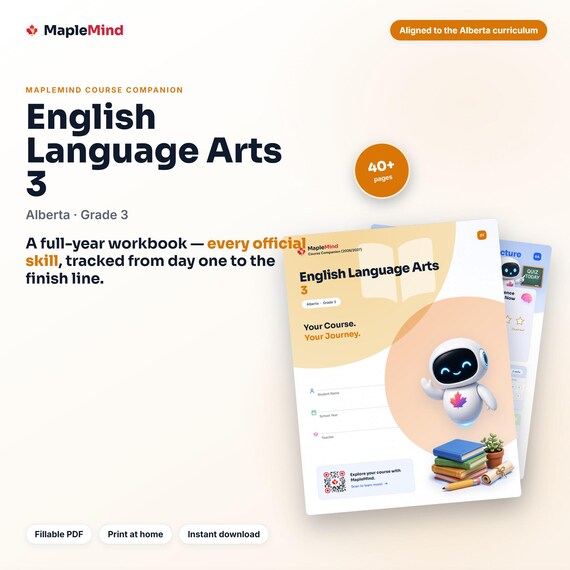
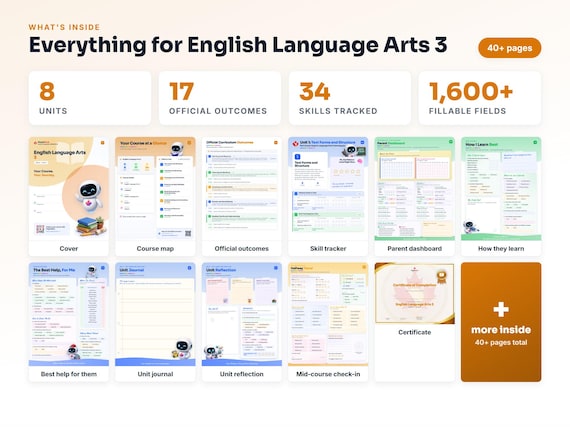
A English Language Arts 3 workbook worth keeping
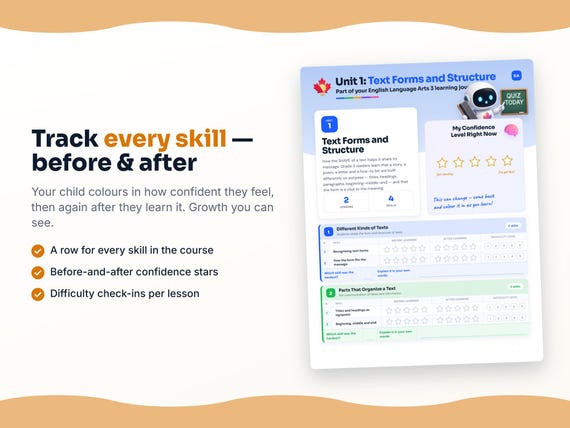
Built from the same official curriculum as this page. Before and after each skill above, your student colours in how sure they feel — so the two of you can see, on one page, what's clicking and what needs another look. It's a quiet way to follow how the year is really going.
By June it's full of their own handwriting: units worked through, confidence grown, a mid-year check-in, notes from parent-teacher night, and a certificate at the end. Less a worksheet, more a record of the year worth keeping on the shelf.
Instant download · see every page, reviews and the full description · five or more workbooks are $2.99 each
What it looks like in the app



Common questions
Can MapleMind help my child with English Language Arts 3?
Yes. MapleMind's AI tutor covers all 34 skills in Alberta's English Language Arts 3 — your child picks the exact skill, and the tutor teaches it step by step: a short lesson, a worked example, solving together, then a skill check to show it stuck.
Is MapleMind aligned to Alberta's official curriculum?
Yes. Every skill in this course maps to an official outcome code from Alberta's Grade 3 English Language Arts curriculum, and the ministry's own wording is quoted under each unit on this page — with the official government source linked so you can check it yourself.
What does MapleMind cost?
It's free to start — 5 tutoring chats and a practice quiz every day, no credit card. A Pro subscription ($9.99/month or $49.99/year CAD, 7-day free trial) unlocks unlimited tutoring, practice, and exam simulations.
What if my child is stuck on just one topic?
That's the point of skill-level tutoring: open English Language Arts 3 in the app, tap the exact skill from the list on this page, and the tutor teaches just that — no wading through lessons your child doesn't need.
Does MapleMind work in French or other languages?
Yes — 14 languages, including French. Both the app and the tutor's explanations switch to the language your child chooses.
Where can I see the official Alberta curriculum for English Language Arts 3?
The official source is linked on this page — Alberta's official programs of study. The outline here follows it: every MapleMind skill carries its official outcome code, and the ministry's own wording is quoted under each unit.
Keep exploring
Ready when you are
Pick a skill from this page and see it taught properly — free, in the browser, in under a minute.