Provincial assessment · Prince Edward Island
School-based Assessment in Grade 3 Mathematics
- Grade 3
Dates and details can change. We do our best to keep this page up to date, but check the official sources before relying on it.
- Total time
- 2 h 30 min
- Marked questions
- 30
- Parts
- 2
- Calculator
- Not allowed
- Format
- On paper
PEI Grade 3 Math Assessment practice test
The whole exam or the parts you choose, in its own format, on the clock.
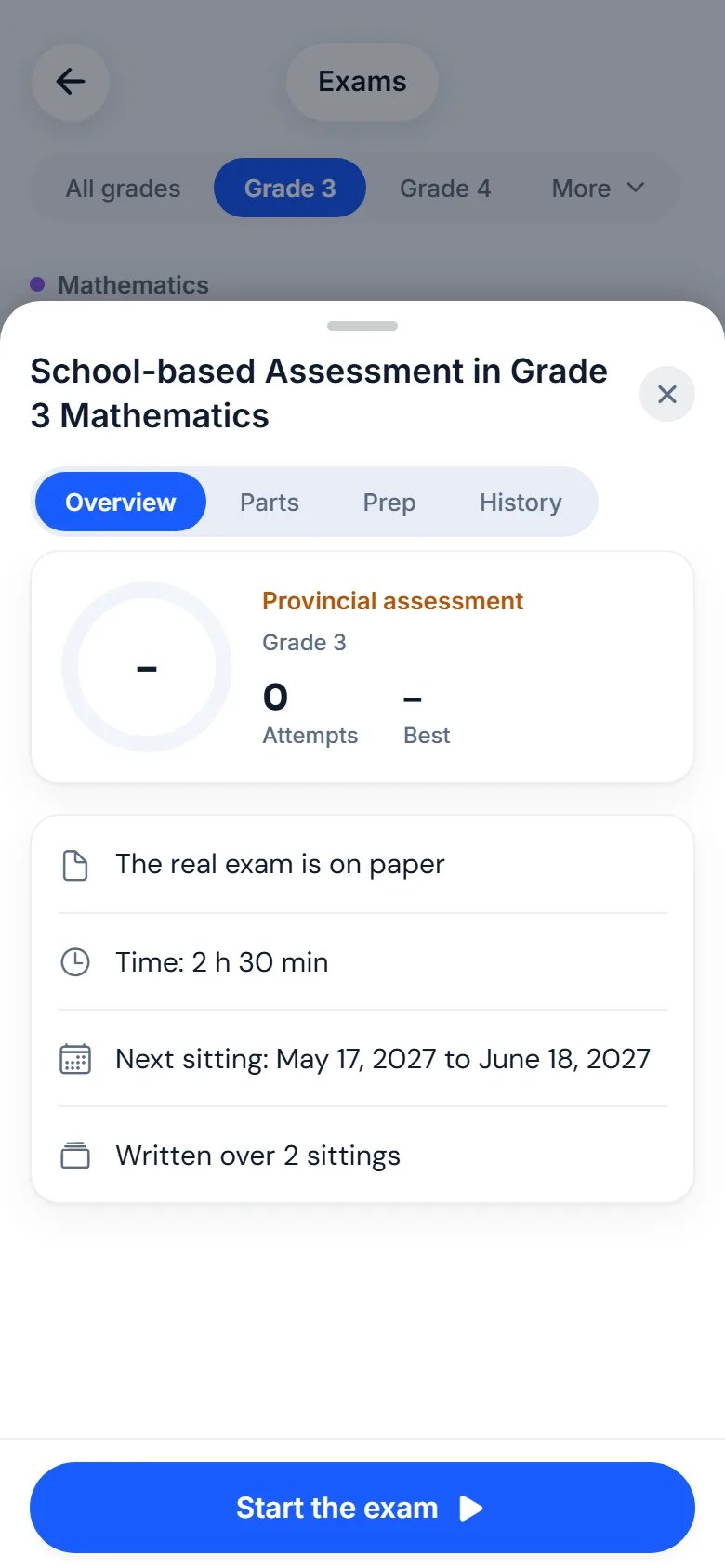 The exam in the app
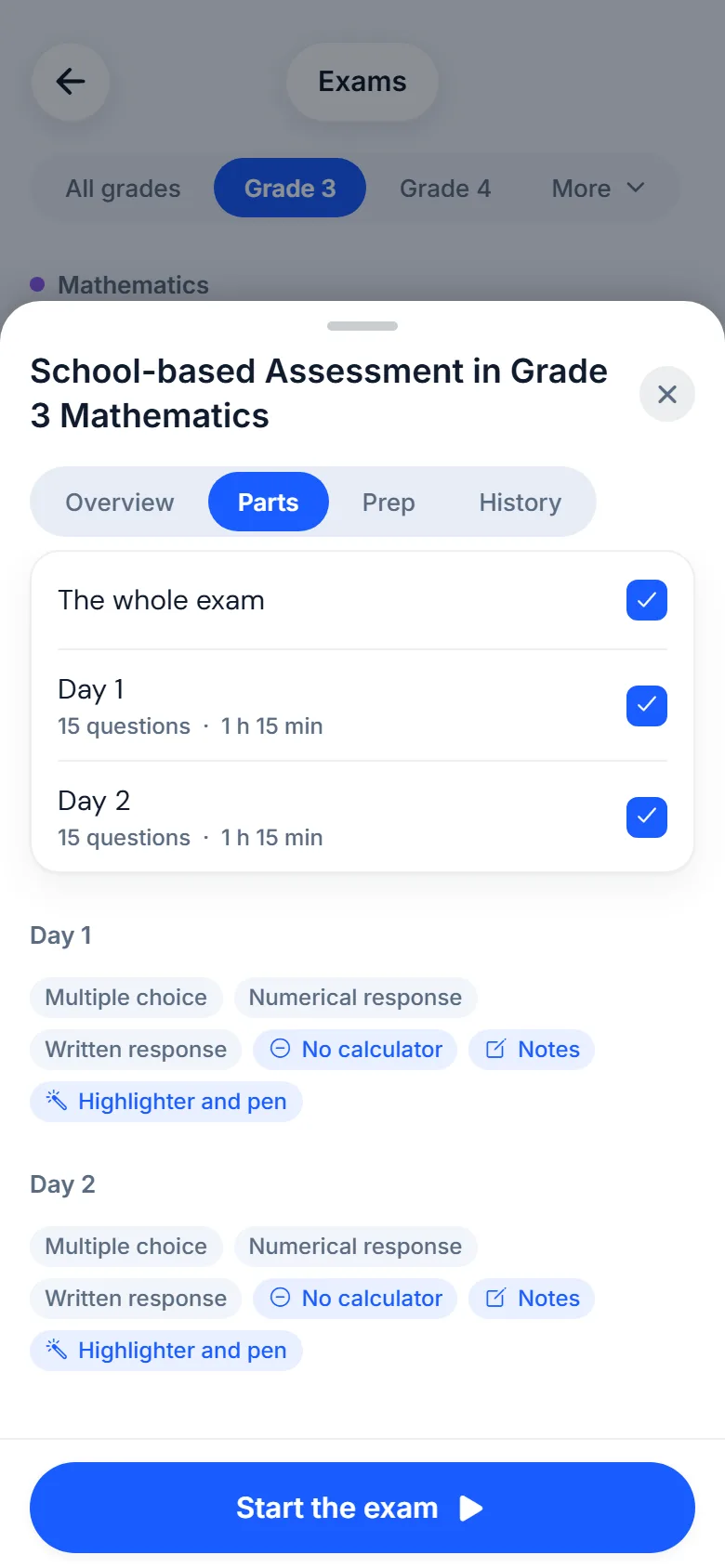 Its parts, and what you can use in each
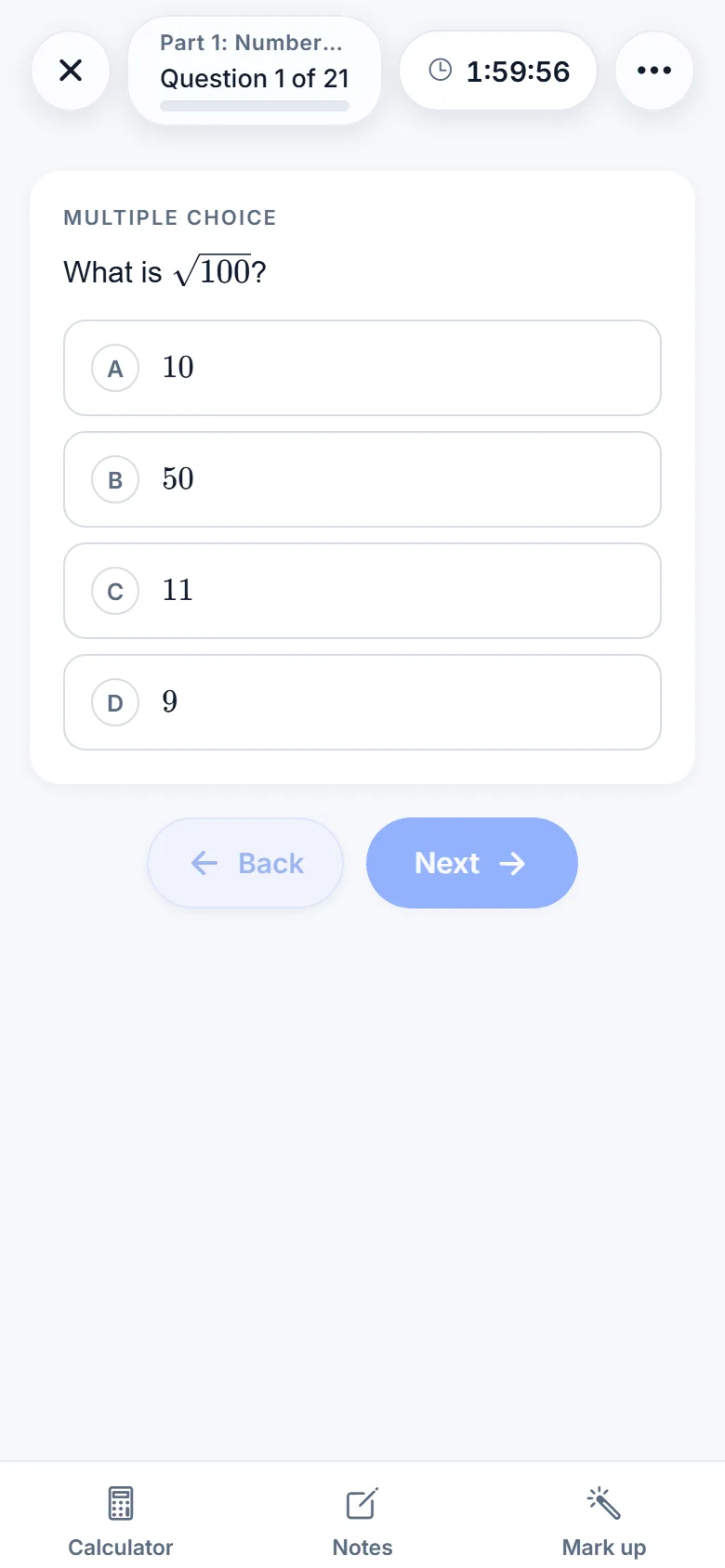 A question, timed, with the exam’s tools
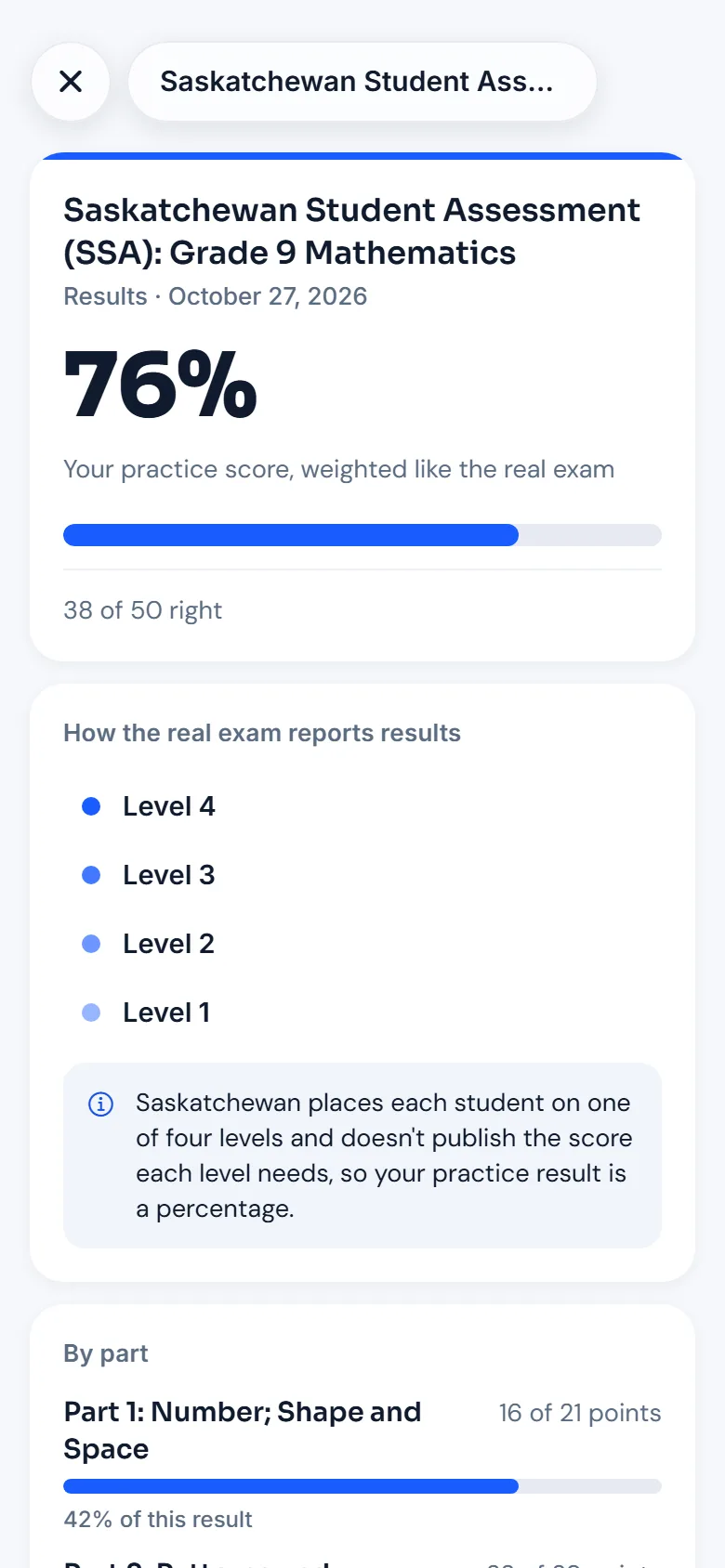 The marked result, part by part
A practice run of Saskatchewan’s Grade 9 math assessment.
Free with a MapleMind account
When
May to June 2027 (the date isn't published; inferred from the spring 2024 sittings and the old May and June design)
- May 17 to June 18, 2027School day · Grade 3 Mathematics school-based assessment, two classroom sessions (the school sets the days)
The dates are Prince Edward Island’s own, read on September 29, 2026. See the official schedule (princeedwardisland.ca)
What’s on it
- Number
- Patterns and relations
- Shape and space
- Statistics and probability
Each topic’s share of the marks isn’t published.
The skills it tests · 34 skills
- A fraction is part of a whole
- Adding numbers to 1000
- Collecting and organizing first-hand data
- Comparing and ordering to 1000
- Comparing fractions with the same bottom number
- Describing and comparing decreasing patterns
- Division as sharing and grouping
- Doubles and making 10
- Estimating length with referents
- Estimating sums and differences
- Extending and creating decreasing patterns
- How centimetres and metres relate
- Hundreds, tens, and ones
- Measuring and recording length
- Measuring mass in grams and kilograms
- Mental math for adding two 2-digit numbers
- Mental math for subtracting two 2-digit numbers
- Multiplication as equal groups
- Perimeter of shapes
- Referents for centimetres and metres
- Relating division to multiplication
- Seconds, minutes, hours, and days
- Showing numbers to 1000
- Skip-counting by 25s
- Skip-counting by 3s and 4s
- Skip-counting by 5s, 10s, and 100s
- Solving multiplication problems
- Solving one-step equations with a symbol
- Sorting polygons by sides
- Subtracting numbers to 1000
- The commutative and zero properties
- Thinking addition for subtraction
- Time for everyday activities
- Where fractions are used
How it’s built
Multiple-choice questions, numerical-response questions and written answers.
- Day 1
- Time
- 75 min
- Questions
- 15
- Marks
- 15
- Of the marks
- 50%
- Multiple choice
- Numerical response
- Written answers
Multiple choice, fill in the blank, and questions where you draw or write a short answer, on number, patterns, shape and space, and data. Use words, pictures and numbers to help you. No calculator.
- Day 2
- Time
- 75 min
- Questions
- 15
- Marks
- 15
- Of the marks
- 50%
- Multiple choice
- Numerical response
- Written answers
The same kinds of questions as Day 1. No calculator.
How it’s marked
Your own teacher marks it and records your result, after training to mark the same way across the province. No pass mark is published.
On the day
- Day 1The first half of the questions, about 75 minutes, without a break.
- Day 2The second half, about 75 minutes. You can't change Day 1's answers.
Two classroom sessions on two days, each without a break. Math posters and charts are covered, but you may use base ten blocks and 2D and 3D shapes. There's no calculator. Once Day 1 is done, you can't change its answers on Day 2.
Getting ready
1 official document to practise with, and 5 tips.
Official practice
Tips from the people who write it
- Read each question carefully; you may need to read it more than once.
- Try every question, even if you're not sure how to do it.
- Look carefully at pictures, graphs and charts: they give you information. You can draw your own pictures to help.
- For multiple choice, read all the answers before you choose, and erase completely to change one.
- For fill-in-the-blank, work it out in the space, then put your answer in the blank.
More for you
Students
Read what’s on it, then write full practice exams under the real time limit.
Practise itParents
Put the dates on the family calendar. The Parent Dashboard shows each practice exam’s result and the skills that need another look.
See the Parent DashboardEducators
The official practice above makes a review plan. Students can practise each skill on its own in MapleMind, free with daily limits.
For schools
Questions about this exam
When is the School-based Assessment in Grade 3 Mathematics in 2026–27?
The next sitting is May 17 to June 18, 2027.
How long is the School-based Assessment in Grade 3 Mathematics?
It takes 2 hours 30 minutes in all, over 2 parts.
How many questions are on the School-based Assessment in Grade 3 Mathematics?
It has 30 marked questions: 15 in Day 1 and 15 in Day 2.
Can you use a calculator on the School-based Assessment in Grade 3 Mathematics?
No. Calculators aren’t allowed.
Where can I find practice tests for the School-based Assessment in Grade 3 Mathematics?
Prince Edward Island publishes Primary Math Assessment Sampler (the old Grade 3 assessment's sample questions; Internet Archive copy). MapleMind also builds a full practice exam in its format, free with an account.

Practise for the School-based Assessment in Grade 3 Mathematics
Every skill on the School-based Assessment in Grade 3 Mathematics, taught one at a time, then practised on questions written like the real ones.