Provincial assessment · Nova Scotia
Nova Scotia Exam: English 10
Nova Scotia Examination: English 10
- Grade 10
- ENG10
Dates and details can change. We do our best to keep this page up to date, but check the official sources before relying on it.
- Total time
- 2 h
- Marked questions
- 36
- Parts
- 5
- Counts for
- 20% of the final mark
- Calculator
- Not allowed
- Format
- On paper
Nova Scotia English 10 Exam practice test
The whole exam or the parts you choose, in its own format, on the clock.
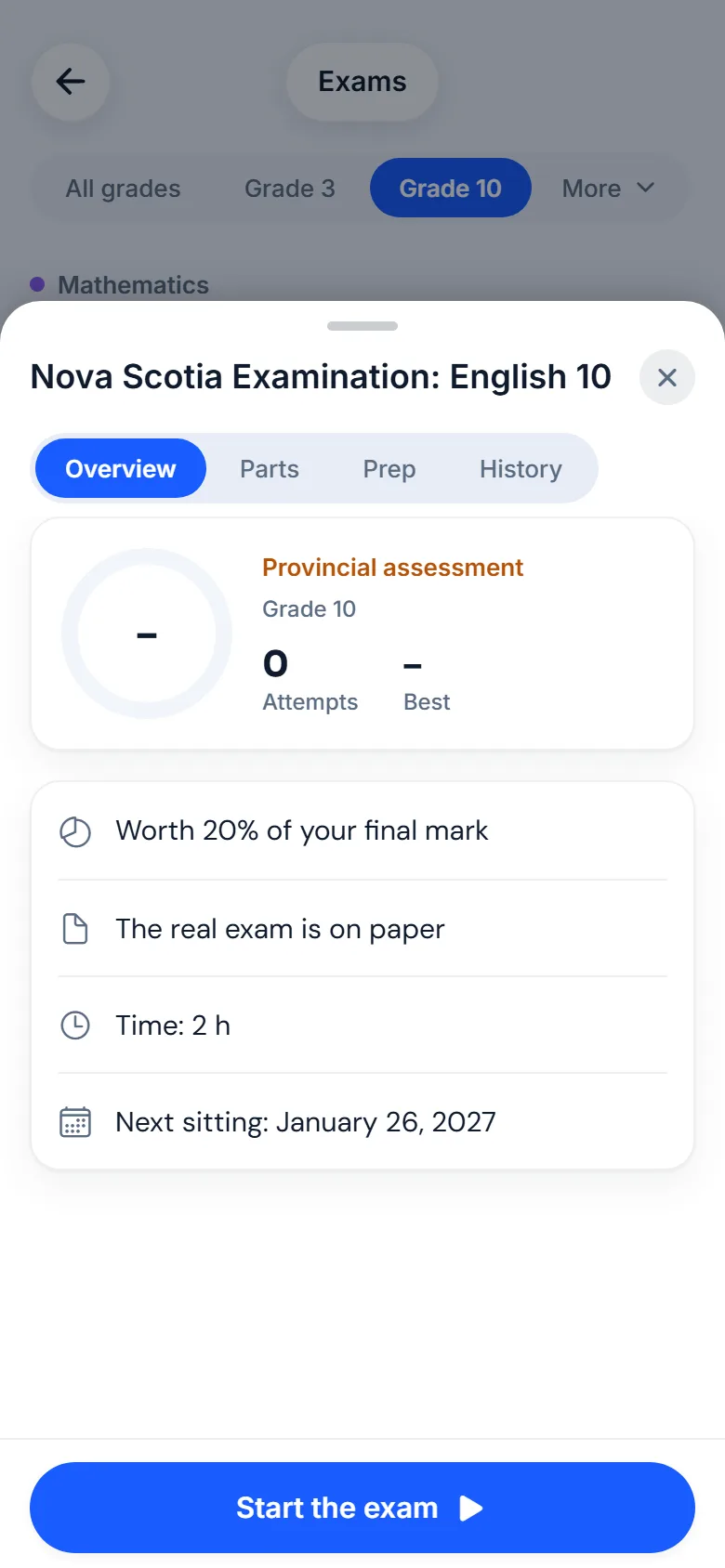 The exam in the app
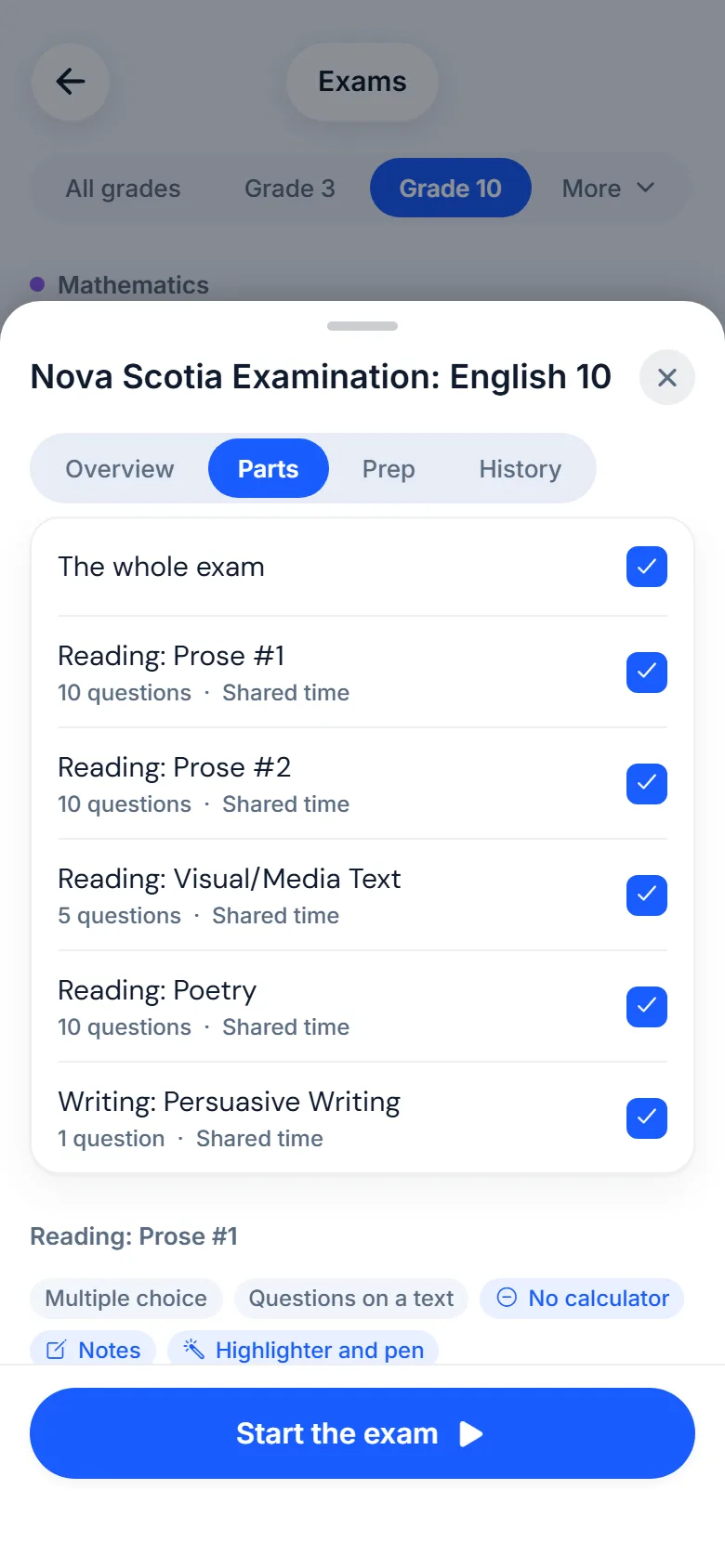 Its parts, and what you can use in each
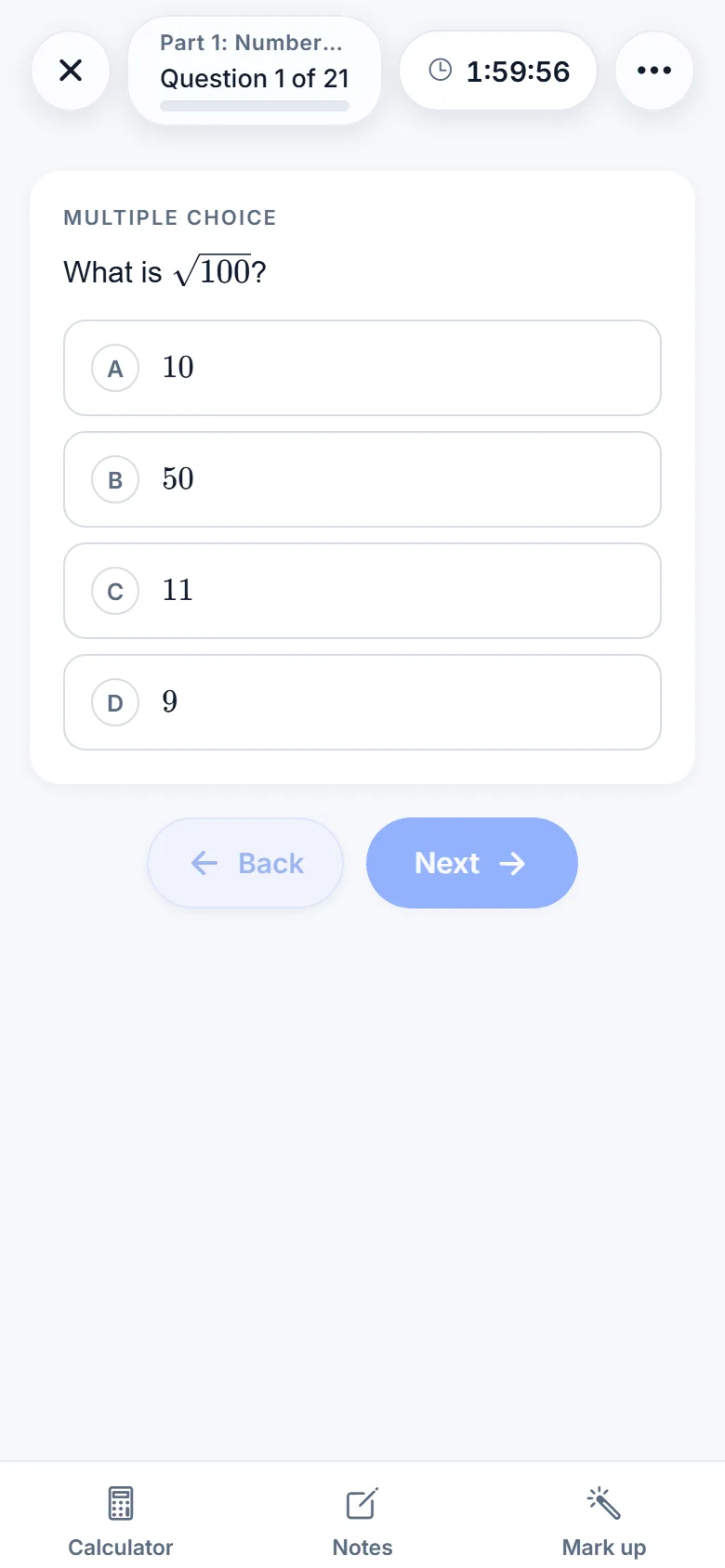 A question, timed, with the exam’s tools
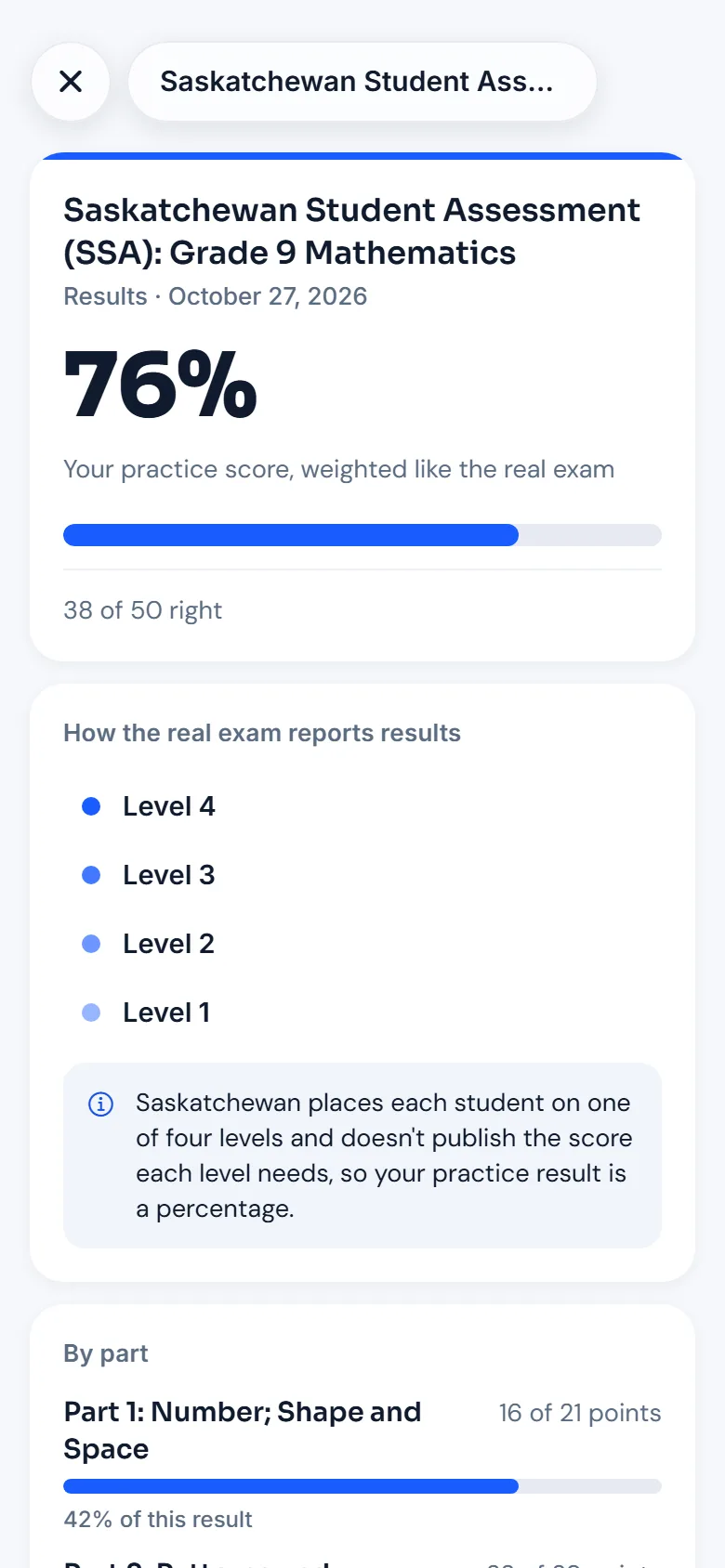 The marked result, part by part
A practice run of Saskatchewan’s Grade 9 math assessment.
Free with a MapleMind account
When
2 sessions this school year: Semester 1 and Semester 2.
Semester 1
- Tuesday, January 26, 2027One two-hour session (+15 minutes if needed)
Semester 2
- Tuesday, June 22, 2027One two-hour session (+15 minutes if needed)
The dates are Nova Scotia’s own, read on September 28, 2026. See the official schedule (plans.ednet.ns.ca)
What’s on it
4 topics. Persuasive essay counts most, at 41%.
Reading
- Prose34%Short story, information text, essay, real-life narrative
- Poetry17%
- Visual/
media text 8%
Writing
- Persuasive essay41%
The skills it tests · 18 skills
- Articulating and supporting a personal response
- Awareness that texts reveal and produce ideologies
- Choosing language for imaginative effect
- Creating an organizing structure for a text
- Evaluating how cultures and groups are portrayed in media
- Examining aspects of texts that contribute to meaning
- Exploring relationships among language, genre, purpose, and audience
- Integrating information to meet a task
- Making inferences and supported responses
- Making thematic connections across texts and media
- Questioning, connecting, evaluating, and extending
- Seeking meaning with reading strategies
- Selecting and evaluating information for a task
- Selecting form and style and engaging the reader
- Understanding the impact of literary devices and media techniques
- Using conventions of written language consistently
- Viewing a wide variety of media and visual texts
- Writing to extend ideas and reflect on learning
How it’s built
Multiple-choice questions, questions in sets and an essay.
- Reading: Prose #1
- Questions
- 10
- Marks
- 10
- Of the marks
- 16.95%
- Multiple choice
- Questions in sets
Read a prose text, such as a short story, an article or an essay, and answer 10 multiple-choice questions.
- Reading: Prose #2
- Questions
- 10
- Marks
- 10
- Of the marks
- 16.95%
- Multiple choice
- Questions in sets
A second prose text, with 10 more multiple-choice questions.
- Reading: Visual/Media Text
- Questions
- 5
- Marks
- 5
- Of the marks
- 8.47%
- Multiple choice
- Questions in sets
Read a visual or media text, such as an ad, a map or a brochure, and answer 5 multiple-choice questions.
- Reading: Poetry
- Questions
- 10
- Marks
- 10
- Of the marks
- 16.95%
- Multiple choice
- Questions in sets
Read a poem and answer 10 multiple-choice questions.
- Writing: Persuasive Writing
- Question
- 1
- Marks
- 24
- Of the marks
- 40.68%
- Essay
Write a persuasive essay on the given topic: take a position, back it with relevant details, and give it a beginning, middle and end. Plan on the planning page first.
How it’s marked
Your English 10 teacher marks it with the department's marking guide. It's out of 59 points and counts for 20% of your final course mark.
On the day
One paper exam. You may use a print dictionary and thesaurus, but no personal devices. There's no scrap paper: all your work goes in the booklet. Anyone who needs it may take up to 15 more minutes.
Getting ready
3 official documents to practise with, and 4 tips.
Official practice
Tips from the people who write it
- Read all the choices before you pick the best answer.
- You may use a dictionary or thesaurus at any time.
- For the essay, have a clear main idea, back it with vivid, relevant details, and give it a beginning, middle and end with varied transitions.
- There's no reading-response writing task in 2026-27, even though the sample questions still have one.
The mark you need
Your class mark counts for 80% of the final mark, the exam for 20%.
You need
50% on the exam
With 75% in class, your final mark lands between 60% (0 on the exam) and 80% (100% on it).
After the exam
- Results
Your teacher marks the exam, and the result goes in the PowerTeacher Gradebook, where parents can see it.
From Program of Learning Assessment for Nova Scotia (PLANS): Grade 10 examinations (plans.ednet.ns.ca), read on October 27, 2026.
More for you
Students
Start with the topics worth the most marks, then write full practice exams under the real time limit.
Practise itParents
Put the dates on the family calendar. The Parent Dashboard shows each practice exam’s result and the skills that need another look.
See the Parent DashboardEducators
The topic weights and the official practice above make a review plan. Students can practise each skill on its own in MapleMind, free with daily limits.
For schools
Questions about this exam
When is the Nova Scotia Exam: English 10 in 2026–27?
The next sitting is January 26, 2027, One two-hour session (+15 minutes if needed). This school year it’s written in Semester 1 and Semester 2.
How long is the Nova Scotia Exam: English 10?
It takes 2 hours in all, over 5 parts.
How many questions are on the Nova Scotia Exam: English 10?
It has 36 marked questions: 10 in Reading: Prose #1, 10 in Reading: Prose #2, 5 in Reading: Visual/Media Text, 10 in Reading: Poetry and 1 in Writing: Persuasive Writing.
Can you use a calculator on the Nova Scotia Exam: English 10?
No. Calculators aren’t allowed.
How much does the Nova Scotia Exam: English 10 count?
It’s worth 20% of the final mark in English 10.
Where can I find practice tests for the Nova Scotia Exam: English 10?
Nova Scotia publishes English 10 Sample Questions (09-2026), with answer key and rubrics. MapleMind also builds a full practice exam in its format, free with an account.

Practise for the Nova Scotia Exam: English 10
Every skill on the Nova Scotia Exam: English 10, taught one at a time, then practised on questions written like the real ones.


