Provincial assessment · Nova Scotia
Nova Scotia Assessment: Literacy and Mathematics/Mathématiques in Grade 3
Nova Scotia Assessment: Literacy and Mathematics/Mathématiques in Grade 3 (LM3-EN / M3-IM)
- Grade 3
Dates and details can change. We do our best to keep this page up to date, but check the official sources before relying on it.
- Total time
- 5 h 10 min
- Marked questions
- 122
- Parts
- 3
- Calculator
- Not allowed
- Format
- On paper
Nova Scotia Grade 3 Assessment practice test
The whole exam or the parts you choose, in its own format, on the clock.
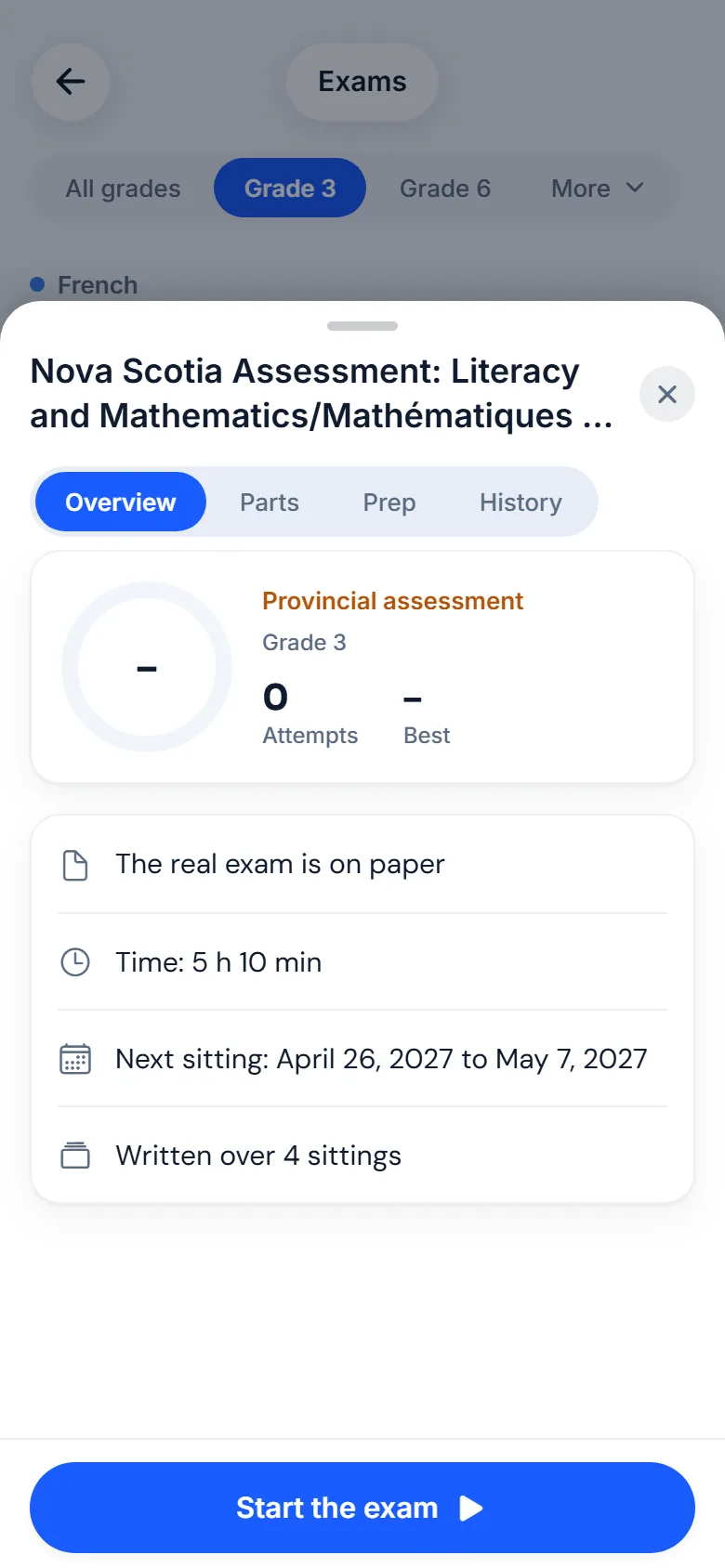 The exam in the app
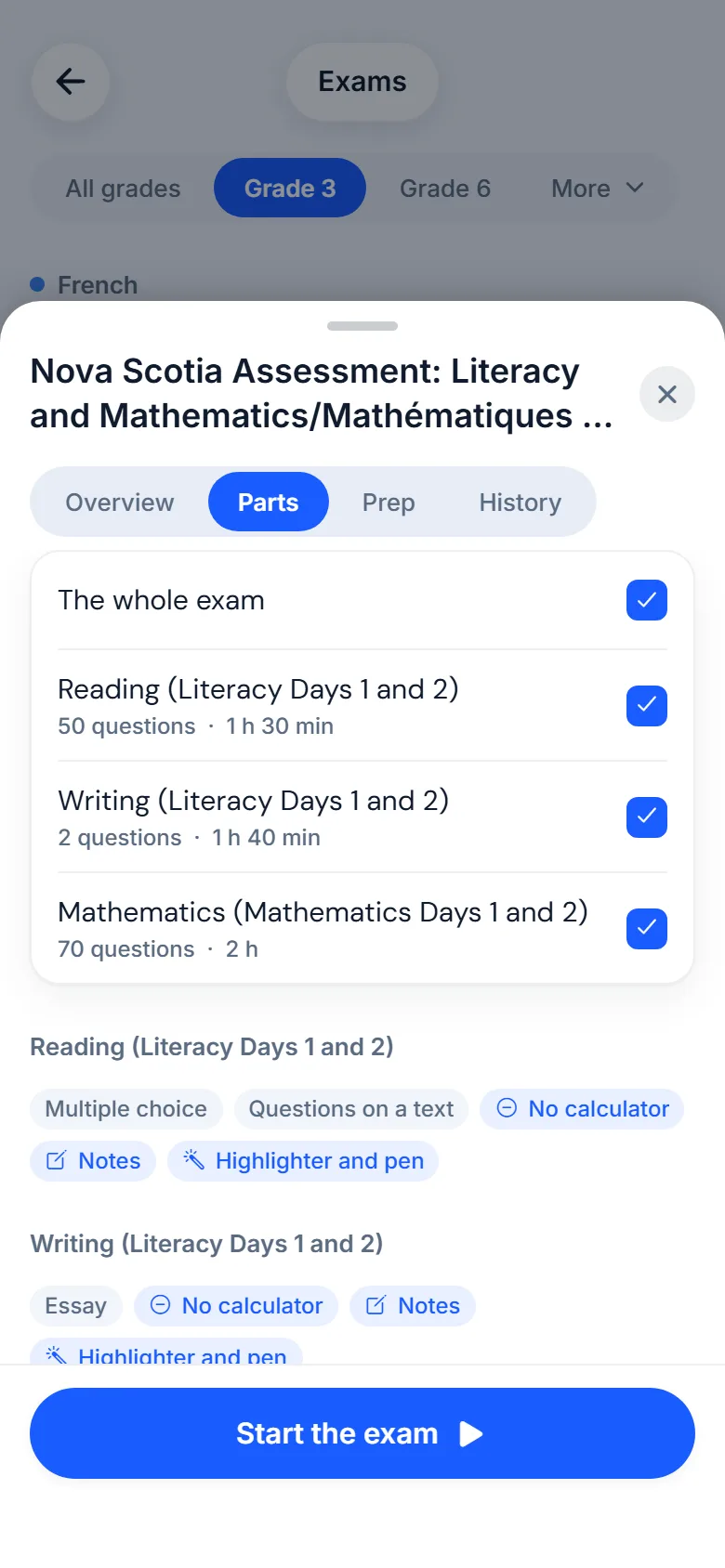 Its parts, and what you can use in each
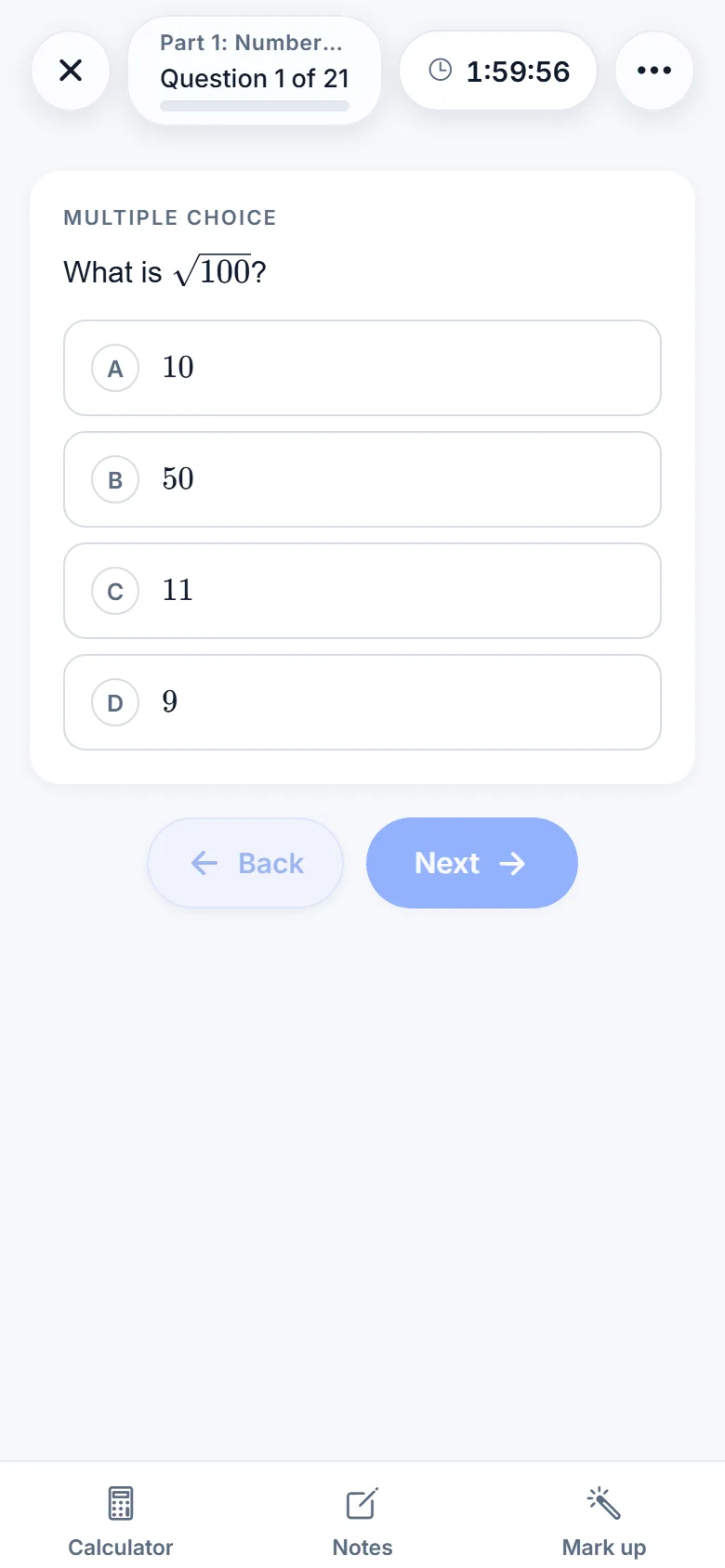 A question, timed, with the exam’s tools
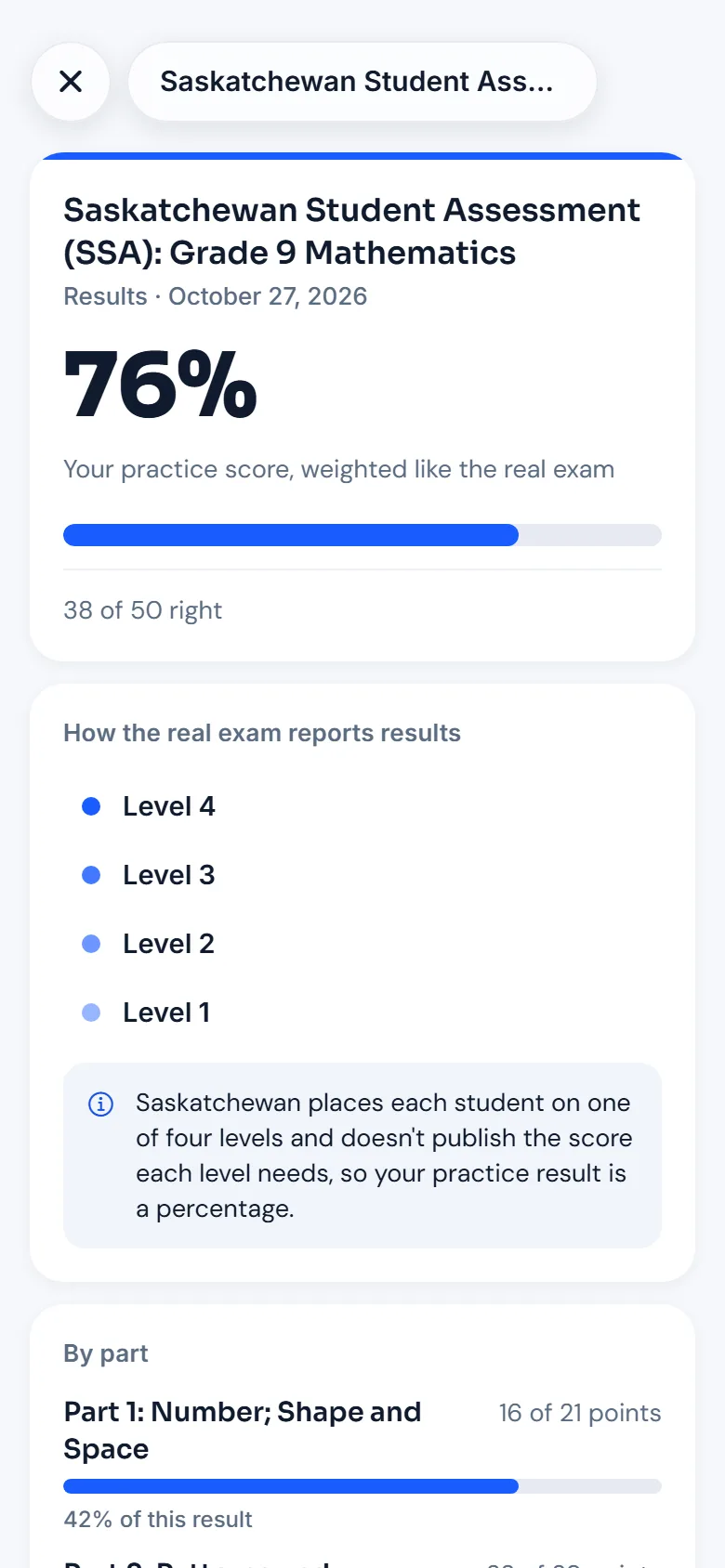 The marked result, part by part
A practice run of Saskatchewan’s Grade 9 math assessment.
Free with a MapleMind account
When
2 sessions this school year: Sample assessment window and Assessment window.
Sample assessment window
- April 26 to May 7, 2027One or two class periods · Sample assessment (in class)
Assessment window
- May 10 to May 26, 2027Mornings · Literacy Day 1 and Day 2, then Mathematics Day 1 and Day 2 (four mornings chosen by the school)
The dates are Nova Scotia’s own, read on September 28, 2026. See the official schedule (plans.ednet.ns.ca)
What’s on it
- ReadingReported on its own (levels)
Writing
- Narrative50%A story
- Informational text50%
Mathematics
- Number40–50%
- Patterns and Relations10–20%
- Measurement10–20%
- Geometry10–15%
- Statistics and Probability10–15%
The skills it tests · 63 skills
- Analysing the author's use of literary elements (Grade 3)
- Breaking numbers into hundreds, tens, and ones
- Building and reading bar graphs
- Capitalization and punctuation (Grade 3)
- Centimetres and metres and how they relate
- Collecting and organizing data
- Comparing and ordering to 1000
- Comparing fractions with the same bottom number
- Comparing, creating, and sorting polygons
- Composing sentences (Grade 3)
- Counting by 1s through the tricky spots
- Creating decreasing patterns
- Creating increasing patterns
- Describing 3-D objects by their faces
- Describing and extending decreasing patterns
- Describing and extending increasing patterns
- Drafting with audience, purpose, topic and conventions (Grade 3)
- Editing and proofreading with correct spelling (Grade 3)
- Elements of style (Grade 3)
- Equivalent ways to show a number
- Estimating amounts to 1000
- Estimating and measuring length
- Estimating and measuring mass
- Estimating sums and differences
- Examining the narrator's point of view (Grade 3)
- Fractions as part of a whole
- Generating and documenting ideas for writing (Grade 3)
- Grams and kilograms and how they relate
- Grapheme-phoneme correspondences / morphology and vocabulary (Grade 3)
- How time units fit together
- Identifying topic, audience and purpose for writing (Grade 3)
- Letters and alphabetic knowledge / orthographic patterns (Grade 3)
- Literary devices and rhetorical techniques (Grade 3)
- Making and solving addition and subtraction stories
- Making inferences to support comprehension (Grade 3)
- Many shapes, same perimeter
- Measuring perimeter
- Mental strategies for adding
- Mental strategies for subtracting
- Monitoring comprehension (Grade 3)
- Naming and describing polygons
- Narrative and informational text forms (Grade 3)
- Organizational structures and text features (Grade 3)
- Organizing writing (Grade 3)
- Parts of speech to support reading and writing (Grade 3)
- Personal strategies for adding and subtracting to 1000
- Phonics: blending and segmenting to read and spell (Grade 3)
- Place value to 1000
- Purpose for reading / background knowledge (Grade 3)
- Purpose for reading and reading goals (Grade 3)
- Quick recall of addition facts
- Quick recall of subtraction facts
- Reading fluently with accuracy, pacing and expression (Grade 3)
- Reflecting on goals and revising writing (Grade 3)
- Showing and reading numbers to 1000
- Skip-counting by 2s, 5s, 10s, and 100s
- Skip-counting by 3s, 4s, and 25s
- Solving equations with an unknown
- The passage of time
- Visual elements and design (Grade 3)
- Vocabulary through instruction and word awareness (Grade 3)
- Writing fluently and legibly by hand (Grade 3)
- Writing strengths, growth areas and goals (Grade 3)
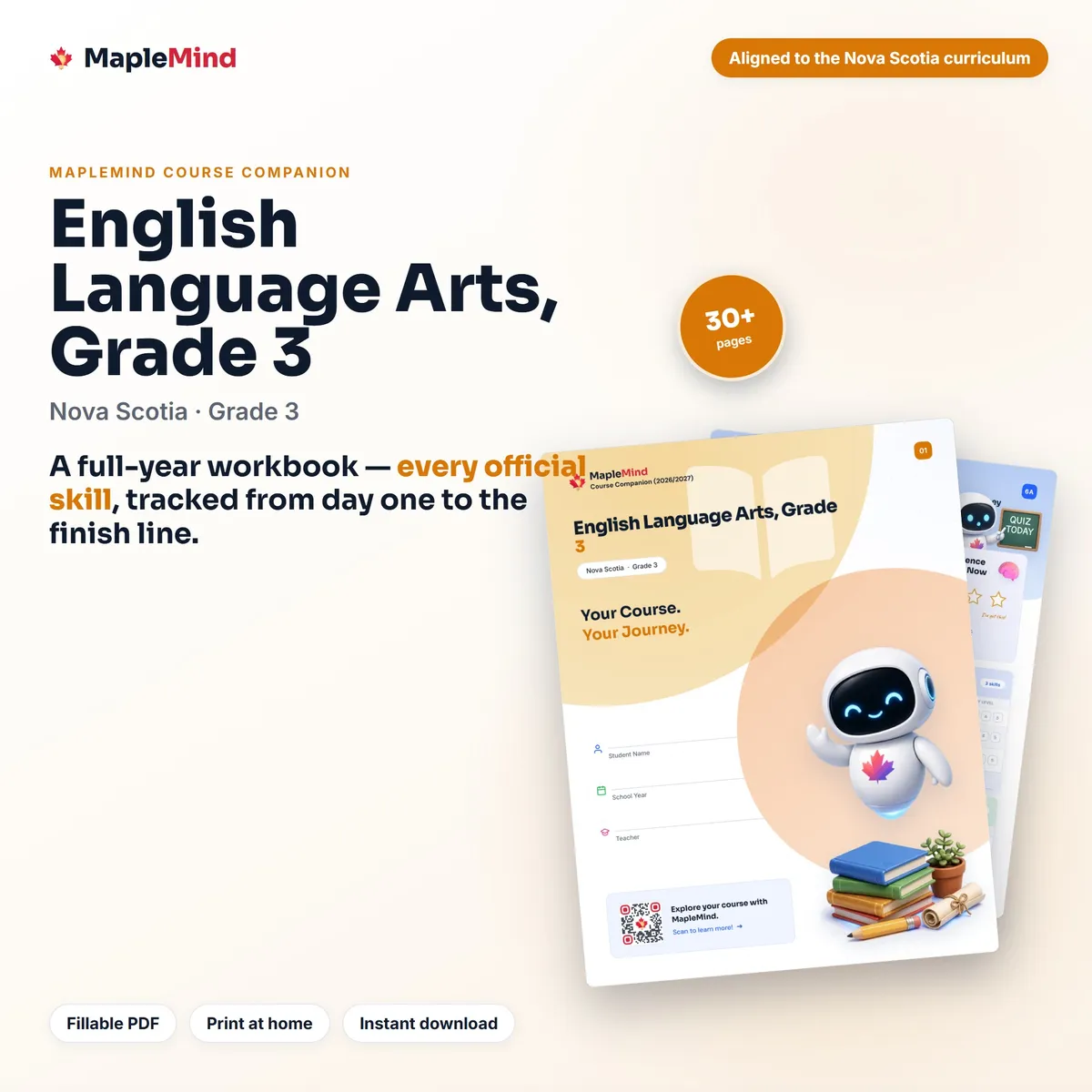
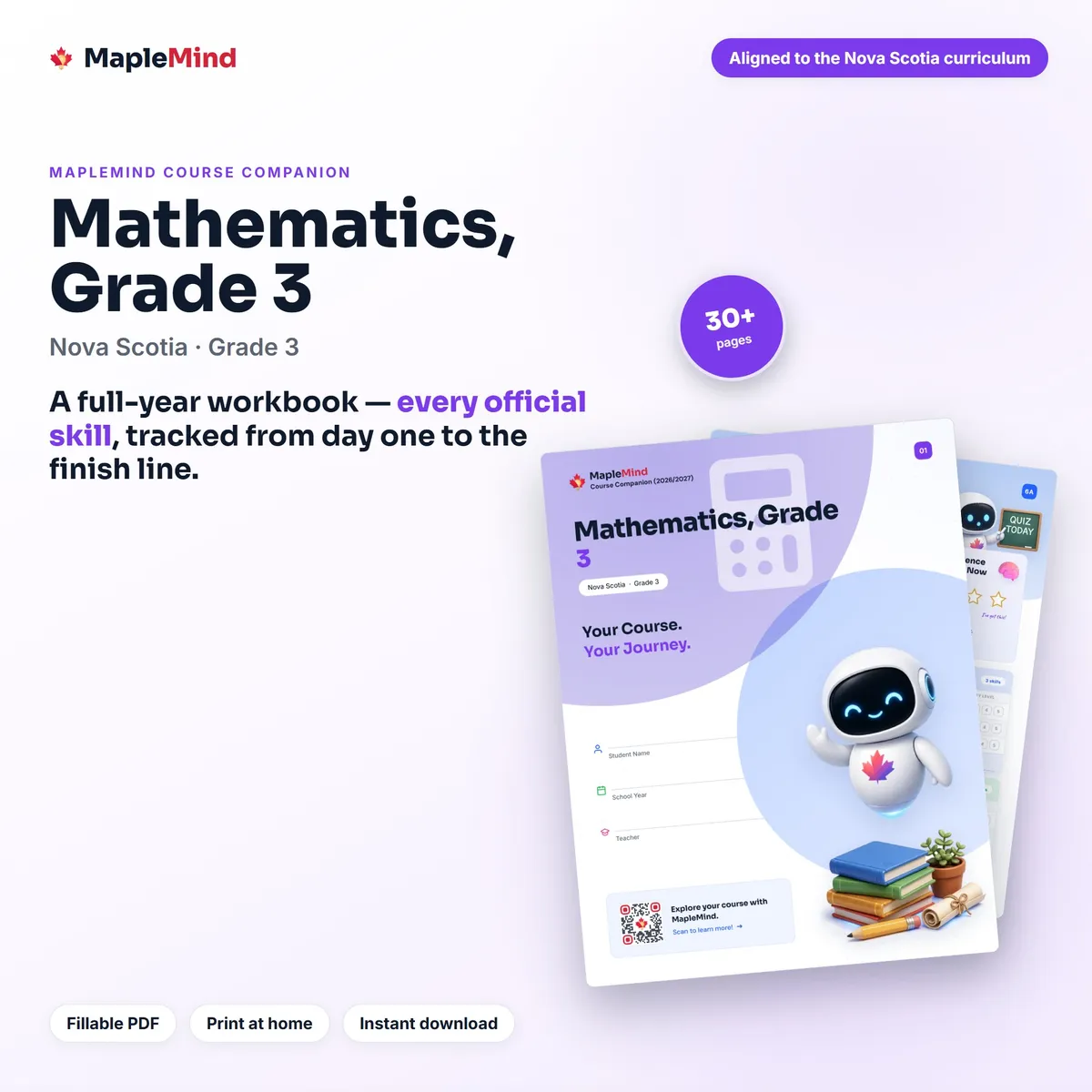
How it’s built
Multiple-choice questions, questions in sets and an essay.
- Reading (Literacy Days 1 and 2)
- Time
- 90 min
- Questions
- 50
- Marks
- 50
- Of the marks
- 33%
- Multiple choice
- Questions in sets
On each literacy morning, 45 minutes to read stories, information texts, poems or songs, and visual texts, and answer multiple-choice questions.
- Writing (Literacy Days 1 and 2)
- Time
- 100 min
- Questions
- 2
- Marks
- 32
- Of the marks
- 33%
- Essay
Two writing tasks, one each literacy morning: a story and an information text. Each takes 50 minutes, including 5 minutes to talk about the topic first.
- Mathematics (Mathematics Days 1 and 2)
- Time
- 120 min
- Questions
- 70
- Marks
- 70
- Of the marks
- 34%
- Multiple choice
Multiple-choice math questions, often in a real-life setting and some needing mental math, on number, patterns, measurement, geometry and data. No calculator.
How it’s marked
- Level 1
- Level 2
- Level 3
- Level 4
A computer marks the multiple-choice answers, and Nova Scotia teachers mark your writing. There's no pass mark: you get a level from 1 to 4 in reading, writing and math, where 3 meets the expectation, and the results don't count on your report card.
On the day
- FirstA sample assessment in class, over one or two class periods.
- Literacy Days 1 and 2Reading and writing, on two mornings.
- Mathematics Days 1 and 2The math, on two more mornings. Your school picks the four mornings: they follow this order, but needn't be in a row.
Two literacy mornings and two math mornings, on paper. Bring pencils and erasers. Dictionaries and thesauruses are there for reading and writing, but there's no calculator. Everyone may take up to 15 extra minutes a day. French Immersion students write only the math.
Getting ready
4 official documents to practise with, and 3 tips.
Official practice
Tips from the people who write it
- You don't need to study ahead: what you learn in class prepares you.
- Your class does short sample assessments first, to get used to the format.
- Get a good sleep and come relaxed on assessment days.
After the exam
- Results
Each student gets an Individual Student Report, available to families through PowerSchool once results are analyzed.
- Marks
Results aren’t used for report card grades or decisions about a student’s grade placement.
- If you miss it
A student with an Individual Program Plan takes part if their planning team, parents included, agrees.
From Program of Learning Assessment for Nova Scotia (PLANS): Grade 3, Grade 6 and Grade 8 (plans.ednet.ns.ca), read on October 27, 2026.
More for you
Students
Start with the topics worth the most marks, then write full practice exams under the real time limit.
Practise itParents
Put the dates on the family calendar. The Parent Dashboard shows each practice exam’s result and the skills that need another look.
See the Parent DashboardEducators
The topic weights and the official practice above make a review plan. Students can practise each skill on its own in MapleMind, free with daily limits.
For schools
Questions about this exam
When is the Nova Scotia Assessment: Literacy and Mathematics/Mathématiques in Grade 3 in 2026–27?
The next sitting is April 26 to May 7, 2027. This school year it’s written in Sample assessment window and Assessment window.
How long is the Nova Scotia Assessment: Literacy and Mathematics/Mathématiques in Grade 3?
It takes 5 hours 10 minutes in all, over 3 parts.
How many questions are on the Nova Scotia Assessment: Literacy and Mathematics/Mathématiques in Grade 3?
It has 122 marked questions: 50 in Reading (Literacy Days 1 and 2), 2 in Writing (Literacy Days 1 and 2) and 70 in Mathematics (Mathematics Days 1 and 2).
Can you use a calculator on the Nova Scotia Assessment: Literacy and Mathematics/Mathématiques in Grade 3?
No. Calculators aren’t allowed.
How are Nova Scotia Assessment: Literacy and Mathematics/Mathématiques in Grade 3 results reported?
At 4 levels: Level 1, Level 2, Level 3 and Level 4.
Where can I find practice tests for the Nova Scotia Assessment: Literacy and Mathematics/Mathématiques in Grade 3?
MapleMind builds a full practice exam in its format. Start it from this page, free with an account.

Practise for the Nova Scotia Assessment: Literacy and Mathematics/Mathématiques in Grade 3
Every skill on the Nova Scotia Assessment: Literacy and Mathematics/Mathématiques in Grade 3, taught one at a time, then practised on questions written like the real ones.


