Provincial assessment · Newfoundland & Labrador
Provincial Reading and Mathematics Assessment: Mathematics, Grade 6 (PRMA)
- Grade 6
Dates and details can change. We do our best to keep this page up to date, but check the official sources before relying on it.
- Total time
- 2 h
- Marked questions
- 40
- Parts
- 2
- Calculator
- Not allowed
- Format
- On paper
NL Grade 6 Math Assessment (PRMA) practice test
The whole exam or the parts you choose, in its own format, on the clock.
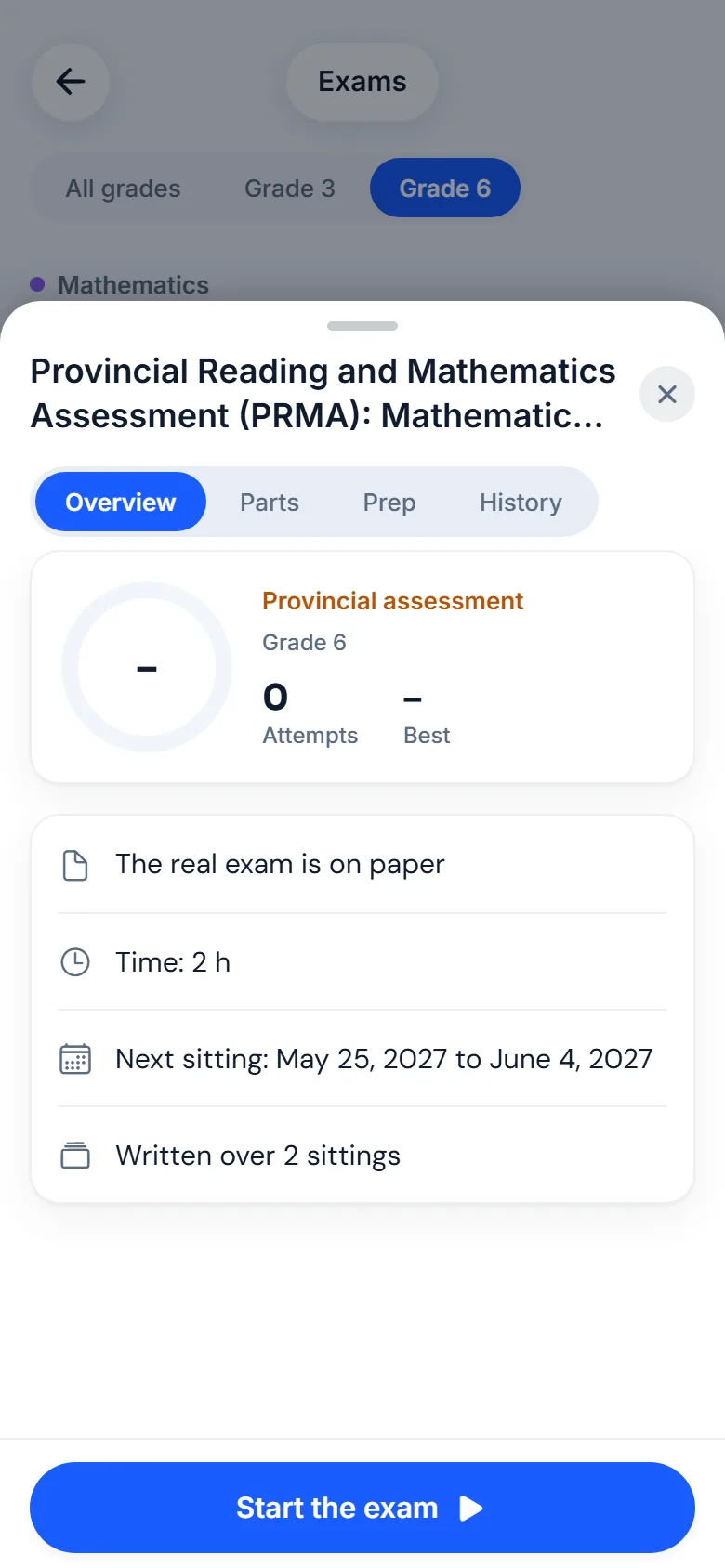 The exam in the app
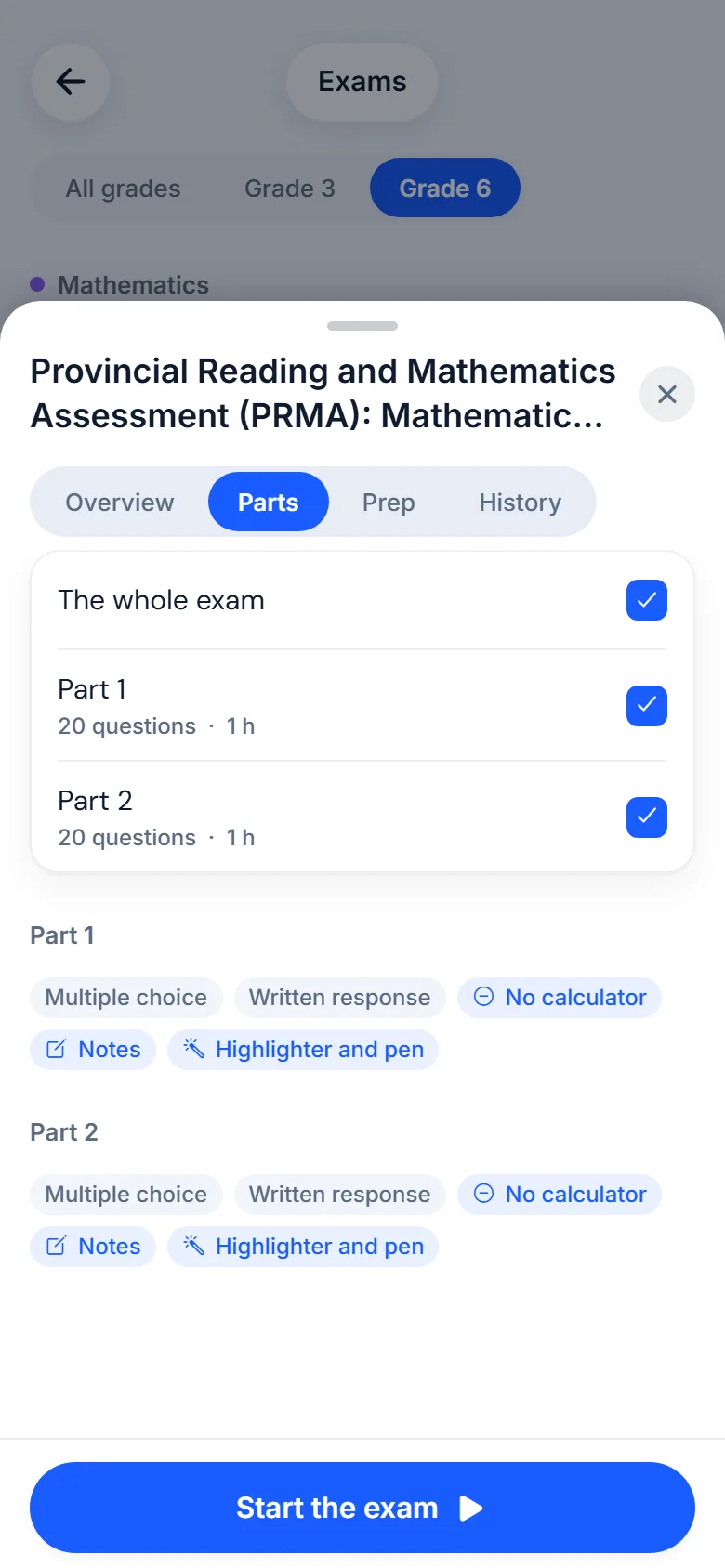 Its parts, and what you can use in each
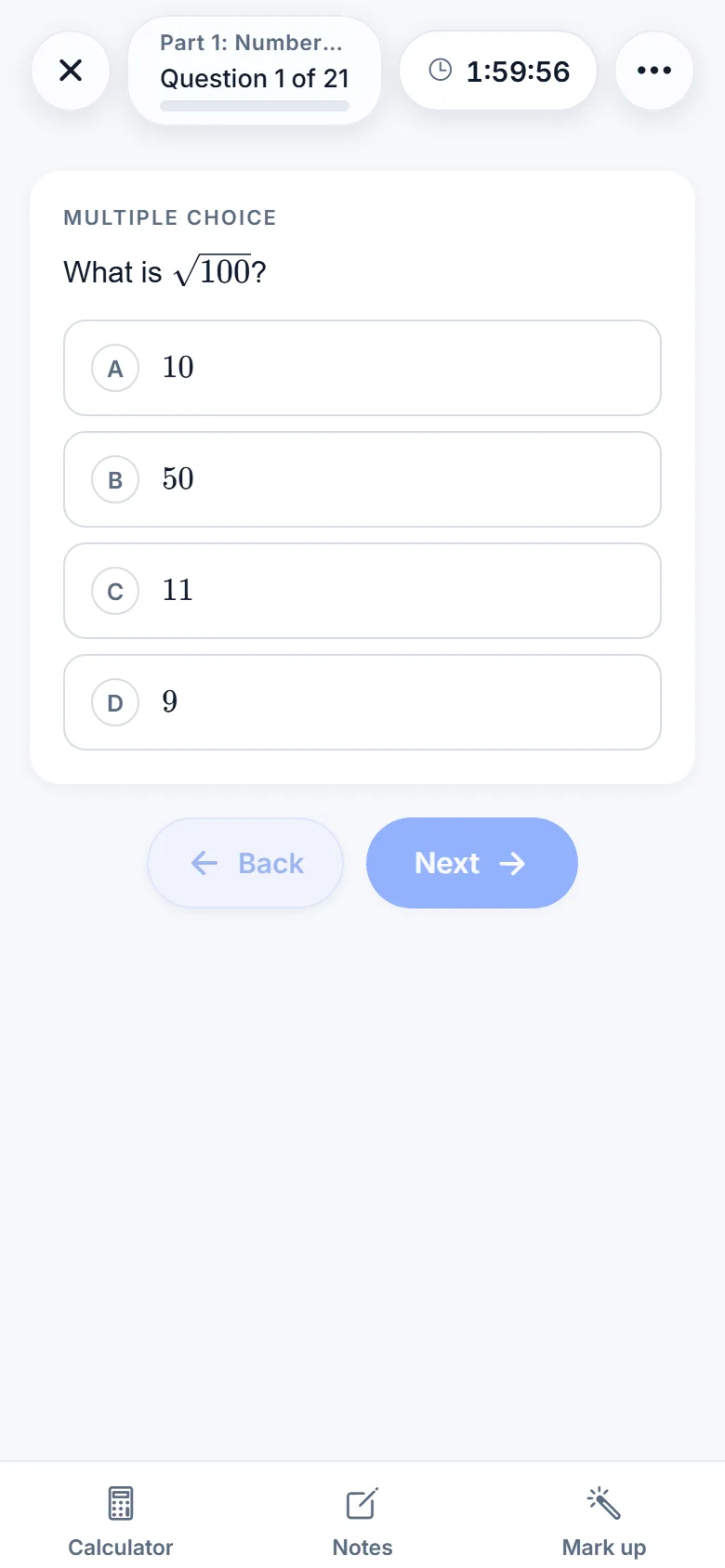 A question, timed, with the exam’s tools
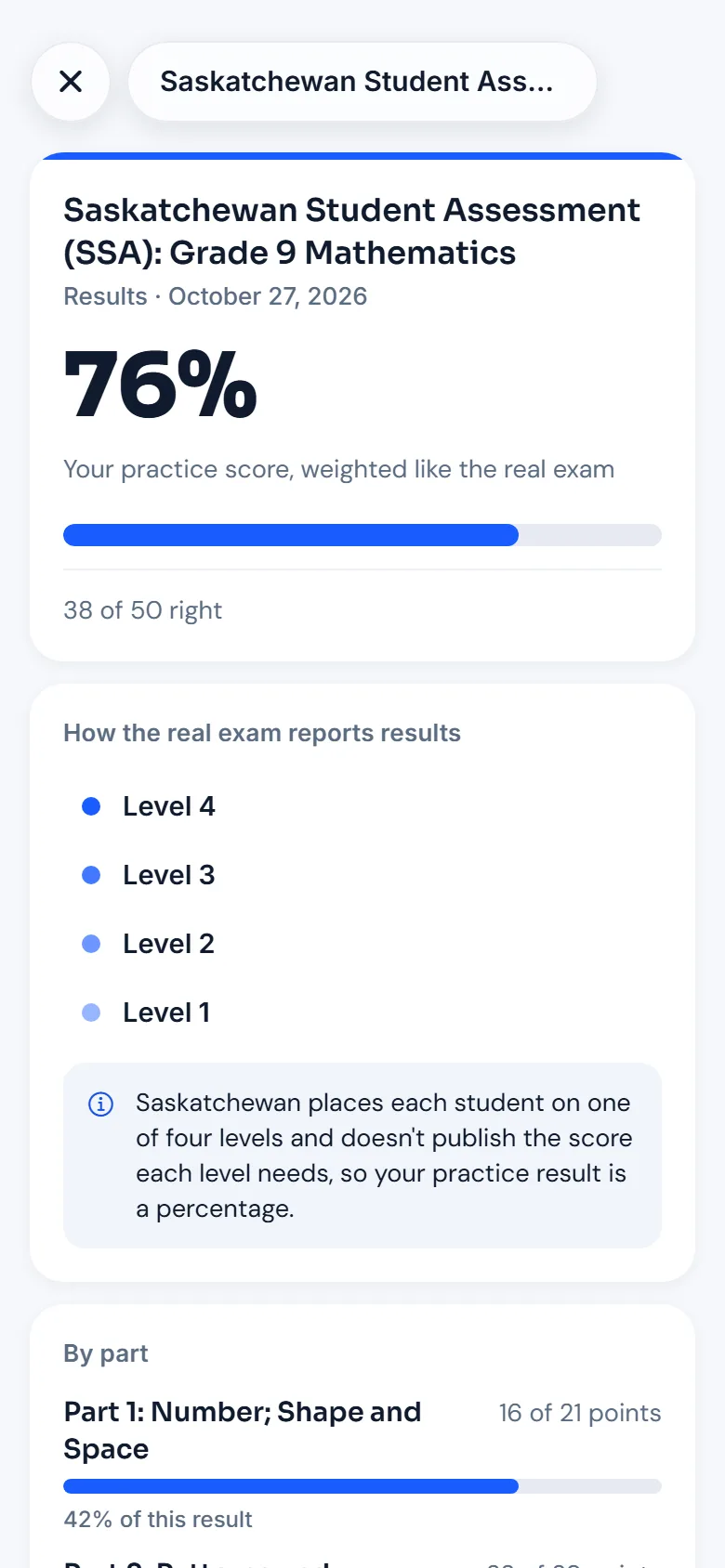 The marked result, part by part
A practice run of Saskatchewan’s Grade 9 math assessment.
Free with a MapleMind account
When
Last week of May and first week of June
- May 25 to June 4, 2027School day · Grade 6 PRMA Mathematics, Parts 1 and 2 (the school picks the days)
The dates are Newfoundland & Labrador’s own, read on September 29, 2026. See the official schedule (gov.nl.ca)
What’s on it
- Number
- Patterns and relations
- Shape and space
- Statistics and probability
Each topic’s share of the marks isn’t published.
The skills it tests · 42 skills
- Angle sums of triangles and quadrilaterals
- Choosing a data collection method
- Choosing an appropriate graph
- Classifying and estimating angles
- Classifying triangles
- Combining successive transformations
- Comparing and ordering integers
- Comparing theoretical and experimental probability
- Congruence in a regular polygon
- Converting and placing fractions
- Creating and interpreting line graphs
- Describing relationships in a table
- Describing transformations on the plane
- Drawing and replicating triangles
- Estimating to place the decimal point
- Factors and multiples
- Improper fractions greater than one
- Integers and the number line
- Large and small numbers around us
- Listing outcomes and theoretical probability
- Measuring and drawing angles
- Modelling and recording percents
- Multiplying and dividing decimals
- Order of operations
- Part-to-part and part-to-whole ratios
- Percent means out of 100
- Performing transformations and finding the image
- Perimeter and area formulas
- Plotting points in the first quadrant
- Preserving equality across operations
- Prime and composite numbers
- Reading and building graphs of patterns
- Regular and irregular polygons
- Shapes and distances on the plane
- Solving percent problems
- Solving ratio problems
- The commutative property
- The place-value pattern
- Using tables to predict and solve
- Volume of right rectangular prisms
- Writing a pattern as an expression
- Writing ratios in many forms
How it’s built
Multiple-choice questions and written answers.
- Part 1
- Time
- 60 min
- Questions
- 20
- Marks
- 20
- Of the marks
- 50%
- Multiple choice
- Written answers
Multiple-choice questions with four choices, and questions where you write your answer and show your reasoning, on number, patterns and equations, shape and space, and data and chance. No calculator.
- Part 2
- Time
- 60 min
- Questions
- 20
- Marks
- 20
- Of the marks
- 50%
- Multiple choice
- Written answers
More questions of the same kinds, across the same areas of math. No calculator.
How it’s marked
- Not Meeting Expectations
- Approaching Expectations
- Meeting Expectations
A computer marks the multiple-choice answers, and teachers on a provincial panel mark your written answers. There's no individual result: your school gets the share of students at each level, and Meeting Expectations is the expected level.
On the day
- Session 1Part 1, up to an hour.
- Session 2Part 2, up to an hour, later the same day after a break or on another day.
Two classroom sessions of up to an hour each, on one day with a break or over two days. No calculator, but you may use counters, cubes, base ten blocks and geometric solids, and working paper is provided. You may ask to have a question read aloud. Extra time is available for everyone.
Getting ready
6 official documents to practise with, and 4 tips.
Official practice
- Provincial Reading and Mathematics Assessment Framework (sample items in Appendix 4)gov.nl.ca
- Cadre de l'Évaluation provinciale en lecture et en mathématiquesgov.nl.ca
- PRMA Question and Answer; infographicgov.nl.ca
- PRMA Handbook for Schoolsk12pl.nl.ca
- PRMA 2025 Mathematics reportgov.nl.ca
- Grades 3 and 6 PRMA video (on the PRMA page)gov.nl.ca
Tips from the people who write it
- You don't need to prepare: the results don't affect your marks or report card, so just do your best.
- Practise working with decimals, area and volume without a calculator.
- If you're not sure, cross out the wrong choices first, and answer every question.
- For a written answer, show your reasoning: explain how you got your answer.
After the exam
- Results
There are no individual results: schools receive the provincial results and their own overall results.
- Marks
The province says no preparation is needed.
- If you miss it
Every Grade 3 and 6 student on the provincial curriculum is expected to take part.
From The Provincial Reading and Mathematics Assessment (PRMA): questions and answers (gov.nl.ca), read on October 27, 2026.
More for you
Students
Read what’s on it, then write full practice exams under the real time limit.
Practise itParents
Put the dates on the family calendar. The Parent Dashboard shows each practice exam’s result and the skills that need another look.
See the Parent DashboardEducators
The official practice above makes a review plan. Students can practise each skill on its own in MapleMind, free with daily limits.
For schools
Questions about this exam
When is the PRMA in 2026–27?
The next sitting is May 25 to June 4, 2027.
How long is the PRMA?
It takes 2 hours in all, over 2 parts.
How many questions are on the PRMA?
It has 40 marked questions: 20 in Part 1 and 20 in Part 2.
Can you use a calculator on the PRMA?
No. Calculators aren’t allowed.
How are PRMA results reported?
At 3 levels: Not Meeting Expectations, Approaching Expectations and Meeting Expectations.
Where can I find practice tests for the PRMA?
Newfoundland & Labrador publishes Provincial Reading and Mathematics Assessment Framework (sample items in Appendix 4). MapleMind also builds a full practice exam in its format, free with an account.

Practise for the PRMA
Every skill on the PRMA, taught one at a time, then practised on questions written like the real ones.


