Provincial Achievement Test · Manitoba
Grade 12 Pre-Calculus Mathematics Achievement Test
- Grade 12
- 40S
Dates and details can change. We do our best to keep this page up to date, but check the official sources before relying on it.
- Total time
- 3 h
- Marked questions
- 44
- Parts
- 3
- Counts for
- 20% of the final mark
- Calculator
- In some parts
- Format
- On paper
Manitoba Grade 12 Pre-Calculus Exam practice test
The whole exam or the parts you choose, in its own format, on the clock.
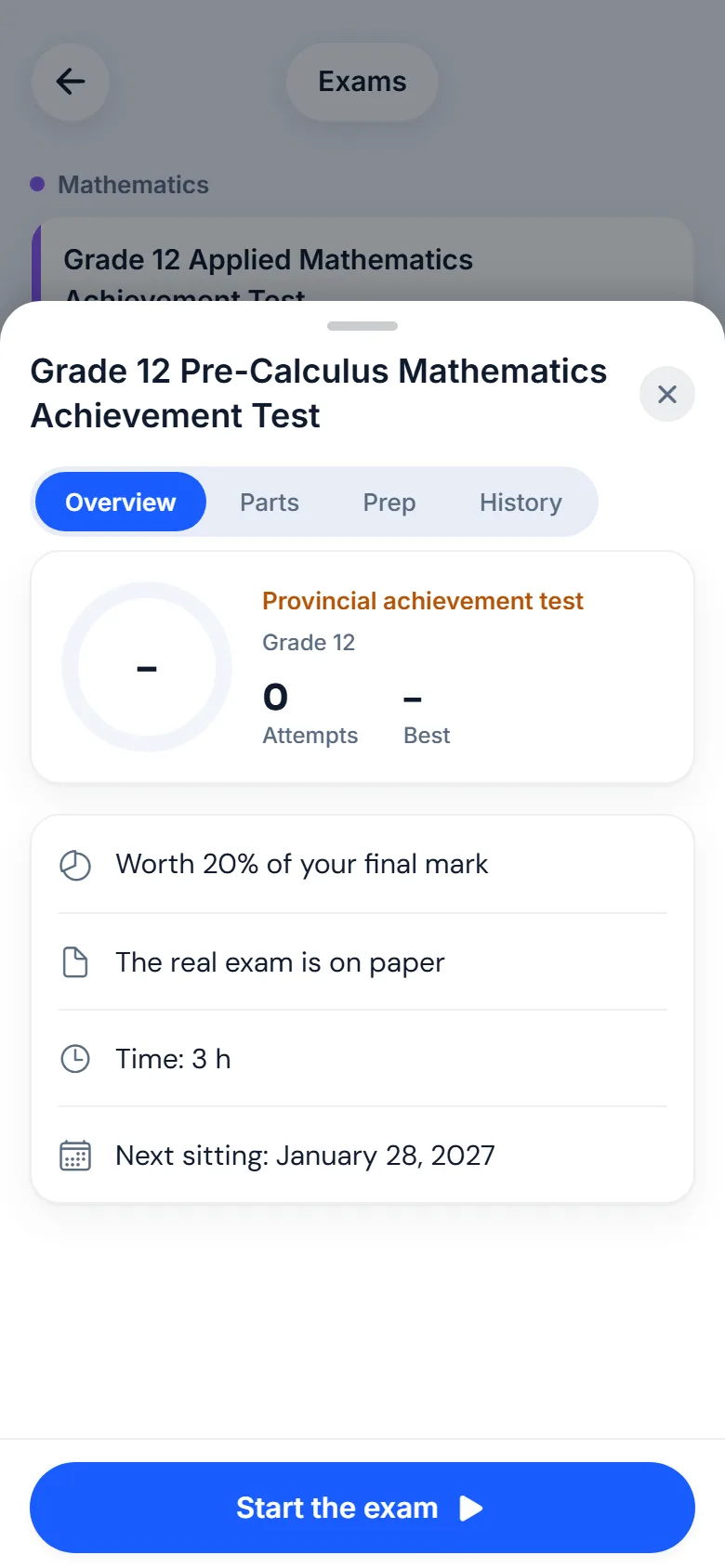 The exam in the app
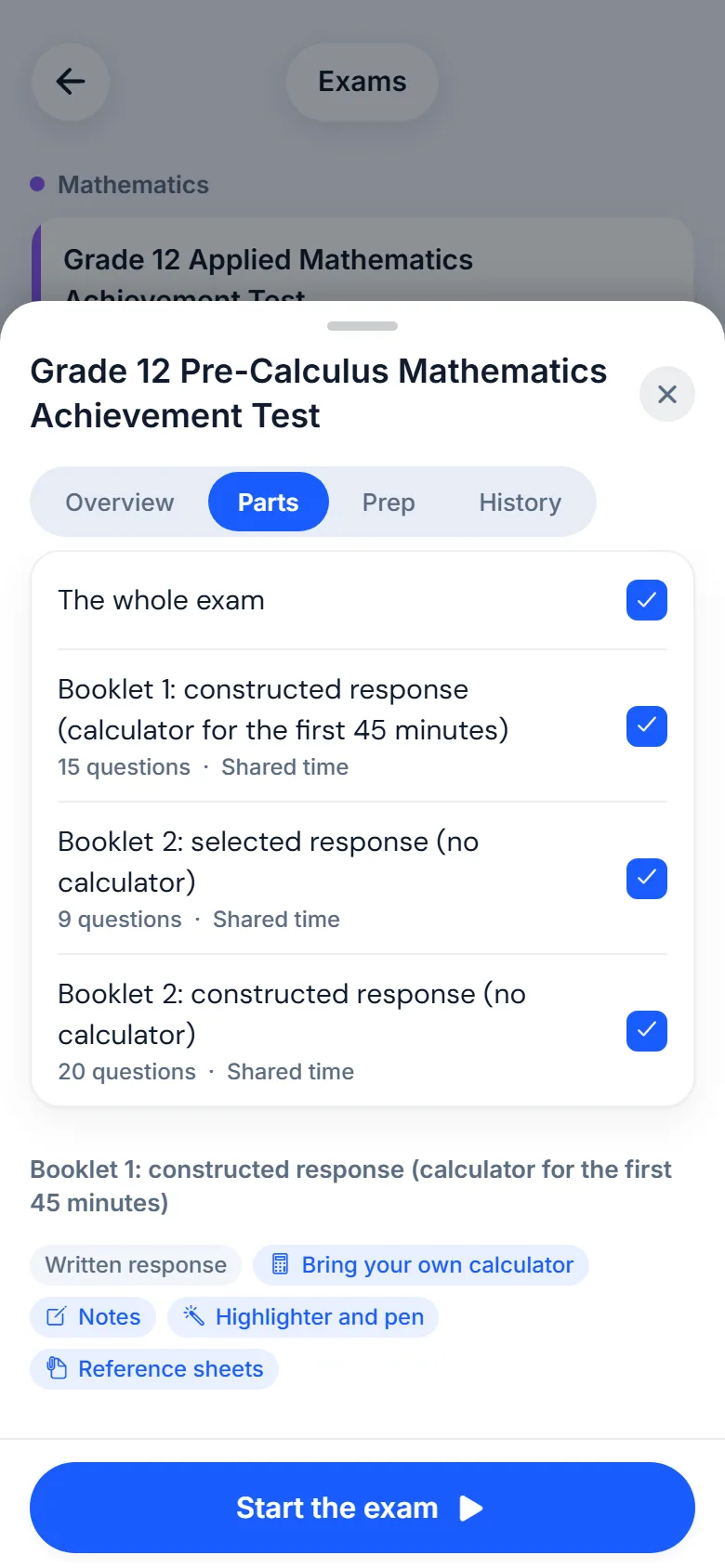 Its parts, and what you can use in each
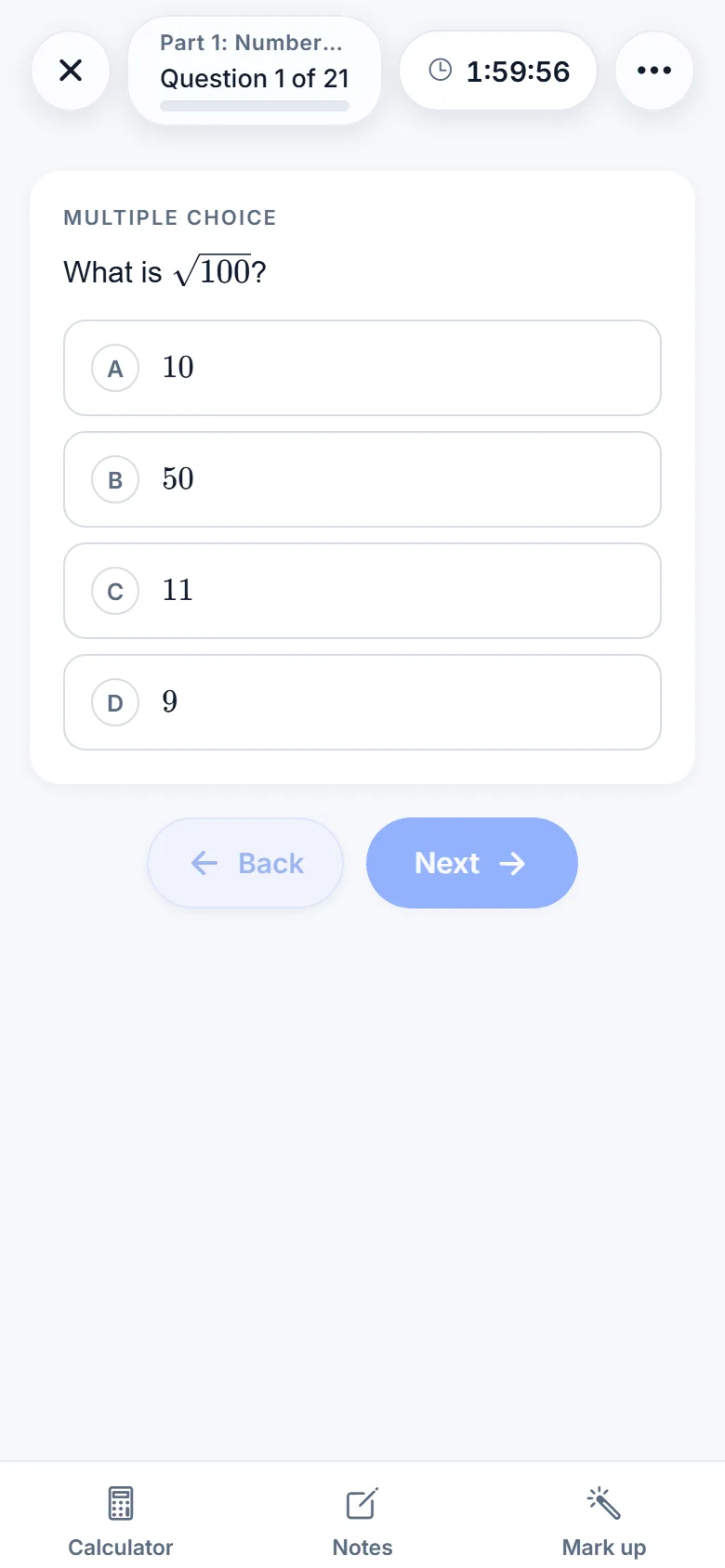 A question, timed, with the exam’s tools
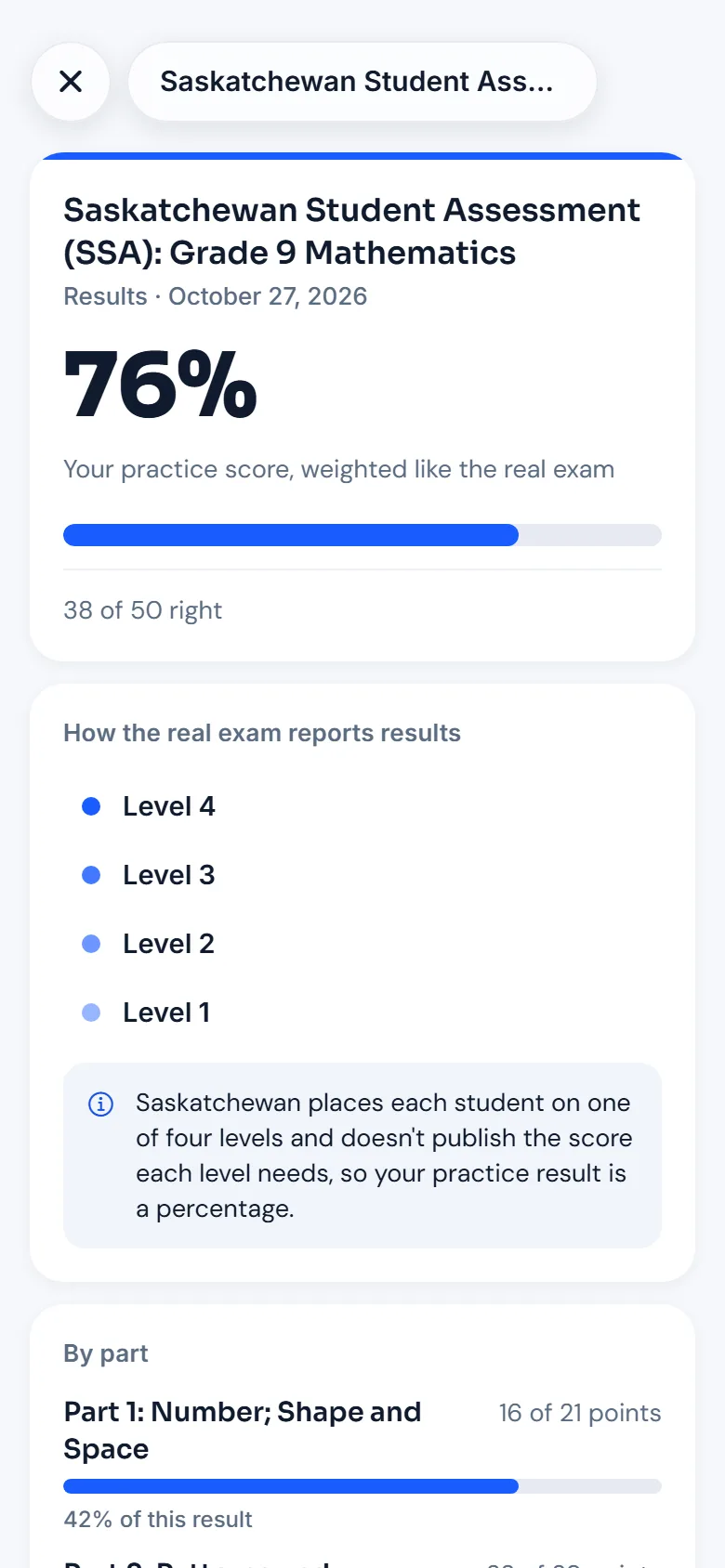 The marked result, part by part
A practice run of Saskatchewan’s Grade 9 math assessment.
Free with a MapleMind account
When
2 sessions this school year: Semester 1 and Semester 2.
Semester 1
- Thursday, January 28, 20273 hours (+30 minutes); calculator for the first 45 minutes only; start between 8:30 and 10:00 a.m.
Semester 2
- Tuesday, June 15, 20273 hours (+30 minutes); calculator for the first 45 minutes only; start between 8:30 and 10:00 a.m.
The dates are Manitoba’s own, read on September 28, 2026. See the official schedule (edu.gov.mb.ca)
What’s on it
7 topics. Exponents and Logarithms counts most, at 17%.
- Transformations of Functions16%
- Trigonometric Functions16%
- Binomial Theorem12%
- Polynomial Functions10%
- Trigonometric Equations and Identities16%
- Exponents and Logarithms17%
- Radicals and Rationals14%
The skills it tests · 34 skills
- Applications of exponential and logarithmic equations
- Combinations
- Combining transformations
- Compositions of functions
- Compressions and stretches
- Coterminal angles and arc length
- Exact trigonometric ratios
- Expanding with the binomial theorem
- General solutions and identities in equations
- Graphing exponential functions
- Graphing logarithmic functions
- Graphing polynomial functions
- Graphs of sine, cosine, and tangent
- Inverses of relations
- Laws of logarithms
- Long and synthetic division of polynomials
- Operations on functions
- Pascal's triangle and binomial patterns
- Permutations
- Proving with reciprocal, quotient, and Pythagorean identities
- Radical functions
- Rational functions
- Reflections of graphs
- Sketching and converting angles
- Solving exponential and logarithmic equations
- Solving trigonometric equations
- Solving with trigonometric ratios
- Sum, difference, and double-angle identities
- The equation of the unit circle
- The fundamental counting principle
- The remainder and factor theorems
- Transforming trigonometric graphs
- Translations of graphs
- Understanding logarithms
How it’s built
Written answers and multiple-choice questions.
- Booklet 1: constructed response (calculator for the first 45 minutes)
- Questions
- 15
- Marks
- 35
- Of the marks
- 38.5%
- Written answers
Worked answers with every step shown. The first few questions need a calculator; after 45 minutes it's put away, but you can keep working.
- Booklet 2: selected response (no calculator)
- Questions
- 9
- Marks
- 9
- Of the marks
- 9.9%
- Multiple choice
Multiple-choice questions with four options, 1 mark each, shaded on the answer sheet. No calculator.
- Booklet 2: constructed response (no calculator)
- Questions
- 20
- Marks
- 47
- Of the marks
- 51.6%
- Written answers
Worked answers without a calculator: exact values, algebra, sketched graphs with their key features, and proofs of identities.
How it’s marked
Your teachers mark it with the department's marking guide, and the department re-marks a random sample. The test counts for 20% of your final course mark; it has no pass mark of its own.
On the day
- Calculator
- Bring a scientific calculator without symbolic manipulation (no CAS), for the first 45 minutes only. No graphing calculator, and no sharing.
- Provided
- Formula Sheet: Pre-Calculus Mathematics and Terminology Sheet: Pre-Calculus Mathematics
One paper test, and everyone gets 30 more minutes. You may use a scientific calculator only for the first 45 minutes, then it's put away. Bring a pencil, ruler, eraser and a paper dictionary; there's no study sheet or scrap paper.
Getting ready
3 official documents to practise with, and 5 tips.
Official practice
Tips from the people who write it
- Do the calculator questions at the start of Booklet 1 first: calculators are put away after 45 minutes.
- Show every solution before you reject one that doesn't work, such as a cosine greater than 1.
- A sketched graph needs labelled axes, a scale, the right shape, dashed asymptotes and intercepts, with at least two points.
- Prove identities in a T-structure, left side and right side; never set the two sides equal.
- Describe transformations in math language, not as steps like 'add 5 to the x values'.
The mark you need
Your class mark counts for 80% of the final mark, the exam for 20%.
You need
50% on the exam
With 75% in class, your final mark lands between 60% (0 on the exam) and 80% (100% on it).
After the exam
- Results
Your school marks the test and gives you your result right after. Report cards show it apart from your course mark.
- Re-marking
A reread is up to your school division.
- Writing it again
You can rewrite at any later sitting once the course is done, enrolled or not. It’s free, there’s no limit, and your higher result becomes your official mark. Retaking the course doesn’t mean rewriting the test.
- If you miss it
Tests can’t be rescheduled. If you’re absent for illness, a death in the family or another crisis, your school sets your final grade and your report card shows “no mark” for the test. Absent without a reason, or refusing to write, gives 0% for the parts missed.
From Grade 12 Provincial Tests: Policies and Procedures (edu.gov.mb.ca), read on October 27, 2026.
More for you
Students
Start with the topics worth the most marks, then write full practice exams under the real time limit.
Practise itParents
Put the dates on the family calendar. The Parent Dashboard shows each practice exam’s result and the skills that need another look.
See the Parent DashboardEducators
The topic weights and the official practice above make a review plan. Students can practise each skill on its own in MapleMind, free with daily limits.
For schools
Questions about this exam
When is the Grade 12 Pre-Calculus Mathematics Achievement Test in 2026–27?
The next sitting is January 28, 2027, 3 hours (+30 minutes); calculator for the first 45 minutes only; start between 8:30 and 10:00 a.m.. This school year it’s written in Semester 1 and Semester 2.
How long is the Grade 12 Pre-Calculus Mathematics Achievement Test?
It takes 3 hours in all, over 3 parts.
How many questions are on the Grade 12 Pre-Calculus Mathematics Achievement Test?
It has 44 marked questions: 15 in Booklet 1: constructed response (calculator for the first 45 minutes), 9 in Booklet 2: selected response (no calculator) and 20 in Booklet 2: constructed response (no calculator).
Can you use a calculator on the Grade 12 Pre-Calculus Mathematics Achievement Test?
In some parts only: Booklet 1: constructed response (calculator for the first 45 minutes).
How much does the Grade 12 Pre-Calculus Mathematics Achievement Test count?
It’s worth 20% of the final mark in Pre-Calculus Mathematics, Grade 12 (40S).
Where can I find practice tests for the Grade 12 Pre-Calculus Mathematics Achievement Test?
Manitoba publishes Archived tests and support documents (June 2018 to June 2026). MapleMind also builds a full practice exam in its format, free with an account.

Practise for the Grade 12 Pre-Calculus Mathematics Achievement Test
Every skill on the Grade 12 Pre-Calculus Mathematics Achievement Test, taught one at a time, then practised on questions written like the real ones.


