Graduation assessment · British Columbia
Grade 10 Graduation Numeracy Assessment
Grade 10 Graduation Numeracy Assessment (NME10)
- Grade 10
- NME10
Dates and details can change. We do our best to keep this page up to date, but check the official sources before relying on it.
- Total time
- 2 h
- Marked questions
- 26
- Marked parts
- 4
- Counts for
- Needed to graduate
- Calculator
- Approved models
- Format
- Paper and computer
BC Numeracy 10 Assessment practice test
The whole exam or the parts you choose, in its own format, on the clock.
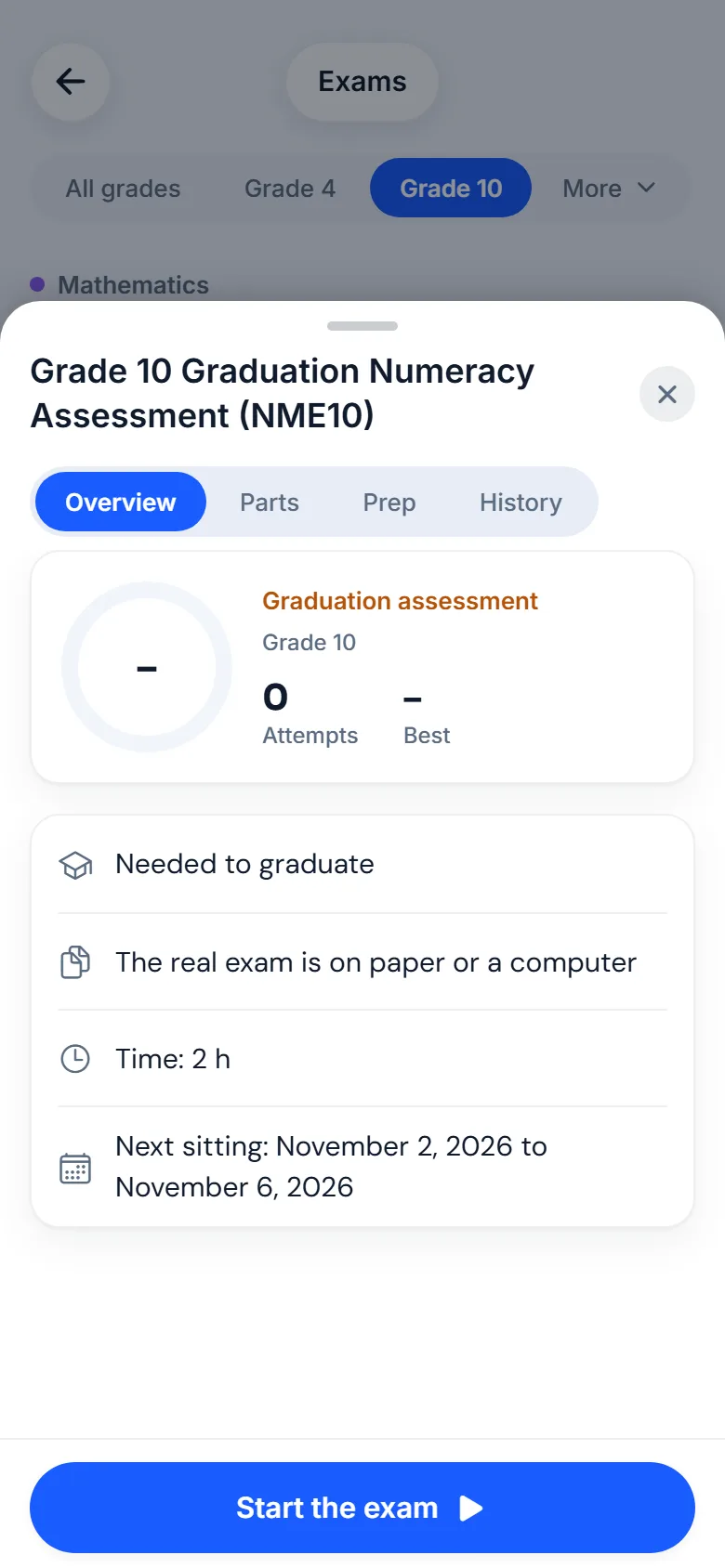 The exam in the app
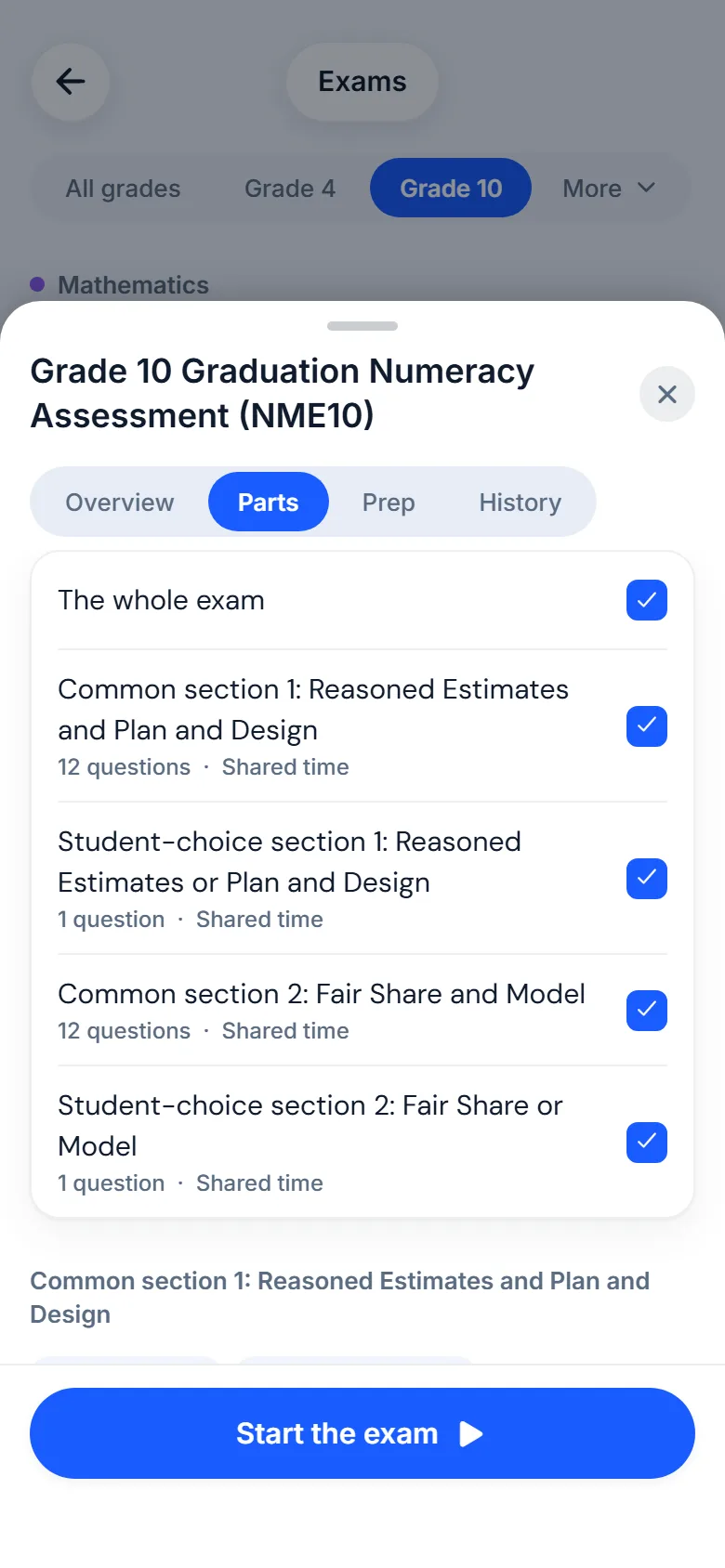 Its parts, and what you can use in each
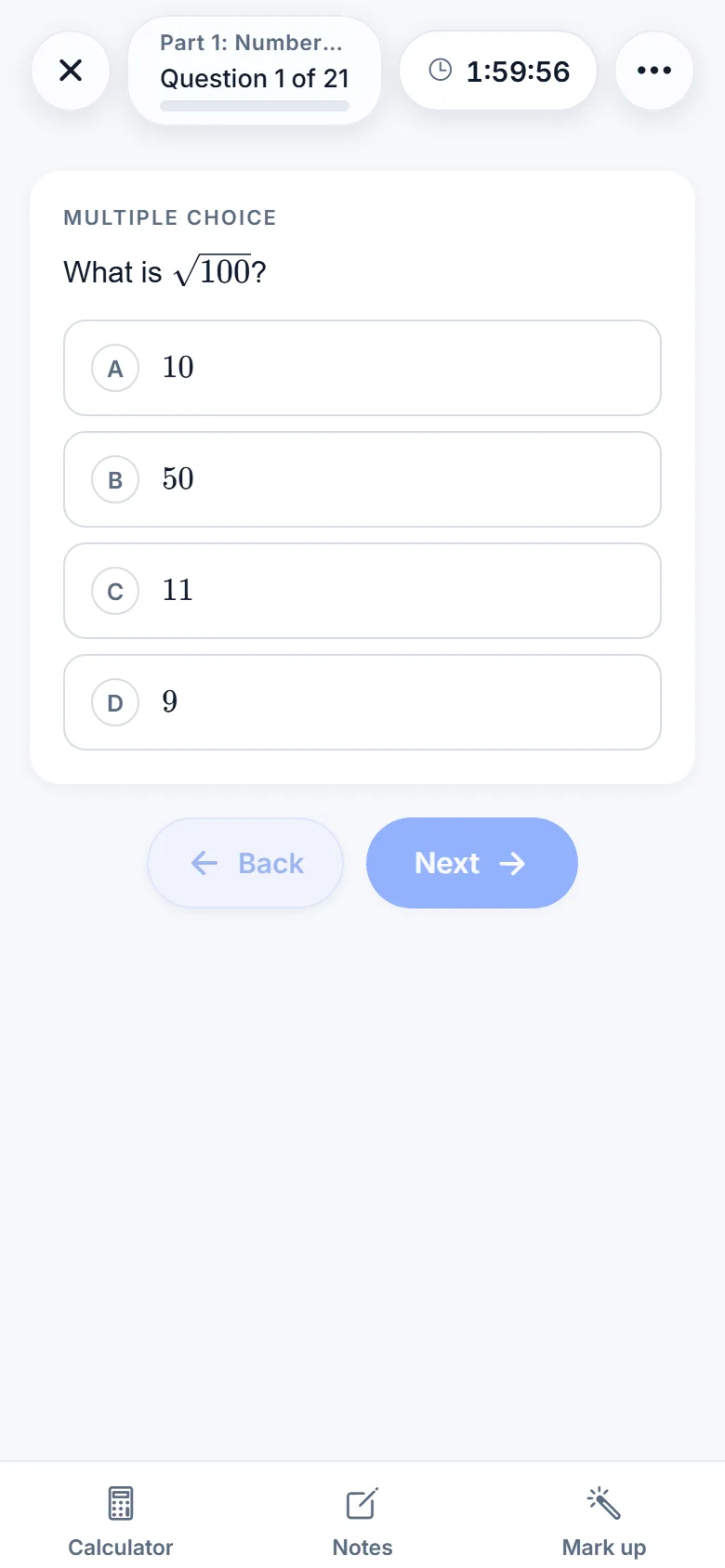 A question, timed, with the exam’s tools
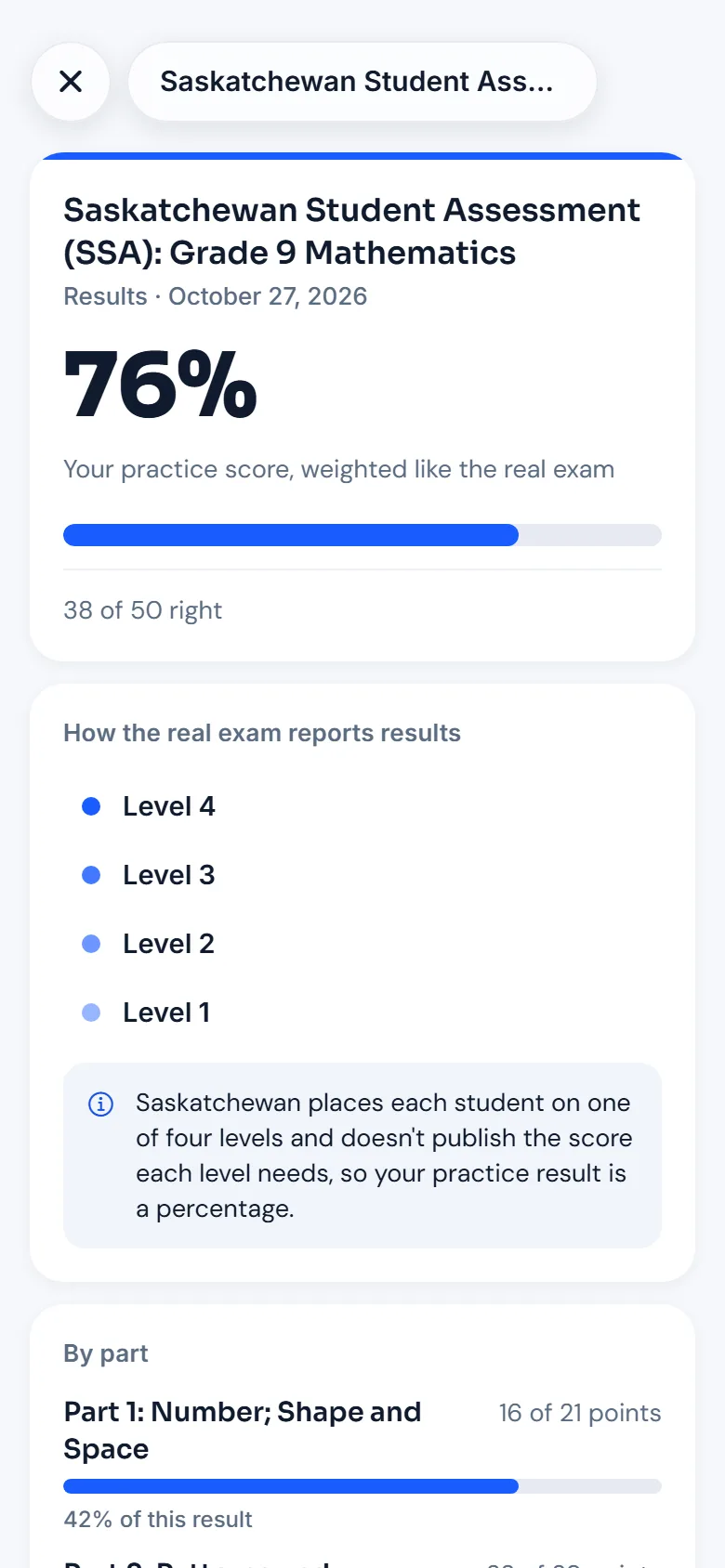 The marked result, part by part
A practice run of Saskatchewan’s Grade 9 math assessment.
Free with a MapleMind account
When
8 sessions this school year: November, January, April, June, November, January, April and June.
November 2026
- November 2 to November 6, 20268:00 AM–4:00 PM launch window (local school time) · Grade 10 Numeracy (NME10)
January 2027
- January 11 to January 22, 20278:00 AM–4:00 PM launch window (local school time) · Grade 10 Numeracy (NME10)
Later sessions · 6
April 2027
- April 12 to April 16, 20278:00 AM–4:00 PM launch window (local school time) · Grade 10 Numeracy (NME10)
June 2027
- June 7 to June 18, 20278:00 AM–4:00 PM launch window (local school time) · Grade 10 Numeracy (NME10)
November 2026
- Monday, November 2, 20268:00 AM–4:00 PM launch window (local school time) · Évaluation de numératie 10 (NMF10, French form)
January 2027
- Monday, January 18, 20278:00 AM–4:00 PM launch window (local school time) · Évaluation de numératie 10 (NMF10, French form)
April 2027
- Monday, April 12, 20278:00 AM–4:00 PM launch window (local school time) · Évaluation de numératie 10 (NMF10, French form)
June 2027
- Monday, June 14, 20278:00 AM–4:00 PM launch window (local school time) · Évaluation de numératie 10 (NMF10, French form)
The dates are British Columbia’s own, read on September 28, 2026. See the official schedule (gov.bc.ca)
What’s on it
3 topics. Level 2, skills and concepts: 16 common-section questions and Level 3, strategic thinking: 2 written responses count most, at 40% each.
- Level 1, recall: 8 common-section questions20%
- Level 2, skills and concepts: 16 common-section questions40%
- Level 3, strategic thinking: 2 written responses40%4-point rubric each
How it’s built
Multiple-choice questions, numerical-response questions, questions in sets and written answers.
- Common section 1: Reasoned Estimates and Plan and Design
- Questions
- 12
- Marks
- 12
- Of the marks
- 30%
- Multiple choice
- Numerical response
- Questions in sets
Two real-world tasks, six questions each: multiple choice, matching, clicking on a spot, plotting a graph, entering a number or building an expression.
- Student-choice section 1: Reasoned Estimates or Plan and Design
- Question
- 1
- Marks
- 4
- Of the marks
- 20%
- Written answers
Choose one of two options and write a longer answer on paper that builds on a task from the common section. Your choice can't be changed.
- Common section 2: Fair Share and Model
- Questions
- 12
- Marks
- 12
- Of the marks
- 30%
- Multiple choice
- Numerical response
- Questions in sets
Two more real-world tasks, six questions each, in the same formats as the first common section.
- Student-choice section 2: Fair Share or Model
- Question
- 1
- Marks
- 4
- Of the marks
- 20%
- Written answers
Choose one of two options and write a longer answer on paper that builds on a task from the second common section. Your choice can't be changed.
- Self-reflectionNot marked
- Multiple choice
- Written answers
How it’s marked
- Emerging
- Developing
- Proficient
- Extending
A computer marks the online questions, and BC teachers mark your written answers. There's no pass or fail: completing it is what you need to graduate, and your level, from 1 to 4, is reported. You may rewrite it to raise your level.
On the day
- Provided
- Grade 10 Numeracy Assessment reference pages
One sitting you can start any time from 8 a.m. to 4 p.m., and anyone may take up to 60 more minutes. A scientific calculator is built in.
Getting ready
2 official documents to practise with, and 5 tips.
Official practice
Tips from the people who write it
- It's about numeracy in real-world situations, not recalling formulas from a math course.
- Finish each common section before its choice section: once you pick an option, it can't be changed.
- Do the official online sample to learn question types such as drag-and-drop matching and clicking on a spot.
- The written answers go on paper, so practise showing your number reasoning in writing.
- You may bring your own calculator, even a graphing one, but not one with CAS, wireless, a camera or stored notes.
After the exam
- Results
Your results are posted to the StudentTranscripts Service; parents get them through the school. Results are out by:
- November 2026by December 18, 2026
- January 2027by March 22, 2027
- April 2027by May 31, 2027
- June 2027by July 30, 2027
- Re-marking
With your principal, you can ask to see your marked assessment, up to a year after the session.
- Writing it again
You can write each assessment up to three times before you graduate: the first try and two rewrites, at any session from Grade 10 to 12, never twice in one session. Your best result goes on your transcript. Registering and not writing doesn’t use a try.
- If you miss it
If sudden illness, an injury or an emergency gets in the way, your school first looks at supports, then at a later session. An exemption (aegrotat standing, shown as AEG on the transcript) is a last resort for exceptional cases; ongoing conditions don’t qualify.
From 2026–27 B.C. Graduation Program Handbook of Procedures (gov.bc.ca) and 2026–27 Chart of Important Dates (gov.bc.ca), read on October 27, 2026.
More for you
Students
Start with the topics worth the most marks, then write full practice exams under the real time limit.
Practise itParents
Put the dates on the family calendar. The Parent Dashboard shows each practice exam’s result.
See the Parent DashboardEducators
The topic weights and the official practice above make a review plan. Students can write practice exams in MapleMind, free with daily limits.
For schools
Questions about this exam
When is the Grade 10 Graduation Numeracy Assessment in 2026–27?
The next sitting is January 11 to January 22, 2027. This school year it’s written in November 2026, January 2027, April 2027 and June 2027.
How long is the Grade 10 Graduation Numeracy Assessment?
It takes 2 hours in all, over 4 parts.
How many questions are on the Grade 10 Graduation Numeracy Assessment?
It has 26 marked questions: 12 in Common section 1: Reasoned Estimates and Plan and Design, 1 in Student-choice section 1: Reasoned Estimates or Plan and Design, 12 in Common section 2: Fair Share and Model and 1 in Student-choice section 2: Fair Share or Model.
Can you use a calculator on the Grade 10 Graduation Numeracy Assessment?
Yes, a calculator from the approved list.
How much does the Grade 10 Graduation Numeracy Assessment count?
Passing it is needed to graduate in British Columbia.
How are Grade 10 Graduation Numeracy Assessment results reported?
At 4 levels: Emerging, Developing, Proficient and Extending.
When do Grade 10 Graduation Numeracy Assessment results come out?
For 2026–27: the November 2026 sitting on or before December 18, 2026, the January 2027 sitting on or before March 22, 2027, the April 2027 sitting on or before May 31, 2027 and the June 2027 sitting on or before July 30, 2027.
Where can I find practice tests for the Grade 10 Graduation Numeracy Assessment?
British Columbia publishes Official online sample (numeracy 10). MapleMind also builds a full practice exam in its format, free with an account.

Practise for the Grade 10 Graduation Numeracy Assessment
Practice exams for the Grade 10 Graduation Numeracy Assessment, written like the real ones.


