Get help with Science and Technology, Grade 1
Most tutoring makes your child sit through material your child already knows. MapleMind flips that: pick the exact skill that's causing trouble — any of the 15 below — and the tutor teaches just that one, step by step, as many times as it takes. Ask questions in plain words, any time of day, in English, French, or 12 other languages.
The official Quebec Science and Technology, Grade 1 curriculum
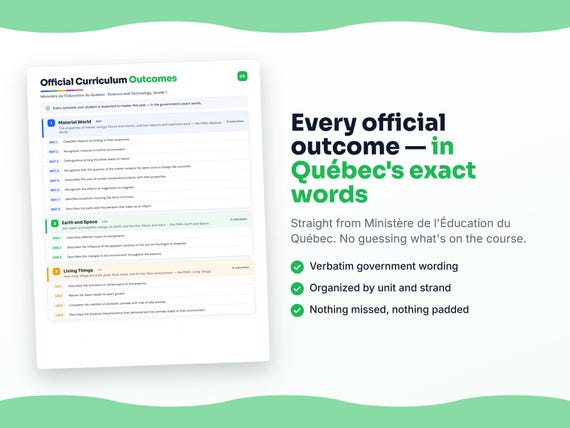
Quebec defines Science and Technology, Grade 1 by strands and outcomes. MapleMind teaches the same curriculum reorganized for one-skill-at-a-time tutoring — the table shows exactly where every official strand lands, and the ministry's own wording is quoted under each unit below.
Official source Québec's official education programRead it on the government site — quebec.ca ↗| Official strand | Outcomes | Where MapleMind teaches it |
|---|---|---|
| Strand A | 8 | Material World |
| Strand B | 3 | Earth and Space |
| Strand C | 4 | Living Things |
Every skill below, taught one on one.
 Try the first session free
How MapleMind teaches Science and Technology, Grade 1 — every unit, lesson, and skill
Every skill below runs as a short session: a plain-words lesson, a worked example, solving it together, then a five-question skill check that earns up to three stars. Guided Mode keeps it teaching instead of answer-handing — turning it off needs a parent's password.
Unit 1Material WorldOfficial strand · Strand A
The properties of matter, energy, forces and motion, and how objects and machines work — the PDA's Material World.
Sorting objects by what they are like
- Sorting objects by what they are likeMAT.A.1 — The child learns to classifies objects according to their properties (e.g. colour, shape, size, texture, smell).
Mixtures we can find at home
- Mixtures we can find at homeMAT.A.12 — The child learns to recognizes mixtures in his/her environment (e.g. air, juice, salad dressing, soup, raisin bread).
Solids, liquids, and gases
- Solids, liquids, and gasesMAT.A.15 — The child learns to distinguishes among the three states of matter (solid, liquid, gas).
The amount of matter stays the same
- The amount of matter stays the sameMAT.A.19 — The child learns to recognizes that the quantity of the matter remains the same once a change has occurred (e.g. 50 ml of water in a saucer or a glass, whole piece of chalk or ground chalk, flattened piece of modelling clay or a ball of modelling clay).
Everyday products and staying safe
- Everyday products and staying safeMAT.A.23 — The child learns to associates the uses of certain household products with their properties (e.g. cleaning products remove grease, vinegar and lemon juice help preserve certain foods).
Magnets: pulling and pushing
- Magnets: pulling and pushingMAT.C.2 — The child learns to recognizes the effects of magnetism on magnets (attraction and repulsion).
Friction when things rub
- Friction when things rubMAT.C.10 — The child learns to identifies situations involving the force of friction (pushing on an object, sliding an object, rolling an object).
The parts of an object and what it is for
- The parts of an object and what it is forMAT.D.1 — The child learns to describes the parts and mechanisms that make up an object.
The official wording — 8 outcomes in this unit
- MAT.A.1
Classifies objects according to their properties
- MAT.A.12
Recognizes mixtures in his/her environment
- MAT.A.15
Distinguishes among the three states of matter
- MAT.A.19
Recognizes that the quantity of the matter remains the same once a change has occurred
- MAT.A.23
Associates the uses of certain household products with their properties
- MAT.C.2
Recognizes the effects of magnetism on magnets
- MAT.C.10
Identifies situations involving the force of friction
- MAT.D.1
Describes the parts and mechanisms that make up an object
Unit 2Earth and SpaceOfficial strand · Strand B
Soil, water and weather, energy on Earth, and the Sun, Moon, and stars — the PDA's Earth and Space.
Rain, snow, and where water comes from
- Rain, snow, and where water comes fromEAS.A.8 — The child learns to describes different types of precipitation (rain, snow, hail, freezing rain).
The Sun, shadows, and the sky
- The Sun, shadows, and the skyEAS.D.1 — The child learns to describes the influence of the apparent position of the sun on the length of shadows.
The four seasons and how warm it feels
- The four seasons and how warm it feelsEAS.D.8 — The child learns to describes the changes to the environment throughout the seasons (temperature, amount of daylight, type of precipitation).
The official wording — 3 outcomes in this unit
- EAS.A.8
Describes different types of precipitation
- EAS.D.1
Describes the influence of the apparent position of the sun on the length of shadows
- EAS.D.8
Describes the changes to the environment throughout the seasons
Unit 3Living ThingsOfficial strand · Strand C
How living things are built, grow, feed, move, and fit into their environment — the PDA's Living Things.
Body parts and what they do
- Body parts and what they doLIV.A.7 — The child learns to describes the functions of certain parts of the anatomy (e.g. limbs, head, heart, stomach).
What a plant needs to grow
- What a plant needs to growLIV.A.16 — The child learns to names the basic needs for plant growth (water, air, light, mineral salts).
How animals eat and how we use living things
- How animals eat and how we use living thingsLIV.B.1 — The child learns to compares the nutrition of domestic animals with that of wild animals.
How animals fit where they live
- How animals fit where they liveLIV.D.1 — The child learns to describes the physical characteristics that demonstrate how animals adapt to their environment.
The official wording — 4 outcomes in this unit
- LIV.A.7
Describes the functions of certain parts of the anatomy
- LIV.A.16
Names the basic needs for plant growth
- LIV.B.1
Compares the nutrition of domestic animals with that of wild animals
- LIV.D.1
Describes the physical characteristics that demonstrate how animals adapt to their environment
Printable workbook · A keepsake of the year
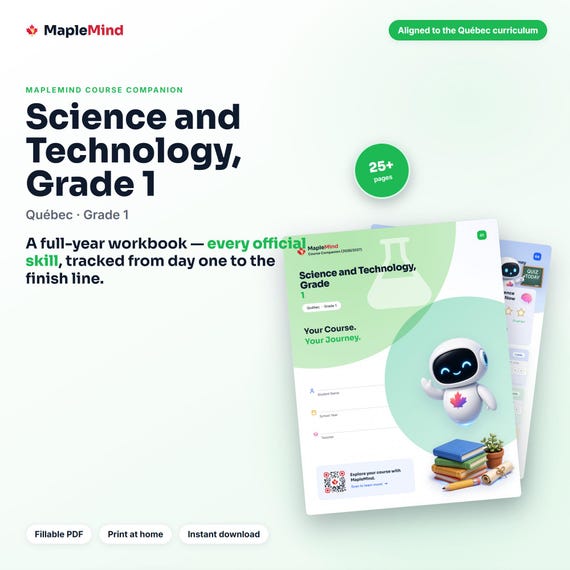
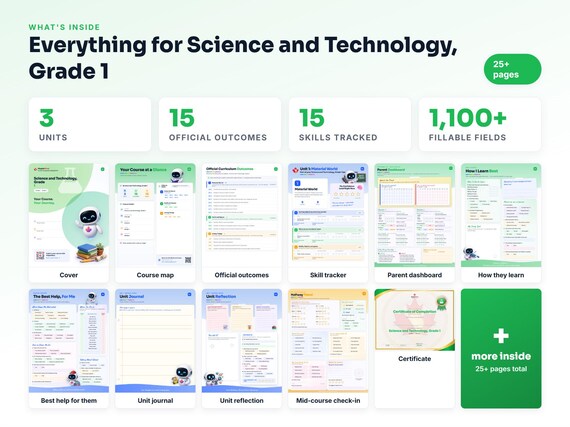
A Science and Technology, Grade 1 workbook worth keeping
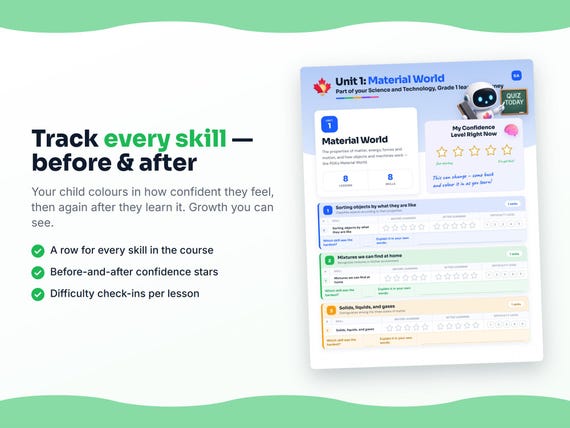
Built from the same official curriculum as this page. Before and after each skill above, your student colours in how sure they feel — so the two of you can see, on one page, what's clicking and what needs another look. It's a quiet way to follow how the year is really going.
By June it's full of their own handwriting: units worked through, confidence grown, a mid-year check-in, notes from parent-teacher night, and a certificate at the end. Less a worksheet, more a record of the year worth keeping on the shelf.
Instant download · see every page, reviews and the full description · five or more workbooks are $2.99 each
What it looks like in the app



Common questions
Can MapleMind help my child with Science and Technology, Grade 1?
Yes. MapleMind's AI tutor covers all 15 skills in Quebec's Science and Technology, Grade 1 — your child picks the exact skill, and the tutor teaches it step by step: a short lesson, a worked example, solving together, then a skill check to show it stuck.
Is MapleMind aligned to Quebec's official curriculum?
Yes. Every skill in this course maps to an official outcome code from Quebec's Grade 1 Science curriculum, and the ministry's own wording is quoted under each unit on this page — with the official government source linked so you can check it yourself.
What does MapleMind cost?
It's free to start — 5 tutoring chats and a practice quiz every day, no credit card. A Pro subscription ($9.99/month or $49.99/year CAD, 7-day free trial) unlocks unlimited tutoring, practice, and exam simulations.
What if my child is stuck on just one topic?
That's the point of skill-level tutoring: open Science and Technology, Grade 1 in the app, tap the exact skill from the list on this page, and the tutor teaches just that — no wading through lessons your child doesn't need.
Does MapleMind work in French or other languages?
Yes — 14 languages, including French. Both the app and the tutor's explanations switch to the language your child chooses.
Where can I see the official Quebec curriculum for Science and Technology, Grade 1?
The official source is linked on this page — Québec's official education program. The outline here follows it: every MapleMind skill carries its official outcome code, and the ministry's own wording is quoted under each unit.
Keep exploring
Ready when you are
Pick a skill from this page and see it taught properly — free, in the browser, in under a minute.