Get help with Mathematics, Grade 4
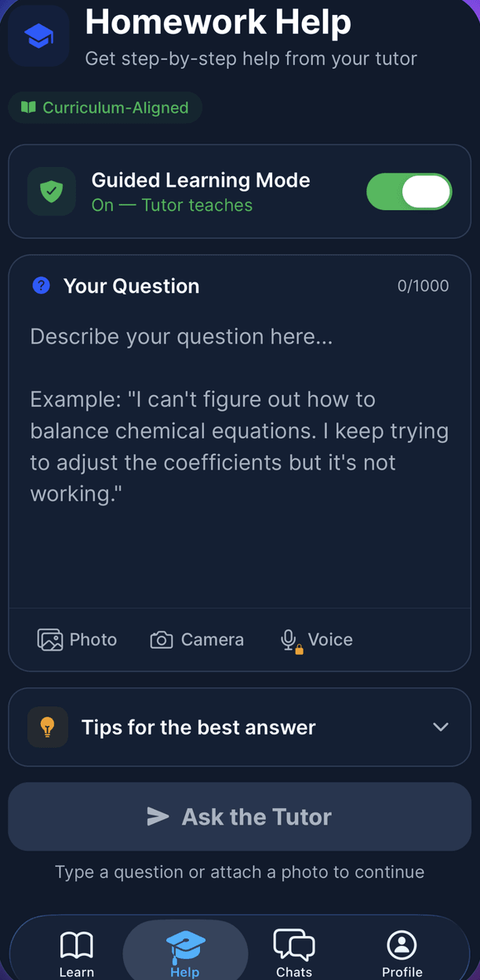
Most tutoring makes your child sit through material your child already knows. MapleMind flips that: pick the exact skill that's causing trouble — any of the 97 below — and the tutor teaches just that one, step by step, as many times as it takes. Ask questions in plain words, any time of day, in English, French, or 12 other languages.
The official Quebec Mathematics, Grade 4 curriculum
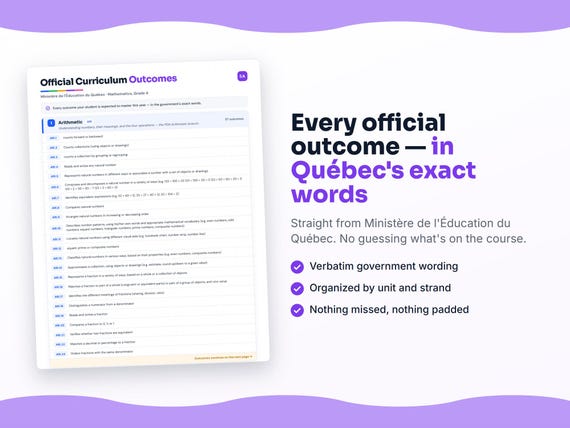
Quebec defines Mathematics, Grade 4 by strands and outcomes. MapleMind teaches the same curriculum reorganized for one-skill-at-a-time tutoring — the table shows exactly where every official strand lands, and the ministry's own wording is quoted under each unit below.
Official source Québec's official education programRead it on the government site — quebec.ca ↗| Official strand | Outcomes | Where MapleMind teaches it |
|---|---|---|
| Strand A | 57 | Arithmetic |
| Strand G | 13 | Geometry |
| Strand M | 13 | Measurement |
| Strand S | 4 | Statistics |
| Strand P | 10 | Probability |
Every skill below, taught one on one.
 Try the first session free
How MapleMind teaches Mathematics, Grade 4 — every unit, lesson, and skill
Every skill below runs as a short session: a plain-words lesson, a worked example, solving it together, then a five-question skill check that earns up to three stars. Guided Mode keeps it teaching instead of answer-handing — turning it off needs a parent's password.
Unit 1ArithmeticOfficial strand · Strand A
Understanding numbers, their meanings, and the four operations — the PDA Arithmetic branch.
Counts or recites counting rhymes involving natural numbers — count…
- Counts or recites counting rhymes involving natural numbers — counts forward or backwardARITH.U.A.1.b — The student counts or recites counting rhymes involving natural numbers, counts forward or backward.
Counts collections (using objects or drawings)
- Counts collections (using objects or drawings)ARITH.U.A.2 — The student counts collections (using objects or drawings).
Counts collections (using objects or drawings) — counts a collectio…
- Counts collections (using objects or drawings) — counts a collection by grouping or regroupingARITH.U.A.2.c — The student counts collections (using objects or drawings), counts a collection by grouping or regrouping.
Reads and writes any natural number
- Reads and writes any natural numberARITH.U.A.3 — The student reads and writes any natural number.
Represents natural numbers in different ways or associates a number…
- Represents natural numbers in different ways or associates a number with a set of objects or drawingsARITH.U.A.4 — The student represents natural numbers in different ways or associates a number with a set of objects or drawings.
Composes and decomposes a natural number in a variety of ways
- Composes and decomposes a natural number in a variety of waysARITH.U.A.5 — The student composes and decomposes a natural number in a variety of ways.
Identifies equivalent expressions
- Identifies equivalent expressionsARITH.U.A.6 — The student identifies equivalent expressions.
Compares natural numbers
- Compares natural numbersARITH.U.A.7 — The student compares natural numbers.
Arranges natural numbers in increasing or decreasing order
- Arranges natural numbers in increasing or decreasing orderARITH.U.A.8 — The student arranges natural numbers in increasing or decreasing order.
Describes number patterns, using his/her own words and appropriate…
- Describes number patterns, using his/her own words and appropriate mathematical vocabularyARITH.U.A.9 — The student describes number patterns, using his/her own words and appropriate mathematical vocabulary.
Locates natural numbers using different visual aids
- Locates natural numbers using different visual aidsARITH.U.A.10 — The student locates natural numbers using different visual aids.
Identifies properties of natural numbers — square, prime or composi…
- Identifies properties of natural numbers — square, prime or composite numbersARITH.U.A.11.b — The student identifies properties of natural numbers, square, prime or composite numbers.
Classifies natural numbers in various ways, based on their properti…
- Classifies natural numbers in various ways, based on their propertiesARITH.U.A.12 — The student classifies natural numbers in various ways, based on their properties.
Approximates a collection, using objects or drawings
- Approximates a collection, using objects or drawingsARITH.U.A.13 — The student approximates a collection, using objects or drawings.
Represents a fraction in a variety of ways, based on a whole or a c…
- Represents a fraction in a variety of ways, based on a whole or a collection of objectsARITH.U.B.2 — The student represents a fraction in a variety of ways, based on a whole or a collection of objects.
Matches a fraction to part of a whole (congruent or equivalent part…
- Matches a fraction to part of a whole (congruent or equivalent parts) or part of a group of objects, and vice versaARITH.U.B.3 — The student matches a fraction to part of a whole (congruent or equivalent parts) or part of a group of objects, and vice versa.
Identifies the different meanings of fractions (sharing, division,…
- Identifies the different meanings of fractions (sharing, division, ratio)ARITH.U.B.4 — The student identifies the different meanings of fractions (sharing, division, ratio).
Distinguishes a numerator from a denominator
- Distinguishes a numerator from a denominatorARITH.U.B.5 — The student distinguishes a numerator from a denominator.
Reads and writes a fraction
- Reads and writes a fractionARITH.U.B.6 — The student reads and writes a fraction.
Compares a fraction to 0, ½ or 1
- Compares a fraction to 0, ½ or 1ARITH.U.B.7 — The student compares a fraction to 0, ½ or 1.
Verifies whether two fractions are equivalent
- Verifies whether two fractions are equivalentARITH.U.B.8 — The student verifies whether two fractions are equivalent.
Matches a decimal or percentage to a fraction
- Matches a decimal or percentage to a fractionARITH.U.B.9 — The student matches a decimal or percentage to a fraction.
Orders fractions with the same denominator
- Orders fractions with the same denominatorARITH.U.B.10 — The student orders fractions with the same denominator.
Represents decimals in a variety of ways (using objects or drawings)
- Represents decimals in a variety of ways (using objects or drawings)ARITH.U.C.1 — The student represents decimals to hundredths and thousandths in a variety of ways, using objects or drawings.
Identifies equivalent representations (using objects or drawings)
- Identifies equivalent representations (using objects or drawings)ARITH.U.C.2 — The student identifies equivalent representations (using objects or drawings).
Reads and writes numbers written in decimal notation
- Reads and writes numbers written in decimal notationARITH.U.C.3 — The student reads and writes numbers written in decimal notation.
Understands the role of the decimal point
- Understands the role of the decimal pointARITH.U.C.4 — The student understands the role of the decimal point.
Composes and decomposes a decimal written in decimal notation
- Composes and decomposes a decimal written in decimal notationARITH.U.C.5 — The student composes and decomposes a decimal written in decimal notation.
Recognizes equivalent expressions
- Recognizes equivalent expressionsARITH.U.C.6 — The student recognizes equivalent expressions.
Locates decimals on a number line
- Locates decimals on a number lineARITH.U.C.7 — The student locates decimals on a number line.
Compares two decimals
- Compares two decimalsARITH.U.C.8 — The student compares two decimals.
Approximates a decimal (estimates, rounds or truncates)
- Approximates a decimal (estimates, rounds or truncates)ARITH.U.C.9 — The student approximates a decimal by estimating, rounding to a given value, or truncating decimal places.
Arranges decimals in increasing or decreasing order
- Arranges decimals in increasing or decreasing orderARITH.U.C.10 — The student arranges decimals in increasing or decreasing order.
Matches a fraction to its decimal or percentage
- Matches a fraction to its decimal or percentageARITH.U.C.11 — The student matches a fraction to its decimal, and a fraction or percentage to its decimal.
Represents integers in a variety of ways (using objects or drawings)
- Represents integers in a variety of ways (using objects or drawings)ARITH.U.D.1 — The student represents integers in a variety of ways (using objects or drawings).
Determines the operation(s) to perform in a given situation
- Determines the operation(s) to perform in a given situationARITH.M.A.1 — The student determines the operation(s) to perform in a given situation.
Uses objects, diagrams or equations to represent a situation and co…
- Uses objects, diagrams or equations to represent a situation and conversely, describes a situation represented by objects, diagrams or equations (use of different meanings of addition and subtraction)ARITH.M.A.2 — The student uses objects, diagrams or equations to represent a situation and conversely, describes a situation represented by objects, diagrams or equations (use of different meanings of addition and subtraction).
Uses objects, diagrams or equations to represent a situation and co…
- Uses objects, diagrams or equations to represent a situation and conversely, describes a situation represented by objects, diagrams or equations (use of different meanings of multiplication and division) — rectangular arrays, repeated addition, Cartesian product, area, volume, repeated subtraction, sharing, number of times x goes into y, and comparisons (using objects, diagrams or equations)ARITH.M.A.3.b — The student uses objects, diagrams or equations to represent a situation and conversely, describes a situation represented by objects, diagrams or equations (use of different meanings of multiplication and division), rectangular arrays, repeated addition, Cartesian product, area, volume, repeated subtraction, sharing, number of times x goes into y, and comparisons (using objects, diagrams or equations).
Establishes equality relations between numerical expressions
- Establishes equality relations between numerical expressionsARITH.M.A.4 — The student establishes equality relations between numerical expressions.
Determines numerical equivalencies using operations and the commuta…
- Determines numerical equivalencies using operations and the commutative propertyARITH.M.A.5.b — The student determines numerical equivalencies using the four operations and the commutative property of addition and multiplication.
Represents a situation with objects, diagrams or equations (additio…
- Represents a situation with objects, diagrams or equations (addition and subtraction of decimals)ARITH.M.B.1 — The student uses objects, diagrams or equations to represent a situation and, conversely, describes a situation represented by objects, diagrams or equations.
Uses objects, diagrams or equations to represent a situation and co…
- Uses objects, diagrams or equations to represent a situation and conversely, describes a situation represented by objects, diagrams or equations (use of different meanings of multiplication and division: rectangular arrays, Cartesian product, area, volume, sharing, number of times x goes into y, and comparisons)ARITH.M.B.2 — The student uses objects, diagrams or equations to represent a situation and conversely, describes a situation represented by objects, diagrams or equations (use of different meanings of multiplication and division: rectangular arrays, Cartesian product, area, volume, sharing, number of times x goes into y, and comparisons).
Determines numerical equivalencies using relationships between oper…
- Determines numerical equivalencies using relationships between operationsARITH.M.B.3 — The student determines numerical equivalencies using the relationships between operations and the commutative property.
Approximates the result of any of the four operations on natural nu…
- Approximates the result of any of the four operations on natural numbersARITH.O.A.1.b — The student approximates the result of any of the four operations involving natural numbers.
Develops processes for mental computation — uses his/her own proces…
- Develops processes for mental computation — uses his/her own processes to determine the product or quotient of two natural numbersARITH.O.A.3.b — The student develops processes for mental computation, uses his/her own processes to determine the product or quotient of two natural numbers.
Develops processes for written computation (addition and subtractio…
- Develops processes for written computation (addition and subtraction) — uses conventional processes to determine the sum of two natural numbers of up to four digitsARITH.O.A.4.b — The student develops processes for written computation (addition and subtraction), uses conventional processes to determine the sum of two natural numbers of up to four digits.
Builds a repertoire of memorized multiplication and division facts
- Builds a repertoire of memorized multiplication and division factsARITH.O.A.6 — The student builds a repertoire of memorized multiplication and division facts.
Develops processes for written computation (multiplication and divi…
- Develops processes for written computation (multiplication and division)ARITH.O.A.7 — The student develops processes for written computation (multiplication and division).
Determines the missing term in an equation (relationships between o…
- Determines the missing term in an equation (relationships between operations) — a × b = □, a × □ = c, □ × b = c, a ÷ b = □, a ÷ □ = c, □ ÷ b = cARITH.O.A.8 — The student determines the missing term in an equation (relationships between operations), a × b = □, a × □ = c, □ × b = c, a ÷ b = □, a ÷ □ = c, □ ÷ b = c.
Decomposes a number into prime factors
- Decomposes a number into prime factorsARITH.O.A.9 — The student decomposes a number into prime factors.
Describes patterns in a series of numbers and a family of operations
- Describes patterns in a series of numbers and a family of operationsARITH.O.A.13.c — The student uses his/her own words and appropriate mathematical language to describe a series of numbers and a family of operations.
Adds new terms to a series when the first three terms or more are g…
- Adds new terms to a series when the first three terms or more are givenARITH.O.A.14 — The student adds new terms to a series when the first three terms or more are given.
Uses a calculator: becomes familiar with its × and ÷ functions
- Uses a calculator: becomes familiar with its × and ÷ functionsARITH.O.A.15.b — The student uses a calculator and becomes familiar with its × and ÷ functions.
Generates a set of equivalent fractions
- Generates a set of equivalent fractionsARITH.O.B.1 — The student generates a set of equivalent fractions.
Approximates the result of an operation on decimals
- Approximates the result of an operation on decimalsARITH.O.C.1 — The student approximates the result of an addition, subtraction, multiplication or division.
Develops processes for mental computation
- Develops processes for mental computationARITH.O.C.2 — The student develops processes for mental computation.
Develops processes for written computation
- Develops processes for written computationARITH.O.C.3 — The student develops processes for written computation.
The official wording — 57 outcomes in this unit
- ARITH.U.A.1.b
counts forward or backward
- ARITH.U.A.2
Counts collections (using objects or drawings)
- ARITH.U.A.2.c
counts a collection by grouping or regrouping
- ARITH.U.A.3
Reads and writes any natural number
- ARITH.U.A.4
Represents natural numbers in different ways or associates a number with a set of objects or drawings
- ARITH.U.A.5
Composes and decomposes a natural number in a variety of ways (e.g. 123 = 100 + 23 123 = 100 + 20 + 3 123 = 50 + 50 + 20 + 3 123 = 2 × 50 + 30 − 7 123 = 2 × 60 + 3)
- ARITH.U.A.6
Identifies equivalent expressions (e.g. 52 = 40 + 12, 25 + 27 = 40 + 12, 52 = 104 ÷ 2)
- ARITH.U.A.7
Compares natural numbers
- ARITH.U.A.8
Arranges natural numbers in increasing or decreasing order
- ARITH.U.A.9
Describes number patterns, using his/her own words and appropriate mathematical vocabulary (e.g. even numbers, odd numbers, square numbers, triangular numbers, prime numbers, composite numbers)
- ARITH.U.A.10
Locates natural numbers using different visual aids (e.g. hundreds chart, number strip, number line)
- ARITH.U.A.11.b
square, prime or composite numbers
- ARITH.U.A.12
Classifies natural numbers in various ways, based on their properties (e.g. even numbers, composite numbers)
- ARITH.U.A.13
Approximates a collection, using objects or drawings (e.g. estimate, round up/down to a given value)
- ARITH.U.B.2
Represents a fraction in a variety of ways, based on a whole or a collection of objects
- ARITH.U.B.3
Matches a fraction to part of a whole (congruent or equivalent parts) or part of a group of objects, and vice versa
- ARITH.U.B.4
Identifies the different meanings of fractions (sharing, division, ratio)
- ARITH.U.B.5
Distinguishes a numerator from a denominator
- ARITH.U.B.6
Reads and writes a fraction
- ARITH.U.B.7
Compares a fraction to 0, ½ or 1
- ARITH.U.B.8
Verifies whether two fractions are equivalent
- ARITH.U.B.9
Matches a decimal or percentage to a fraction
- ARITH.U.B.10
Orders fractions with the same denominator
- ARITH.U.C.1
Represents decimals in a variety of ways (using objects or drawings)
- ARITH.U.C.2
Identifies equivalent representations (using objects or drawings)
- ARITH.U.C.3
Reads and writes numbers written in decimal notation
- ARITH.U.C.4
Understands the role of the decimal point
- ARITH.U.C.5
Composes and decomposes a decimal written in decimal notation
- ARITH.U.C.6
Recognizes equivalent expressions (e.g. 12 tenths is equivalent to 1 unit and 2 tenths; 0.5 is equivalent to 0.50)
- ARITH.U.C.7
Locates decimals on a number line
- ARITH.U.C.8
Compares two decimals
- ARITH.U.C.9
Approximates
- ARITH.U.C.10
Arranges decimals in increasing or decreasing order
- ARITH.U.C.11
Matches
- ARITH.U.D.1
Represents integers in a variety of ways (using objects or drawings) (e.g. tokens in two different colours, number line, thermometer, football field, elevator, hot air balloon)
- ARITH.M.A.1
Determines the operation(s) to perform in a given situation
- ARITH.M.A.2
Uses objects, diagrams or equations to represent a situation and conversely, describes a situation represented by objects, diagrams or equations (use of different meanings of addition and subtraction)
- ARITH.M.A.3.b
rectangular arrays, repeated addition, Cartesian product, area, volume, repeated subtraction, sharing, number of times x goes into y, and comparisons (using objects, diagrams or equations)
- ARITH.M.A.4
Establishes equality relations between numerical expressions (e.g. 3 + 2 = 6 – 1)
- ARITH.M.A.5.b
operations (the four operations), the commutative property of addition and multiplication and the associative property
- ARITH.M.B.1
Uses objects, diagrams or equations to represent a situation
- ARITH.M.B.2
Uses objects, diagrams or equations to represent a situation and conversely, describes a situation represented by objects, diagrams or equations (use of different meanings of multiplication and division: rectangular arrays, Cartesian product, area, volume, sharing, number of times x goes into y, and comparisons)
- ARITH.M.B.3
Determines numerical equivalencies using
- ARITH.O.A.1.b
any of the four operations involving natural numbers
- ARITH.O.A.3.b
Uses his/her own processes to determine the product or quotient of two natural numbers
- ARITH.O.A.4.b
Uses conventional processes to determine the sum of two natural numbers of up to four digits
- ARITH.O.A.6
Builds a repertoire of memorized multiplication and division facts
- ARITH.O.A.7
Develops processes for written computation (multiplication and division)
- ARITH.O.A.8
Determines the missing term in an equation (relationships between operations): a × b = □, a × □ = c, □ × b = c, a ÷ b = □, a ÷ □ = c, □ ÷ b = c
- ARITH.O.A.9
Decomposes a number into prime factors
- ARITH.O.A.13.c
series of numbers and family of operations
- ARITH.O.A.14
Adds new terms to a series when the first three terms or more are given
- ARITH.O.A.15.b
becomes familiar with its × and ÷ functions
- ARITH.O.B.1
Generates a set of equivalent fractions
- ARITH.O.C.1
Approximates the result of
- ARITH.O.C.2
Develops processes for mental computation
- ARITH.O.C.3
Develops processes for written computation
Unit 2GeometryOfficial strand · Strand G
Space, plane figures and solids, and spatial sense — the PDA Geometry branch.
Locates objects in a plane
- Locates objects in a planeGEOM.A.2 — The student locates objects in a plane.
Locates objects on an axis (based on the types of numbers studied)
- Locates objects on an axis (based on the types of numbers studied)GEOM.A.3 — The student locates objects on an axis (based on the types of numbers studied).
Locates points in a Cartesian plane
- Locates points in a Cartesian planeGEOM.A.4 — The student locates points in a Cartesian plane.
Describes prisms and pyramids in terms of faces, vertices and edges
- Describes prisms and pyramids in terms of faces, vertices and edgesGEOM.B.5 — The student describes prisms and pyramids in terms of faces, vertices and edges.
Classifies prisms and pyramids
- Classifies prisms and pyramidsGEOM.B.6 — The student classifies prisms and pyramids.
Constructs a net of a prism or pyramid
- Constructs a net of a prism or pyramidGEOM.B.7 — The student constructs a net of a prism or pyramid.
Matches the net of a solid to the corresponding solid
- Matches the net of a solid to the corresponding solidGEOM.B.8 — The student matches the net of a prism, pyramid or convex polyhedron to the corresponding solid, and vice versa.
Describes convex and non-convex polygons
- Describes convex and non-convex polygonsGEOM.C.4 — The student describes convex and non-convex polygons using their straight sides.
Identifies and constructs parallel lines and perpendicular lines
- Identifies and constructs parallel lines and perpendicular linesGEOM.C.5 — The student identifies and constructs parallel lines and perpendicular lines.
Describes quadrilaterals
- Describes quadrilateralsGEOM.C.6 — The student describes quadrilaterals.
Classifies quadrilaterals
- Classifies quadrilateralsGEOM.C.7 — The student classifies quadrilaterals.
Observes and produces patterns using geometric figures
- Observes and produces patterns using geometric figuresGEOM.D.2 — The student observes and produces patterns using geometric figures.
Observes and produces frieze patterns and tessellations
- Observes and produces frieze patterns and tessellationsGEOM.D.3 — The student observes and produces frieze patterns and tessellations.
The official wording — 13 outcomes in this unit
- GEOM.A.2
Locates objects in a plane
- GEOM.A.3
Locates objects on an axis (based on the types of numbers studied)
- GEOM.A.4
Locates points in a Cartesian plane
- GEOM.B.5
Describes prisms and pyramids in terms of faces, vertices and edges
- GEOM.B.6
Classifies prisms and pyramids
- GEOM.B.7
Constructs a net of a prism or pyramid
- GEOM.B.8
Matches the net of
- GEOM.C.4
Describes convex and nonconvex polygons
- GEOM.C.5
Identifies and constructs parallel lines and perpendicular lines
- GEOM.C.6
Describes quadrilaterals (e.g. parallel segments, perpendicular segments, right angles, acute angles, obtuse angles)
- GEOM.C.7
Classifies quadrilaterals
- GEOM.D.2
Observes and produces patterns using geometric figures
- GEOM.D.3
Observes and produces frieze patterns and tessellations
Unit 3MeasurementOfficial strand · Strand M
Comparing and measuring length, area, volume, time, angles and more — the PDA Measurement branch.
Estimates and measures the dimensions of an object using convention…
- Estimates and measures the dimensions of an object using conventional units — metre, decimetre, centimetre and millimetreMEAS.A.4.b — The student estimates and measures the dimensions of an object using conventional units, metre, decimetre, centimetre and millimetre.
Establishes relationships between units of measure for length
- Establishes relationships between units of measure for lengthMEAS.A.5 — The student establishes relationships between the units of measure for length.
Calculates the perimeter of plane figures
- Calculates the perimeter of plane figuresMEAS.A.6 — The student calculates the perimeter of plane figures.
Estimates and measures surface area
- Estimates and measures surface areaMEAS.B.1 — The student estimates and measures surface area.
Estimates and measures volume
- Estimates and measures volumeMEAS.C.1 — The student estimates and measures volume.
Compares angles
- Compares anglesMEAS.D.1 — The student compares angles.
Estimates and measures capacity using unconventional units
- Estimates and measures capacity using unconventional unitsMEAS.E.1 — The student estimates and measures capacity using unconventional units.
Estimates and measures capacity using conventional units
- Estimates and measures capacity using conventional unitsMEAS.E.2 — The student estimates and measures capacity using conventional units.
Estimates and measures mass using unconventional units
- Estimates and measures mass using unconventional unitsMEAS.F.1 — The student estimates and measures mass using unconventional units.
Estimates and measures mass using conventional units
- Estimates and measures mass using conventional unitsMEAS.F.2 — The student estimates and measures mass using conventional units.
Estimates and measures time using conventional units
- Estimates and measures time using conventional unitsMEAS.G.1 — The student estimates and measures time using conventional units.
Establishes relationships between units of measure for time
- Establishes relationships between units of measure for timeMEAS.G.2 — The student establishes relationships between the units of measure for time.
Estimates and measures temperature using conventional units
- Estimates and measures temperature using conventional unitsMEAS.H.1 — The student estimates and measures temperature using conventional units.
The official wording — 13 outcomes in this unit
- MEAS.A.4.b
metre, decimetre, centimetre and millimetre
- MEAS.A.5
Establishes relationships between units of measure for length
- MEAS.A.6
Calculates the perimeter of plane figures
- MEAS.B.1
Estimates and measures surface area
- MEAS.C.1
Estimates and measures volume
- MEAS.D.1
Compares angles
- MEAS.E.1
Estimates and measures capacity using unconventional units
- MEAS.E.2
Estimates and measures capacity using conventional units
- MEAS.F.1
Estimates and measures mass using unconventional units
- MEAS.F.2
Estimates and measures mass using conventional units
- MEAS.G.1
Estimates and measures time using conventional units
- MEAS.G.2
Establishes relationships between units of measure
- MEAS.H.1
Estimates and measures temperature using conventional units
Unit 4StatisticsOfficial strand · Strand S
Collecting, organizing and reading data — the PDA Statistics branch.
Formulates questions for a survey (based on age-appropriate topics,…
- Formulates questions for a survey (based on age-appropriate topics, students’ language level, etc.)STAT.1 — The student formulates questions for a survey (based on age-appropriate topics, students’ language level, etc.).
Collects, describes and organizes data (classifies or categorizes)…
- Collects, describes and organizes data (classifies or categorizes) using tablesSTAT.2 — The student collects, describes and organizes data (classifies or categorizes) using tables.
Interprets data using a table, a bar graph, a pictograph and a brok…
- Interprets data using a table, a bar graph, a pictograph and a broken-line graphSTAT.3.b — The student interprets data using a table, a bar graph, a pictograph and a broken-line graph.
Displays data using a table, a bar graph, a pictograph and a broken…
- Displays data using a table, a bar graph, a pictograph and a broken-line graphSTAT.4.b — The student displays data using a table, a bar graph, a pictograph and a broken-line graph.
The official wording — 4 outcomes in this unit
- STAT.1
Formulates questions for a survey (based on age-appropriate topics, students’ language level, etc.)
- STAT.2
Collects, describes and organizes data (classifies or categorizes) using tables
- STAT.3.b
a table, a bar graph, a pictograph and a broken-line graph
- STAT.4.b
a table, a bar graph, a pictograph and a broken-line graph
Unit 5ProbabilityOfficial strand · Strand P
Chance, likelihood and simple experiments — the PDA Probability branch.
When applicable, recognizes variability in possible outcomes (uncer…
- When applicable, recognizes variability in possible outcomes (uncertainty)PROB.1 — The student when applicable, recognizes variability in possible outcomes (uncertainty).
When applicable, recognizes equiprobability
- When applicable, recognizes equiprobabilityPROB.2 — The student when applicable, recognizes equiprobability.
When applicable, becomes aware of the independence of events in an…
- When applicable, becomes aware of the independence of events in an experimentPROB.3 — The student when applicable, becomes aware of the independence of events in an experiment.
Experiments with activities involving chance, using various objects
- Experiments with activities involving chance, using various objectsPROB.4 — The student experiments with activities involving chance, using various objects.
Predicts qualitatively an outcome or several events using a probabi…
- Predicts qualitatively an outcome or several events using a probability line, among other thingsPROB.5 — The student predicts qualitatively an outcome or several events using a probability line, among other things.
Distinguishes between prediction and outcome
- Distinguishes between prediction and outcomePROB.6 — The student distinguishes between prediction and outcome.
Uses tables or diagrams to collect and display the outcomes of an e…
- Uses tables or diagrams to collect and display the outcomes of an experimentPROB.7 — The student uses tables or diagrams to collect and display the outcomes of an experiment.
Enumerates the possible outcomes of a random experiment using a tab…
- Enumerates the possible outcomes of a random experiment using a table or tree diagramPROB.8.b — The student enumerates the possible outcomes of a random experiment, using a table or a tree diagram.
Compares qualitatively the theoretical or experimental probability…
- Compares qualitatively the theoretical or experimental probability of eventsPROB.9 — The student compares qualitatively the theoretical or experimental probability of events.
Simulates random experiments with or without the use of technology
- Simulates random experiments with or without the use of technologyPROB.13 — The student simulates random experiments with or without the use of technology.
The official wording — 10 outcomes in this unit
- PROB.1
When applicable, recognizes variability in possible outcomes (uncertainty)
- PROB.2
When applicable, recognizes equiprobability (e.g. quantity, symmetry of an object [cube])
- PROB.3
When applicable, becomes aware of the independence of events in an experiment
- PROB.4
Experiments with activities involving chance, using various objects (e.g. spinners, rectangular prisms, glasses, marbles, thumb tacks, 6-, 8- or 12-sided dice)
- PROB.5
Predicts qualitatively an outcome or several events using a probability line, among other things
- PROB.6
Distinguishes between prediction and outcome
- PROB.7
Uses tables or diagrams to collect and display the outcomes of an experiment
- PROB.8.b
a random experiment, using a table, a tree diagram
- PROB.9
Compares qualitatively the theoretical or experimental probability of events
- PROB.13
Simulates random experiments with or without the use of technology

Printable workbook · A keepsake of the year
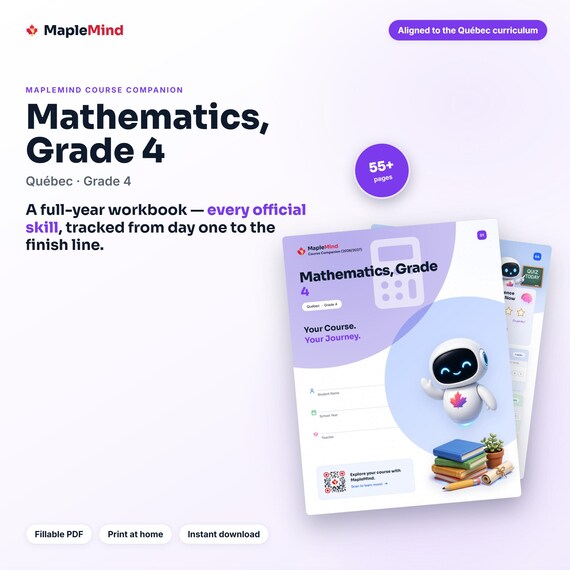
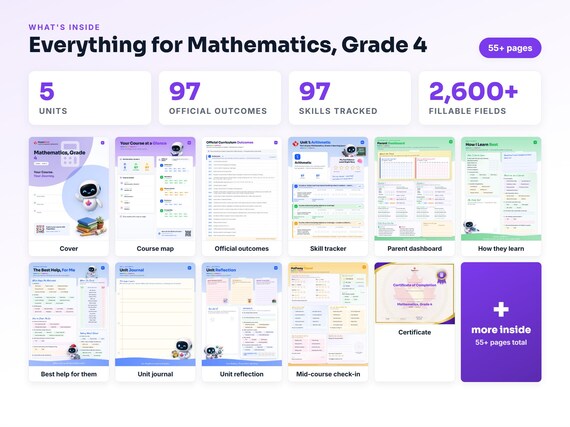
A Mathematics, Grade 4 workbook worth keeping
Built from the same official curriculum as this page. Before and after each skill above, your student colours in how sure they feel — so the two of you can see, on one page, what's clicking and what needs another look. It's a quiet way to follow how the year is really going.
By June it's full of their own handwriting: units worked through, confidence grown, a mid-year check-in, notes from parent-teacher night, and a certificate at the end. Less a worksheet, more a record of the year worth keeping on the shelf.
Instant download · see every page, reviews and the full description · five or more workbooks are $2.99 each
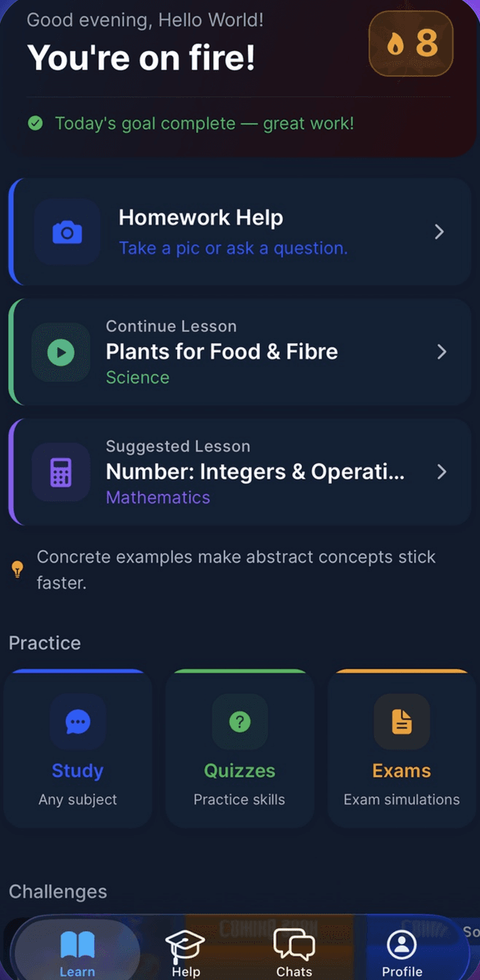
What it looks like in the app
Common questions
Can MapleMind help my child with Mathematics, Grade 4?
Yes. MapleMind's AI tutor covers all 97 skills in Quebec's Mathematics, Grade 4 — your child picks the exact skill, and the tutor teaches it step by step: a short lesson, a worked example, solving together, then a skill check to show it stuck.
Is MapleMind aligned to Quebec's official curriculum?
Yes. Every skill in this course maps to an official outcome code from Quebec's Grade 4 Mathematics curriculum, and the ministry's own wording is quoted under each unit on this page — with the official government source linked so you can check it yourself.
What does MapleMind cost?
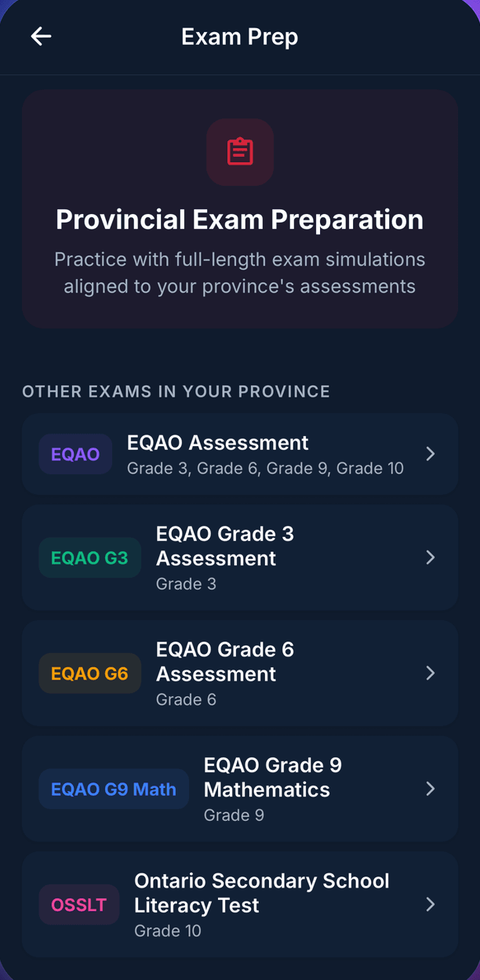
It's free to start — 5 tutoring chats and a practice quiz every day, no credit card. A Pro subscription ($9.99/month or $49.99/year CAD, 7-day free trial) unlocks unlimited tutoring, practice, and exam simulations.
What if my child is stuck on just one topic?
That's the point of skill-level tutoring: open Mathematics, Grade 4 in the app, tap the exact skill from the list on this page, and the tutor teaches just that — no wading through lessons your child doesn't need.
Does MapleMind work in French or other languages?
Yes — 14 languages, including French. Both the app and the tutor's explanations switch to the language your child chooses.
Where can I see the official Quebec curriculum for Mathematics, Grade 4?
The official source is linked on this page — Québec's official education program. The outline here follows it: every MapleMind skill carries its official outcome code, and the ministry's own wording is quoted under each unit.
Keep exploring
Ready when you are
Pick a skill from this page and see it taught properly — free, in the browser, in under a minute.