Get help with English as a Second Language (Core), Grade 4
Most tutoring makes your child sit through material your child already knows. MapleMind flips that: pick the exact skill that's causing trouble — any of the 28 below — and the tutor teaches just that one, step by step, as many times as it takes. Ask questions in plain words, any time of day, in English, French, or 12 other languages.
The official Quebec English as a Second Language (Core), Grade 4 curriculum
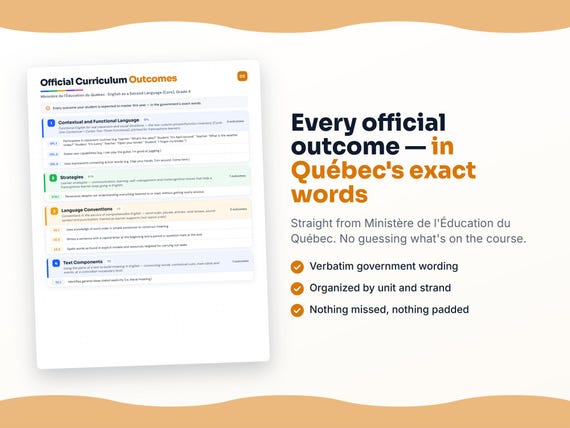
Quebec defines English as a Second Language (Core), Grade 4 by strands and outcomes. MapleMind teaches the same curriculum reorganized for one-skill-at-a-time tutoring — the table shows exactly where every official strand lands, and the ministry's own wording is quoted under each unit below.
Official source Québec's official education programRead it on the government site — quebec.ca ↗| Official strand | Outcomes | Where MapleMind teaches it |
|---|---|---|
| Course outcomes | 28 | Contextual and Functional Language · Strategies · Language Conventions · Text Components |
Every skill below, taught one on one.
 Try the first session free
How MapleMind teaches English as a Second Language (Core), Grade 4 — every unit, lesson, and skill
Every skill below runs as a short session: a plain-words lesson, a worked example, solving it together, then a five-question skill check that earns up to three stars. Guided Mode keeps it teaching instead of answer-handing — turning it off needs a parent's password.
Unit 1Contextual and Functional Language
Functional English for real classroom and social situations — the two-column phrase/function inventory (Cycle One Contextual + Cycles Two-Three Functional), pitched for francophone learners.
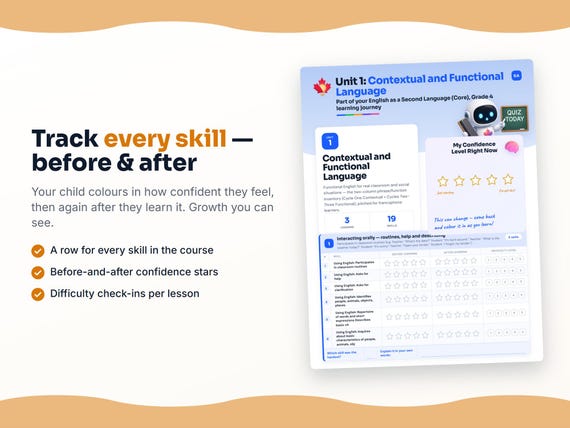
Interacting orally — routines, help and describing
- Using English: Participates in classroom routines1A.rout.c23 — Mastery of “Participates in classroom routines” (Interacting orally in familiar situations) at English as a Second Language (Core), Grade 4 ESL (A1→A2).
- Using English: Asks for help1A.help.c23 — Mastery of “Asks for help” (Interacting orally in familiar situations) at English as a Second Language (Core), Grade 4 ESL (A1→A2).
- Using English: Asks for clarification1A.clar.c23 — Mastery of “Asks for clarification” (Interacting orally in familiar situations) at English as a Second Language (Core), Grade 4 ESL (A1→A2).
- Using English: Identifies people, animals, objects, places1A.ident.c23 — Mastery of “Identifies people, animals, objects, places” (Interacting orally in familiar situations) at English as a Second Language (Core), Grade 4 ESL (A1→A2).
- Using English: Repertoire of words and short expressions Describes basic ch1A.desc.c23 — Mastery of “Repertoire of words and short expressions Describes basic ch” (Interacting orally in familiar situations) at English as a Second Language (Core), Grade 4 ESL (A1→A2).
- Using English: Inquires about basic characteristics of people, animals, obj1A.desc2.c23 — Mastery of “Inquires about basic characteristics of people, animals, obj” (Interacting orally in familiar situations) at English as a Second Language (Core), Grade 4 ESL (A1→A2).
Interacting orally — needs, permission and agreement
- Using English: States own capabilities1A.cap.c23 — Mastery of “States own capabilities” (Interacting orally in familiar situations) at English as a Second Language (Core), Grade 4 ESL (A1→A2).
- Using English: Expresses agreement/disagreement1A.agree.c23 — Mastery of “Expresses agreement/disagreement” (Interacting orally in familiar situations) at English as a Second Language (Core), Grade 4 ESL (A1→A2).
- Using English: Asks for permission1A.perm.c23 — Mastery of “Asks for permission” (Interacting orally in familiar situations) at English as a Second Language (Core), Grade 4 ESL (A1→A2).
- Using English: Accepts or declines offers of assistance1A.assist2.c23 — Mastery of “Accepts or declines offers of assistance” (Interacting orally in familiar situations) at English as a Second Language (Core), Grade 4 ESL (A1→A2).
- Using English: Expresses personal needs and wants1A.needs.c23 — Mastery of “Expresses personal needs and wants” (Interacting orally in familiar situations) at English as a Second Language (Core), Grade 4 ESL (A1→A2).
- Using English: Contributes in creating harmonious exchanges1A.harm.c23 — Mastery of “Contributes in creating harmonious exchanges” (Interacting orally in familiar situations) at English as a Second Language (Core), Grade 4 ESL (A1→A2).
Reinvesting understanding of texts
- Using English: Uses expressions containing action words1B.action.c1 — Mastery of “Uses expressions containing action words” (Reinvesting understanding of texts) at English as a Second Language (Core), Grade 4 ESL (A1→A2).
- Using English: Uses personal pronouns and possessive forms in context to ta1B.pron.self — Mastery of “Uses personal pronouns and possessive forms in context to ta” (Reinvesting understanding of texts) at English as a Second Language (Core), Grade 4 ESL (A1→A2).
- Using English: Uses the alphabet to spell words in context1B.alpha — Mastery of “Uses the alphabet to spell words in context” (Reinvesting understanding of texts) at English as a Second Language (Core), Grade 4 ESL (A1→A2).
- Using English: Uses common cardinal and ordinal numbers1B.num — Mastery of “Uses cardinal and ordinal numbers frequently encountered in ” (Reinvesting understanding of texts) at English as a Second Language (Core), Grade 4 ESL (A1→A2).
- Using English: Uses the names of colours and shapes frequently encountered 1B.col — Mastery of “Uses the names of colours and shapes frequently encountered ” (Reinvesting understanding of texts) at English as a Second Language (Core), Grade 4 ESL (A1→A2).
- Discover: Uses question words in context1B.qw.use — Guided introduction of “Uses question words in context” (Reinvesting understanding of texts) at English as a Second Language (Core), Grade 4 ESL (A1→A2).
The official wording — 19 outcomes in this unit
- 1A.rout.c23
Participates in classroom routines (e.g. Teacher: “What’s the date?” Student: “It’s April second.” Teacher: “What is the weather today?” Student: “It’s sunny.” Teacher: “Open your binder.” Student: “I forgot my binder.”)
- 1A.help.c23
Asks for help (e.g. Can you help me? I have a problem. How do you say…?)
- 1A.clar.c23
Asks for clarification (e.g. I don’t understand. Can you repeat? What do you mean?)
- 1A.ident.c23
Identifies people, animals, objects, places (e.g. I’m a hockey player. This is my sister. It’s a polar bear.)
- 1A.desc.c23
Repertoire of words and short expressions Describes basic characteristics of people, animals, objects, places (e.g. She is tall. It is round. It’s a big house.)
- 1A.desc2.c23
Inquires about basic characteristics of people, animals, objects, places (e.g. Does he wear glasses? Is it round? What colour is it?)
- 1A.cap.c23
States own capabilities (e.g. I can play the guitar. I’m good at juggling.)
- 1A.agree.c23
Expresses agreement/disagreement (e.g. That’s right. I agree. I don’t agree.)
- 1A.perm.c23
Asks for permission (e.g. May I go to the washroom? Can I borrow a pencil?)
- 1A.assist2.c23
Accepts or declines offers of assistance (e.g. Sure. I’m okay.)
- 1A.needs.c23
Expresses personal needs and wants (e.g. I need a pencil. I want a new skateboard.)
- 1A.harm.c23
Contributes in creating harmonious exchanges (e.g. That’s a good idea. Let’s listen to Sophie. What a team. )
- 1B.action.c1
Uses expressions containing action words (e.g. Clap your hands. Turn around. Come here.)
- 1B.env.c23
Uses vocabulary related to other familiar environments (e.g. living room, grocery store, park)
- 1B.pron.self
Uses personal pronouns and possessive forms in context to talk about self (e.g. I have my book. The pencil is mine.)
- 1B.alpha
Uses the alphabet to spell words in context
- 1B.num
Uses cardinal and ordinal numbers frequently encountered in class
- 1B.col
Uses the names of colours and shapes frequently encountered in class
- 1B.qw.use
Uses question words in context
Unit 2Strategies
Learner strategies — communication, learning, self-management and metacognitive moves that help a francophone learner keep going in English.
Learning and self-management strategies
- Using English: Perseveres despite not understanding everything heard2B.persev.c23 — Mastery of “Perseveres despite not understanding everything listened to ” (Learning and self-management strategies) at English as a Second Language (Core), Grade 4 ESL (A1→A2).
The official wording — 1 outcome in this unit
- 2B.persev.c23
Perseveres despite not understanding everything listened to or read, without getting overly anxious
Unit 3Language Conventions
Conventions in the service of comprehensible English — word order, plurals, articles, verb tenses, sound-symbol and punctuation, framed as learner supports (not native craft).
Grammar in the service of meaning
- Using English: Uses knowledge of word order in simple sentences to construc3A.wordord.und — Mastery of “Uses knowledge of word order in simple sentences to construc” (Grammar in the service of meaning) at English as a Second Language (Core), Grade 4 ESL (A1→A2).
- Using English: Forms simple sentences3A.wordord.form — Mastery of “Forms simple sentences” (Grammar in the service of meaning) at English as a Second Language (Core), Grade 4 ESL (A1→A2).
- Using English: Uses knowledge of regular and common irregular plurals to co3A.plur.und — Mastery of “Uses knowledge of regular and common irregular plurals to co” (Grammar in the service of meaning) at English as a Second Language (Core), Grade 4 ESL (A1→A2).
- Using English: Writes an “s” at the end of nouns for regular plurals3A.plur.s — Mastery of “Writes an “s” at the end of nouns for regular plurals” (Grammar in the service of meaning) at English as a Second Language (Core), Grade 4 ESL (A1→A2).
Punctuation and capitalization
- Using English: Writes a sentence with a capital letter and end punctuation3C.punct.sent — Mastery of “Writes a sentence with a capital letter at the beginning and” (Punctuation and capitalization) at English as a Second Language (Core), Grade 4 ESL (A1→A2).
Spelling conventions
- Using English: Spells words as found in explicit models and resources targe3D.spell.explicit — Mastery of “Spells words as found in explicit models and resources targe” (Spelling conventions) at English as a Second Language (Core), Grade 4 ESL (A1→A2).
The official wording — 6 outcomes in this unit
- 3A.wordord.und
Uses knowledge of word order in simple sentences to construct meaning
- 3A.wordord.form
Forms simple sentences (e.g. I like apples. Emily can sing and dance. Bring your book.)
- 3A.plur.und
Uses knowledge of regular and common irregular plurals to construct meaning
- 3A.plur.s
Writes an “s” at the end of nouns for regular plurals (e.g. kayaks, oranges, toys)
- 3C.punct.sent
Writes a sentence with a capital letter at the beginning and a period or question mark at the end
- 3D.spell.explicit
Spells words as found in explicit models and resources targeted for carrying out tasks
Unit 4Text Components
Using the parts of a text to build meaning in English — connecting words, contextual cues, main ideas and events, at a controlled-vocabulary level.
Understanding how a text works
- Using English: Identifies general ideas stated explicitly (i.e. literal mea4.overall.lit.c23 — Mastery of “Identifies general ideas stated explicitly (i.e. literal mea” (Understanding how a text works) at English as a Second Language (Core), Grade 4 ESL (A1→A2).
- Using English: Orally identifies characters, actions, objects and places4.key.c1 — Mastery of “Orally identifies characters, actions, objects and places” (Understanding how a text works) at English as a Second Language (Core), Grade 4 ESL (A1→A2).
The official wording — 2 outcomes in this unit
- 4.overall.lit.c23
Identifies general ideas stated explicitly (i.e. literal meaning)
- 4.key.c1
Orally identifies characters, actions, objects and places
Printable workbook · A keepsake of the year
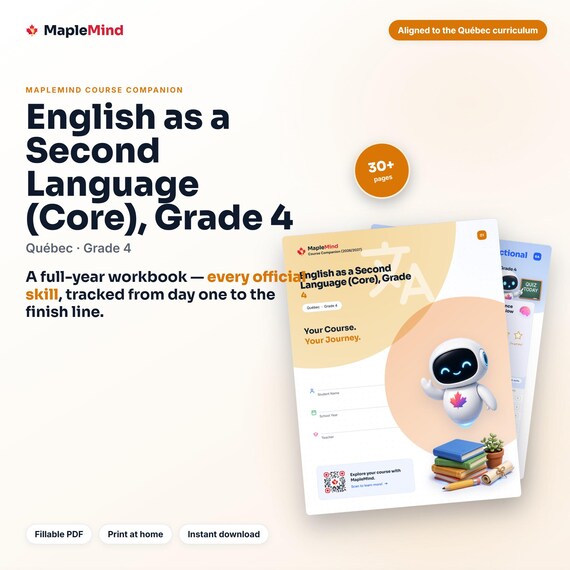
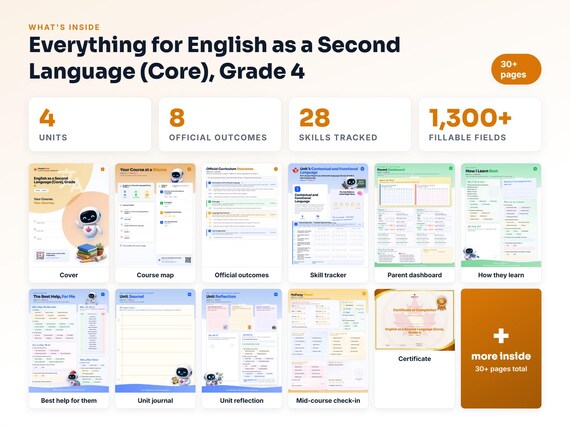
A English as a Second Language (Core), Grade 4 workbook worth keeping
Built from the same official curriculum as this page. Before and after each skill above, your student colours in how sure they feel — so the two of you can see, on one page, what's clicking and what needs another look. It's a quiet way to follow how the year is really going.
By June it's full of their own handwriting: units worked through, confidence grown, a mid-year check-in, notes from parent-teacher night, and a certificate at the end. Less a worksheet, more a record of the year worth keeping on the shelf.
Instant download · see every page, reviews and the full description · five or more workbooks are $2.99 each
What it looks like in the app



Common questions
Can MapleMind help my child with English as a Second Language (Core), Grade 4?
Yes. MapleMind's AI tutor covers all 28 skills in Quebec's English as a Second Language (Core), Grade 4 — your child picks the exact skill, and the tutor teaches it step by step: a short lesson, a worked example, solving together, then a skill check to show it stuck.
Is MapleMind aligned to Quebec's official curriculum?
Yes. Every skill in this course maps to an official outcome code from Quebec's Grade 4 English as an Additional Language curriculum, and the ministry's own wording is quoted under each unit on this page — with the official government source linked so you can check it yourself.
What does MapleMind cost?
It's free to start — 5 tutoring chats and a practice quiz every day, no credit card. A Pro subscription ($9.99/month or $49.99/year CAD, 7-day free trial) unlocks unlimited tutoring, practice, and exam simulations.
What if my child is stuck on just one topic?
That's the point of skill-level tutoring: open English as a Second Language (Core), Grade 4 in the app, tap the exact skill from the list on this page, and the tutor teaches just that — no wading through lessons your child doesn't need.
Does MapleMind work in French or other languages?
Yes — 14 languages, including French. Both the app and the tutor's explanations switch to the language your child chooses.
Where can I see the official Quebec curriculum for English as a Second Language (Core), Grade 4?
The official source is linked on this page — Québec's official education program. The outline here follows it: every MapleMind skill carries its official outcome code, and the ministry's own wording is quoted under each unit.
Keep exploring
Ready when you are
Pick a skill from this page and see it taught properly — free, in the browser, in under a minute.