Get help with Social Studies, Grade 6
Most tutoring makes your child sit through material your child already knows. MapleMind flips that: pick the exact skill that's causing trouble — any of the 9 below — and the tutor teaches just that one, step by step, as many times as it takes. Ask questions in plain words, any time of day, in English, French, or 12 other languages.
The official Prince Edward Island Social Studies, Grade 6 curriculum
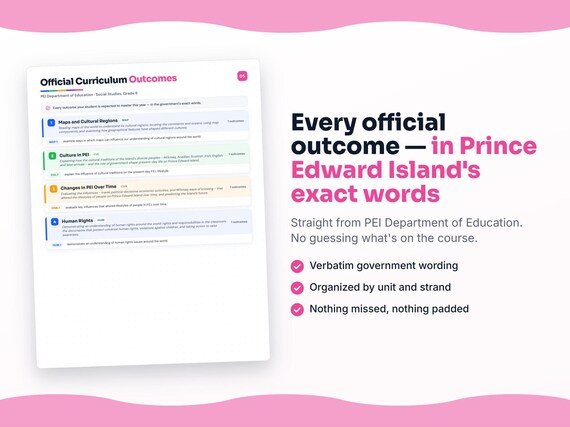
Prince Edward Island defines Social Studies, Grade 6 by strands and outcomes. MapleMind teaches the same curriculum reorganized for one-skill-at-a-time tutoring — the table shows exactly where every official strand lands, and the ministry's own wording is quoted under each unit below.
Official source Prince Edward Island's official curriculumRead it on the government site — princeedwardisland.ca ↗| Official strand | Outcomes | Where MapleMind teaches it |
|---|---|---|
| 2.1 | 1 | Maps and Cultural Regions |
| 2.2 | 1 | Culture in PEI |
| 2.3 | 1 | Changes in PEI Over Time |
| 2.4 | 1 | Human Rights |
Every skill below, taught one on one.
 Try the first session free
How MapleMind teaches Social Studies, Grade 6 — every unit, lesson, and skill
Every skill below runs as a short session: a plain-words lesson, a worked example, solving it together, then a five-question skill check that earns up to three stars. Guided Mode keeps it teaching instead of answer-handing — turning it off needs a parent's password.
Unit 1Maps and Cultural RegionsOfficial strand · 2.1
Reading maps of the world to understand its cultural regions: locating the continents and oceans, using map components, and examining how geographical features have shaped different cultures.
Reading Maps of the World
- Continents, oceans, and the parts of a mapDK 2.1 — Locate the continents and oceans of the world on a map and use map component terminology - legend, scale, compass rose, grid, latitude, and longitude - to read and discuss maps.
- How geography shapes cultural regionsDK 2.1 — Examine how significant geographical features - mountains, seas, deserts, rivers - have shaped the physical landscape, settlement, trade, and the development of different cultural regions of the world.
The official wording — 1 outcome in this unit
- DK 2.1
examine ways in which maps can influence our understanding of cultural regions around the world.
Unit 2Culture in PEIOfficial strand · 2.2
Explaining how the cultural traditions of the Island's diverse peoples - Mi'kmaq, Acadian, Scottish, Irish, English, and later arrivals - and the role of government shape present-day life on Prince Edward Island.
The Cultural Traditions of the Island
- The Island's peoples and their cultural traditionsDK 2.2 — Identify the diverse peoples in PEI's history - the Mi'kmaq, Acadians, Scottish, Irish, English, and later arrivals - and explain how their cultural traditions shape food, music, celebrations, and daily life on the Island today.
- How government influences culture in PEIDK 2.2 — Describe how government policies and institutions - funding festivals, supporting French-language and Acadian heritage, providing public art spaces, and teaching Island culture in schools - shape cultural life on Prince Edward Island.
The official wording — 1 outcome in this unit
- DK 2.2
explain the influence of cultural traditions on the present day P.E.I. lifestyle.
Unit 3Changes in PEI Over TimeOfficial strand · 2.3
Evaluating the influences - travel, political decisions, economic activities, and Mi'kmaq ways of knowing - that altered the lifestyles of people on Prince Edward Island over time, and predicting the Island's future.
What Changed Life on the Island
- Travel, political decisions, and economic activitiesDK 2.3 — Evaluate how modes of travel, political decisions, and economic activities altered the lifestyles of people on Prince Edward Island over time.
- The influence of Mi'kmaq ways of knowingDK 2.3 — Identify the important ways Mi'kmaq ways of knowing have influenced life on Prince Edward Island (Epekwitk) over time - in travel, the fur trade, sustainable use of the land and waters, language and art, and community decision-making.
- The Island's future economy and the people who shaped itDK 2.3 — Predict the future economy of Prince Edward Island using the three economic sectors, and identify people from diverse cultural backgrounds who have made significant contributions to Island life over time.
The official wording — 1 outcome in this unit
- DK 2.3
evaluate key influences that altered lifestyles of people in P.E.I. over time.
Unit 4Human RightsOfficial strand · 2.4
Demonstrating an understanding of human rights around the world: rights and responsibilities in the classroom, the documents that protect universal human rights, violations against children, and taking action to raise awareness.
Understanding Human Rights
- Rights, responsibilities, and the documents that protect themDK 2.4 — Prepare an inclusive list of classroom rights and responsibilities and identify the documents that protect universal human rights - the Canadian Charter, the UN Convention on the Rights of the Child, and the UN Declaration on the Rights of Indigenous Peoples.
- Children's rights and taking actionDK 2.4 — Identify significant human-rights violations against children - including residential schools - and develop an effective plan of action to raise awareness of children's rights issues in the community and around the world.
The official wording — 1 outcome in this unit
- DK 2.4
demonstrate an understanding of human rights issues around the world.
Printable workbook · A keepsake of the year
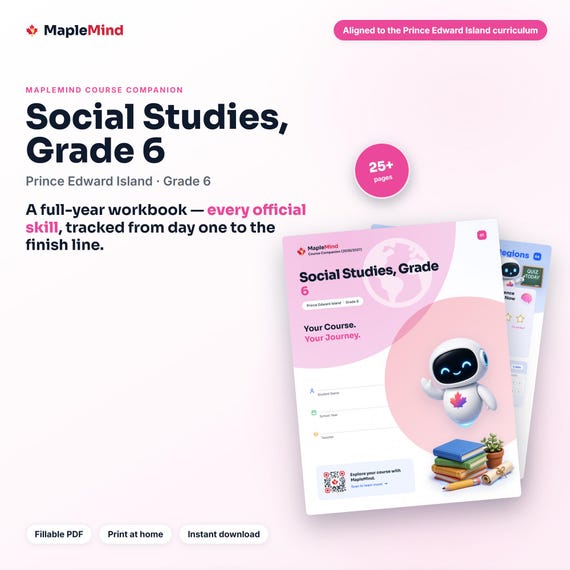
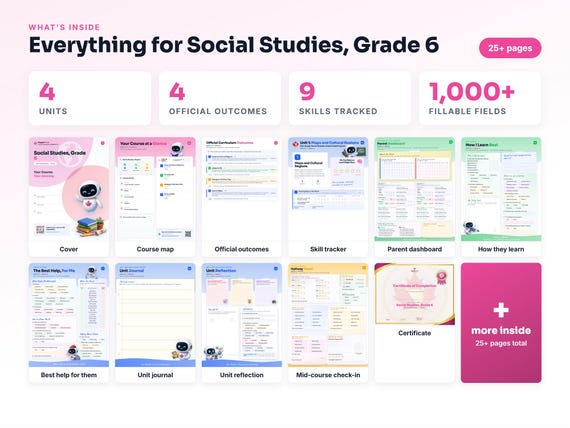
A Social Studies, Grade 6 workbook worth keeping
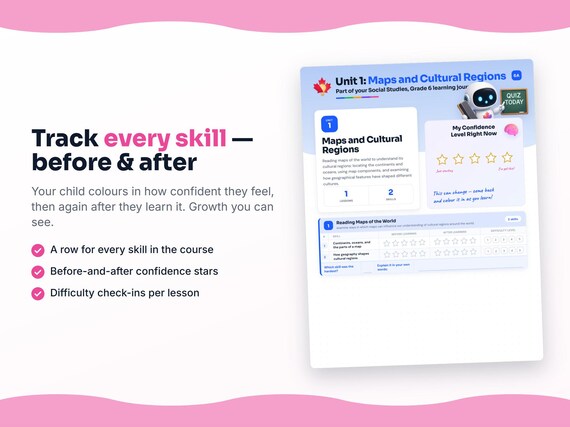
Built from the same official curriculum as this page. Before and after each skill above, your student colours in how sure they feel — so the two of you can see, on one page, what's clicking and what needs another look. It's a quiet way to follow how the year is really going.
By June it's full of their own handwriting: units worked through, confidence grown, a mid-year check-in, notes from parent-teacher night, and a certificate at the end. Less a worksheet, more a record of the year worth keeping on the shelf.
Instant download · see every page, reviews and the full description · five or more workbooks are $2.99 each
What it looks like in the app



Common questions
Can MapleMind help my child with Social Studies, Grade 6?
Yes. MapleMind's AI tutor covers all 9 skills in Prince Edward Island's Social Studies, Grade 6 — your child picks the exact skill, and the tutor teaches it step by step: a short lesson, a worked example, solving together, then a skill check to show it stuck.
Is MapleMind aligned to Prince Edward Island's official curriculum?
Yes. Every skill in this course maps to an official outcome code from Prince Edward Island's Grade 6 Social Studies curriculum, and the ministry's own wording is quoted under each unit on this page — with the official government source linked so you can check it yourself.
What does MapleMind cost?
It's free to start — 5 tutoring chats and a practice quiz every day, no credit card. A Pro subscription ($9.99/month or $49.99/year CAD, 7-day free trial) unlocks unlimited tutoring, practice, and exam simulations.
What if my child is stuck on just one topic?
That's the point of skill-level tutoring: open Social Studies, Grade 6 in the app, tap the exact skill from the list on this page, and the tutor teaches just that — no wading through lessons your child doesn't need.
Does MapleMind work in French or other languages?
Yes — 14 languages, including French. Both the app and the tutor's explanations switch to the language your child chooses.
Where can I see the official Prince Edward Island curriculum for Social Studies, Grade 6?
The official source is linked on this page — Prince Edward Island's official curriculum. The outline here follows it: every MapleMind skill carries its official outcome code, and the ministry's own wording is quoted under each unit.
Keep exploring
Ready when you are
Pick a skill from this page and see it taught properly — free, in the browser, in under a minute.