Get help with Science, Grade 7
Most tutoring makes you sit through material you already know. MapleMind flips that: pick the exact skill that's causing trouble — any of the 14 below — and the tutor teaches just that one, step by step, as many times as it takes. Ask questions in plain words, any time of day, in English, French, or 12 other languages.
The official Prince Edward Island Science, Grade 7 curriculum
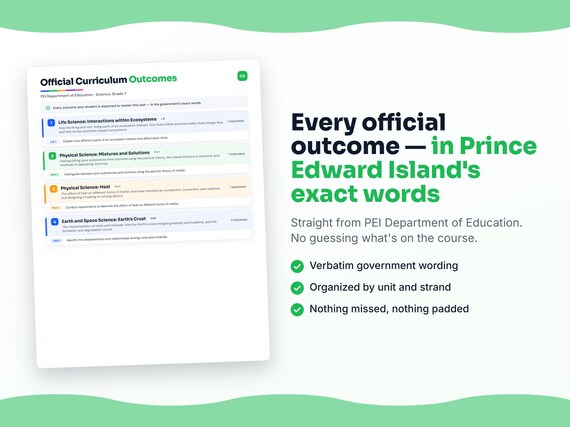
Prince Edward Island defines Science, Grade 7 by strands and outcomes. MapleMind teaches the same curriculum reorganized for one-skill-at-a-time tutoring — the table shows exactly where every official strand lands, and the ministry's own wording is quoted under each unit below.
Official source Prince Edward Island's official curriculumRead it on the government site — princeedwardisland.ca ↗| Official strand | Outcomes | Where MapleMind teaches it |
|---|---|---|
| Strand LS | 3 | Life Science: Interactions within Ecosystems |
| PS-MS | 3 | Physical Science: Mixtures and Solutions |
| PS-H | 3 | Physical Science: Heat |
| ESS | 3 | Earth and Space Science: Earth's Crust |
Every skill below, taught one on one.
 Try the first session free
How MapleMind teaches Science, Grade 7 — every unit, lesson, and skill
Every skill below runs as a short session: a plain-words lesson, a worked example, solving it together, then a five-question skill check that earns up to three stars. Guided Mode keeps it teaching instead of answer-handing — turning it off needs a parent's password.
Unit 1Life Science: Interactions within EcosystemsOfficial strand · Strand LS
How the living and non-living parts of an ecosystem interact, how food chains and food webs show energy flow, and how human activities impact ecosystems.
How Ecosystems Interact
- Parts of an ecosystem interactsci7.LS1 — Explain how the living and non-living parts of an ecosystem interact and affect each other.
- Food chains and food webssci7.LS2 — Illustrate food chains and food webs to show how organisms are connected in an ecosystem.
- Energy transfer in an ecosystemsci7.LS2 — Analyse how energy is transferred through food chains and food webs in an ecosystem.
- Reducing human impactsci7.LS3 — Propose actions to reduce the impact of human activities on a specific ecosystem.
The official wording — 3 outcomes in this unit
- sci7.LS1
Explain how different parts of an ecosystem interact and affect each other.
- sci7.LS2
Illustrate and analyse how food chains and food webs can be used
- sci7.LS3
Propose actions to reduce the impact of human activities on a specific ecosystem.
Unit 2Physical Science: Mixtures and SolutionsOfficial strand · PS-MS
Distinguishing pure substances from mixtures using the particle theory, the characteristics of solutions, and methods of separating mixtures.
Mixtures, Solutions, and Separating
- Pure substances and mixturessci7.PS1 — Distinguish between pure substances and mixtures using the particle theory of matter.
- Characteristics of solutionssci7.PS2 — Describe the characteristics and applications of solutions.
- Separating mixtures and solutionssci7.PS3 — Design experiments to separate mixtures and solutions and consider the impact of those methods.
The official wording — 3 outcomes in this unit
- sci7.PS1
Distinguish between pure substances and mixtures using the particle theory of matter.
- sci7.PS2
Describe the characteristics and applications of solutions.
- sci7.PS3
Design and conduct out experiments to explore methods of separating mixtures and solutions and extend the impact of those methods on society and the environment.
Unit 3Physical Science: HeatOfficial strand · PS-H
The effect of heat on different forms of matter, how heat transfers by conduction, convection, and radiation, and designing a heating or cooling device.
Heat and How It Moves
- The effect of heat on mattersci7.PS4 — Conduct experiments to describe the effect of heat on different forms of matter.
- Conduction and convectionsci7.PS5 — Explain how heat is transferred by conduction in solids and convection in liquids and gases.
- Radiationsci7.PS5 — Explain how heat is transferred by radiation, which needs no medium.
- A heating or cooling devicesci7.PS6 — Create a prototype of a device that solves a practical heating or cooling problem.
The official wording — 3 outcomes in this unit
- sci7.PS4
Conduct experiments to describe the effect of heat on different forms of matter.
- sci7.PS5
Explain how heat is transferred by conduction, convection and radiation in solids, liquids, and gasses.
- sci7.PS6
Create a prototype of a device that will provide a solution to a practical heating or cooling problem.
Unit 4Earth and Space Science: Earth's CrustOfficial strand · ESS
The characteristics of rocks and minerals, how the Earth's crust changes gradually and suddenly, and the formation and degradation of soil.
Rocks, the Crust, and Soil
- Rocks and mineralssci7.ESS1 — Identify the characteristics and relationships among rocks and minerals.
- Gradual and sudden changes to the crustsci7.ESS2 — Explain how the Earth's crust changes gradually and suddenly over time.
- Soil formation and degradationsci7.ESS3 — Investigate the characteristics of soil and the conditions that affect its formation and degradation.
The official wording — 3 outcomes in this unit
- sci7.ESS1
Identify the characteristics and relationships among rocks and minerals.
- sci7.ESS2
Explain how the Earth’s crust undergoes gradual and sudden changes over time.
- sci7.ESS3
Investigate the characteristics of soil and conditions that affect its formation and degradation.
Printable workbook · A keepsake of the year
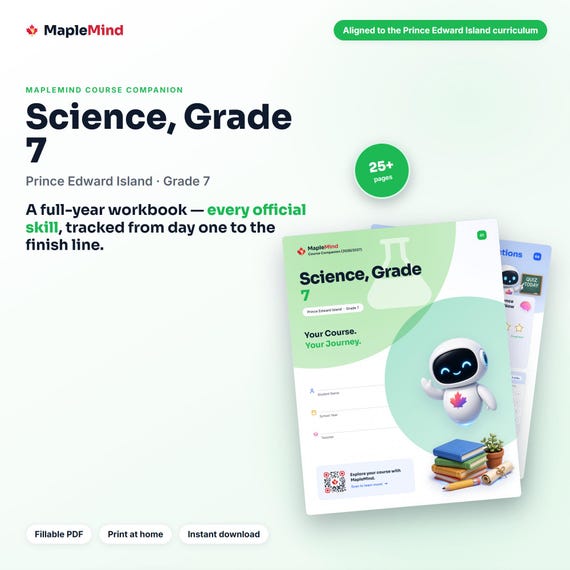
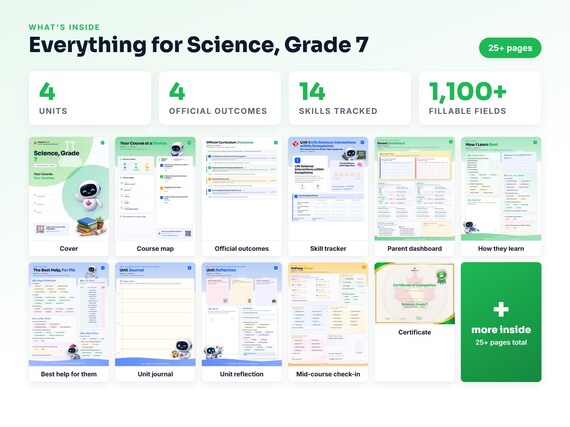
A Science, Grade 7 workbook worth keeping
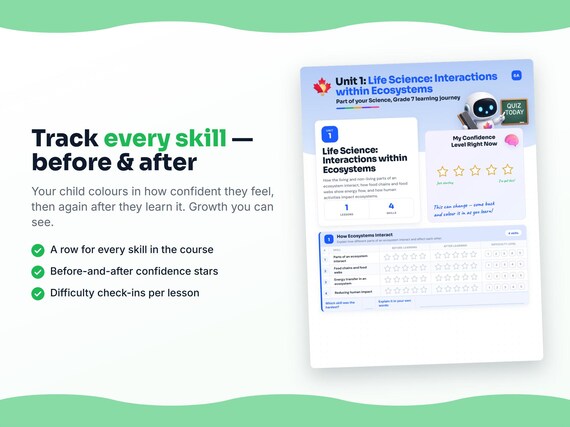
Built from the same official curriculum as this page. Before and after each skill above, your student colours in how sure they feel — so the two of you can see, on one page, what's clicking and what needs another look. It's a quiet way to follow how the year is really going.
By June it's full of their own handwriting: units worked through, confidence grown, a mid-year check-in, notes from parent-teacher night, and a certificate at the end. Less a worksheet, more a record of the year worth keeping on the shelf.
Instant download · see every page, reviews and the full description · five or more workbooks are $2.99 each
What it looks like in the app



Common questions
Can MapleMind help me with Science, Grade 7?
Yes. MapleMind's AI tutor covers all 14 skills in Prince Edward Island's Science, Grade 7 — you pick the exact skill, and the tutor teaches it step by step: a short lesson, a worked example, solving together, then a skill check to show it stuck.
Is MapleMind aligned to Prince Edward Island's official curriculum?
Yes. Every skill in this course maps to an official outcome code from Prince Edward Island's Grade 7 Science curriculum, and the ministry's own wording is quoted under each unit on this page — with the official government source linked so you can check it yourself.
What does MapleMind cost?
It's free to start — 5 tutoring chats and a practice quiz every day, no credit card. A Pro subscription ($9.99/month or $49.99/year CAD, 7-day free trial) unlocks unlimited tutoring, practice, and exam simulations.
What if I'm stuck on just one topic?
That's the point of skill-level tutoring: open Science, Grade 7 in the app, tap the exact skill from the list on this page, and the tutor teaches just that — no wading through lessons you don't need.
Does MapleMind work in French or other languages?
Yes — 14 languages, including French. Both the app and the tutor's explanations switch to the language you choose.
Where can I see the official Prince Edward Island curriculum for Science, Grade 7?
The official source is linked on this page — Prince Edward Island's official curriculum. The outline here follows it: every MapleMind skill carries its official outcome code, and the ministry's own wording is quoted under each unit.
Keep exploring
Ready when you are
Pick a skill from this page and see it taught properly — free, in the browser, in under a minute.