Get help with Social Studies, Grade 1
Most tutoring makes your child sit through material your child already knows. MapleMind flips that: pick the exact skill that's causing trouble — any of the 21 below — and the tutor teaches just that one, step by step, as many times as it takes. Ask questions in plain words, any time of day, in English, French, or 12 other languages.
The official Ontario Social Studies, Grade 1 curriculum
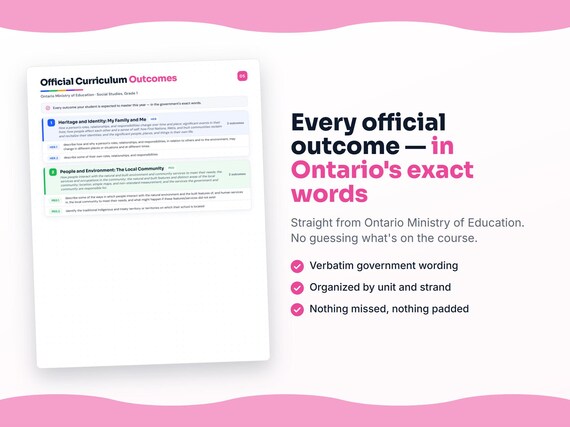
Ontario defines Social Studies, Grade 1 by strands and outcomes. MapleMind teaches the same curriculum reorganized for one-skill-at-a-time tutoring — the table shows exactly where every official strand lands, and the ministry's own wording is quoted under each unit below.
Official source Ontario's official curriculumRead it on the government site — dcp.edu.gov.on.ca ↗| Official strand | Outcomes | Where MapleMind teaches it |
|---|---|---|
| Strand A | 10 | Heritage and Identity: My Family and Me |
| Strand B | 11 | People and Environment: The Local Community |
Every skill below, taught one on one.
 Try the first session free
How MapleMind teaches Social Studies, Grade 1 — every unit, lesson, and skill
Every skill below runs as a short session: a plain-words lesson, a worked example, solving it together, then a five-question skill check that earns up to three stars. Guided Mode keeps it teaching instead of answer-handing — turning it off needs a parent's password.
Unit 1Heritage and Identity: My Family and MeOfficial strand · Strand A
How a person's roles, relationships, and responsibilities change over time and place; significant events in their lives; how people affect each other and a sense of self; how First Nations, Métis, and Inuit communities reclaim and revitalize their identities; and the significant people, places, and things in their own life.
Roles, Relationships, and Responsibilities Change
- How and why roles and relationships changeA1.1 — Describe how and why a person's roles, relationships, and responsibilities may change in different places, situations, and times.
- Significant events change our livesA1.2 — Describe how significant events in their lives led to changes in their roles, relationships, and responsibilities.
- Comparing our lives with othersA1.3 — Compare significant events in their own lives or their family's lives with those in the lives of their peers.
- How people affect each otherA1.4 — Describe the impact people can have on each other in different situations and how interactions can affect a person's sense of self.
- Reclaiming and revitalizing identityA1.5 — Identify ways First Nations, Métis, and Inuit individuals and communities are reclaiming and revitalizing their identity, and the role this plays in their sense of self.
My Roles, and the People and Places in My Life
- My own roles and responsibilitiesA3.1 — Describe some of their own roles, relationships, and responsibilities.
- Significant people, places, and thingsA3.2 — Identify significant people, places, and things in their life and describe their purpose or role.
- Putting my life in orderA3.3 — Demonstrate an understanding of simple chronology by ordering significant events from their personal experience.
- Positive and inclusive actionsA3.4 — Identify elements of positive and inclusive behaviour and actions they and others can practise.
- Respecting people and the environmentA3.5 — Demonstrate an understanding that it is important to treat other people and the environment with respect.
The official wording — 10 outcomes in this unit
- A1.1
describe how and why a person’s roles, relationships, and responsibilities, in relation to others and to the environment, may change in different places or situations and at different times
- A1.2
describe how some significant events in their lives led to changes in their roles, relationships, and/or responsibilities
- A1.3
compare some of the significant events in their own lives and/or the lives of their family members with those in the lives of their peers
- A1.4
describe the impact that people can have on each other in some different situations and some of the ways in which interactions between people can affect a person’s sense of self
- A1.5
identify some of the ways in which First Nations, Métis, and Inuit individuals and communities are reclaiming and revitalizing aspects of their identity and the role that these aspects play in their sense of self
- A3.1
describe some of their own roles, relationships, and responsibilities
- A3.2
identify some of the significant people, places, and things in their life, including their life in the community and describe their purpose or the role they have
- A3.3
demonstrate an understanding of simple chronology by identifying and organizing chronologically some significant events related to their personal experience
- A3.4
identify some elements of positive and inclusive behaviour and actions that they can practise in their everyday life and/or that other people practise
- A3.5
demonstrate an understanding that it is important to treat other people and the environment with respect
Unit 2People and Environment: The Local CommunityOfficial strand · Strand B
How people interact with the natural and built environment and community services to meet their needs; the services and occupations in the community; the natural and built features and distinct areas of the local community; location, simple maps, and non-standard measurement; and the services the government and community are responsible for.
People, Services, and the Community
- Meeting needs in the communityB1.1 — Describe ways people interact with the natural and built environment and services to meet their needs, and what might happen without them.
- Services and the people who provide themB1.2 — Identify services and service-related occupations in their community and describe how they meet people's needs.
- A plan to care for my communityB1.3 — Create a plan for responsibly interacting with the built and natural environment and describe how it might improve the local environment.
My Community's Features and Maps
- The territory our school is onB3.1 — Identify the traditional Indigenous and treaty territory or territories on which their school is located.
- Natural and built featuresB3.2 — Identify some of the natural and built features of their community.
- Different areas in my communityB3.3 — Identify distinct areas in the local community and describe some of their characteristics.
- Where places are: relative locationB3.4 — Describe the location of significant places using relative location, distance, and direction.
- The parts of a mapB3.5 — Demonstrate an understanding of the basic elements of a map when reading and constructing simple maps.
- Measuring with non-standard unitsB3.6 — Demonstrate an understanding of some common non-standard units of measurement.
- Making my own mapB3.7 — Construct simple maps of places they have visited, using symbols and non-standard units.
- Services the community is responsible forB3.8 — Identify services the government and community are responsible for and describe people's key responsibilities related to them.
The official wording — 11 outcomes in this unit
- B1.1
describe some of the ways in which people interact with the natural environment and the built features of, and human services in, the local community to meet their needs, and what might happen if these features/services did not exist
- B1.2
identify some services and service-related occupations in their community and describe how they meet people’s needs, including their own needs
- B1.3
create a plan that outlines some specific ways in which they can responsibly interact with the built and/or natural environment in the local community and describe how their actions might enhance the features of the local environment
- B3.1
identify the traditional Indigenous and treaty territory or territories on which their school is located
- B3.2
identify some of the natural and built features of their community
- B3.3
identify some distinct areas in the local community and describe some of the characteristics of these areas
- B3.4
describe the location of some significant places in their community, using relative location relative distance and relative direction
- B3.5
demonstrate an understanding of the basic elements of a map when reading and constructing simple maps showing places that are significant to them
- B3.6
demonstrate an understanding of some common non-standard units of measurement
- B3.7
demonstrate the ability to construct simple maps of places they have visited, using symbols and non-standard units
- B3.8
identify some of the services in the community for which the government and/or community is responsible and describe key responsibilities of people in the community in relation to those services
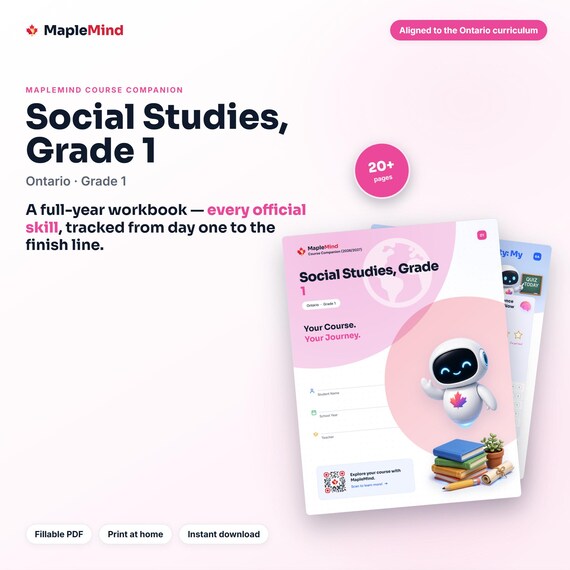
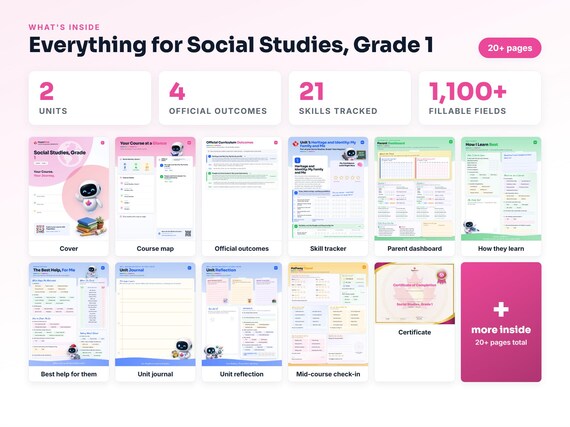
Printable workbook · A keepsake of the year
A Social Studies, Grade 1 workbook worth keeping
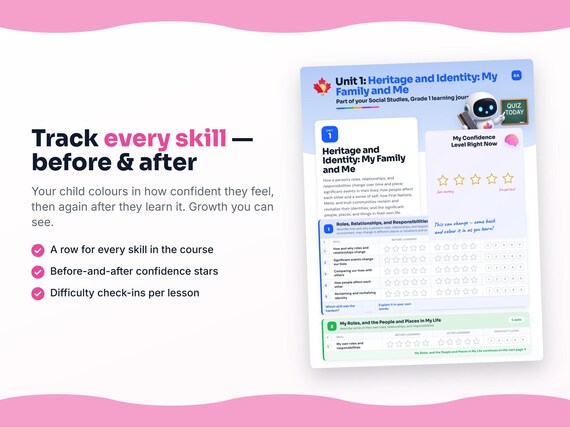
Built from the same official curriculum as this page. Before and after each skill above, your student colours in how sure they feel — so the two of you can see, on one page, what's clicking and what needs another look. It's a quiet way to follow how the year is really going.
By June it's full of their own handwriting: units worked through, confidence grown, a mid-year check-in, notes from parent-teacher night, and a certificate at the end. Less a worksheet, more a record of the year worth keeping on the shelf.
Instant download · see every page, reviews and the full description · five or more workbooks are $2.99 each
What it looks like in the app



Common questions
Can MapleMind help my child with Social Studies, Grade 1?
Yes. MapleMind's AI tutor covers all 21 skills in Ontario's Social Studies, Grade 1 — your child picks the exact skill, and the tutor teaches it step by step: a short lesson, a worked example, solving together, then a skill check to show it stuck.
Is MapleMind aligned to Ontario's official curriculum?
Yes. Every skill in this course maps to an official outcome code from Ontario's Grade 1 Social Studies curriculum, and the ministry's own wording is quoted under each unit on this page — with the official government source linked so you can check it yourself.
What does MapleMind cost?
It's free to start — 5 tutoring chats and a practice quiz every day, no credit card. A Pro subscription ($9.99/month or $49.99/year CAD, 7-day free trial) unlocks unlimited tutoring, practice, and exam simulations.
What if my child is stuck on just one topic?
That's the point of skill-level tutoring: open Social Studies, Grade 1 in the app, tap the exact skill from the list on this page, and the tutor teaches just that — no wading through lessons your child doesn't need.
Does MapleMind work in French or other languages?
Yes — 14 languages, including French. Both the app and the tutor's explanations switch to the language your child chooses.
Where can I see the official Ontario curriculum for Social Studies, Grade 1?
The official source is linked on this page — Ontario's official curriculum. The outline here follows it: every MapleMind skill carries its official outcome code, and the ministry's own wording is quoted under each unit.
Keep exploring
Ready when you are
Pick a skill from this page and see it taught properly — free, in the browser, in under a minute.