Get help with Mathematics, Grade 1
Most tutoring makes your child sit through material your child already knows. MapleMind flips that: pick the exact skill that's causing trouble — any of the 38 below — and the tutor teaches just that one, step by step, as many times as it takes. Ask questions in plain words, any time of day, in English, French, or 12 other languages.
The official Ontario Mathematics, Grade 1 curriculum
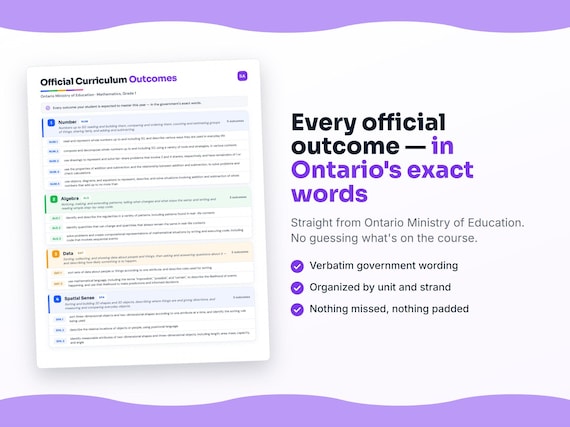
Ontario defines Mathematics, Grade 1 by strands and outcomes. MapleMind teaches the same curriculum reorganized for one-skill-at-a-time tutoring — the table shows exactly where every official strand lands, and the ministry's own wording is quoted under each unit below.
Official source Ontario's official mathematics curriculumRead it on the government site — dcp.edu.gov.on.ca ↗| Official strand | Outcomes | Where MapleMind teaches it |
|---|---|---|
| Strand B | 13 | Number |
| Strand C | 9 | Algebra |
| Strand D | 7 | Data |
| Strand E | 8 | Spatial Sense |
| Strand F | 1 | Financial Literacy |
Ontario also defines Strand A — Social-Emotional Learning Skills — which the ministry teaches through every other strand rather than as its own unit, so it doesn't get a row of its own.
Every skill below, taught one on one.
 Try the first session free
How MapleMind teaches Mathematics, Grade 1 — every unit, lesson, and skill
Every skill below runs as a short session: a plain-words lesson, a worked example, solving it together, then a five-question skill check that earns up to three stars. Guided Mode keeps it teaching instead of answer-handing — turning it off needs a parent's password.
Unit 1NumberOfficial strand · Strand B
Numbers up to 50: reading and building them, comparing and ordering them, counting and estimating groups of things, sharing fairly, and adding and subtracting.
Numbers to 50
- Reading and showing numbers to 50B1.1 — Read and show whole numbers up to 50 in different ways, and talk about how numbers show up in everyday life.
- Comparing and ordering numbers to 50B1.3 — Compare two numbers up to 50 and put a group of numbers in order from least to greatest or greatest to least.
- Estimating and checking by countingB1.4 — Guess about how many objects are in a group of up to 50, then count to check the guess.
- Counting by 1s, 2s, 5s, and 10s to 50B1.5 — Count to 50 by ones, twos, fives, and tens, using tools like a hundred chart or objects grouped together.
Putting Numbers Together and Taking Them Apart
- Building numbers from parts and breaking them apartB1.2 — Put smaller numbers together to build a number up to 50, and break a number up to 50 into smaller parts, using tools like ten frames or number lines.
Fair Sharing and Fractions
- Sharing fairly among 2 and 4 friendsB1.6 — Use drawings to share things fairly among 2 friends or among 4 friends, even when there is 1 or 2 left over.
- One half is the same as two fourthsB1.7 — Notice that one half of something and two fourths of the same thing are the same amount, when sharing fairly.
- Comparing fraction pieces with drawingsB1.8 — Use drawings to compare and order the size of one fair-share piece when a whole is shared among different numbers of friends, up to 10 sharers.
Addition and Subtraction Facts and Strategies
- How addition and subtraction help each otherB2.1 — Use what adding and subtracting have in common, and how they undo each other, to solve problems and check answers.
- Addition and subtraction facts to 10B2.2 — Know and quickly use addition facts for numbers up to 10, and the matching subtraction facts.
- Mental math to add and subtract within 20B2.3 — Use mental math tricks, including estimating, to add and subtract numbers that total no more than 20, and explain how it was solved.
Solving Addition and Subtraction Problems
- Using objects and pictures to solve number storiesB2.4 — Use objects, drawings, and equations to show and solve addition and subtraction stories that total no more than 50.
- Equal-group problems up to 10B2.5 — Solve problems about equal groups of things (including groups that are a half), using tools and drawings, when the total is no more than 10.
The official wording — 13 outcomes in this unit
- B1.1
read and represent whole numbers up to and including 50, and describe various ways they are used in everyday life
- B1.3
compare and order whole numbers up to and including 50, in various contexts
- B1.4
estimate the number of objects in collections of up to 50, and verify their estimates by counting
- B1.5
count to 50 by 1s, 2s, 5s, and 10s, using a variety of tools and strategies
- B1.2
compose and decompose whole numbers up to and including 50, using a variety of tools and strategies, in various contexts
- B1.6
use drawings to represent and solve fair-share problems that involve 2 and 4 sharers, respectively, and have remainders of 1 or
- B1.7
recognize that one half and two fourths of the same whole are equal, in fair-sharing contexts
- B1.8
use drawings to compare and order unit fractions representing the individual portions that result when a whole is shared by different numbers of sharers, up to a maximum of
- B2.1
use the properties of addition and subtraction, and the relationship between addition and subtraction, to solve problems and check calculations
- B2.2
recall and demonstrate addition facts for numbers up to 10, and related subtraction facts
- B2.3
use mental math strategies, including estimation, to add and subtract whole numbers that add up to no more than 20, and explain the strategies used
- B2.4
use objects, diagrams, and equations to represent, describe, and solve situations involving addition and subtraction of whole numbers that add up to no more than
- B2.5
represent and solve equal-group problems where the total number of items is no more than 10, including problems in which each group is a half, using tools and drawings
Unit 2AlgebraOfficial strand · Strand C
Noticing, making, and extending patterns; telling what changes and what stays the same; and writing and reading simple step-by-step code.
Patterns All Around Us
- Spotting what repeats in a patternC1.1 — Notice and describe what stays the same or repeats in different patterns, including patterns from everyday life.
- Making and re-showing patternsC1.2 — Create patterns using movements, sounds, objects, shapes, letters, and numbers, and show the same pattern a different way.
- Finding the pattern rule to extend and predictC1.3 — Figure out the rule of a pattern, then use it to extend the pattern, make and check predictions, and fill in missing parts.
- Using patterns to show how numbers relateC1.4 — Make and describe patterns that show relationships among whole numbers up to 50.
Things That Change and Things That Stay the Same
- What changes and what always stays the sameC2.1 — Identify which everyday quantities can change and which always stay the same.
- Are two number sentences equal?C2.2 — Figure out whether two addition or subtraction number sentences give the same amount.
- Finding equal ways to make the same numberC2.3 — Find and use different ways of making the same amount for whole numbers up to 50.
Coding with Step-by-Step Instructions
- Writing and running step-by-step codeC3.1 — Solve problems and show math situations by writing and running code made of steps that happen one after another in order.
- Reading and changing step-by-step codeC3.2 — Read code made of steps that happen in order, change it, and describe what happens differently.
The official wording — 9 outcomes in this unit
- C1.1
identify and describe the regularities in a variety of patterns, including patterns found in real- life contexts
- C1.2
create and translate patterns using movements, sounds, objects, shapes, letters, and numbers
- C1.3
determine pattern rules and use them to extend patterns, make and justify predictions, and identify missing elements in patterns
- C1.4
create and describe patterns to illustrate relationships among whole numbers up to 50
- C2.1
identify quantities that can change and quantities that always remain the same in real-life contexts
- C2.2
determine whether given pairs of addition and subtraction expressions are equivalent or not
- C2.3
identify and use equivalent relationships for whole numbers up to 50, in various contexts
- C3.1
solve problems and create computational representations of mathematical situations by writing and executing code, including code that involves sequential events
- C3.2
read and alter existing code, including code that involves sequential events, and describe how changes to the code affect the outcomes
Unit 3DataOfficial strand · Strand D
Sorting, collecting, and showing data about people and things, then asking and answering questions about it — and describing how likely something is to happen.
Sorting, Collecting, and Showing Data
- Sorting data by one featureD1.1 — Sort information about people or things by one feature, and describe the rule used for sorting.
- Collecting data and using tally tablesD1.2 — Collect data by watching, trying things out, or asking questions, then organize the data in a tally table.
- Showing data with real objects and picturesD1.3 — Show data using one object or one picture for each piece of information, in a concrete graph or pictograph with a title and labels.
- Putting data groups in order by how manyD1.4 — Put groups of data in order from the group with the most to the group with the least, using tally tables, concrete graphs, and pictographs.
- Asking and answering questions about dataD1.5 — Look closely at data shown in tally tables, concrete graphs, and pictographs by asking and answering questions, then use it to make a good decision.
How Likely Is It?
- Describing likelihood: impossible, possible, certainD2.1 — Use the words "impossible," "possible," and "certain" to describe how likely something is to happen, and use that to make predictions.
- Predicting if two groups will matchD2.2 — Make and test a prediction about whether the same categories will show up the same amount in data collected from a different, same-sized group.
The official wording — 7 outcomes in this unit
- D1.1
sort sets of data about people or things according to one attribute, and describe rules used for sorting
- D1.2
collect data through observations, experiments, and interviews to answer questions of interest that focus on a single piece of information; record the data using methods of their choice; and organize the data in tally tables
- D1.3
display sets of data, using one-to-one correspondence, in concrete graphs and pictographs with proper sources, titles, and labels
- D1.4
order categories of data from greatest to least frequency for various data sets displayed in tally tables, concrete graphs, and pictographs
- D1.5
analyse different sets of data presented in various ways, including in tally tables, concrete graphs, and pictographs, by asking and answering questions about the data and drawing conclusions, then make convincing arguments and informed decisions
- D2.1
use mathematical language, including the terms "impossible", "possible", and "certain", to describe the likelihood of events happening, and use that likelihood to make predictions and informed decisions
- D2.2
make and test predictions about the likelihood that the categories in a data set from one population will have the same frequencies in data collected from a different population of the same size
Unit 4Spatial SenseOfficial strand · Strand E
Sorting and building 2D shapes and 3D objects, describing where things are and giving directions, and measuring and comparing everyday objects.
Sorting and Building Shapes and Objects
- Sorting shapes and objects by one featureE1.1 — Sort 3D objects and 2D shapes by one feature at a time, and say what the sorting rule is.
- Building 3D objects and finding 2D shapes insideE1.2 — Build 3D objects, and find 2D shapes hiding inside structures and objects.
- Shapes and objects with matching halvesE1.3 — Build and describe 2D shapes and 3D objects that have two matching halves.
Positions and Directions
- Describing where things areE1.4 — Describe where objects or people are compared to each other, using position words like above, below, and beside.
- Giving and following directionsE1.5 — Give directions for moving from one place to another, and follow directions someone else gives.
Measuring, Comparing, and the Calendar
- Noticing what can be measuredE2.1 — Notice things about 2D shapes and 3D objects that can be measured, like length, area, mass, capacity, and angle.
- Comparing and ordering everyday objectsE2.2 — Compare several everyday objects and put them in order by length, area, mass, or capacity.
- Reading and using a calendarE2.3 — Read the date on a calendar, and use it to find days, weeks, months, holidays, and seasons.
The official wording — 8 outcomes in this unit
- E1.1
sort three-dimensional objects and two-dimensional shapes according to one attribute at a time, and identify the sorting rule being used
- E1.2
construct three-dimensional objects, and identify two-dimensional shapes contained within structures and objects
- E1.3
construct and describe two-dimensional shapes and three-dimensional objects that have matching halves
- E1.4
describe the relative locations of objects or people, using positional language
- E1.5
give and follow directions for moving from one location to another
- E2.1
identify measurable attributes of two-dimensional shapes and three-dimensional objects, including length, area, mass, capacity, and angle
- E2.2
compare several everyday objects and order them according to length, area, mass, and capacity
- E2.3
read the date on a calendar, and use a calendar to identify days, weeks, months, holidays, and seasons
Unit 5Financial LiteracyOfficial strand · Strand F
Getting to know Canadian coins and bills and comparing their values.
Canadian Coins and Bills
- Naming coins and bills and comparing their valueF1.1 — Identify Canadian coins up to 50 cents and coins and bills up to $50, and compare how much they are worth.
The official wording — 1 outcome in this unit
- F1.1
identify the various Canadian coins up to 50¢ and coins and bills up to $50, and compare their values
Printable workbook · A keepsake of the year
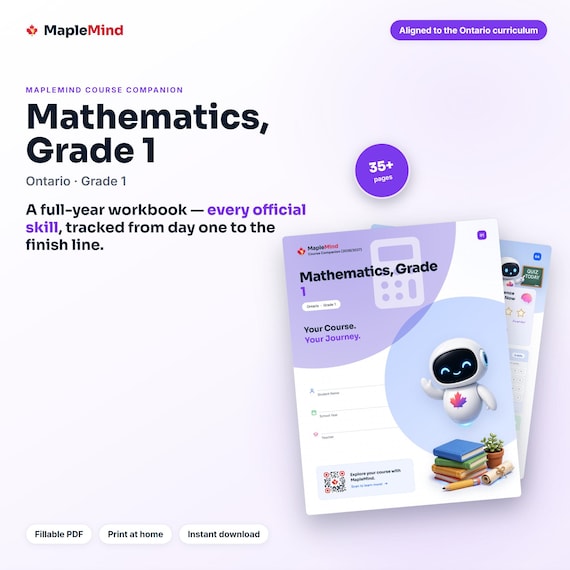
A Mathematics, Grade 1 workbook worth keeping
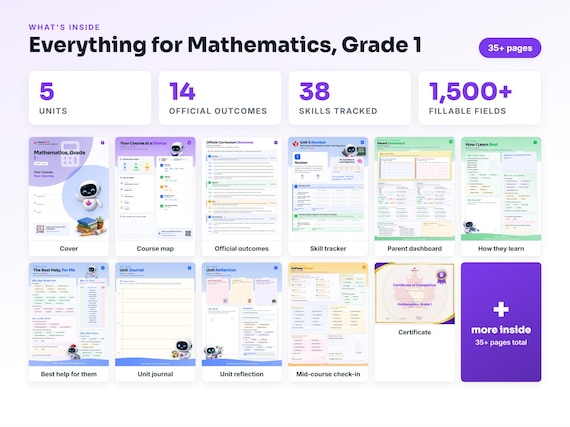
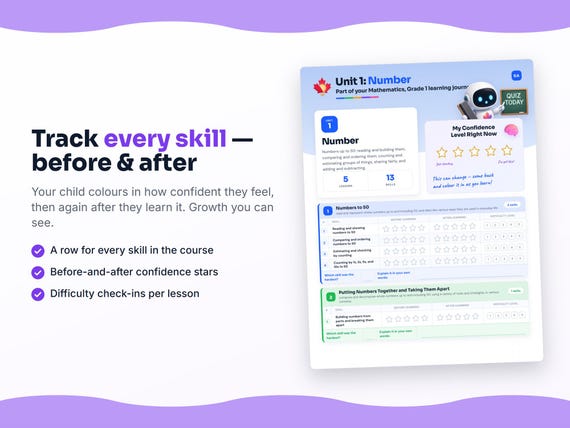
Built from the same official curriculum as this page. Before and after each skill above, your student colours in how sure they feel — so the two of you can see, on one page, what's clicking and what needs another look. It's a quiet way to follow how the year is really going.
By June it's full of their own handwriting: units worked through, confidence grown, a mid-year check-in, notes from parent-teacher night, and a certificate at the end. Less a worksheet, more a record of the year worth keeping on the shelf.
Instant download · see every page, reviews and the full description · five or more workbooks are $2.99 each
What it looks like in the app



Common questions
Can MapleMind help my child with Mathematics, Grade 1?
Yes. MapleMind's AI tutor covers all 38 skills in Ontario's Mathematics, Grade 1 — your child picks the exact skill, and the tutor teaches it step by step: a short lesson, a worked example, solving together, then a skill check to show it stuck.
Is MapleMind aligned to Ontario's official curriculum?
Yes. Every skill in this course maps to an official outcome code from Ontario's Grade 1 Mathematics curriculum, and the ministry's own wording is quoted under each unit on this page — with the official government source linked so you can check it yourself.
What does MapleMind cost?
It's free to start — 5 tutoring chats and a practice quiz every day, no credit card. A Pro subscription ($9.99/month or $49.99/year CAD, 7-day free trial) unlocks unlimited tutoring, practice, and exam simulations.
What if my child is stuck on just one topic?
That's the point of skill-level tutoring: open Mathematics, Grade 1 in the app, tap the exact skill from the list on this page, and the tutor teaches just that — no wading through lessons your child doesn't need.
Does MapleMind work in French or other languages?
Yes — 14 languages, including French. Both the app and the tutor's explanations switch to the language your child chooses.
Where can I see the official Ontario curriculum for Mathematics, Grade 1?
The official source is linked on this page — Ontario's official mathematics curriculum. The outline here follows it: every MapleMind skill carries its official outcome code, and the ministry's own wording is quoted under each unit.
Keep exploring
Ready when you are
Pick a skill from this page and see it taught properly — free, in the browser, in under a minute.