Get help with Core French, Grade 12, University Preparation
Most tutoring makes you sit through material you already know. MapleMind flips that: pick the exact skill that's causing trouble — any of the 39 below — and the tutor teaches just that one, step by step, as many times as it takes. Ask questions in plain words, any time of day, in English, French, or 12 other languages.
The official Ontario Core French, Grade 12, University Preparation curriculum
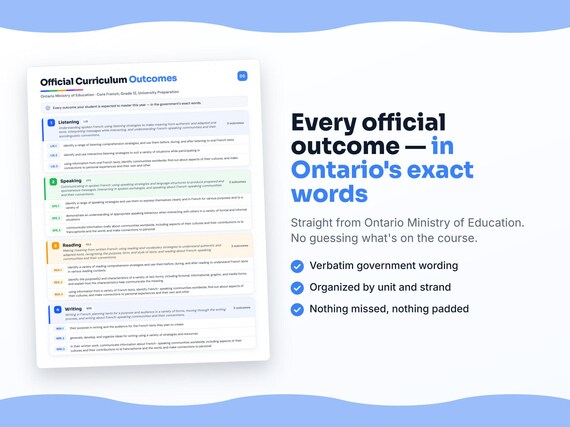
Ontario defines Core French, Grade 12, University Preparation by strands and outcomes. MapleMind teaches the same curriculum reorganized for one-skill-at-a-time tutoring — the table shows exactly where every official strand lands, and the ministry's own wording is quoted under each unit below.
Official source Ontario's official curriculumRead it on the government site — dcp.edu.gov.on.ca ↗Every skill below, taught one on one.
 Try the first session free
How MapleMind teaches Core French, Grade 12, University Preparation — every unit, lesson, and skill
Every skill below runs as a short session: a plain-words lesson, a worked example, solving it together, then a five-question skill check that earns up to three stars. Guided Mode keeps it teaching instead of answer-handing — turning it off needs a parent's password.
Unit 1ListeningOfficial strand · Strand A
Understanding spoken French: using listening strategies to make meaning from authentic and adapted oral texts, interpreting messages while interacting, and understanding French-speaking communities and their sociolinguistic conventions.
Listening to Understand
- Using listening strategiesfsf4u.A1.1 — Choose and use a range of listening strategies before, during, and after listening to understand authentic and adapted French texts about a wide variety of topics, including their implicit messages.
- Showing you understoodfsf4u.A1.2 — Show you understand explicit and implicit messages about a wide variety of topics in oral French texts, with support as appropriate.
Listening to Interact
- Interactive listening strategiesfsf4u.A2.1 — Use interactive listening strategies that suit a variety of situations while taking part in social and academic interactions.
- Responding in interactionsfsf4u.A2.2 — Respond with understanding in interactions about a wide variety of topics, in formal and informal situations.
- Naming what helped me listenfsf4u.A2.3 — Explain which listening strategies you found helpful before, during, and after listening.
- My strengths and next steps as a listenerfsf4u.A2.3 — Identify your areas of greater and lesser strength as a listener and plan concrete steps to improve your listening skills.
Culture and Conventions in Listening
- Hearing about French-speaking communities worldwidefsf4u.A3.1 — Using oral French texts, identify French-speaking communities worldwide, find out about aspects of their cultures, and connect to your own and other communities.
- Conventions you hearfsf4u.A3.2 — From oral French texts, identify and understand sociolinguistic conventions used in a variety of situations in diverse French-speaking communities.
The official wording — 7 outcomes in this unit
- fsf4u.A1.1
identify a range of listening comprehension strategies, and use them before, during, and after listening to oral French texts
- fsf4u.A1.2
an understanding of explicit and implicit messages about a wide variety of topics in oral French texts, with support as appropriate
- fsf4u.A2.1
identify and use interactive listening strategies to suit a variety of situations while participating in
- fsf4u.A2.2
respond with understanding to what others say while participating in interactions about a wide variety of topics, in formal and informal situations
- fsf4u.A2.3
explain which strategies they found helpful
- fsf4u.A3.1
using information from oral French texts, identify communities worldwide, find out about aspects of their cultures, and make connections to personal experiences and their own and other
- fsf4u.A3.2
using information from oral French texts, identify and demonstrate an understanding of sociolinguistic conventions used in a variety of situations in diverse communities
Unit 2SpeakingOfficial strand · Strand B
Communicating in spoken French: using speaking strategies and language structures to produce prepared and spontaneous messages, interacting in spoken exchanges, and speaking about French-speaking communities and their conventions.
Speaking to Communicate
- Using speaking strategiesfsf4u.B1.1 — Choose and use a range of speaking strategies to express yourself clearly and coherently in French for various purposes and audiences.
- Producing spoken messagesfsf4u.B1.2 — Produce prepared and spontaneous French messages about a wide variety of topics, with support as appropriate.
- Speaking with fluencyfsf4u.B1.3 — Speak with a smooth pace, appropriate intonation, and accurate pronunciation in prepared and spontaneous communications about a wide range of topics.
- Applying language structuresfsf4u.B1.4 — Communicate your meaning clearly in speech, using parts of speech and word order appropriately.
Speaking to Interact
- Speaking-interaction strategiesfsf4u.B2.1 — Show appropriate speaking behaviour when interacting with others in a variety of formal and informal situations.
- Taking part in spoken exchangesfsf4u.B2.2 — Exchange information, ideas, and opinions in prepared and spontaneous spoken interactions about a wide variety of topics.
- Naming what helped me speakfsf4u.B2.3 — Explain which speaking strategies you found helpful before, during, and after speaking.
- My strengths and next steps as a speakerfsf4u.B2.3 — Identify your areas of greater and lesser strength as a speaker and plan concrete steps to improve your speaking skills.
Culture and Conventions in Speaking
- Speaking about French-speaking communities worldwidefsf4u.B3.1 — Communicate orally about French-speaking communities worldwide, including their cultures and contributions to la francophonie, and connect to your own and other communities.
- Conventions when you speakfsf4u.B3.2 — Identify sociolinguistic conventions associated with a variety of social situations in diverse French-speaking communities and use them appropriately in spoken interactions.
The official wording — 9 outcomes in this unit
- fsf4u.B1.1
identify a range of speaking strategies and use them to express themselves clearly and in French for various purposes and to a variety of
- fsf4u.B1.2
produce prepared and spontaneous messages in French to communicate information, ideas, and opinions about a wide variety of topics, with support as appropriate
- fsf4u.B1.3
speak with a smooth pace, appropriate intonation, and accurate pronunciation in prepared
- fsf4u.B1.4
their meaning clearly, using parts of speech and word order appropriately
- fsf4u.B2.1
demonstrate an understanding of appropriate speaking behaviour when interacting with others in a variety of formal and informal situations
- fsf4u.B2.2
exchange information, ideas, and opinions with others in prepared and spontaneous spoken interactions about a wide variety of topics, with support as appropriate
- fsf4u.B2.3
explain which strategies they found helpful
- fsf4u.B3.1
communicate information orally about communities worldwide, including aspects of their cultures and their contributions to la francophonie and the world, and make connections to personal
- fsf4u.B3.2
identify sociolinguistic conventions associated with a variety of social situations in diverse communities and use them appropriately in spoken interactions
Unit 3ReadingOfficial strand · Strand C
Making meaning from written French: using reading and vocabulary strategies to understand authentic and adapted texts, recognizing the purpose, form, and style of texts, and reading about French-speaking communities and their conventions.
Reading Comprehension
- Using reading strategiesfsf4u.C1.1 — Choose and use a variety of reading strategies before, during, and after reading to understand French texts.
- Reading for meaningfsf4u.C1.2 — Understand explicit and implicit messages in student- and teacher-selected French texts about academic and personally relevant topics.
- Reading with fluencyfsf4u.C1.3 — Read a variety of French texts at a sufficient rate and ease to show you understand the overall sense of the text.
- Developing vocabularyfsf4u.C1.4 — Use a variety of vocabulary-acquisition strategies before, during, and after reading to determine or confirm the meaning of new, unfamiliar, or recently learned words and expressions.
Purpose, Form, and Style
- Purpose of text formsfsf4u.C2.1 — Identify the purpose(s) and characteristics of a variety of text forms - fictional, informational, graphic, and media - and explain how the characteristics help communicate the meaning.
- Features and stylefsf4u.C2.2 — Identify features and stylistic elements of a variety of text forms and explain how they convey explicit and implicit messages.
- Naming what helped me readfsf4u.C2.3 — Explain which reading strategies you found helpful before, during, and after reading.
- My strengths and next steps as a readerfsf4u.C2.3 — Identify your areas of greater and lesser strength as a reader and plan concrete steps to improve your reading skills.
Culture and Conventions in Reading
- Reading about French-speaking communities worldwidefsf4u.C3.1 — Using a variety of French texts, identify French-speaking communities worldwide, find out about aspects of their cultures, and connect to your own and other communities.
- Conventions in French textsfsf4u.C3.2 — In a variety of French texts, identify examples of sociolinguistic conventions associated with a variety of social situations in diverse French-speaking communities.
The official wording — 9 outcomes in this unit
- fsf4u.C1.1
identify a variety of reading comprehension strategies and use them before, during, and after reading to understand French texts in various reading contexts
- fsf4u.C1.2
demonstrate an understanding of explicit and implicit messages in a variety of French texts about academic and personally relevant topics
- fsf4u.C1.3
read a variety of French texts at a sufficient rate and with sufficient ease to demonstrate that they understand the overall sense of the text
- fsf4u.C1.4
use a variety of strategies before, during, and after reading to determine or confirm the meaning of new, unfamiliar, or recently learned words and expressions
- fsf4u.C2.1
identify the purpose(s) and characteristics of a variety of text forms, including fictional, informational, graphic, and media forms, and explain how the characteristics help communicate the meaning
- fsf4u.C2.2
identify some features and stylistic elements of a variety of text forms, including fictional, informational, graphic, and media forms, and explain how they help to convey explicit and implicit messages
- fsf4u.C2.3
explain which strategies they found helpful before, during, and after reading to understand
- fsf4u.C3.1
using information from a variety of French texts, identify French- speaking communities worldwide, find out about aspects of their cultures, and make connections to personal experiences and their own and other
- fsf4u.C3.2
identify, in a variety of French texts, examples of sociolinguistic conventions associated with a variety of social situations in diverse communities
Unit 4WritingOfficial strand · Strand D
Writing in French: planning texts for a purpose and audience in a variety of forms, moving through the writing process, and writing about French-speaking communities and their conventions.
Purpose, Audience, and Form
- Identifying purpose and audiencefsf4u.D1.1 — Determine your purpose in writing and the audience for the French texts you plan to create.
- Writing in different formsfsf4u.D1.2 — Write a variety of French texts to convey information, ideas, and opinions, applying your knowledge of the structural and stylistic elements of each form.
- Relative and demonstrative pronounsfsf4u.D1.3 — Communicate meaning clearly in writing, linking ideas using relative pronouns such as qui, que, dont, and making comparisons using demonstrative pronouns.
- Tense sequence, subjonctif, and indirect discoursefsf4u.D1.3 — Communicate meaning clearly in writing, using the appropriate sequence of present and past tenses, the subjonctif present, and indirect discourse.
The Writing Process
- Pre-writing: gathering ideasfsf4u.D2.1 — Generate, develop, and organize ideas for writing using a variety of pre-writing strategies and resources.
- Drafting and revisingfsf4u.D2.2 — Plan and produce drafts and revise your work using a variety of teacher-directed and independent strategies.
- Producing finished workfsf4u.D2.3 — Make improvements to enhance the clarity and readability of your written work, and use elements of effective presentation to produce a polished product.
- Naming what helped me writefsf4u.D2.4 — Explain which writing strategies you found helpful before, during, and after writing.
- My strengths and next steps as a writerfsf4u.D2.4 — Identify your areas of greater and lesser strength as a writer and plan concrete steps to improve your writing skills.
Culture and Conventions in Writing
- Writing about French-speaking communities worldwidefsf4u.D3.1 — In your written work, communicate information about French-speaking communities worldwide, including their cultures and contributions to la francophonie, and connect to your own and other communities.
- Conventions in my writingfsf4u.D3.2 — Identify sociolinguistic conventions associated with a variety of social situations in diverse French-speaking communities and use them appropriately in your written work.
The official wording — 9 outcomes in this unit
- fsf4u.D1.1
their purpose in writing and the audience for the French texts they plan to create
- fsf4u.D1.2
write a variety of French texts to convey information, ideas, and opinions about academic and personally relevant topics, applying their knowledge of the structural and stylistic elements of each form
- fsf4u.D1.3
replace a subject, direct object, indirect object, or preposition, and link ideas, using relative pronouns such as qui, que, dont, ou; make comparisons using demonstrative pronouns such as
- fsf4u.D2.1
generate, develop, and organize ideas for writing using a variety of strategies and resources
- fsf4u.D2.2
plan and produce drafts and revise their work using a variety of and independent strategies
- fsf4u.D2.3
make to enhance the clarity and readability of their written work, and use various elements of effective presentation to produce a polished product for publication
- fsf4u.D2.4
explain which strategies they found helpful
- fsf4u.D3.1
in their written work, communicate information about French- speaking communities worldwide, including aspects of their cultures and their contributions to la francophonie and the world, and make connections to personal
- fsf4u.D3.2
identify sociolinguistic conventions associated with a variety of social situations in diverse

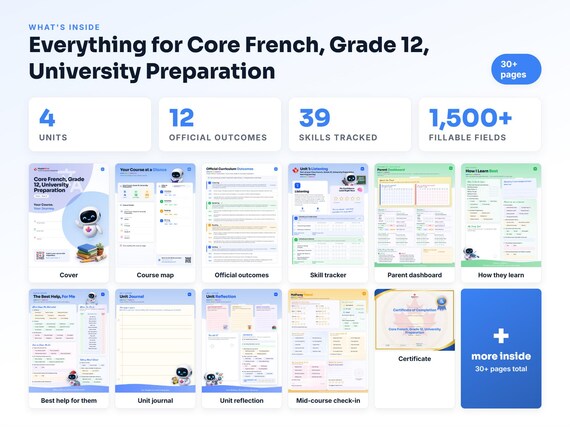

Printable workbook · A keepsake of the year
A Core French, Grade 12, University Preparation workbook worth keeping
Built from the same official curriculum as this page. Before and after each skill above, your student colours in how sure they feel — so the two of you can see, on one page, what's clicking and what needs another look. It's a quiet way to follow how the year is really going.
By June it's full of their own handwriting: units worked through, confidence grown, a mid-year check-in, notes from parent-teacher night, and a certificate at the end. Less a worksheet, more a record of the year worth keeping on the shelf.
Instant download · see every page, reviews and the full description · five or more workbooks are $2.99 each
What it looks like in the app



Common questions
Can MapleMind help me with Core French, Grade 12, University Preparation?
Yes. MapleMind's AI tutor covers all 39 skills in Ontario's Core French, Grade 12, University Preparation — you pick the exact skill, and the tutor teaches it step by step: a short lesson, a worked example, solving together, then a skill check to show it stuck.
Is MapleMind aligned to Ontario's official curriculum?
Yes. Every skill in this course maps to an official outcome code from Ontario's Grade 12 French curriculum, and the ministry's own wording is quoted under each unit on this page — with the official government source linked so you can check it yourself.
What does MapleMind cost?
It's free to start — 5 tutoring chats and a practice quiz every day, no credit card. A Pro subscription ($9.99/month or $49.99/year CAD, 7-day free trial) unlocks unlimited tutoring, practice, and exam simulations.
What if I'm stuck on just one topic?
That's the point of skill-level tutoring: open Core French, Grade 12, University Preparation in the app, tap the exact skill from the list on this page, and the tutor teaches just that — no wading through lessons you don't need.
Does MapleMind work in French or other languages?
Yes — 14 languages, including French. Both the app and the tutor's explanations switch to the language you choose.
Where can I see the official Ontario curriculum for Core French, Grade 12, University Preparation?
The official source is linked on this page — Ontario's official curriculum. The outline here follows it: every MapleMind skill carries its official outcome code, and the ministry's own wording is quoted under each unit.
Keep exploring
Ready when you are
Pick a skill from this page and see it taught properly — free, in the browser, in under a minute.